

Powered exoskeletons are beginning to occupy a new space in older-adult mobility. In 2026, an independently mobile person can encounter walking assistance through direct purchase, rental, physical fitting, home trials or a clinical pathway. At the same time, products originally developed for hiking and general consumer mobility are beginning to overlap with active aging.
That overlap makes the market more interesting, but also much harder to evaluate. A healthy 72-year-old who wants help on hills is not the same user as someone of the same age with impaired balance, knee osteoarthritis or neurological weakness. A product that makes walking feel easier is not automatically a medical mobility aid, and a good ten-minute demonstration tells us very little about whether somebody will still use it six months later.
For this analysis, Exoskeleton Index collaborated with Exoskeleton Report and Borislav “Bobby” Marinov, who has spent more than a decade following, testing and documenting wearable robotics. Bobby shared Exoskeleton Report’s current consumer-exoskeleton tracking data and contributed his perspective on market history, usability, product architecture and the evidence still missing. We also spoke with Kirk Warren, 76, an Australian consumer-exoskeleton user with right-knee osteoarthritis who told Exoskeleton Index that he also serves as a consumer representative involved in aged-care innovation assessment with ARIIA.
Rather than ranking the “best exoskeletons for seniors,” this analysis asks a different set of questions: what can an older adult actually buy, rent or trial? Who are these products really designed for? What changes when the user is 70 rather than 30? Where should assistance be applied? What does the research actually prove? And, ultimately, does the technology become useful enough to remain part of everyday life once the novelty wears off?
Can somebody actually buy, rent or trial it?
Which older user is the system really designed around?
What has actually been measured in older adults?
Will people still choose to wear it months later?
Who are these products actually for?
Walking assistance for older adults is not a new research idea. What has changed is the commercial environment around it.
Bobby sees today’s consumer wave as fundamentally different from the powered-exoskeleton market that came before it. Historically, lower-limb systems were dominated by medical and research products with prices commonly in the tens of thousands of dollars. A growing consumer category now sits much closer to roughly US$1,000–US$5,000. That broader shift is also visible in the Exoskeleton Index 2026 market analysis and our exoskeleton price guide.
That price difference does not make the technologies interchangeable. A consumer product such as Hypershell Halo requires independent walking and balance. A personal medical system such as Ekso Indego Personal exists for a fundamentally different mobility context. The user, regulatory expectations, training requirements and definition of success can all be different.
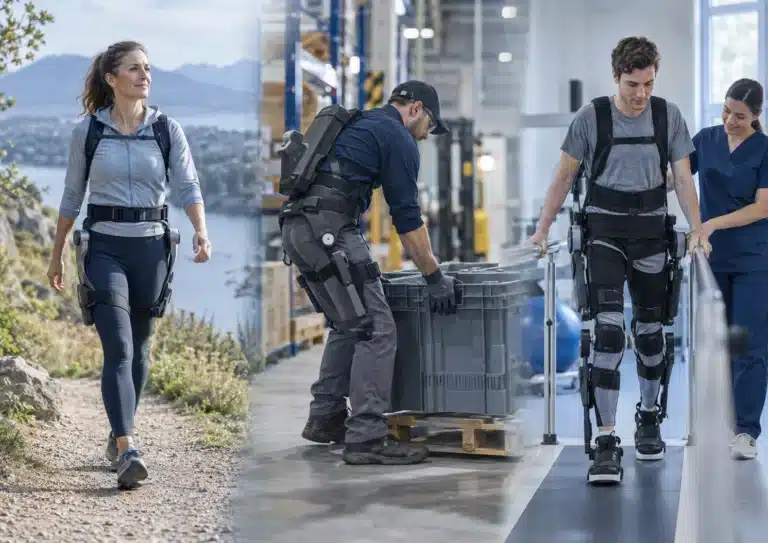
For this analysis, it is more useful to keep three overlapping commercial and assistive markets distinct.
Older-adult positioning
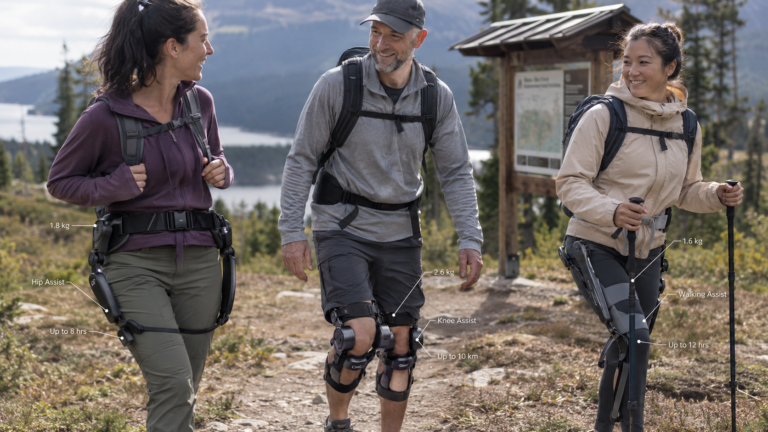
Lightweight products whose marketing or retail strategy explicitly includes older users, daily walking, age-related decline or active aging.
General mobility products
Hiking, outdoor and everyday mobility systems that were not necessarily developed for aging but may still be relevant to independently mobile older users.
Structured mobility support
Products associated with diagnosed impairment, professional assessment, rehabilitation or a more formal assistive-mobility pathway.
Research platforms form an important fourth layer, but we keep them separate from systems somebody can realistically obtain today.
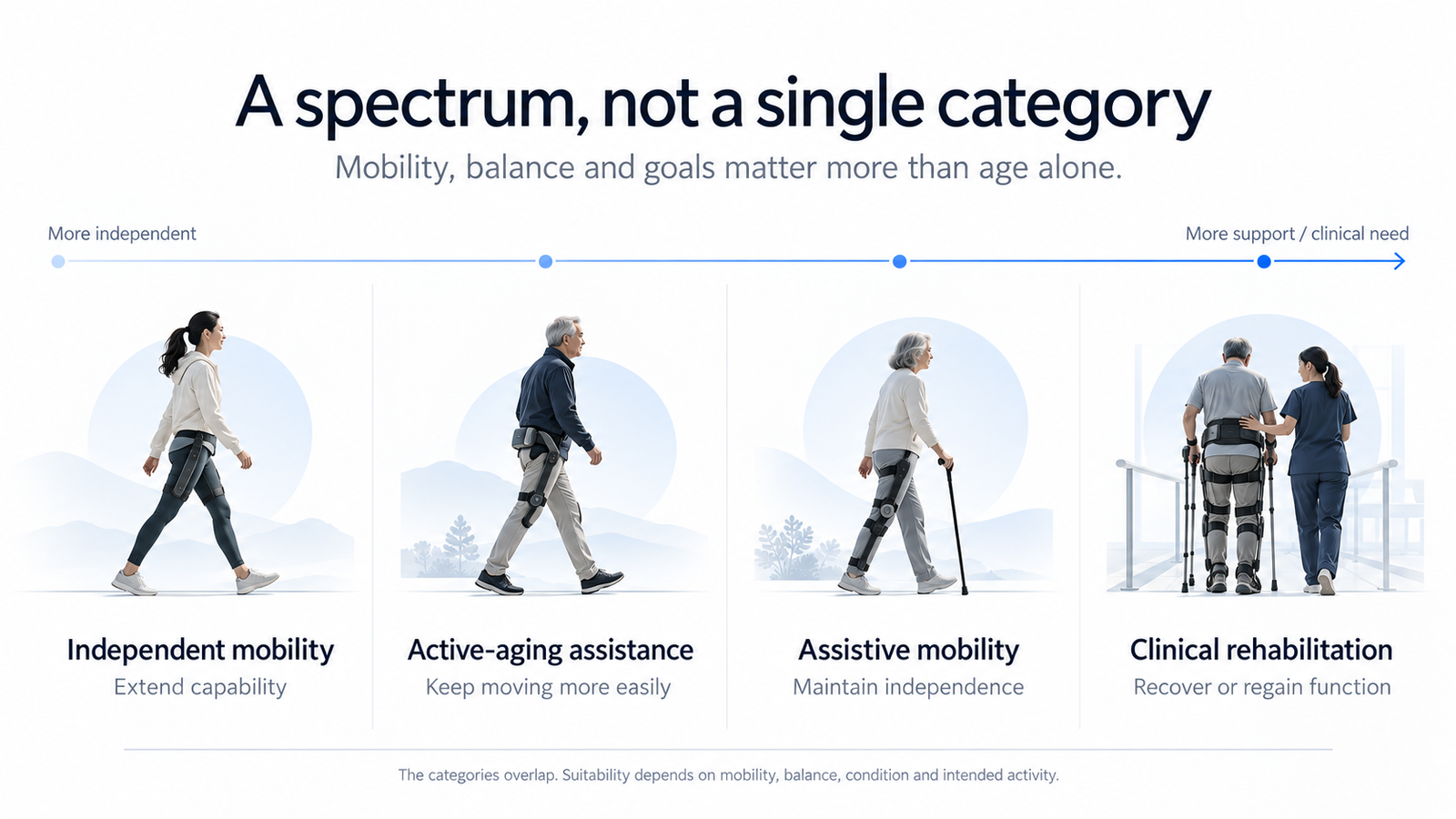
The practical consequence is simple: age alone is a poor way to match a person with a wearable robot. Remaining balance, gait, the activity being attempted and the level of support required are much more informative.
That distinction becomes particularly clear at the boundary between consumer and medical technology. NAVEE, for example, includes older adults in the positioning of the EXO S Pro, but explicitly excludes medical treatment, rehabilitation and fall prevention and says the product is not intended for people who require help standing or walking.
A device can make walking easier without being capable of making an unsafe walker safe.
What can older adults actually buy, rent or trial in 2026?
Once those markets are separated, the commercial picture becomes easier to read. There is now a meaningful group of systems that somebody can genuinely purchase, rent, preorder, trial or access through professional assessment.
“Available,” however, covers very different realities. A checkout button, a five-year rental contract, an in-person fitting and a three-week home trial should not be treated as equivalent forms of access.
| System | Market | Assist | Access | Approx. price |
|---|---|---|---|---|
| WIM S | Active aging | Hip | Direct purchase · South Korea | ≈ US$2,080 ₩2.79 million |
| Coway / WIRobotics wearable | Active-aging rental | Hip | Rental · South Korea | from ≈ US$43/mo ₩57,900 on reviewed long-term plan |
| Haier W3 | Active aging | Hip | Retail + physical fitting · China | Regional retail pricing |
| RoboCT GoGo-H Pro | Consumer | Hip | Direct purchase | US$1,999 |
| VIGX Ant-H1 Pro | Walking assist | Hip | Direct purchase | ≈ US$2,000 |
| NAVEE EXO S Pro | Active-aging positioning | Hip | Direct ecommerce · Europe | ≈ US$1,230 €1,099 locally |
| AlpWalk S1 | Active-aging positioning | Hip | Preorder | US$1,099 |
| curara | Assistive / training | Hip or hip + knee | Purchase, rental or trial · Japan | Half ≈ US$7,770 ¥1.232m · rental ≈ US$389/mo Full ≈ US$11,030 ¥1.749m · rental ≈ US$555/mo |
| JuRoot T01 / Pro / Ultra | Older-adult walking | Hip | Consumer market · China | ≈ US$1,195–2,240 RMB 7,999–14,999 |
| Dephy Sidekick | Consumer crossover | Ankle | Direct purchase · US | US$4,500 |
| Hypershell Halo | Consumer crossover | Hip + knee | Preorder | US$2,299 Europe ≈ US$2,576 from €2,299 |
| Keeogo / Keeogo+ | Assistive / clinical | Knee-focused | Evaluation + structured trial | Provider pathway |
USD equivalents are approximate and use mid-market exchange rates from 11 October 2026. Local pricing remains authoritative. Access and prices can change by region.
“Commercially available” can hide major differences in risk and support. Direct ecommerce places far more responsibility on the buyer than a pathway that includes fitting, assessment and a multi-week trial.
The wider landscape is larger still. TaShan AsExo-TK2000, PLANKEXA Walker One, Shenxing and COSuit all connect to everyday or older-adult lower-limb mobility, but their commercial routes are more regional, enquiry-based or less transparent.
The other mistake would be to stop at products explicitly marketed around age. The wider consumer exoskeleton market already includes ankle, knee, hip and multi-joint systems built for hiking, recreation and general mobility. An independently mobile person in their seventies may be evaluating exactly the same hill, staircase or walking-distance problem as a younger recreational user.
What changes when the user is 70 rather than 30?
Weight, torque and battery capacity are easy to place on a specification sheet. They say much less about whether somebody will actually want to live with the product.
From Bobby’s hands-on experience, the decisive details can be surprisingly ordinary: sound, appearance, ease of use, intuitive controls, smoothness of assistance, body fit and how quickly somebody can get the system on and off.
For older users, those details meet a more heterogeneous physical reality. Age-related weakness may coexist with osteoarthritis, previous injury, gait asymmetry, reduced dexterity, balance limitations, sensory change or compensatory movement.
Can the user put it on independently?
Can the controls be understood without repeatedly opening an app?
Does assistance remain predictable on stairs or slopes?
Can it cope with an asymmetric gait?
Is it still comfortable after an hour?
Who helps when fit or mobility changes six months later?
Bobby also points to a longstanding development problem: intended users have often entered exoskeleton design relatively late. By that point, major decisions around structure, interfaces and control may already have been made.
Research with older adults supports a broader definition of usability. A 2025 participatory study combined six co-design workshops involving older adults and caregivers with separate laboratory assessments of 157 older adults. Comfort, personalisation, ease of use, affordability, durability, aesthetics, autonomy, social participation and avoiding stigma emerged alongside the physical assistance itself.
Haier’s W3 provides a useful commercial example. The company reported that body-shape differences, gait variation and left-right strength imbalance made online-only sales difficult. Its response was not simply another motor revision. Haier developed physical experience points with gait assessment, fitting and instruction, and later created the W3 Mom variant after finding that the original configuration did not fit part of the older female population well enough.
“Senior” is not a body type.
If the customer base becomes older and more physically diverse, fitting and after-sales support may become part of the product itself rather than optional customer service.
Hip, knee, ankle or the whole leg?
There is also no settled answer on where powered assistance should be applied.
The commercial landscape already ranges from ankle assistance with Sidekick, to knee-focused systems such as DNSYS Z1, MO/GO and PowrKnee, to the large hip category represented by WIM S, NAVEE EXO S Pro and DNSYS X1, and newer hip-and-knee approaches such as Halo.
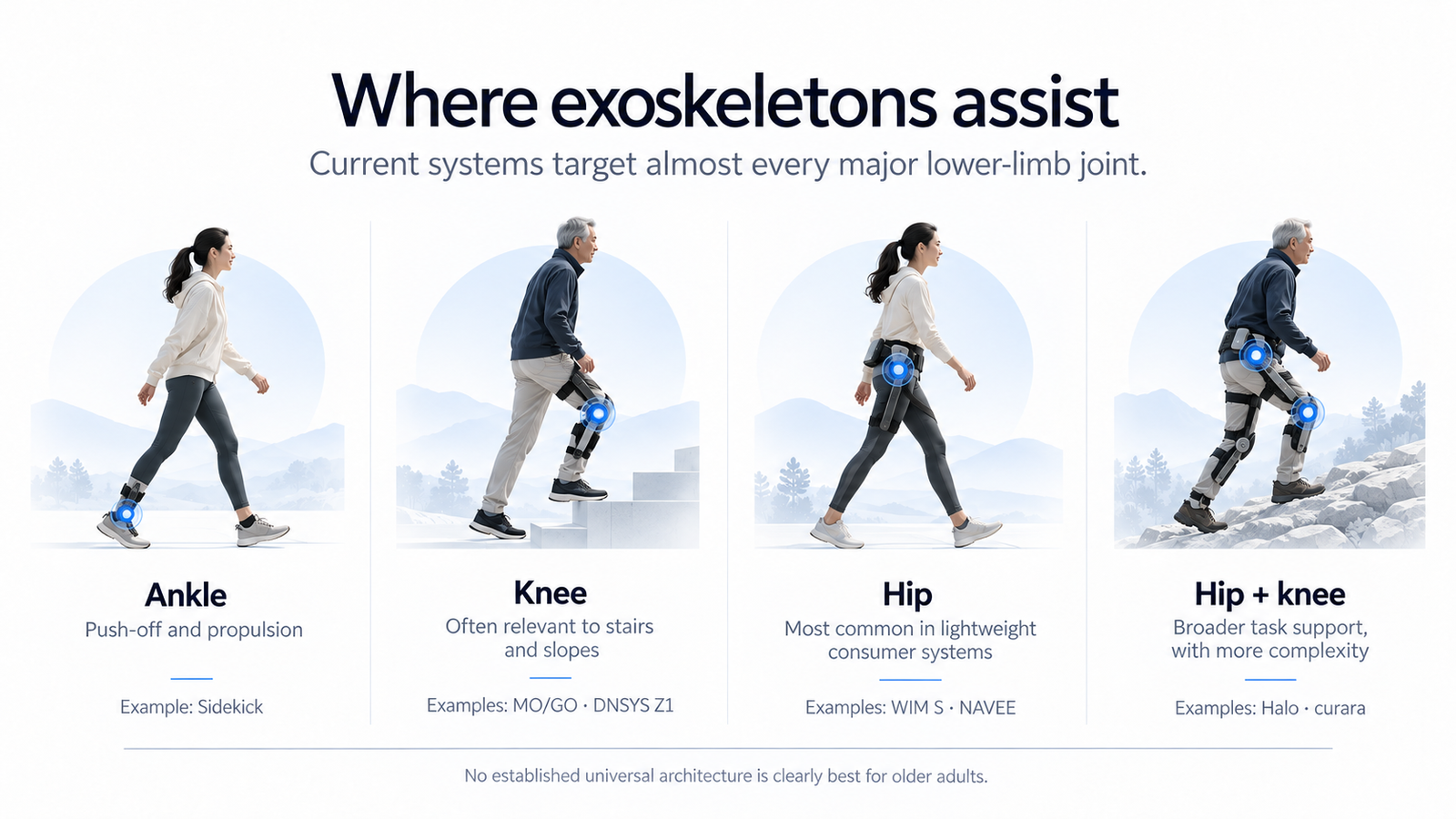
The architecture question therefore becomes an evidence question. Different mobility problems may genuinely require different forms of assistance, and research already points in more than one direction.
In one older-adult study using tethered ankle exoskeletons and individualized human-in-the-loop optimization, ten participants over 65 increased self-selected walking speed by 8% while metabolic rate fell 19% relative to zero-torque exoskeleton walking. The energetic cost of transport fell 25%.
That is strong evidence that carefully optimized ankle assistance can improve both speed and economy in healthy older adults. It is not evidence that every commercial ankle exoskeleton will reproduce the same effect.
What does the evidence actually show?
The evidence is more encouraging than it was a few years ago, but less definitive than the expanding product market can make it appear.
Rather than assigning a simplistic evidence score to each brand, the more useful approach is to ask what each study actually tested, in whom, and for how long.
WIM: one platform, two useful studies, the same important limitation
WIRobotics has one of the more developed published older-adult datasets around a lightweight consumer-oriented platform.
Four weeks
10 m walking speed improved 14.8% and six-minute walking speed improved 10.6%. Timed Up and Go and SPPB performance also improved.
There was no non-exoskeleton walking-training control group, so the gains cannot be attributed cleanly to the device.
Six weeks
Self-selected and fast walking speed improved, alongside gains in several functional and lower-limb strength measures.
This was again a single-group pre/post study, so training, practice and expectation cannot be separated cleanly from robotic assistance.
Taken together, these studies are encouraging. They are not equivalent to a randomized trial showing that buying a WIM S causes a long-term increase in independent daily mobility.
Powered hip assistance on a steep incline
In a randomized crossover study, active assistance reduced Physiological Cost Index and perceived exertion. Peak heart rate was lowest with assistance, although the difference was not statistically significant.
Powered hip assistance can reduce acute effort during this specific uphill task.
H-Medi as a training tool
Both groups completed an exercise programme, but only one trained with hip-extensor assistance. The robotic group showed greater changes in selected gait and plantar-pressure measures.
Outcomes were measured without the suit. This tests assisted training, not permanent daily assistance.
Sit-to-stand may deserve much more attention
A 2026 TUM feasibility study used a soft hip exosuit with ten older adults and examined both walking and rising from a chair.
The sample was small and the system was a research platform, but the task is important. Everyday independence is not only continuous walking.
Not every study is positive
Negative evidence is important in a market filled with intuitive claims about assistance. A 2026 randomized crossover study involving 23 senior adults found no significant improvement in cadence, step length, oxygen uptake or metabolic power with a passive hip exoskeleton compared with no-exoskeleton and sham conditions.
Clinical research offers another caution. Studies involving MyoSuit have shown that changing muscle activation does not automatically translate into greater functional walking, while a randomized home/community study after incomplete spinal cord injury found no significant between-group increase in daily walking time.
Lower effort, improved biomechanics, easier subjective walking and greater real-world independence are related outcomes. They are not interchangeable.
From a successful demo to real-world use
A few minutes in an exoskeleton can answer one question quickly: can the user feel the assistance? It tells us much less about everything that follows.
Bobby cautions against placing too much weight on extremely short demonstrations. In his experience, something closer to 20 minutes begins to reveal more about assistance and usability, while extended testing approaching a couple of hours can expose pressure points, fatigue, control problems and practical issues that may never appear during the first few steps.
Those are not universal scientific thresholds. Longer testing does not automatically create stronger evidence. It simply exposes different questions.
Can the wearer feel the system helping?
Can the change be quantified objectively?
Is the product comfortable and practical enough to wear?
Does the person choose to use it without researchers present?
Subjective and objective benefit can diverge. Someone may genuinely feel that a device helps even when a physiological measurement does not show a significant difference. The reverse is also possible: a laboratory may record lower metabolic cost while the wearer finds the product too uncomfortable or inconvenient for normal life.
Kirk’s experience is interesting because it does not fit neatly into one market box. He has osteoarthritis in his right knee, yet he is evaluating technology from the broader consumer mobility market rather than entering through a conventional medical-exoskeleton pathway.
His reaction cannot establish that Halo unloads an osteoarthritic knee or that it is appropriate treatment. What it does show is that older consumers are already evaluating general consumer products through the lens of their own age-related mobility needs.
The harder question starts after the novelty
During our work on this analysis, Bobby repeatedly returned to one issue: will people keep using these systems?
Long-duration consumer adherence data remain much thinner than acute laboratory tests. Even a six-week programme with excellent attendance is still a structured intervention. It is different from somebody independently deciding to charge, fit and wear a device several times a week for a year.
The industry is increasingly good at showing that motors can reduce effort.
The harder challenge is proving that people choose to keep wearing them when nobody is running the study.
Access may matter as much as the hardware
The exoskeleton itself is only one part of the product. How somebody obtains it determines the upfront cost, how long they can test it, whether somebody checks the fit and what happens when the hardware needs service.
Direct ecommerce and conventional consumer ownership.
Lower upfront commitment and the chance to evaluate longer-term use.
Physical assessment, fitting and instruction before committing.
Professional evaluation when mobility impairment is more significant.
Rental changes more than the price
Coway’s 2026 entry in South Korea is one of the more interesting commercial experiments because the company did not introduce its WIRobotics-developed wearable as a conventional one-time purchase. It launched through rental, including shorter options and longer household-style contracts.
The reviewed long-term plan starts at roughly US$43 per month (₩57,900). By comparison, a WIM S currently costs about US$2,080 (₩2.79 million) to purchase in Korea.
Those are not identical products or contracts, so the figures should not be read as a simple rent-versus-buy calculation. The more interesting difference is behavioural. Rental can allow somebody to discover whether a wearable robot is genuinely useful over weeks or months rather than deciding after a short demonstration.
If sustained use is one of the market’s biggest unanswered questions, rental may become more than financing. It can also become a practical way for users to test whether assistance deserves a place in their routine.
Coway’s model is examined in more detail in our dedicated analysis: A $5.3 Billion Consumer Giant Just Entered the Exoskeleton Market.
Japan’s curara offers another model. The half configuration currently costs about US$7,770 (¥1.232 million) to purchase or roughly US$389 per month (¥61,600) to rent. The full hip-and-knee configuration is about US$11,030 (¥1.749 million), or approximately US$555 per month (¥88,000) to rent. Users can also arrange a physical trial.
That price tier is well above the typical lightweight hiking exoskeleton and belongs closer to assistive walking and training. The market distinction matters: curara and a US$1,000 consumer hip device may both assist the legs, but they are not the same commercial or clinical proposition.
What Kirk adds to the access question
Kirk’s interest in exoskeletons has gradually moved beyond whether the hardware works for him personally. He is also trying to understand how this type of technology could fit into the systems that already exist around older people.
He told Exoskeleton Index that he serves as a consumer representative involved in assessing aged-care innovation proposals with Aged Care Research & Industry Innovation Australia (ARIIA). We describe the role as Kirk described it to us rather than assigning him a formal committee title that ARIIA has not publicly listed.
That perspective raises questions product pages rarely answer. If someone wants an exoskeleton mainly for longer walks, travel, shopping or difficult terrain, does every person need to own one? Could an aged-care provider hold a small fleet? Could an occupational therapist or physiotherapist help identify which users are appropriate? Could a month-long rental reveal whether the technology is useful enough before public or private money is spent on ownership?
Kirk has suggested a neighbourhood or cooperative model in which devices could be shared between households instead of spending most of the week unused.
That is not an established consumer-exoskeleton market today. But the idea becomes less theoretical when viewed alongside what is already happening: Coway is offering household rental, curara can be rented monthly, clinical robots are often shared institutional assets, and short-term consumer rental is beginning to appear in events and tourism.
Exoskeleton Index documented one such example at WorldSkills Shanghai, where visitors could rent consumer exoskeletons to move around the exhibition.
If many older users ultimately need powered assistance occasionally rather than continuously, permanent personal ownership may not be the only sensible model.
Australia: when the product arrives before the funding category
Australia makes the access problem especially visible.
Under the Support at Home Assistive Technology and Home Modifications scheme, eligible participants with an assessed need can receive dedicated assistive-technology funding outside their normal ongoing-care budget. As of October 2026, the high assistive-technology tier is approximately US$10,750 from the official A$15,390 allocation.
That amount overlaps with the price of some powered walking technologies. It does not mean consumer exoskeletons automatically qualify.
Eligibility still depends on assessed need, the person’s support plan and the scheme’s rules. Professional prescription and supporting evidence may be required. Kirk says occupational therapists and physiotherapists are central to the practical route he is navigating.
Is a consumer walking exoskeleton wellness equipment, exercise technology, assistive technology or a medical device? The hardware can become commercially available before funding systems have a clear answer.
China is building almost the opposite environment
China is notable because hardware supply, physical retail, rental, public policy and aging strategy are developing in parallel.
National policy has encouraged exoskeleton robots and other age-friendly technologies to move into elderly households, communities, hospitals, pharmacies and care institutions. Physical experience centres and trial models are also becoming part of the market infrastructure.
Exoskeleton Index has tracked that policy build-out across China’s push to bring exoskeletons into elderly households and the country’s broader rehabilitation technology and medical-exoskeleton strategy.
Local governments are also beginning to add direct consumer incentives. Beijing’s current programme covers qualifying exoskeleton robots at 15% of the final purchase price, capped at approximately US$224 from the RMB 1,500 local limit. Beijing’s programme is now joined by a similar Jiangsu consumer subsidy using the same 15% structure and RMB 1,500 cap for qualifying systems.
These are not large subsidies relative to the cost of many products, and they are not blanket discounts on every exoskeleton. Their importance is structural: wearable robotics is beginning to be recognised inside ordinary consumer-support policy.
What would convince us that this market actually works?
By 2026, proving that a wearable robot can generate assistive torque is no longer enough. For exoskeletons to become meaningful active-aging technology, the next evidence threshold has to move closer to everyday life.
How many users are still wearing the device after three, six or twelve months?
Do people actually walk farther, more often or in situations they previously avoided?
Do stairs, shopping, transport and sit-to-stand become meaningfully easier?
Falls, near-falls, skin issues, discomfort and compensatory movement need systematic reporting.
Healthy active older adults should not be pooled with users who have frailty, arthritis, neurological impairment or poor balance.
Powered assistance should sometimes be compared with physiotherapy, exercise, poles, braces and other lower-cost options.
Fitting, charging, battery replacement, software support and repair affect long-term use.
Claims that exoskeletons delay care needs or reduce costs eventually need real evidence.
What Bobby is watching
Hypershell Halo
Interesting because a mainstream consumer-exoskeleton company is moving beyond the familiar hip-only format into powered hip-and-knee assistance.
Compact VIGX designs
Smaller hardware may matter significantly for everyday wearability. Bobby explicitly noted that he has not personally tested the specific newer compact version.
Sit-to-stand + stairs
Potentially more relevant to older users than another increase in peak motor output because real mobility is not continuous level walking.
The Exoskeleton Index view
The most important development in exoskeletons for older adults is not one breakthrough product. It is that there are now enough products, price points, joint architectures and access models for an actual market to begin forming between conventional consumer technology and medical mobility robotics.
An independently mobile older adult can already buy a powered hip system online. Another can rent a walking-assist wearable instead. Someone in Japan can trial an assistive system before deciding whether to purchase or rent it. A user with greater impairment may enter through professional evaluation and a structured clinical pathway. At the same time, older consumers are experimenting with broader consumer products that were never designed as geriatric equipment.
That makes the market more important, but also harder to describe responsibly. A reduction in metabolic cost does not automatically mean greater independence. A positive short-term experience does not prove sustained use. Senior-facing marketing does not establish suitability for every older adult. And a device designed for an independently mobile hiker should not be judged by the same criteria as a medical system intended for significant neurological impairment.
The question that mattersNot simply: “Can an exoskeleton make walking easier?”
But: for which older adults, doing which activities, with which type of assistance, through which access pathway, and does the benefit remain meaningful once they leave the lab?
Methodology and contributors
Commercial status, prices, access, manufacturer positioning, public policy and academic evidence were reviewed against manufacturer, distributor, government and peer-reviewed sources.
Bobby Marinov shared Exoskeleton Report’s working consumer-exoskeleton dataset dated 27 September 2026, covering 57 tracked consumer systems, and contributed commentary on market history, usability, active-aging positioning, architectures and evidence.
Kirk Warren, 76, Australia, provided first-hand experience of consumer-exoskeleton use and assistive-technology access. He told Exoskeleton Index that he also serves as a consumer representative involved in aged-care innovation assessment with ARIIA. His comments are lived experience, not clinical evidence.
“Active aging” and similar labels describe manufacturer positioning or the scope of this analysis, not medical suitability. Non-US prices use approximate USD conversions from 11 October 2026.
Frequently asked questions
Can older adults actually buy a walking exoskeleton in 2026?
Yes. Several lightweight powered systems can now be purchased directly, while others are available through rental, preorder or structured assessment. The important distinction is whether the product is a consumer walking-assist system or an assistive or medical technology intended for a different level of impairment.
How much does a consumer walking exoskeleton cost?
Many current lightweight consumer products fall roughly in the US$1,000–US$5,000 range. Structured assistive systems can cost substantially more, while medical exoskeletons occupy a different price category. See the Exoskeleton Index 2026 price guide for the wider market.
Can an exoskeleton be rented instead of bought?
Yes, in some markets. Coway has introduced consumer rental in South Korea, while curara can be rented monthly in Japan. Clinical systems can also use rental or home-trial pathways. Rental is especially interesting because it gives users longer to determine whether the technology is genuinely useful.
Are consumer exoskeletons medical devices?
Many are not. Some products explicitly identify themselves as wellness or consumer mobility devices and require independent walking and balance. A system that reduces walking effort should not automatically be treated as rehabilitation or fall-prevention technology.
Which joint should an exoskeleton assist for an older adult?
There is no universal answer. Hip, knee, ankle and multi-joint systems address different movements. The more useful starting point is the activity and mobility limitation that actually need assistance.
Can a consumer exoskeleton prevent falls?
Fall prevention should never be assumed unless a product has specifically been designed, tested and validated for that purpose. Several consumer products require independent balance as a condition of use.
Selected sources
- Exoskeleton Report: About the team.
- WIRobotics: WIM S product page.
- Coway: 2026 walking-assist wearable launch.
- Scientific Reports: WIM four-week older-adult walking study.
- JMIR mHealth and uHealth: Six-week WIM training study.
- Journal of NeuroEngineering and Rehabilitation: Optimized ankle-exoskeleton assistance in older adults.
- PubMed / Journal of Visualized Experiments: Powered hip assistance during uphill walking.
- Frontiers in Bioengineering and Biotechnology: H-Medi randomized older-adult pilot.
- Nature Communications: Soft hip exosuit for walking and sit-to-stand in older adults.
- Passive hip-exoskeleton crossover study: 2026 senior-adult study.
- MyoSuit: Randomized home/community trial.
- MyoSuit: Neuromuscular evaluation.
- Human-centred exoskeleton design: 2025 participatory older-adult study.
- Haier: W3 commercialization and older-adult positioning.
- Haier: W3 Mom fit redesign.
- AssistMotion: curara purchase, rental and trial.
- NAVEE: EXO S Pro European listing.
- Dephy: Sidekick commercial listing.
- Hypershell: Halo European product page.
- Keeogo: Evaluation and home-trial pathway.
- China rehabilitation-assistive-device policy: 2026–2028 action plan.
- Beijing Municipal Government: 2026 smart-product subsidy.
- My Aged Care: Support at Home assistive-technology funding.
- ARIIA: Innovation Validation Program.