
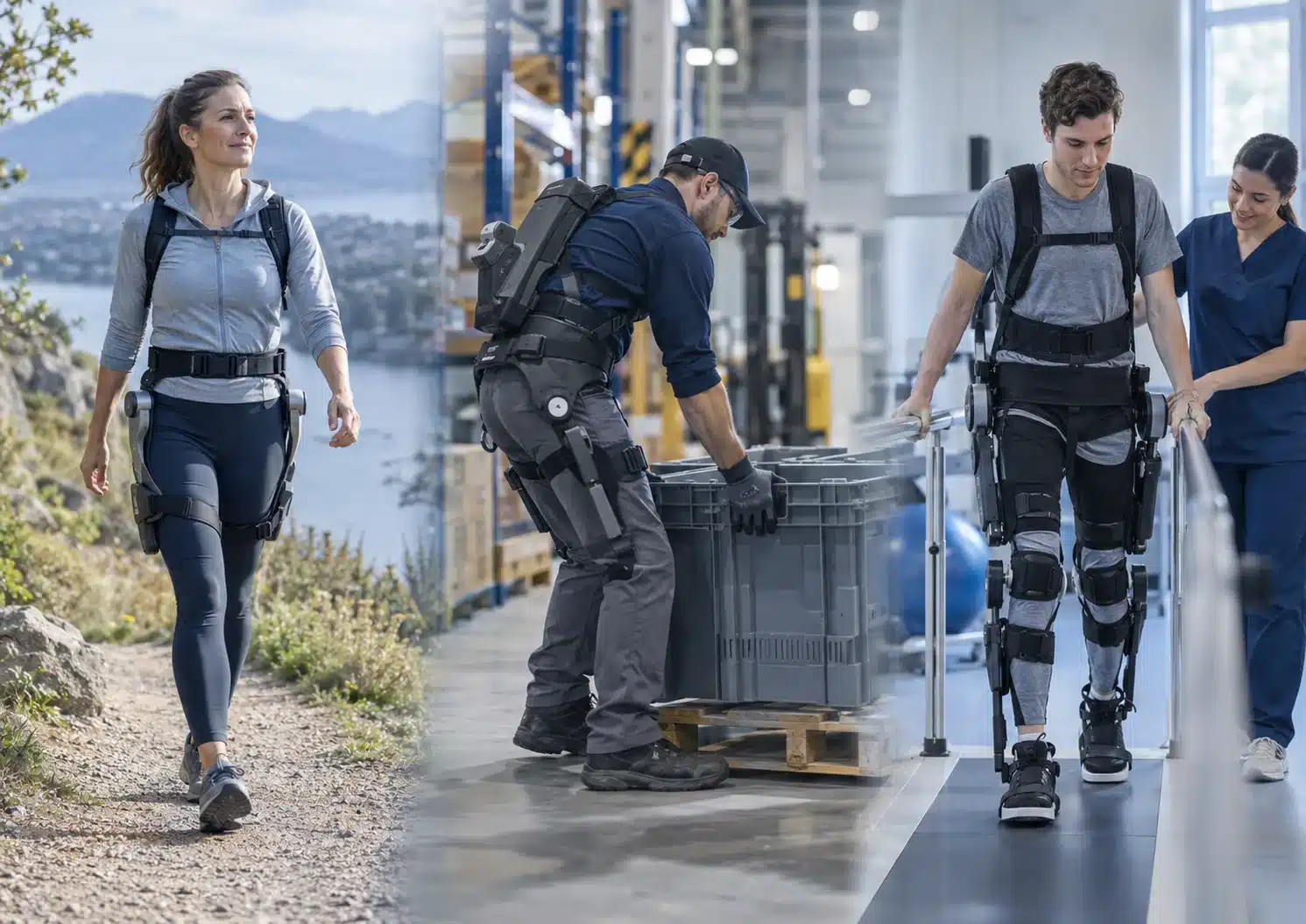
Exoskeleton pricing is becoming more transparent, but the headline numbers are easier to misunderstand than ever. A consumer can now buy a powered walking-assistance system online for around US$1,000. A workplace support may cost a few hundred euros or several thousand, depending on the body area and task. A medical exoskeleton can move into tens of thousands of dollars, or be sold only after clinical assessment and quotation. All of those numbers are real, but they do not describe the same kind of product or the same kind of transaction.
That distinction matters as the market matures. A sale price, an MSRP, a preorder deposit, a fleet package, a subscription, a hospital tender and an insurance reimbursement are often reported side by side as though they were interchangeable versions of “the price of an exoskeleton.” They are not.
This Price Intelligence guide separates those layers. Consumer products are compared using current commercial offers. Workplace systems are grouped by the task they are designed to support, rather than ranked in one misleading list. Medical manufacturer pricing is kept separate from hospital procurement and reimbursement. The goal is not to produce the widest possible price range. It is to show what buyers are actually being asked to pay, through which route, and what each number really means.
Key takeaways
- A real consumer price band has emerged. Several directly purchasable powered hip-assist systems now compete around roughly US$900 to US$2,000, giving buyers more price transparency than the category had only a few years ago.
- Industrial exoskeleton cost only makes sense when the task is defined. A passive neck support, a back-assist suit, an overhead-support system and an active grip device solve different problems and should not be treated as substitutes on one price ladder.
- One product can have several valid commercial prices. Region, promotion, package size, tax treatment, preorder status, fleet purchasing and subscription models can all change the offer without creating a true contradiction.
- Medical pricing is structurally different. Some manufacturers publish standard sales prices, but specialist assessment, quotation and institutional purchasing remain common.
- Procurement and reimbursement are separate evidence layers. A hospital award tells us what one institution paid. A reimbursement amount tells us what a payer may allow. Neither should be presented as universal retail price.
- Price is useful only after product fit is understood. Architecture, comfort, included equipment, training, support, maintenance and adoption can matter more than the lowest sticker price.
Direct answer: how much does an exoskeleton cost in 2026?
For mainstream powered consumer hip-assist systems with public direct-purchase pricing, current offers typically sit around US$900 to US$2,000. Premium or different-architecture personal systems can move to roughly US$2,300 to US$5,000. Workplace products range from a few hundred euros for targeted passive supports to several thousand euros for back, shoulder and multi-task systems, while specialist active hand assistance can approach €10,000. Medical exoskeletons can reach tens of thousands of dollars, although many remain quote-based. These are different product classes and commercial routes, so a single “average exoskeleton price” would be more misleading than useful.
Price data in this guide was reviewed through 12 September 2026. Current commercial pricing is taken from Exoskeleton Index’s structured price-offer layer and checked against primary manufacturer, storefront or official commercial evidence. Original currencies remain canonical. Approximate EUR and USD conversions are provided only where they help readers compare scale.
Consumer exoskeleton pricing is becoming a real retail market
The clearest change in 2026 is not simply that consumer exoskeletons have become cheaper. It is that enough products now have visible, directly purchasable prices for buyers to compare them like a genuine consumer technology category.
Hypershell, DNSYS, Ascentiz, VIGX and NAVEE all expose current commercial offers. That is a meaningful shift from a market dominated by prototypes, quote requests and launch announcements. Buyers can now compare an actual checkout price with product architecture, weight, assistance, battery configuration and service instead of trying to infer cost from a press release.
Exoskeleton Index view
The strongest consumer-market signal is the emergence of competition around roughly US$900 to US$2,000 among several powered hip-assist systems. No single product defines that market. The importance is the cluster itself. It gives buyers alternatives, makes promotions visible and puts pressure on manufacturers to justify what a higher price delivers.
Mainstream powered hip-assist systems
| Product | Current price | Reference / context | Route |
|---|---|---|---|
| DNSYS X1 Carbon | US$889 | Reference price US$1,299 | Direct purchase |
| Hypershell X Pro S | US$999 / €999 | Regional direct pricing | Direct purchase |
| VIGX π | US$1,099 | Reference price US$1,199 | Direct purchase |
| NAVEE EXO S Pro | €1,099 | EU / German direct price | Direct purchase |
| Ascentiz H Pro | US$1,299 | Reference price US$1,499 | Direct purchase |
| VIGX π Plus | US$1,399 | Reference price US$1,499 | Direct purchase |
| Hypershell X Max S | US$1,499 / €1,499 | Regional direct pricing | Direct purchase |
| Ascentiz H Ultra | US$1,699 | Reference price US$1,999 | Direct purchase |
| Hypershell X Ultra S | US$1,999 / €1,999 | Regional direct pricing | Direct purchase |
The table is useful because these products are close enough in market position to make price comparison meaningful. A buyer is no longer choosing between a US$1,000 consumer device and a hospital rehabilitation robot. Several products now compete inside a roughly US$1,100 spread.
That still does not make them interchangeable. Assistance strategy, peak torque, battery setup, weight, fit, noise, software, warranty and after-sales support can differ materially. The right question is therefore not “which is cheapest?” but what additional capability or ownership experience am I getting for the extra money?
For product-level selection, see our Best Consumer Exoskeletons guide, the Best Hiking Exoskeletons guide and the Exoskeleton Index Compare tool.
Discounting is now part of the competitive picture
Promotional pricing has become common enough that it should not be treated as a footnote. A current selling price and a visible reference price are two different commercial facts, and both are useful.
DNSYS X1 Carbon is currently US$889 against a US$1,299 reference price. VIGX π is US$1,099 against US$1,199, while VIGX π Plus is US$1,399 against US$1,499. Ascentiz H Pro is currently US$1,299 against US$1,499, while Ascentiz H Ultra starts at US$1,699 against US$1,999.[1][4][5]
For buyers, this means an older MSRP or launch price may no longer describe the amount they will actually pay. For market analysis, it also means price competition is becoming visible in a way that was difficult to observe when most products were quote-based.
How we handle changing prices
The newest verified commercial offer is treated as the current offer. Older official prices remain useful as price history, not as values to average into today’s number. When two current first-party sources genuinely disagree, Exoskeleton Index keeps the conflict visible rather than manufacturing a false midpoint.
Above the mainstream price band, architecture matters more than ranking
Once personal systems move beyond the mainstream hip-assist range, a simple cheapest-to-most-expensive comparison becomes much less useful. Some products add another powered joint, some move assistance to the ankle, and others use a different mobility concept or preorder model altogether.
| Product | Current commercial price | What changes the comparison | Status |
|---|---|---|---|
| DNSYS Z1 Dual Joint | US$1,299 Reference price US$1,499; US$1,099 retained as historical |
Dual-joint lower-limb architecture | Direct purchase |
| WIRobotics WIM S | ₩2,790,000 ≈ €1,792 / US$2,078 |
South Korean wellness walking system with optional software subscription | Regional direct purchase |
| Hypershell Halo | US$2,299 / €2,299 | Full-leg hip and knee assistance | Preorder; shipping from late November 2026 |
| Dephy Sidekick Starter Pack | US$4,500 | Powered ankle assistance; pair of devices, batteries, charger and footwear | Direct purchase |
| Skip × Arc’teryx MO/GO Starter Pack | US$4,999 total US$99 refundable deposit due now |
Premium personal mobility system with reservation model | Preorder; summer 2027 shipping |
Price conflict: DNSYS Z1
DNSYS currently lists Z1 at US$1,299 with a US$1,499 reference price. A previously observed US$1,099 figure is not present in current first-party checks and is retained as historical pricing rather than a current conflict.[1]
The price spread in this group reflects architecture as much as positioning. Hypershell Halo adds powered assistance at both the hip and knee. Dephy Sidekick moves assistance to the ankle and includes dedicated footwear in its Starter Pack. MO/GO follows a premium personal-mobility model with a reservation and future shipping date. WIM S adds an optional recurring software layer.
These products may compete for some of the same customers, but the buyer is not paying only for “more exoskeleton.” They are paying for a different assistance architecture, package and use case.
A deposit is not the product price
Skip’s MO/GO reservation requires US$99 today, but the total Starter Pack price is US$4,999, with shipping planned for summer 2027.[9] The US$99 is a refundable reservation deposit. Reporting it as the price of MO/GO would materially misrepresent the offer.
Hypershell Halo is a different preorder case. Its total commercial price is already public at US$2,299 / €2,299. The uncertainty is not price, but availability: current European sales material says shipping begins from late November 2026.[3]
Consumer ownership is starting to include software
WIRobotics WIM S sells for ₩2,790,000 in South Korea, approximately €1,792 or US$2,078 at the exchange rates used in this article.[7] The optional WIM Premium service then adds recurring plans. The Single tier is ₩9,900 per month or ₩79,000 per year, roughly €6.36 / US$7.37 monthly or €50.75 / US$58.83 annually.[8]
The amounts are modest relative to the hardware, but the model is important. Consumer exoskeleton ownership is beginning to include software and service economics that look more like connected mobility or fitness technology than traditional assistive equipment.
Industrial exoskeleton cost only makes sense when the task is defined
Workplace pricing is where broad “exoskeleton cost” ranges become most misleading.
A neck support designed to reduce static head load can be mechanically simple and relatively inexpensive. A back-assist suit must redistribute load across the torso. An overhead-support exoskeleton needs to assist the arms without restricting reach. An active grip system adds actuation, sensing and hand interfaces. Those are different engineering problems, so they should not be placed on one universal price ladder.
For an employer, the better question is: what does it cost to address this specific task with a product workers can realistically use?
Back, lifting and forward-leaning support
| Product | Current public price | Commercial context |
|---|---|---|
| Skelex Edge | €825 | Excluding VAT; purchase option |
| Auxivo LiftSuit 2 | CHF 950 ≈ €1,005 / US$1,165 |
Current manufacturer list price |
| HAPO HD | From €1,069 | Current HAPO catalogue |
| HeroWear Apex 2 | US$1,999 individual | Individual US purchase; enterprise packages priced differently |
| HUNIC SoftExo Lift | €2,900 | Net, excluding VAT and shipping |
| HAPO BR | From €2,996 | Current HAPO catalogue |
Even within one broad category, the range is substantial. That reflects differences in construction, force paths, assistance profile, adjustability, supported postures and deployment model. A textile exosuit and a more structured passive system may both support lifting, but they do not necessarily deliver the same experience or fit the same task.
There are useful mid-range examples beyond the table. HAPO CS and HAPO SD are both listed from €1,799, while HUNIC SoftExo Hold is €1,950 net and is designed around frequent forward-flexion work.[11][14]
Shoulder and overhead support
| Product | Current public price | Commercial context |
|---|---|---|
| Hilti EXO-S | From US$899 | Discounted net US price; variant dependent |
| Ekso EVO | US$1,495 | US direct store; currently sold out |
| HAPO FRONT | From €1,900 | Current canonical catalogue price; first-party conflict noted below |
| Auxivo DeltaSuit | CHF 2,290 ≈ €2,423 / US$2,809 |
Current manufacturer list price |
| Skelex 360 | €2,995 | Excluding VAT; purchase option |
| HAPO UP | From €3,500 | Current HAPO catalogue |
Price conflict: HAPO FRONT
HAPO’s current product catalogue and main commercial surface show €1,900 for HAPO FRONT, while other first-party informational pages have continued to expose €2,500.[14] Exoskeleton Index uses €1,900 as the stronger current commercial offer and keeps the €2,500 figure as an explicit conflict note.
Hilti EXO-S also illustrates why “from” pricing matters. The system is advertised from US$899 as a discounted net US price, while other variants can be materially higher. Hilti also offers Fleet Management through a monthly usage fee, but the current recurring rate is not public.[13] We leave that number blank rather than estimating it.
Carrying and multi-task support
| Product | Current public price | Primary commercial context |
|---|---|---|
| HUNIC SoftExo Carry | €490 | Net, excluding VAT and shipping; carrying and logistics support |
| Auxivo CarrySuit | CHF 1,690 ≈ €1,788 / US$2,073 |
Current manufacturer list price |
| Auxivo OmniSuit | CHF 2,990 ≈ €3,164 / US$3,667 |
Multi-task upper-body support |
The spread here should not be read as one brand being simply “cheap” and another “expensive.” SoftExo Carry and OmniSuit address different loading patterns and use different assistance concepts. Price becomes meaningful only after the task, body region and expected use pattern are defined.
Targeted neck and hand support
| Product | Current public price | Target |
|---|---|---|
| Skelex Neck | €175 | Targeted neck support |
| HAPO NECK | From €534 | Targeted neck support |
| Skelex Ironhand | €9,995 | Active hand / grip assistance |
This small table shows why headline industrial ranges can be technically correct and still analytically poor. Saying “industrial exoskeletons cost €175 to €9,995” combines a targeted passive neck device with an active hand-assistance system and implies the endpoints are substitutes. They are not.
For workplace selection, our practical buyer’s guide, workplace adoption analysis and pilot planning guide provide a better framework than choosing from price alone.
Need help narrowing a workplace shortlist?
If you are sourcing an exoskeleton for a specific task, tell us what the work involves. Exoskeleton Index can help identify relevant products and suppliers before you commit to a pilot.
For employers, the purchase price is only one commercial model
Workplace exoskeleton suppliers are increasingly offering more than one route to the same hardware. That matters because a procurement team comparing only unit prices can miss the actual economics of deployment.
HeroWear Apex 2: individual price versus deployment economics
HeroWear lists an individual Apex 2 at US$1,999 in the United States. Its published workplace packages follow a different model: 10 users cost US$14,990, 25 users cost US$37,475 and 50 users cost US$74,950.[12] Those package totals work out to US$1,499 per user, but that should not be presented as the individual retail price because the package is tied to a multi-user workplace deployment.
HeroWear also advertises qualifying Exoskeleton as a Service deployments starting below US$99 per user per month. One product can therefore have three valid commercial figures: individual purchase, multi-user deployment and recurring service access.
Why this matters
A single price field would make the Apex 2 look inconsistent. An offer-based model shows what is actually happening: the price changes with the route to market. That is an important sign of a workplace category moving from one-off hardware sales toward managed deployment programmes.
Skelex: purchase and recurring access side by side
Skelex Edge can be purchased for €825 excluding VAT, while Skelex also publishes a six-month plan at €45 per month plus a €270 setup fee. Skelex 360 can be purchased for €2,995 or accessed through a six-month plan at €139 per month plus an €834 setup fee.[15]
That produces a published six-month cash outlay of €540 for Edge and €1,668 for 360. It does not tell us that the customer owns the product after six months, so those totals should not be compared directly with purchase price without checking the contract terms.
HUNIC: public unit pricing, custom deployment pricing
HUNIC shows another common pattern. Its direct shop publishes clear net prices for individual products such as SoftExo Lift, SoftExo Hold and SoftExo Carry, while larger purchases and test deployments move into a quotation process.[11]
“Quote-based” therefore does not always mean the product lacks a public price. Sometimes the unit price is public and the deployment becomes custom once scale, training or pilot support enter the discussion.
Japan shows how low-cost workplace assistance can form its own submarket
Japanese manufacturer Innophys provides one of the clearest lower-cost price ladders in the workplace market. Its lighter products sit well below many European occupational exoskeletons, and the manufacturer publishes prices with tax included.
| Innophys product | Japanese price | Approx. equivalent | Status |
|---|---|---|---|
| Soft-Power EASY-LIFT | ¥22,000 | ≈ €123 / US$143 | Commercially available |
| Soft-Light2 | ¥39,600 | ≈ €222 / US$257 | Commercially available |
| Soft-Power | ¥59,400 | ≈ €333 / US$386 | Commercially available |
| Muscle Suit Every | ¥149,600 | ≈ €838 / US$971 | Commercially available |
The useful conclusion is not simply that “Japanese exoskeletons are cheaper.” Innophys spans lightweight textile or supporter-style products and the more substantial Muscle Suit platform. The price ladder shows how a manufacturer can serve several levels of workplace assistance without forcing every use case into a multi-thousand-euro device.
Innophys has also announced Every-Light at ¥132,000, approximately €739 / US$857. However, the product was presented in September 2026 as a mass-production pre-production prototype.[17] Exoskeleton Index therefore does not treat it as ordinary shipping retail inventory yet.
Medical exoskeleton pricing follows a different commercial logic
Medical systems should not be treated as an expensive extension of the consumer table.
A medical exoskeleton may require patient screening, clinical assessment, prescription, specialist fitting, training and payer approval before a transaction can happen. Hospitals may buy through public procurement. Personal systems may depend on insurance or another funding pathway. Service and support can also be part of the sale.
That means a missing online checkout price is not necessarily a lack of commercial information. In many cases, the route to purchase is deliberately specialist.
| Product | Manufacturer pricing evidence | Approx. context | Route |
|---|---|---|---|
| ANGEL LEGS M20 | ₩120,000,000 domestic US$85,000 export |
Domestic amount ≈ €77,093 / US$89,366; VAT excluded | Institutional / specialist sale |
| ANGEL SUIT H10 | ₩31,500,000 | ≈ €20,237 / US$23,459; VAT excluded | Institutional / specialist sale |
| Trexo Theo | Price confirmed after assessment | Configuration and price provided in writing before purchase agreement | Assessment + prescription pathway |
| Trexo Home | Quote-based | Specialist pathway | Specialist purchase |
| ReWalk 7 | Contact / coverage pathway | Do not substitute Medicare reimbursement for retail price | Prescription + payer / specialist pathway |
Angel Robotics is unusually useful for medical price intelligence because its corporate reporting explicitly identifies the M20 and H10 figures as standard sales prices and states that VAT is separate.[18] That is stronger evidence than trying to infer a manufacturer’s price from an old reseller listing or a hospital tender.
Trexo follows a different commercial route. Its official purchase process explains that after assessment and prescription, the configuration and price for Trexo Theo are confirmed in writing before the purchase agreement is sent.[19] ReWalk 7 likewise follows a specialist access and coverage pathway rather than a normal consumer-store checkout.[20]
Exoskeleton Index view
Medical price opacity is partly structural. The device may be only one component of a clinical and funding pathway. Filling that gap with a reimbursement amount or a hospital contract would create false precision. When a reliable current manufacturer price is not public, the correct label is still quote-based.
Hospital procurement shows what institutions actually pay
Public procurement is one of the strongest evidence sources in the medical exoskeleton market because it records real institutional transactions. It is also one of the easiest sources to misuse.
A hospital award can include distributor margin, training, installation, service, warranty conditions, local taxes and contract-specific requirements. It can also reflect the level of competition in a particular tender. The award therefore answers a precise question: what did this buyer agree to pay under this contract? It does not establish a universal MSRP.
Selected public exoskeleton procurement transactions
| Buyer / country | System | Transaction value | Approx. equivalent |
|---|---|---|---|
| Rehabilitation Hospital affiliated with the National Rehabilitation Assistive Products Research Center, China | ZEPU-AI9, 1 unit | CNY 545,000[21] | ≈ €70,086 / US$81,243 |
| Ningxia Medical University General Hospital, China | ZEPU-AI9, 1 unit | CNY 599,800[22] | ≈ €77,133 / US$89,412 |
| Guangdong Provincial Hospital of TCM Hainan Hospital, China | Fourier M4L02L, 2 units | CNY 1,175,000 per unit[23] | ≈ €151,102 / US$175,158 per unit |
| Hangzhou Rehabilitation Hospital, China | UGO223, 1 unit | CNY 580,000[24] | ≈ €74,587 / US$86,461 |
| Wangcang County Hospital of TCM, China | Aider3S-310, 1 unit | CNY 470,000[24] | ≈ €60,441 / US$70,063 |
| Hospital Nacional de Parapléjicos, Toledo, Spain | Adult gait exoskeleton, model not named | €90,000[25] | GOGOA Mobility Robots awarded supplier |
| Hospital Universitario Dr José Molina Orosa, Lanzarote, Spain | Lower-limb robotic exoskeleton, model not named | €95,000[26] | ABLE Human Motion awarded supplier |
The same ZEPU-AI9 appears at two different prices
The two ZEPU-AI9 awards are among the most useful pieces of pricing evidence in the dataset. One Chinese public buyer paid CNY 545,000, approximately €70,086 / US$81,243. Another paid CNY 599,800, approximately €77,133 / US$89,412.[21][22]
The named system is the same. The institutional transaction value is not.
What that tells us
Procurement pricing is transaction-specific. Buyer, timing, distributor, contract scope, competition, training and service requirements can all change the final amount. Converting one hospital award into a universal product price would throw away exactly the information that makes procurement evidence valuable.
Do not invent the model when the tender does not name it
The Spanish cases require the same discipline. The Toledo award identifies GOGOA Mobility Robots as supplier and the Lanzarote award identifies ABLE Human Motion. The procurement records do not provide enough evidence to map either transaction confidently to one exact named product model.
Exoskeleton Index therefore records the transaction without guessing the model. Precision only adds value when the source supports it.
Reimbursement is not retail price
Reimbursement can affect affordability and market demand, but it is another type of number again.
United States: Medicare K1007
For qualifying powered lower-limb personal exoskeletons, Lifeward’s current investor material cites a 2026 Medicare fee-schedule amount of approximately US$95,081 for HCPCS K1007, while CMS maintains the DMEPOS fee-schedule framework governing the code.[27][28]
That figure is a reimbursement benchmark. It should not be copied into the ReWalk 7 product profile and presented as though Lifeward has published a universal US$95,081 retail price.
South Korea: reimbursement for treatment, not for buying the robot
South Korea illustrates an even clearer distinction. The expanded selective-benefit pathway covers qualifying robot-assisted gait training of at least 30 minutes at 365.55 relative-value points. Eligible pathways include paediatric central-nervous-system and cerebral-palsy cases, with a 50% patient copay under the selective-benefit framework.[29]
The reimbursed object is the treatment session, not the exoskeleton itself.
Three numbers that should never be collapsed
Manufacturer price is what the supplier publishes or quotes for the device or package. Procurement value is what a specific institution pays under a contract. Reimbursement is what a payer may allow for an eligible device, treatment or service. They can influence one another, but they answer different questions.
Why one exoskeleton can have several valid prices
Seeing two prices for the same product does not automatically mean one source is wrong. The underlying offer needs to be compared first.
- Region: a US storefront and a European storefront may use deliberately different prices rather than live currency conversion.
- Tax: workplace manufacturers may publish net or ex-VAT prices, while Japanese consumer or workplace prices may include tax.
- Promotion: the current selling price may sit below a visible reference or list price.
- Variant: size, configuration, power level or included hardware can change the amount.
- Package size: an individual purchase and a multi-user deployment can have different unit economics.
- Commercial route: purchase, subscription, fleet and Exoskeleton as a Service can coexist for the same product.
- Preorder: a reservation deposit is not the total product price.
- Availability: a public price can remain visible even when the product is sold out or not yet shipping.
- Time: launch offers and promotions can move faster than editorial pages or older product descriptions.
Hypershell’s US$999 and €999 prices for the X Pro S are a simple example. Those are regional commercial prices, not a currency conversion. At the exchange rates used elsewhere in this article, €999 is not equal to US$999.[2]
The sticker price is not the total cost of ownership
A lower purchase price can be attractive, but it does not by itself tell a consumer, employer or hospital which system offers better value.
For consumers
Check what is actually included: battery count, charger, compatible footwear or accessories, replacement-battery cost, shipping, taxes, warranty and return policy. A US$1,699 product that requires several paid additions can end up closer in ownership cost to a US$1,999 package that includes more hardware from the start.
For workplaces
Deployment cost can include fitting, worker selection, training, hygiene, storage, replacement textiles, batteries, maintenance, pilot measurement and supplier support. A passive textile system and a powered exoskeleton should not be assigned the same operating assumptions.
Adoption is also part of the economics. A cheaper product that workers avoid wearing can produce worse value than a more expensive system that fits the task, remains comfortable and is used consistently. The correct sequence is to define the task, shortlist the right architecture, test with representative users and then calculate deployment cost.
For medical buyers
The device price may sit inside a larger care pathway that includes therapist time, training, maintenance, patient screening, utilisation rate, funding and reimbursement. A hospital that evaluates only hardware price can miss much of the real cost and value of the programme.
That is why our Exoskeleton Market 2026 analysis treats commercial pricing, institutional procurement and reimbursement as related but separate adoption drivers.
Exoskeleton Price Intelligence methodology
This analysis uses Exoskeleton Index’s structured commercial price-offer model as the primary source for current product pricing. Legacy product-price text is retained only as fallback or historical context when a current structured offer is unavailable.
Commercial evidence is prioritised in this order:
- Current manufacturer storefront or official checkout.
- Current manufacturer catalogue or official pricing page.
- Official corporate filings or current commercial documents.
- Authorised or primary distribution evidence where manufacturer pricing is unavailable.
- Legacy Exoskeleton Index pricing only as fallback or historical context.
For each commercial offer, the relevant context can include the amount, currency, reference price, region, tax basis, availability, commercial route, package or variant, deposit, recurring charge, setup fee, source and last-checked date.
How currency conversions are handled
The original manufacturer or procurement currency remains the canonical value. Approximate EUR and USD equivalents are included only to help readers compare scale. This article uses European Central Bank reference rates for 11 September 2026, the latest ECB working-day reference before publication: €1 = US$1.1592, ¥178.56 JPY, CHF 0.9451, CNY 7.7762 and ₩1,556.56 KRW.[30]
Conversions are rounded and are not transaction quotes. Bank, card, tax and settlement rates can differ.
How price conflicts are handled
If two prices represent different regions, variants, packages or commercial routes, both can be valid. If two current first-party sources genuinely disagree, Exoskeleton Index identifies the stronger current commercial source where possible and keeps the conflict visible where it remains unresolved. DNSYS Z1 and HAPO FRONT are examples in this article.
What is excluded from product price
Public procurement awards are stored as procurement evidence, not product MSRP. Payer fee schedules and treatment reimbursement are stored as reimbursement evidence, not manufacturer price. Preorder deposits are stored separately from total purchase price.
Important limitation
Prices, promotions, taxes and availability can change quickly. This article is an evidence-led market snapshot, not a binding quote. Buyers should confirm the current package, region and terms directly with the supplier before purchase, pilot or procurement.
Frequently asked questions
How much does an exoskeleton cost in 2026?
Mainstream powered consumer hip-assist systems with public direct-purchase pricing commonly sit around US$900 to US$2,000. Premium or different-architecture personal systems can reach roughly US$2,300 to US$5,000. Workplace products range from a few hundred euros for targeted passive supports to several thousand euros for back, shoulder and multi-task systems, while specialist active hand assistance can approach €10,000. Medical systems can cost tens of thousands of dollars, but quote-based sales remain common.
Is there an exoskeleton price list?
Yes. This guide functions as Exoskeleton Index’s current price list, but products are separated by market, task and commercial route rather than placed in one misleading ranking. Promotions, subscriptions, procurement transactions and reimbursement are identified separately.
How much does a consumer exoskeleton cost?
Among the mainstream powered hip-assist systems tracked here, current direct-purchase prices commonly sit around US$900 to US$2,000. Full-leg, ankle-assist and other premium personal systems can move above that range.
What is the cheapest exoskeleton?
There is no useful single answer because products support different body regions and tasks. Targeted passive workplace supports can cost a few hundred euros or less, while powered walking, grip and medical systems are much more expensive. The cheapest product overall may be irrelevant to the user’s actual need.
How much does an industrial exoskeleton cost?
Current public workplace pricing ranges from hundreds to several thousand euros or dollars depending on body area, architecture and commercial route. Back and shoulder systems commonly appear between roughly €800 and €3,500 in the public offers reviewed here, while targeted supports can be lower and specialist active hand assistance can be substantially higher.
How much does a medical exoskeleton cost?
Public manufacturer prices can reach tens of thousands of dollars. Angel Robotics publishes a US$85,000 export standard sales price for ANGEL LEGS M20, while many other medical systems remain quote-based and are sold through assessment, prescription or institutional channels.
Are exoskeleton prices coming down?
In parts of the market, yes. Consumer hip-assist products now show visible competition and frequent promotional pricing, while some passive workplace supports are available well below €1,000. That does not mean every category is becoming inexpensive. Medical systems and specialist powered workplace devices operate under very different cost structures.
Why do different websites show different prices for the same exoskeleton?
The difference may reflect region, tax, promotion, product variant, package size, subscription or fleet terms, or an outdated page. Current price intelligence should identify the commercial context rather than average the numbers together.
Can a company subscribe to an exoskeleton instead of buying one?
Yes, for some workplace products. Skelex publishes recurring plans for Edge and 360, HeroWear offers Exoskeleton as a Service for qualifying Apex 2 deployments, and Hilti offers Fleet Management for EXO-S. Terms vary by product and region.
Does Medicare’s K1007 amount tell me the retail price of ReWalk 7?
No. K1007 is a Medicare reimbursement benchmark for qualifying powered lower-limb personal exoskeletons. It should not be used as a universal manufacturer retail price for ReWalk 7 or another product.
Why are hospital procurement prices different for the same model?
Institutional pricing can reflect contract scope, distributor, training, warranty, support, competition and timing. Two Chinese public buyers purchased the same ZEPU-AI9 at different awarded values, which is direct evidence that procurement transactions should not be converted into one universal MSRP.
Are more expensive exoskeletons better?
No. Price can reflect architecture, powered assistance, materials, service, regulation or package content, but it does not prove better fit for a specific task or user. Evidence, comfort, usability, safety, local support and deployment requirements should be evaluated separately.
Explore the exoskeleton product directory
Compare exoskeleton products
Review exoskeleton applications by industry
Talk to Exoskeleton Index about product sourcing
References
- DNSYS. X1 official model pricing page, including X1 Carbon. See also Z1 global product pricing, the global Z1 collection and the German Z1 collection. Checked 12 September 2026.
- Hypershell. Current X Series US pricing. See also Hypershell EU X Series pricing.
- Hypershell. Halo official EU product page, €2,299 preorder and late-November shipping information.
- VIGX. Official π and π Plus store pricing.
- Ascentiz. H Pro official store. See also H Ultra official store.
- NAVEE. EXO S Pro official German store.
- WIRobotics. WIM S official South Korean store, ₩2,790,000.
- WIRobotics. WIM Premium official subscription pricing.
- Skip. MO/GO Starter Pack reservation terms, US$99 deposit and US$4,999 total price.
- Dephy. Sidekick Starter Pack official store, US$4,500.
- HUNIC. SoftExo direct pricing, net excluding VAT and shipping.
- HeroWear. Apex 2 individual, workplace package and Exoskeleton as a Service pricing.
- Hilti. EXO-S official US pricing and Fleet Management route.
- HAPO. Current exoskeleton catalogue and commercial pricing.
- Skelex. Published Edge and 360 plans and setup fees. See also the Skelex product shop.
- Auxivo. Official LiftSuit 2, CarrySuit, DeltaSuit and OmniSuit pricing.
- Innophys. Soft-Power and EASY-LIFT manufacturer prices. See also Soft-Light2 pricing and the Every-Light pre-production announcement.
- Angel Robotics. 2025 annual report published in 2026, standard sales prices for ANGEL LEGS M20 and ANGEL SUIT H10.
- Trexo Robotics. Theo assessment, prescription, configuration and purchase process.
- Lifeward. ReWalk 7 official product and coverage pathway.
- China Government Procurement. Rehabilitation Hospital affiliated with the National Rehabilitation Assistive Products Research Center, ZEPU-AI9, ¥545,000, procurement 0686-2611BK045194Z/3.
- Ningxia Government Procurement. Ningxia Medical University General Hospital, ZEPU-AI9, ¥599,800, procurement 2026NCZ001087.
- China Government Procurement. Guangdong Provincial Hospital of TCM Hainan Hospital, Fourier M4L02L, 2 units at ¥1,175,000 each.
- China Government Procurement. Hangzhou Rehabilitation Hospital, UGO223, ¥580,000, hwcg2025-137. See also Wangcang County Hospital of TCM, Aider3S-310, ¥470,000.
- Spain Public Sector Procurement Platform. Hospital Nacional de Parapléjicos, Toledo, procurement 2026/034691. Award data cross-checked against the public-contract dataset.
- Government of Spain Recovery Plan. Hospital Universitario Dr José Molina Orosa exoskeleton procurement, SUM/2026/0000005950. Award value and supplier cross-checked against the public-contract dataset.
- Lifeward. September 2026 investor presentation citing the 2026 K1007 Medicare fee-schedule rate.
- U.S. Centers for Medicare & Medicaid Services. DMEPOS fee schedule.
- Health Insurance Review & Assessment Service, South Korea. 2026 robot-assisted gait-training selective-benefit decision.
- European Central Bank. Euro foreign-exchange reference rates, 11 September 2026. Used only for approximate reader-aid conversions.
Editorial note: This article is independently prepared by Exoskeleton Index from current structured commercial offers, manufacturer sources, public procurement records, payer information and other primary evidence. Manufacturer prices, promotions, taxes, availability and commercial terms can change. Approximate currency conversions are provided for comparison only. Manufacturer claims and current terms should be verified before purchase, pilot or procurement. Learn more about Exoskeleton Index and our approach to independent market coverage.