
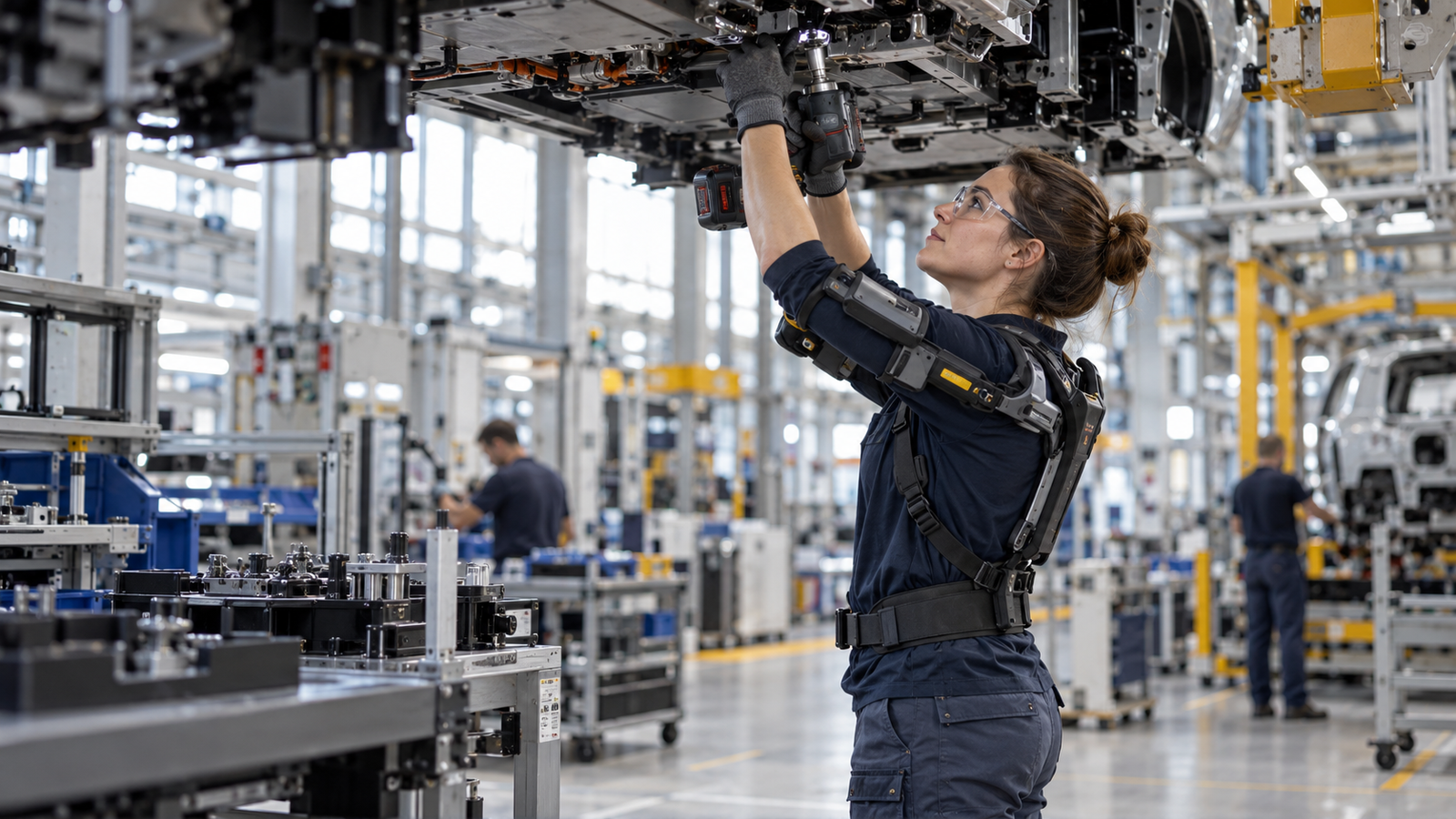
In one factory, an exoskeleton helps support arms held overhead. In a warehouse, another is worn for repeated bending and lifting. Both are industrial exoskeletons, but they solve different problems and have different demands on the person wearing them.
There are more devices to consider in 2026, and more ways to obtain them. For an employer, the difficult part is deciding which system belongs in a particular job, then finding out whether it really helps over a full working shift. That means looking beyond a demonstration: who is wearing it, how often the task occurs, what other movements the job requires, and whether support is available when something needs adjusting.
Where does physical demand arise?
Which movements must stay free?
What benefit has actually been measured?
Who can fit and service it locally?
Industrial exoskeletons in 2026: a market taking shape
The term covers everything from lightweight shoulder frames to textile back supports and motor-driven systems. That variety is useful, but it makes comparisons harder. A product designed for overhead assembly should not be judged against a warehouse suit as though they were competing to do the same job. Nor does the absence of motors necessarily make a device easier to wear: bulk, attachment points, support timing and the need to change posture can matter more than the power source.
More ways to assist
Springs, textiles, pneumatics and powered systems bring different forms of support, along with different restrictions.
More ways to try
Purchase, distributor enquiry, demonstrations and managed trials are increasingly part of the commercial conversation.
More questions to answer
Research can demonstrate reduced physical demand without yet proving lasting improvements in comfort or injury rates.
This is why industrial exoskeletons are worth considering as practical workplace equipment, rather than simply a technology demonstration. The most promising opportunities tend to be jobs with a recurring physical demand, a clear match between the movement and the assistance, and enough repetition to evaluate the result. There is no universal winner: a back-support device may help with bending yet get in the way of driving or crouching. The right comparison takes the worker, the full task sequence and the device together.
A useful boundary
A product being sold, a device reducing muscle activity and a workplace reporting fewer injuries are three different kinds of evidence.
The task comes first
Four work scenes, four different support questions
Holding a tool overhead, lifting from a low pallet, carrying across a warehouse and working with a heavy tool at a fixed station ask different things of the body. The illustration offers a quick way to see why a shortlist should start with the movement, including whether a non-wearable tool support might be the better option.
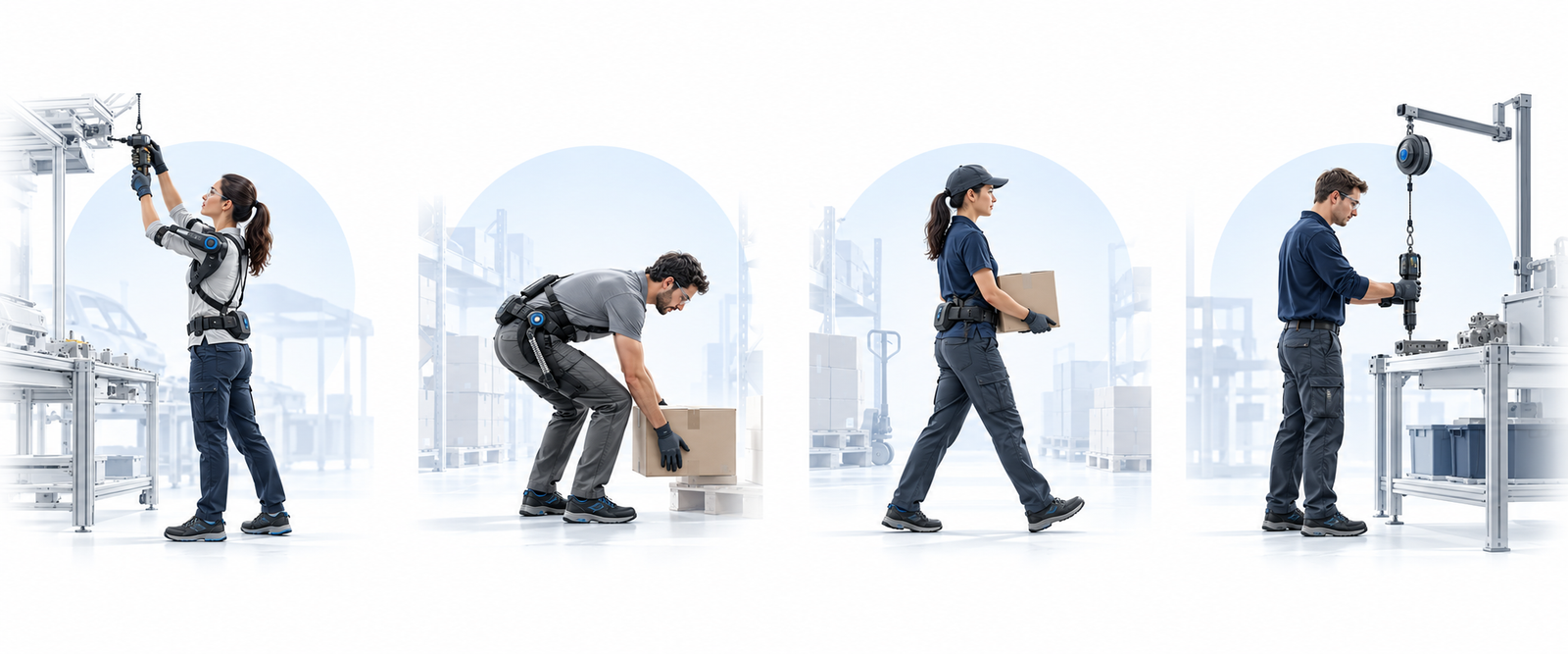
Swipe across to explore the full illustration.
For the broader industry context, see EI’s exoskeleton market analysis. Here, we focus on what industrial buyers can find, what the research says and what still needs checking.
Start with the work itself
“Manual handling” can mean several different movements within the same shift. Someone might lift a carton, carry it down an aisle, step into a vehicle and later reach above shoulder height. An assistance rating measured for one movement tells us little about the others. Before inviting suppliers, it helps to document how long each activity lasts, which postures dominate, how often workers switch tasks and what equipment they already use.
Three jobs where an exoskeleton pilot makes sense
These are illustrative workplace scenarios, not claims about a named customer site. They show the kind of task that can make a trial worthwhile and the details that decide whether the device earns its place in a normal shift.
Arms raised for repeated work
Think of vehicle underbody assembly, aircraft maintenance or repeated fastening above shoulder height. A shoulder-support exoskeleton could reduce the effort of holding the arms up, provided it does not obstruct tools or the rest of the task cycle.
Test in the pilot Time with arms elevated, access to fasteners, comfort and whether support helps during the actual work sequence.
Repeated pallet work and picking
Some warehouse jobs involve frequent bending, picking from low levels and placing cartons onto pallets. Passive or powered back assistance may be worth testing when these movements account for a substantial part of the shift.
Test in the pilot Wear time, bending cycles, turning and walking, perceived effort, discomfort and any effect on normal picking pace.
Ceiling finishing and installation
Painting, sanding or installing services above head height can involve long periods of arm elevation. A portable shoulder-support system may be useful when the work area is suitable and the device is compatible with ladders, site clothing and tools.
Test in the pilot Reach and tool control, donning time, PPE compatibility, mobility between work areas and battery logistics if powered.
Match the support to the entire task
The most useful shortlist starts with task observation, not a manufacturer’s maximum assistance number. The matrix below brings together likely approaches and the constraints that can turn a good demonstration into a poor everyday fit.
Swipe across the table for all columns.
| Work profile | Assistance to investigate | Important trade-off to test |
|---|---|---|
| Overhead assembly, finishing or installation | Shoulder or arm support; passive spring systems and powered arm assistance. | Arm range, tool positioning, reach below shoulder height and confined space. |
| Repeated forward bending and lifting | Back/hip support; textile, rigid passive, pneumatic or powered configurations. | Squatting, twisting, walking, close-to-body handling and transfer of load elsewhere. |
| Carrying and mixed warehouse work | Task-specific back or load-carrying assistance; sometimes no exoskeleton. | Transitions, gait, vehicle access, varying packages, pace and don/doff time. |
| Construction and field operations | Overhead support for suitable tasks; mobile back support for defined handling patterns. | Uneven terrain, ladders, weather, dust, PPE, subcontractor rotation and portability. |
| Heavy tool handling at a fixed station | Compare wearables with fixed tool balancers or articulated supports. | Whether a non-wearable engineering control removes the demand more reliably. |
The table is a starting point for observation, not a device recommendation. Actual movement patterns and working conditions decide what is worth testing.
That context changes across sectors. Manufacturing may involve sustained arm positions. Warehousing adds walking and frequent transitions. Construction brings uneven ground, changing tools and PPE constraints.
The better starting question
Which physical demand is still present after sensible changes to the workstation, tool or workflow?
A manufacturer’s assistance rating describes a device under specific conditions. It does not raise a worker’s safe lifting limit or prove that injuries will be prevented. But where the task is well chosen and the system remains comfortable, an employer has a credible reason to test whether employees experience less effort and whether the device can fit into ordinary operations.
For a more detailed task-by-task selection method, see EI’s comparison guide and back-support buyer’s guide.
How different systems provide support
Passive and powered devices are often discussed as opposing choices. In practice, the details matter more. How force reaches the body, when it is applied and how easily the wearer can move all affect whether the device suits the job.
Swipe across the table for all columns.
| Approach | What it does | What must be evaluated |
|---|---|---|
| Passive spring / elastic | Stores and returns mechanical energy; assistance can be tied to posture and movement. | Support timing, resistance during non-target tasks, alignment and comfort. |
| Soft / textile | Uses straps, fabrics and load paths with fewer rigid structures; often passive. | Fit consistency, pressure distribution, clothing and durability. |
| Pneumatic | Uses air pressure or artificial muscles to generate support; architecture and energy supply vary. | Charging/pumping, response, upkeep and range of movement. |
| Powered electromechanical | Uses motors, sensors and controls to vary assistance under defined conditions. | Battery, weight, modes, safety behavior, servicing, software and data governance. |
“Soft,” “pneumatic,” “passive” and “powered” are overlapping descriptors in some product designs, not four mutually exclusive market buckets.
A powered system may offer adjustable support, but it also introduces batteries, controls, charging and servicing requirements. A passive device may be simpler to operate, though its assistance can be less adaptable to changing loads and postures. The force path is equally important: a device that relieves one muscle group may shift pressure to a belt, cuff or another body region. Neither label tells you how comfortable the system will remain after hours of work.
EI’s evaluation guide looks at these differences in more detail. For a workplace trial, the practical test is whether support remains useful throughout the shift, not only during the best demonstration cycle.
Industrial products and where to find them
These selected products from the EI directory illustrate different jobs, designs and buying routes. They are examples, not a ranking or exhaustive list. The region dividers identify each manufacturer’s home base, not where a device can be purchased. A buyer may be able to obtain support from a manufacturer or partner on another continent, so local fitting and service arrangements deserve their own check.
Swipe across the table for product details.
| Product | Typical task | Design | Access route |
|---|---|---|---|
| 01 Europe Manufacturer home region | |||
| Comau MATE-XT GO | Shoulder support, repeated elevated arm tasks | Passive | Supplier enquiry / distribution |
| Festool EXO 18-Basic | Overhead and chest-level arm work | Powered | Regional sales channel |
| Schmalz NEXO Pro | Forward bending and back assistance | Passive | Schmalz B2B channel, including UK |
| Auxivo OmniSuit | Several manual-work postures | Passive | Published base price / supplier |
| German Bionic Exia | Lifting, carrying and mixed industrial tasks | Powered | Quotation / consultation |
| 02 North America Manufacturer home region | |||
| HeroWear Apex family | Back support in material handling | Passive, soft | Product / program enquiry |
| Mawashi UPLIFT family | Modular occupational body support | Passive | Supplier enquiry |
| Verve Motion SafeLift | Warehouse lifting and handling | Powered exosuit | Workplace program / supplier enquiry |
| 03 Asia-Pacific Manufacturer home region | |||
| Innophys Exo-Power | Lifting and forward bending | Pneumatic | Japan-focused product sales |
| DAYDO TASK AR-X JRC | Upper-arm support during raised-arm work; forearm support is a different WJ variant | Passive | Japan-based rental / trial enquiry |
| Hyundai X-ble Shoulder | Overhead industrial work | Passive | Enterprise sales / rollout |
| ULS Robotics MAPS-E | Powered shoulder and upper-arm support | Powered | Manufacturer enquiry; local service needs confirmation |
Access routes reflect publicly documented supplier offerings, not live inventory or guaranteed country coverage. For example, Festool publishes a U.S. EXO 18 configuration and HeroWear has international partners; those details should not be extrapolated to every SKU. Force ratings, device weights and prices are omitted because the underlying specifications are not directly comparable.
Reading the product claims
An “up to” assistance figure describes performance under particular test conditions. It is not an increase in the amount a worker can safely lift.
A product listed as available may still require a distributor, fitting appointment, business account or trial agreement. A machine ordered through a tool retailer and an enterprise device supplied with an ergonomics program bring different levels of hands-on support.
Finding a local route
Examples of where companies can start
Comau documents U.S. activity with MATE-XT and MATE-XB. Festool EXO 18 also has an official U.S. configuration. The route for the newer Comau MATE-XT GO must be checked separately.
Schmalz NEXO Pro has an official UK listing. Multi-brand suppliers Future Mobility and Stanley Handling offer industrial systems, including HAPO models. Confirm the exact variant, fitting and service before ordering.
Auxivo describes a worldwide partner network; HeroWear lists country-level partners. EI also profiles multi-brand organisations such as Carl Stahl. Network reach is not proof that every model is stocked locally.
EI’s distributor and dealer map offers more country-specific leads, while the comparison tool helps build a product shortlist. Ask the supplier who will handle the demonstration, fitting, replacement parts and after-sales support in your location.
From product discovery to workplace proof
Finding a device is the beginning, not the end
A supplier listing makes a system discoverable. A fitting session tells you whether people can wear it properly. A controlled task test helps establish what physical demand changes. A workplace trial shows whether those gains survive real schedules, changing movements and repeated use. Each step adds information a buying team needs.
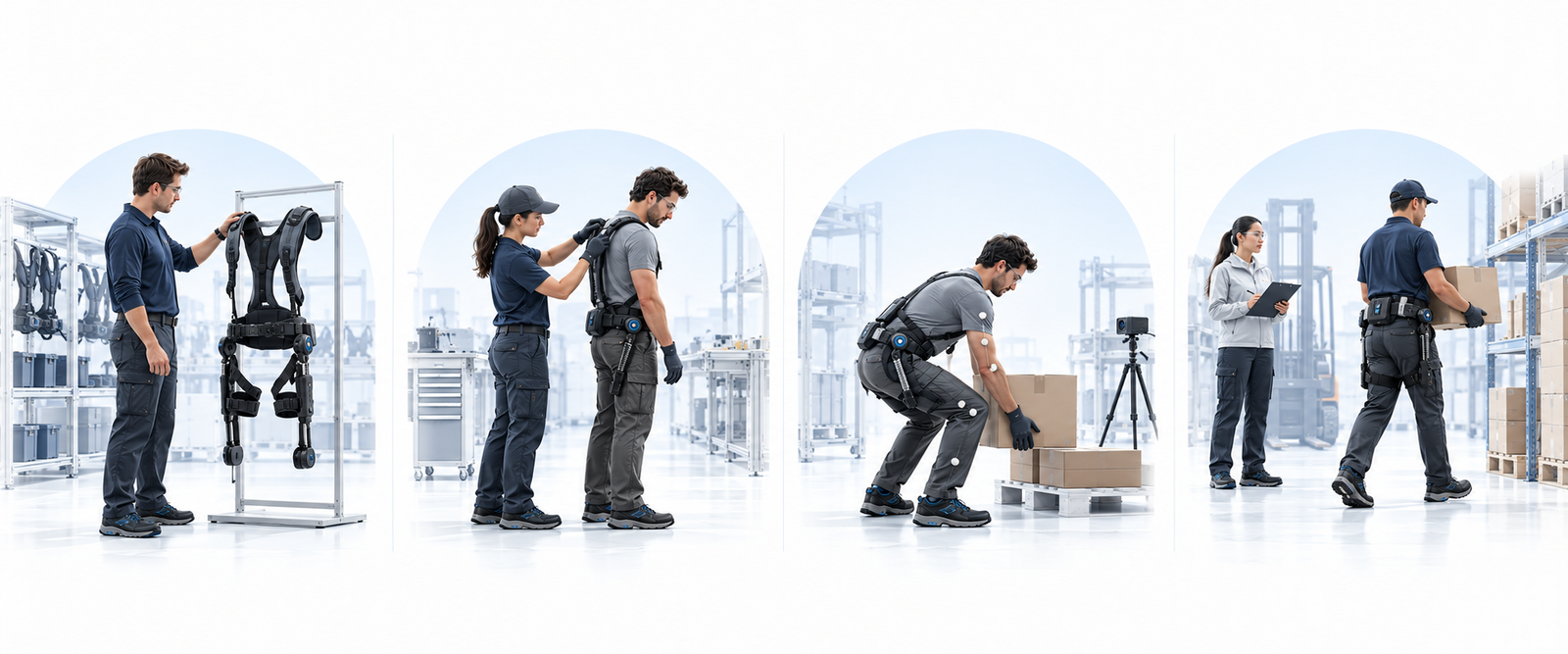
Swipe across to explore the full illustration.
The research below helps show which parts of that journey already have strong task-level signals and where employers still need their own trial data.
What studies can tell us
The research provides a genuine reason for interest. Controlled studies repeatedly examine whether exoskeletons can reduce physical demand in specific tasks, and several reviews report encouraging biomechanical results. The next question is how much of that benefit carries into an ordinary shift. Lower muscle activity is useful information, but it is not the same as proving lasting comfort, adoption or fewer injuries.
Reduced loading is easier to demonstrate than lasting benefit
A 2026 meta-analysis of passive lumbar exoskeletons brought together 50 papers involving 787 participants. The pooled results indicated reductions in several physiological and biomechanical measures, including muscle activity and loading indicators.[1]
Subjective outcomes and functional performance told a different story: the review found no significant pooled improvement. Every included study used a within-subject design, which also limits how confidently the findings can be generalized.
Another 2026 review examined 37 studies of active exoskeletons for manual material handling. It found encouraging task-level effects, while pointing to limits in mobility, versatility and longer-term usability.[2]
Where the task-level signals look most promising
The clearest opportunities are not necessarily the heaviest jobs. What matters is whether a device’s assistance matches a movement that occurs often enough to make a difference. Two studies of overhead work illustrate why holding an arm position and constantly changing movements should not be treated as the same task.
CONTROLLED TASK COMPARISON
Static overhead work
- PARTICIPANTS
- 22
- TASKS TESTED
- 6
- SETTING
- Simulated work
- DESIGN
- Randomized crossover
During isometric overhead work, anterior deltoid muscle activity fell by up to 16% and fatigue measures by up to 41% with the tested passive shoulder device.[3]
Assistance was less pronounced during dynamic tasks. Some participants reported frustration and discomfort where the device contacted the body.
REAL CONSTRUCTION WORK
Overhead work on site
- PARTICIPANTS
- 20
- OCCUPATION
- Carpenters
- SETTING
- Field tasks
- DESIGN
- Randomized crossover
Peak shoulder and forearm muscle activity fell by 3.1–9.4% with the tested passive exoskeleton. Workers also reported positive usability.[4]
Lower-back muscle activity increased by 2.3–3.4%. Reduced loading at one body region does not guarantee less demand elsewhere.
An important distinction: these studies tested different conditions and outcomes. Their percentages are not comparable product scores or estimates of injury reduction.
For repeated lifting and bending, the passive lumbar and powered-system reviews also report favorable biomechanical effects. Mixed jobs with frequent walking, twisting or task transitions need closer screening because assistance that works well for one movement may be less useful during another. That gives employers a constructive starting point: test the recurring, well-defined task first, then check how the device behaves through the rest of the shift.
A warehouse trial worth reading carefully
A 2026 randomized trial of the Verve Motion SafeLift powered exosuit was conducted in working warehouses. The primary intention-to-treat analysis found no significant difference in back-discomfort incidence or intensity between the assigned groups. Some other results were more encouraging, which is why the distinction between primary and exploratory findings is important.[5]
Field evidence · Read the primary outcome first
What the warehouse trial actually found
No statistically significant difference in the primary incidence or intensity outcomes for back discomfort between assigned groups. Overall body discomfort did decrease.
Moderate users reported lower back-discomfort incidence and effort. But actual use level was not randomized: selection, adherence and other differences may explain the association.
The exploratory signal deserves further study. It does not overturn the primary result or establish injury prevention.[5]
A separate 24-week logistics trial published in 2025 randomized 20 workers. Three people in the exoskeleton group stopped using the device. Although researchers detected changes in biomechanical loading, they did not find a significant reduction in discomfort.[6]
There was a practical complication, too: actual tasks did not always involve the physical loads anticipated when the study was planned. A system can offer mechanical assistance and still be underused or fail to improve the outcome an employer hoped to change.
What the 106-study review adds
A 2026 review covered 106 studies spanning industrial exoskeletons and related sensing and ergonomic-assessment technologies. It includes work in logistics, manufacturing and construction, with encouraging reductions in muscle activity and spinal loading reported in particular experiments. This breadth is a sign of serious research interest across many tasks. EI also covered the review’s practical implications for workplaces.[7]
It is not, however, a ranking of which job benefits most. Some included papers studied monitoring systems without mechanical assistance, and the review did not pool heterogeneous outcomes into a task-by-task effectiveness comparison. The practical opportunity is to match a promising design to a specific job, then measure the right outcomes. Muscle activity, perceived effort and recorded injury incidence remain distinct measures.
What real deployments tell us
Industrial exoskeletons are reaching workplaces through procurement projects and organized rollouts. These announcements matter. They show that companies are prepared to invest time and money beyond a laboratory demonstration. They rarely tell us what happened over months of everyday use.
In July 2025, Hyundai Motor Group announced delivery of its first X-ble Shoulder unit to Korean Air. It is evidence of a commercial delivery, not a measured long-term ergonomic outcome at that workplace.[8]
EI’s Athens International Airport deployment report describes the introduction of 15 SUITX IX BACK AIR units for baggage handling. The number and rollout details come from supplier-facing reporting. No independently measured reduction in injuries or improvement in throughput is established by that announcement.[9]
Another application is Hyundai E&C’s reported introduction of X-ble Shoulder for overhead construction work. That account documents a different task environment, not an independently measured long-term injury benefit.
What a rollout announcement leaves open
How often were the devices worn? Who stopped using them? What happened to comfort, PPE compatibility, maintenance and the normal pace of work?
A 2025 study of automotive logistics workers followed user experience for periods of up to 18 months. It brought familiar practical problems into view, including thermal discomfort. The details that seem minor in a demonstration can shape whether people continue wearing a device.[10]
From a promising trial to a workable program
Before considering a wearable, it is worth asking whether a workstation change, lifting aid or adjustment to material flow could reduce the physical demand more directly. Exoskeletons may have a role where demanding tasks remain, but they are not a substitute for safer work design.
Commercial terms can change the project just as much as the hardware. One supplier may sell through a distributor, another may arrange a demonstration or a managed pilot. A local multi-brand specialist can be valuable when the team is still comparing back, shoulder and non-wearable options, provided its product relationships and technical capabilities are clear. Equipment price alone does not cover fitting, training, service, replacement parts, hygienic textile replacement and support across several sites.
Six questions before a wider rollout
- Which physical demand is still present after practical non-wearable controls?
- Does the system help without restricting walking, turning or other parts of the job?
- Who wears it consistently, and why do some people stop?
- What outcomes will be measured, and what will they be compared with?
- Can the supplier provide fitting, training, servicing and replacements locally?
- What result would make the team continue, change course or stop the pilot?
A practical screening list, not a replacement for qualified occupational health, safety or ergonomics assessment.
Make the pilot measurable
A simple scorecard to take onto the shop floor
Before the trial, record a short baseline for the same workers and tasks where possible. Repeat the observations while the device is in use, and include people who stop wearing it. The goal is to learn whether the support is helpful in practice, not to manufacture a positive result.
Task exposure
Minutes or cycles per shift in the targeted posture, plus how often the job changes.
Actual use
Who wears the device, for how long, how often and why anyone decides not to.
Worker experience
Effort, comfort, pressure points, freedom of movement and perceived usefulness.
Operational fit
Task time, work quality, interruptions, fitting time and maintenance or support needs.
A useful decision can be to expand, refine the task selection, change devices or stop. All four outcomes are better than rolling out equipment without knowing how it performs.
Standards are also developing. ISO/DIS 25563 addresses the process of identifying needs, selecting, assessing and integrating wearable physical assistive devices. As of November 2026, it remains a Draft International Standard under enquiry. It is not a published standard or a certification of any particular product.[11]
EI’s pilot-planning guide and adoption analysis explore implementation in more depth. For budgeting, see the separate 2026 pricing overview.
Industrial exoskeletons: practical questions
What are industrial exoskeletons used for?
They are evaluated for defined physical demands such as sustained overhead work, repeated forward bending, lifting or handling. Their usefulness depends on the task sequence and fit; a wearable is not automatically suitable for every movement in a shift.
What is the difference between passive and powered exoskeletons?
Passive designs generally use springs, elastics or other mechanical structures to transfer support. Powered designs use energy sources and controlled actuation. Both require task-level evaluation; textile and pneumatic are overlapping design descriptors, not separate quality grades.
Have industrial exoskeletons been proven to prevent workplace injuries?
Research demonstrates reductions in some task-specific biomechanical loads, but evidence for sustained injury prevention remains insufficient to make a general claim. The warehouse randomized trial discussed above found no significant benefit on its primary back-discomfort outcomes.
How should a company evaluate and trial an exoskeleton?
Start with a measured task demand, compare non-wearable controls, shortlist relevant architectures and define field outcomes before testing. Involve qualified occupational safety and ergonomics professionals, and check supplier fitting and service coverage. EI’s pilot guide provides a practical framework.
What would make the next phase more convincing?
Industrial exoskeletons have progressed far enough that carefully selected workplace trials are a reasonable option for more employers. The opportunity is not limited to large automotive groups: warehouses, maintenance teams and skilled trades may also find recurring tasks worth testing. More products will make systems easier to discover, but three further improvements would make purchase and rollout decisions substantially clearer.
Comparable task tests
Product information that describes the movement, conditions and trade-offs behind an assistance claim.
Longer field follow-up
Studies that report actual use, discomfort, safety events and outcomes that matter during normal shifts.
Reliable local support
A clear route for trialling, fitting, servicing and replacing equipment beyond a one-day demonstration.
Sensing and adaptive controls may help tailor assistance and document real use. They also introduce questions about privacy and data interpretation. More sophisticated software does not remove the need for good task design or sound evaluation.
EI perspective
The opportunity is to identify a small number of jobs where a wearable is genuinely worth testing, then let the results decide what happens next.
Scope, methodology and source notes
This Exoskeleton Index editorial assessment reflects information reviewed as of 1 November 2026. The product examples were selected from EI’s database to illustrate different tasks, designs and manufacturer home regions, which are not exclusive sales territories. Region-specific channel examples were checked against manufacturer and supplier pages. The two artwork figures are conceptual illustrations, not photographs of named products, workplaces or studies. The selection is neither exhaustive nor a performance ranking.
Research summaries prioritize peer-reviewed reviews, randomized field studies and primary institutional records. Where a deployment count comes primarily from a supplier, it is identified as such. Assistance metrics, commercial status, geographical coverage, manufacturer ownership and local pricing can change; verify relevant details before procurement. References below link to the source evidence, while embedded product links support deeper database exploration.
- Favro et al. (2026). What is the current state of evidence on passive exoskeletons designed to support the lumbar region? Systematic review and meta-analysis of 50 studies / 787 participants. PubMed record.
- Afshari et al. (2026). Systematic review of active exoskeletons for manual material handling; 37 included studies. PubMed record.
- De Bock et al. (2022). An Occupational Shoulder Exoskeleton Reduces Muscle Activity and Fatigue During Overhead Work. Controlled crossover study of 22 participants completing six simulated industrial tasks; sustained overhead versus dynamic task effects are device- and setting-specific. PubMed record.
- Brandt et al. (2025). Technical field-evaluation of exoskeleton-assisted overhead work among carpenters. Randomized crossover study with 20 carpenters, including effects on shoulder, forearm and lower-back muscle activity. PubMed record.
- Quirk et al. (2026). Moderate exosuit use reduces the incidence of back discomfort in logistic warehouse workers: a randomised controlled trial with an exploratory dose-stratified analysis. Read the intention-to-treat primary result separately from the exploratory subgroup. PubMed record.
- 2025 randomized logistics field trial. Effects of 24-weeks in-field use of a back-supporting exoskeleton on biomechanics, work intensity and musculoskeletal discomfort. PubMed record.
- 2026 systematic review of 106 studies encompassing industrial exoskeletons and related sensing and ergonomic-assessment approaches. Frontiers full text. See also EI’s research news brief.
- Hyundai Motor Group (10 July 2025). X-ble Shoulder first unit delivered to Korean Air. Manufacturer announcement.
- Exoskeleton Index. Athens Airport Exoskeleton Deployment for Baggage Handling. Supplier-reported 15-unit project; not an independent health-outcomes trial. Project coverage.
- Field study (2025). User Experiences and Adoption Factors for a Back-Support Exosuit in Automotive Logistics: Results from Field Testing up to 18 Months. PubMed record.
- International Organization for Standardization. ISO/DIS 25563: Ergonomics—Process for the integration of wearable physical assistive devices. Under development, DIS enquiry phase. Official status page.