
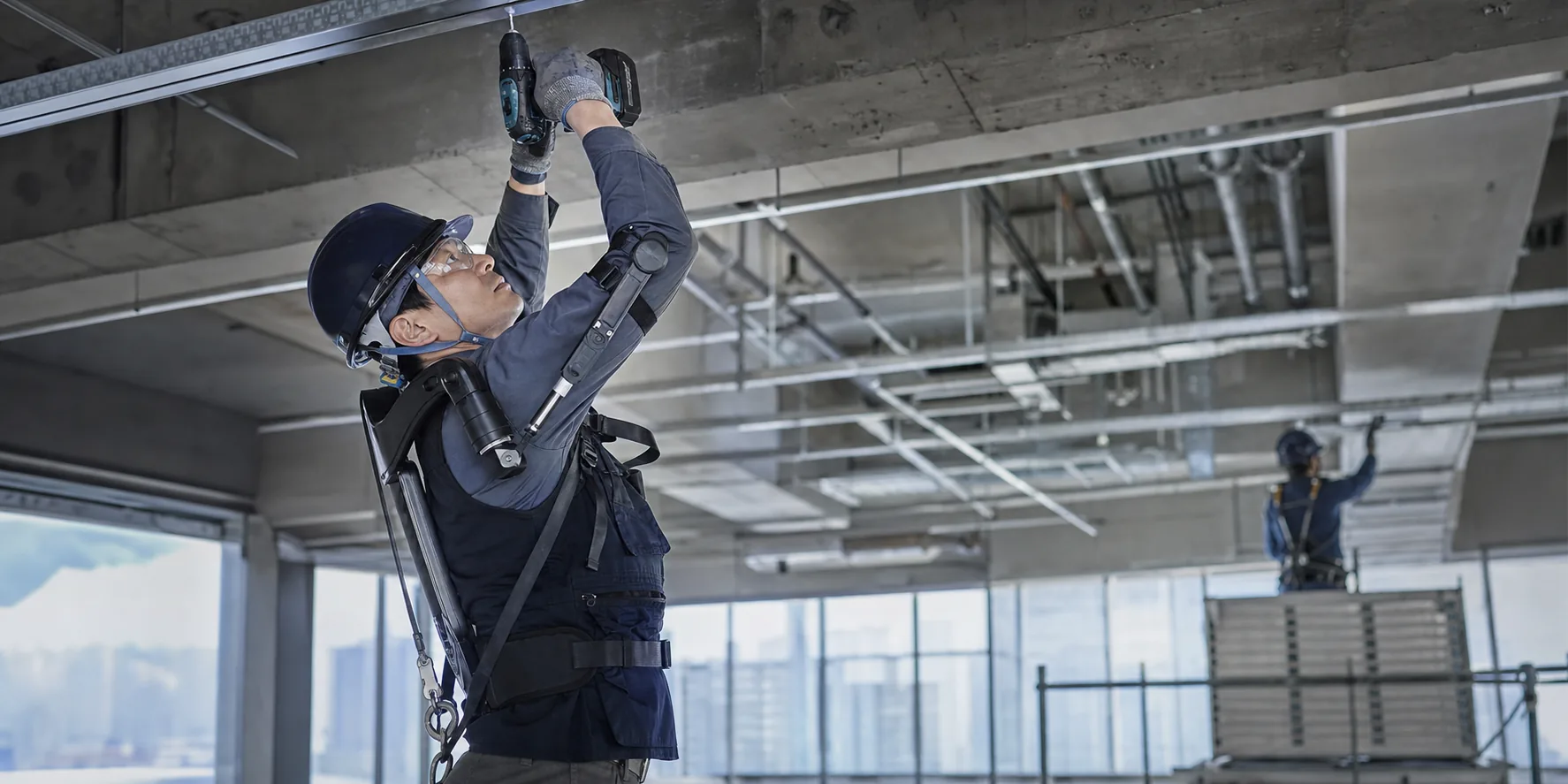
Hyundai Engineering & Construction has introduced the X-ble Shoulder wearable robot for overhead work on a Korean construction site. The reported shoulder-load reduction is a company claim and should not be read as evidence of injury prevention.
At a glance
- Site: The H Class:t Seocho residential construction project in Seoul, according to Korean reporting.
- Task: Interior carpentry and ceiling-related overhead work.
- Status: First reported construction-site introduction, with possible expansion to painting and wallpapering—not a sector-wide rollout.
- System: X-ble Shoulder, a passive spring/torque-generator shoulder-support exoskeleton.
- Claim boundary: Hyundai reports up to 60% lower modeled shoulder-joint load and up to 30% lower deltoid activity under its testing; long-term health benefit is not established.
Hyundai E&C’s first reported construction use
Hyundai Engineering & Construction introduced X-ble Shoulder at The H Class:t Seocho site for workers doing interior carpentry and ceiling work, Seoul Economic Daily reported on 29 July 2026. The account describes the move as the company’s first introduction of a wearable robot in construction. Hyundai E&C said it intends to examine use in other overhead trades, including painting and wallpapering.
The wording supports a site introduction, not a broad deployment. Public reporting does not establish the number of devices, workers, shifts, eligible tasks or wearing hours. It also does not provide a comparative site dataset for quality, productivity, discomfort, adverse events or absence. Those details are needed before the story can be treated as evidence of scale.
A passive device, despite the “robot” label
X-ble Shoulder is an industrial shoulder-support device developed by Hyundai Motor Group Robotics LAB. It does not use a battery or electric motor. A mechanical torque-generator module stores and returns energy to assist the upper arm during elevated work. Hyundai lists a total mass of about 1.9 kg including the vest and a shoulder range of motion from 0 to 180 degrees.
That passive architecture matters operationally. It removes charging and battery-management requirements, but it does not remove fit, inspection, cleaning or task-compatibility work. Assistance is tied to arm position and configuration; workers still need to move through the complete task without unexpected pressure, snagging, restricted access or interference with tools and PPE.
Where the 60% figure comes from
Hyundai says X-ble Shoulder can reduce shoulder-joint load by up to 60% and anterior and lateral deltoid activity by up to 30%. Its Robotics LAB explains that the muscle figure was measured using electromyography, while the joint-load figure came from digital human modeling. Hyundai also reports that approximately 300 Hyundai and Kia workers and health managers participated in pilots between 2022 and 2024.
These are useful product-development data, but the “up to” figures are not measurements from the Seocho construction site. Modeled joint load is not the same as injury incidence, and an acute reduction in muscle activity does not establish a long-term reduction in musculoskeletal disorders. The relevant question for this introduction is what occurs across real shifts, including periods when arms are not overhead.
Exoskeleton Index analysis
Construction is a consequential expansion beyond the controlled repetition of an automotive workstation. Overhead installation can be a plausible match for shoulder support, but construction work also involves ladders, kneeling, carrying, changing rooms, reaching around obstacles and coordinating with other trades. The device should be evaluated over that full work cycle.
The strongest interpretation today is that Hyundai E&C is testing an already-commercialized passive shoulder device in a new sector. It is not evidence that the system prevents injury or fits every overhead trade. A useful evaluation would report task-specific wearing time, removal reasons, worker coverage by body size, discomfort location, tool access, heat, donning time and near misses.
Independent evidence supports caution
Field research on shoulder-support exoskeletons often finds reductions in shoulder-muscle activity during overhead tasks, but acceptance can diverge from biomechanical measures. In a five-week field study involving ten intervention workers and ten controls, measured deltoid and trapezius activity fell during selected tasks, while emotional responses worsened and adherence was low. The sample and device configuration limit generalization, yet the result illustrates why assistance and daily use must be measured separately.
Hyundai’s Korean Industrial Standards certification, announced in March 2026, is evidence that the product went through a recognized quality and safety conformity process. Certification does not prove that a specific employer’s implementation will produce health or economic benefits. Buyers should connect standards review with a site-specific process such as the Exoskeleton Index pilot planning playbook and standards guide.
What a useful construction evaluation would report
A site report should separate ceiling drilling, fastening, carpentry and material handling, because arm elevation and tool reaction differ. It should record the minutes spent above defined arm angles, wearing time, removal, discomfort by body location, fit exclusions, quality rework, near misses and any conflict with ladders or fall-protection equipment. Results should include workers who stopped, not only those who completed the trial. Longer follow-up would be required before discussing health outcomes.
What remains unknown
The public material does not disclose participant count, deployment duration, daily wearing time, non-use, adverse events, fit exclusions or site outcomes. The 60% figure is Hyundai’s modeled maximum and must not be translated into a 60% reduction in fatigue, injuries or compensation claims. Planned exploration of painting and wallpapering is not the same as completed deployment.
Sources
- Seoul Economic Daily, Hyundai E&C construction-site report, 29 July 2026.
- Hyundai Motor Group, X-ble Shoulder KS certification and specifications, March 2026.
- Hyundai Motor Group, launch plans and 2022–2024 pilot summary.
- Jakobsen et al., occupational shoulder-exoskeleton field study, Applied Ergonomics (2023).