
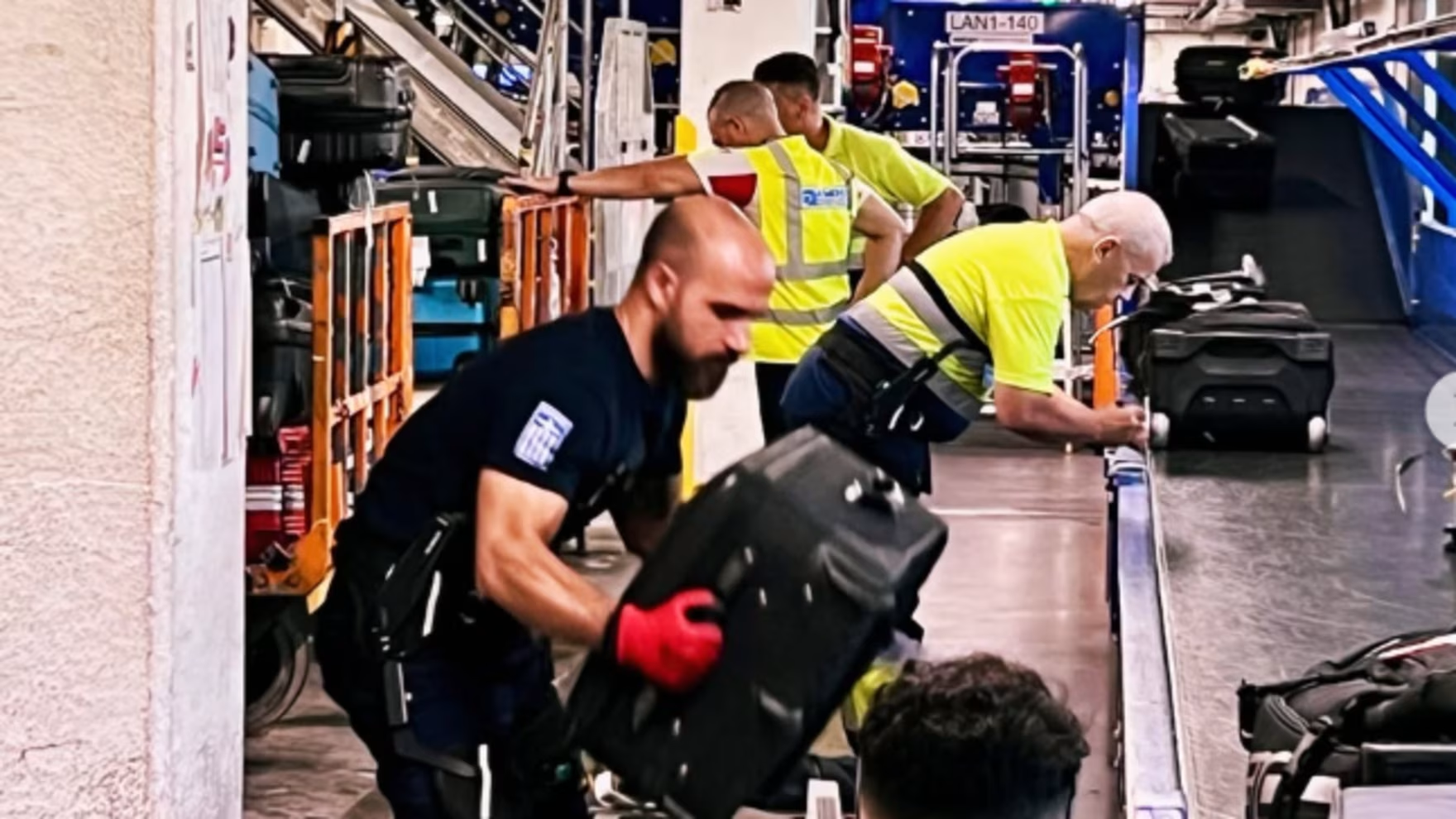
Fifteen exoskeletons are now being used in baggage operations at Athens International Airport, providing another concrete sign that wearable robotics is moving from industrial trials into ordinary workplace deployment.
The airport has rolled out 15 SUITX IX BACK AIR back-support exoskeletons following a procurement process that included a tender and an on-site demonstration.
The initial deployment covers baggage reclaim, conventional baggage handling and oversized-baggage operations. Fifteen key users and three supervisors were trained, allowing supervisors to fit additional employees so the devices can be shared across shifts.
That sequence is what makes this story important.
This is not another manufacturer bringing an exoskeleton to an airport for a short demonstration. The reported process moved through evaluation, procurement, training and operational use.
For an industrial exoskeleton market that has spent years trying to convert promising pilots into repeatable deployments, that distinction matters.
At a glance
- Location
- Athens International Airport, Greece.
- Deployment
- 15 SUITX IX BACK AIR exoskeletons.
- Application
- Baggage reclaim, conventional baggage handling and oversized baggage.
- Technology
- Passive, battery-free back-support exoskeleton.
- Product weight
- Approximately 3 kg, according to Ottobock.
- Training
- 15 key users and three supervisors.
- Procurement path
- Tender followed by an on-site demonstration before deployment.
- Evidence boundary
- The rollout is confirmed, but Athens-specific long-term injury, productivity and worker-acceptance data have not yet been published.
This is more important than another airport demonstration
Exoskeleton companies have demonstrated wearable systems at factories, warehouses, construction sites and airports for years.
Demonstrations are useful, but they tell us relatively little about whether the technology survives contact with real procurement.
A serious deployment requires different questions.
Does the device fit the actual task? Will employees wear it repeatedly? Can supervisors manage fitting and training? Can multiple workers share units safely? Does the hardware interfere with other parts of the job? Can the organization justify purchasing and maintaining it?
The Athens rollout is interesting because the reported process progressed further down that chain.
According to deployment information published on August 27, Athens International Airport launched a tender for industrial exoskeletons, evaluated the IX BACK AIR on site and then deployed 15 units.
The rollout included formal user and supervisor training rather than simply delivering hardware.
Baggage handling is an unusually logical exoskeleton use case
Airports are highly automated environments, but baggage still creates physical tasks that are difficult to eliminate.
Suitcases vary dramatically in weight, dimensions, shape and handle position.
Workers repeatedly lift, rotate, pull and reposition those loads. Some work happens in baggage halls with relatively open space. Other tasks happen inside aircraft cargo holds where employees may have to work while bending, kneeling or twisting.
The result is a combination of repetitive handling and awkward posture that maps closely to the problem back-support exoskeletons are designed to address.
Aviation also creates another reason to care about ergonomics: operational resilience.
Airports cannot simply stop handling baggage when staffing becomes difficult. At the same time, physically demanding roles can become harder to recruit for and retain workers in as populations age and labour markets tighten.
If a wearable system can reduce physical strain without slowing the task or restricting movement, it can become part of a broader workforce strategy.
Why Athens selected a passive exoskeleton
The IX BACK AIR takes a very different approach from powered lifting exoskeletons.
It does not use electric motors or batteries.
Instead, the passive system uses biomechanical structures to redirect, store and release energy as the wearer bends and lifts.
Ottobock lists the device at approximately 3 kg and says it can be put on or removed in under 20 seconds. The manufacturer also states that it can provide relief equivalent to up to 15 kg of lower-back loading during heavy lifting.
Those figures are manufacturer specifications and should not be interpreted as measured outcomes from the Athens deployment.
But the architecture helps explain why this type of system can be attractive for airport operations.
- No charging infrastructure is required.
- There is no battery that needs to last an entire shift.
- The system can remain available throughout the working day.
- Assistance is concentrated around lifting and bending rather than general powered movement.
The trade-off is equally important: passive systems do not actively generate motor torque in the same way a powered exoskeleton can.
The relevant question is therefore not whether passive or powered technology is universally better. It is whether the assistance profile matches the work being performed.
Exoskeleton Index analysis
Athens is exactly the kind of deployment the industrial exoskeleton market needs more of. Commercialization is unlikely to happen through one spectacular announcement where thousands of workers suddenly become augmented. It is more likely to happen through deployments of 10, 15 or 50 units that prove a device can survive procurement, training and daily work. Those deployments gradually create reference customers, supplier experience, worker familiarity and purchasing confidence. That is how exoskeletons can move from innovative pilot equipment toward a normal line item in industrial ergonomics budgets.
The procurement process may be the most valuable data point
Product specifications attract attention, but industrial adoption is ultimately measured through purchasing decisions.
The Athens deployment provides a useful example of what commercialization can look like:
- Identify a repetitive physical task with a clear ergonomic problem.
- Evaluate hardware in the actual work environment.
- Procure the system rather than ending with the pilot.
- Train workers and supervisors.
- Deploy multiple units into normal operations.
This creates something else the industry needs: a reference customer.
Industrial buyers rarely evaluate new ergonomic technology in isolation. A deployment in one airport can reduce perceived adoption risk for another organization facing almost identical baggage-handling tasks.
Athens is a meaningful operating environment
Athens International Airport handled approximately 34 million passengers in 2025, according to airport reporting.
That scale creates continuous baggage-handling demand and makes the airport a more meaningful commercial reference than a small controlled trial site.
The use of 15 units also introduces an important operational feature: shared deployment.
Not every industrial exoskeleton needs to be individually assigned to one worker.
Training supervisors to fit additional users potentially allows the same device fleet to move between employees and shifts, although successful shared use depends on adjustment time, sizing, hygiene, inspection and worker acceptance.
Aviation is becoming a real exoskeleton market
Athens should not be viewed in isolation.
Airports and ground-handling companies have become increasingly visible targets for industrial exoskeleton manufacturers.
The reason is straightforward: aviation combines high labour intensity with manual tasks that remain difficult to automate completely.
Baggage handling is particularly compelling, but suppliers are also targeting cargo handling, aircraft maintenance and other airport operations.
The wider industrial market shows the same progression.
As tracked in the Exoskeleton Index 2026 market analysis, industrial wearable robotics is gradually moving away from the question of whether exoskeletons can function at work toward the more commercially important questions of where they create enough value, which architectures workers accept and how organizations scale successful pilots.
What remains unknown
The rollout is commercially encouraging, but 15 deployed units do not by themselves prove long-term effectiveness.
Public reporting has not yet provided Athens-specific data on musculoskeletal injury rates, sick leave, worker acceptance, utilization rates, productivity effects, maintenance requirements or whether the airport plans to expand the fleet.
It is also not yet clear whether use will extend into aircraft loading or additional ground-handling teams, or how the devices perform across long shifts and hot summer conditions.
Detailed rollout information currently comes primarily from SUITX-related deployment material and Weston Robot’s August 27 customer report rather than a detailed standalone Athens International Airport performance study. Longer-term effectiveness claims should therefore wait for airport-reported or independently measured data.
The next order will matter more than the first 15 units
For SUITX and the wider industrial exoskeleton market, the most interesting number may eventually be the second purchase order.
If employees consistently use the devices and Athens expands the fleet, that would provide much stronger evidence of product-market fit than the initial rollout alone.
We will be watching whether Athens expands beyond the first 15 units, whether other airports adopt IX BACK AIR or competing systems, and whether ground-handling companies begin purchasing exoskeletons across multiple airports.
The industrial exoskeleton market does not need another futuristic concept to prove it exists.
It needs organizations willing to buy wearable robotics for ordinary work.
Fifteen exoskeletons at one of Europe’s major airports are a modest number, but they are exactly the kind of number that can eventually become much larger.
Sources
- Weston Robot, Athens International Airport IX BACK AIR baggage-handling deployment, August 27, 2026.
- Ottobock, official IX BACK AIR and exoskeleton product information.
- Athens International Airport, airport operating and passenger information.
- Exoskeleton Index, IX BACK AIR product profile.
- Exoskeleton Index, 2026 exoskeleton market analysis.
Explore the ecosystem
View the SUITX IX BACK AIR product profile, explore logistics and warehousing exoskeletons, read our Back-Support Exoskeleton Buyer’s Guide, or compare available products using the Exoskeleton Index comparison tool.