

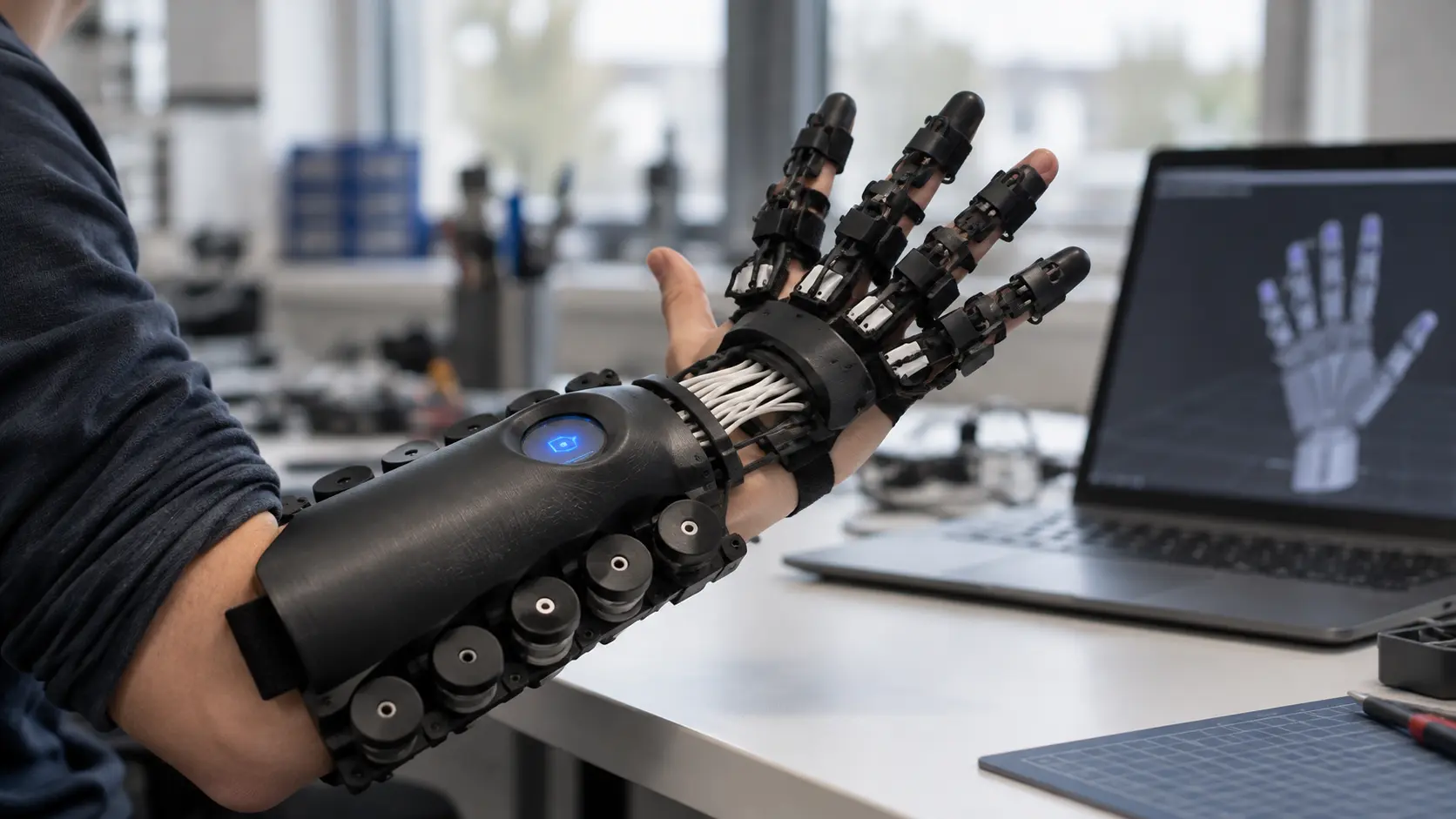
Tracking fingers without relying on a camera
Most people encounter hand tracking through a camera or a virtual-reality headset. That approach can lose visibility when fingers overlap, curl or move out of frame. TAKTO ONE instead measures the joints directly with magnetic encoders mounted on the fingers.
Each of the four long fingers has three measured channels: sideways movement at the main knuckle, knuckle flexion and flexion at the middle joint. The resulting 12 signals can be used to reconstruct finger positions even when a camera cannot see the hand clearly. The current system does not track or actuate the thumb; the hardware reserves expansion capacity for future development.
These are implementation details reported by the developer, not independently validated performance measurements.
The digital twin is more mature than the motorized assistance
TAKTO ONE’s electronics center on a Teensy 4.1 microcontroller that receives the joint-sensor signals, records them to an SD card and interfaces with a motor bus. The developer has demonstrated all 12 encoders operating together on a worn device and driving a live three-dimensional hand representation.
The same measured motion can be displayed through a browser console, a phone application and a prototype augmented-reality viewer. A demonstration using a Meta Quest headset is particularly notable: the digital fingers are driven by the exoskeleton’s own sensors, rather than inferred from the headset’s cameras.
There is an important distinction between the demonstrations. The public website also offers a simulated version of the digital twin for visitors without physical hardware. Simulated movement should not be mistaken for a remote live feed from a functioning exoskeleton.
All 12 encoders have been demonstrated reading joint movement on the worn prototype.
Recorded movement can drive browser and device interfaces; public demos can also run simulated data.
Only two servos are fitted. Force output, latency and assistance performance have not yet been characterized.
What the open-source design actually includes
The published repository contains printable mechanical parts, circuit-board schematics and manufacturing files, firmware, a bill of materials, build instructions and interface software. The wearable structure uses tendon routing from a forearm-mounted assembly toward the fingers. Two custom printed circuit boards handle sensor interfacing and aggregation.
Opening the design does not make the system straightforward to reproduce. A builder still needs electronics assembly, 3D printing, wiring, motor-control experience and their own safety testing. The developer documents known wiring issues and incomplete features, giving researchers a clearer picture of what they would actually be taking on.
The parts list is public, but these are not retail prices
According to the project’s bill of materials, the sensing-only TAKTO Lite configuration has approximately US$184 in listed component costs. The more extensive motorized configuration is estimated at approximately US$1,368 in listed component costs, largely because of the servo motors. A separately priced order of two custom circuit boards cost the developer another US$170.73.
These figures are conversions of the developer’s euro-denominated parts list using the European Central Bank’s 23 October 2026 reference rate (EUR 1 = USD 1.1193). They are not complete, independently verified build costs, retail offers or evidence that a fully motorized configuration has been assembled and validated. Purchasing quantities, availability, shipping, manufacturing and labor may change actual costs.
Exoskeleton Index analysis
The open-source model is the story, not an unproven claim of restored hand function. TAKTO ONE makes a set of research tools—joint-level sensing, motion recording, embedded control and live visualization—accessible to engineering teams that can study and modify them.
That matters because hand exoskeleton research often depends on bespoke hardware that other laboratories cannot easily reproduce. Open design files and clearly documented limitations can make experiments easier to audit, adapt and compare. It may also reduce the starting cost for some sensing-focused projects, although it does not remove the engineering and safety burden.
Potential applications include motion-capture datasets, teleoperation, haptic interfaces and rehabilitation research. None should be interpreted as a proven clinical use for this particular prototype. A useful next step would be repeatable measurement of actuation force, response time, resistance to voluntary movement, fit and user safety before making stronger assistance claims.
What remains between a prototype and useful assistance
The developer is explicit about what has not been measured: force rendering, assistance behavior, transparency and latency. The thumb is not yet implemented. The release includes only two fitted motors, even though the design and cost estimate contemplate a fuller actuator configuration.
The current project also does not demonstrate clinical improvement, unsupervised rehabilitation or reliable everyday use by people with impaired hand function. Those are separate questions requiring appropriate safety controls and human studies. For now, the strongest demonstrated outcome is a functioning sensing-and-visualization platform, with initial tendon actuation tests.
Prototype status matters
TAKTO ONE is an experimental, self-built research platform. It is not certified as a medical device or protective product, and the available documentation warns against treatment, unsupervised rehabilitation or safety-critical use. Images of the proposed fully equipped configuration should not be read as proof that all motors are installed and validated on the current prototype.
What to watch next
The most meaningful next milestone would be independent replication of the sensing system and controlled tests of the full actuation configuration. Demonstrating measured mechanical assistance without sacrificing comfortable, natural hand movement would move the project beyond an impressive open-hardware build.
For researchers, the public TAKTO ONE repository offers the primary technical documentation. EI readers exploring more mature platforms can also consult the Research & Education directory, where commercial and experimental systems should be evaluated according to different evidence and deployment standards.
Sources and reporting notes
Primary developer documentation. Sebastian Molano, TAKTO ONE open-source repository and technical status; includes the hardware implementation, documentation, public demos, cost breakdown and limitations. Accessed 25 October 2026.
Build-cost source. Developer bill of materials; amounts are component estimates, not selling prices. USD approximations use the ECB reference rate for 23 October 2026.
Independent coverage. Hackaday, “TAKTO, Open Source Hand-Tracking Built Like LEGO,” 16 October 2026.
Editorial distinction. “Open-source” describes the published design and software. It does not indicate commercial availability, complete motorization, measured assistance benefit, regulatory clearance or clinical effectiveness.