
The exoskeleton market has crossed an important threshold. It is no longer mainly a research story built around laboratory prototypes and distant forecasts. In 2026, wearable robotics is becoming a commercial category with several credible routes to scale: industrial ergonomics, medical rehabilitation, personal mobility, consumer outdoor assistance and enabling software. The market is still fragmented and definitions remain inconsistent, but the direction is increasingly clear. Products are entering mass production, reimbursement is supporting sales, large industrial groups are investing, private funding rounds are getting larger and listed companies now give public investors several forms of exposure to the sector.
Key takeaways
- Exoskeleton Index is bullish on the category. The strongest evidence is not one optimistic forecast. It is the convergence of commercial deployments, reimbursement, strategic investment, manufacturing scale and improving product design.
- Even conservative market forecasts imply sustained double-digit growth. Narrow public estimates place the 2026 market between roughly US$269 million and US$694 million, with forecast compound annual growth rates of about 13% to 15%. Broader wearable-robotics definitions place the market above US$3.5 billion and project much faster expansion.
- Industrial exoskeletons have moved beyond isolated pilots. Hyundai and Kia describe the X-ble Shoulder as being in mass production, Korean Air became its first customer, and SUITX by Ottobock reports deployments across major employers and multiple countries.
- Capital markets are beginning to validate the ecosystem. Ottobock entered the Frankfurt market at a €4.2 billion IPO valuation, Renault took a minority stake in Wandercraft, Wandercraft secured US$75 million in new financing and WIRobotics raised approximately US$68 million in 2026.
- Medical commercialization is becoming more credible. FDA clearances, broader reimbursement pathways and growing product revenue at listed wearable-robotics companies show that medical exoskeletons can become recurring healthcare businesses rather than one-off demonstration projects.
- Consumer mobility could materially expand the addressable market. Lightweight hip and knee assistance is moving wearable robotics toward hiking, ageing, fatigue reduction and everyday mobility, opening channels beyond hospitals and enterprise procurement.
- The market will not scale evenly. Task-specific products, strong distribution, measurable outcomes and reliable service will win before general-purpose full-body systems. A bullish sector view does not imply that every company, product or forecast will succeed.
Direct answer: what is the exoskeleton market?
The exoskeleton market is the global ecosystem for wearable devices that support, restore or augment human movement. It includes passive mechanical supports, powered exoskeletons, soft exosuits, robotic rehabilitation systems, personal mobility devices and related sensors, software, training and services. Some market reports also include adjacent powered orthoses and broader wearable robotics, which is why published market-size figures differ substantially.
Why Exoskeleton Index is bullish on the market
Being bullish does not mean selecting the largest forecast or overlooking the barriers. It means judging that the probability of meaningful commercial scale is rising. Five developments support that conclusion.
1. The market has several independent growth engines
Many emerging hardware markets depend on one buyer type. Exoskeletons do not. Industrial employers can buy devices to address ergonomics and workforce constraints. Hospitals can procure rehabilitation systems. Insurers and public payers can reimburse eligible personal devices. Consumers can buy lighter mobility products directly. Defence and research programmes can fund advanced systems and enabling technologies.
This diversity matters. If one segment develops more slowly, the entire category does not stop. Industrial adoption can grow while reimbursement evolves. Consumer devices can improve volumes while medical systems build evidence. Components, sensors and control software can create value across all of them.
2. The technology is becoming narrower, lighter and more usable
The field is moving away from the idea that one large powered suit should solve every mobility or lifting problem. Commercial products increasingly focus on one joint, body region or task. Shoulder devices support overhead work. Back systems target lifting. Hip and knee devices support walking. Hand systems assist grip. Narrower designs usually require less power, weigh less, cost less and integrate more easily into daily activity.
This is a positive sign of market maturity. Successful technology categories often scale when broad technical ambition is converted into a specific product with a clear user, environment and economic purpose.
3. Major companies are treating exoskeletons as a strategic capability
Ottobock acquired SUITX and has continued expanding passive, powered and digitally connected workplace systems. Renault invested in Wandercraft and is contributing industrial expertise to scale production. Hyundai and Kia developed and commercialised their own industrial wearable robot. Arc’teryx partnered with Skip, a company spun out of Alphabet’s X, to bring powered assistance into outdoor apparel.
These moves do not guarantee market success, but they reduce the argument that exoskeletons remain an isolated niche. Established companies are contributing manufacturing, distribution, design, brand trust and enterprise access, which are precisely the capabilities specialist robotics firms often lack.
4. Commercial infrastructure is developing around the hardware
Exoskeleton companies are increasingly selling more than a device. The offer can include fitting, training, leasing, maintenance, software, usage analytics, ergonomic assessment and fleet management. This creates recurring revenue and makes deployment easier for buyers.
SUITX by Ottobock, for example, has expanded into sensor-supported digital ergonomics and AI-based analysis. Medical companies combine devices with clinical training, service and payer support. Consumer brands are building retail, reservation and direct-to-consumer channels. The formation of this infrastructure is one of the clearest signs that a product category is becoming an industry.
5. The underlying demand is structural
Workforce ageing, labour shortages, physically demanding work, rehabilitation demand, neurological injury and the desire to remain mobile for longer are not temporary trends. WHO estimates that about 2.4 billion people live with a condition that may benefit from rehabilitation, while more than 15 million people were living with spinal cord injury in 2021.[8][9]
Exoskeletons will address only part of that need, and they will compete with conventional therapy, automation, workplace redesign, orthotics and other assistive products. The opportunity remains substantial because even limited penetration across several large populations can support a meaningful global market.
Exoskeleton Index position
Our view is bullish but selective. We expect wearable robotics to become a larger and more visible market through 2030. We do not expect every device class to scale at the same speed. The strongest near-term categories are likely to be task-specific industrial support, clinic-based rehabilitation, reimbursed personal mobility, lightweight consumer assistance and the software or services that make deployments measurable.
How large is the exoskeleton market in 2026?
There is no universally accepted market boundary, so the most useful answer is a range. Grand View Research estimates the global exoskeleton market at US$694.4 million in 2026, rising to US$1.79 billion by 2033 at a reported 14.5% compound annual growth rate.[1] Fortune Business Insights publishes a narrower estimate of US$268.61 million in 2026, increasing to US$728.08 million by 2034 at a reported 13.27% CAGR.[2]
Other definitions are much broader. The Business Research Company estimates the industrial exoskeleton market at US$1.08 billion in 2026 and US$1.65 billion by 2030.[3] Fortune Business Insights estimates the broader wearable robotic exoskeleton market at US$3.52 billion in 2026, rising to US$64.23 billion by 2034 at a reported 43.7% CAGR.[4]
The broad forecast should be treated as an aggressive scenario because it includes a wider set of applications and assumes unusually rapid expansion. The important bullish signal is that the more conservative forecasts also point in the same direction. Both narrow estimates imply that the market could grow to roughly 2.6 times its 2026 size over the next seven to eight years.
Exoskeleton Index market-size interpretation
The commercial exoskeleton sector is already a several-hundred-million-dollar global market under narrow definitions, while broader wearable-robotics definitions place it above US$1 billion. The exact headline number is uncertain, but sustained double-digit expansion appears across several independent forecasts.
Public 2026 market estimates, US$ millions
$269m
$694m
$1.08bn
$3.52bn
The estimates measure different product and service boundaries. They should not be added together or treated as equivalent.
| Source and scope | 2026 estimate | Forecast | Reported CAGR | Exoskeleton Index reading |
|---|---|---|---|---|
| Fortune Business Insights, exoskeleton market | US$268.61m | US$728.08m by 2034 | 13.27% | Conservative commercial-hardware case |
| Grand View Research, global exoskeleton market | US$694.4m | US$1.79bn by 2033 | 14.5% | Broader but still credible base case |
| The Business Research Company, industrial exoskeletons | US$1.08bn | US$1.65bn by 2030 | 11.4% | Broad industrial ecosystem definition |
| Fortune Business Insights, wearable robotic exoskeletons | US$3.52bn | US$64.23bn by 2034 | 43.7% | High-growth, wide-boundary scenario |
Why market estimates differ, and why that does not weaken the thesis
The wide range is often presented as evidence that the market is too immature to analyse. A better interpretation is that exoskeleton technology is spreading into several adjacent industries faster than statistical categories can stabilise.
Hardware-only versus ecosystem revenue
A narrow report may count only wearable device sales. A broader report may include rehabilitation robots, powered orthoses, software, sensors, maintenance, training, subscriptions and related services. As suppliers add recurring software and support, hardware-only estimates capture a smaller share of total economic activity.
Medical, industrial and consumer boundaries overlap
A powered hip device can be sold as a medical aid, a wellness product or outdoor mobility equipment depending on its intended use and claims. A hand-assist system may be classified as rehabilitation robotics, an orthosis or an industrial support device. These overlaps increase the reported range, but they also show that the technology can reach several budgets and distribution channels.
Revenue is not the same as addressable demand
Some reports estimate current supplier revenue. Others model future unit demand or the value of populations that could benefit. Addressable demand should not be presented as current sales, but it remains relevant to the long-term opportunity.
Private-company disclosure remains limited
Many important specialists are privately held, so audited segment revenue is rarely public. The growing number of listed and diversified corporate participants should improve transparency over time. Until then, market estimates should be compared with real signals such as funding, production, customer deployment, reimbursement and reported product revenue.
Industrial exoskeletons are becoming the first large commercial wedge
Industrial systems have one of the clearest routes to scaled adoption because the buyer, task and economic objective can be defined. Employers can identify high-strain activities, test a device, measure acceptance and determine whether a broader rollout is justified.
The strongest products do not attempt to replace automation or workplace redesign. They address tasks that remain physically demanding after engineering controls have been considered, including overhead assembly, repeated lifting, order preparation, logistics, aircraft maintenance, construction and agriculture.
From pilots to production and procurement
Hyundai Motor and Kia delivered the first X-ble Shoulder units to Korean Air in July 2025 and targeted wider distribution across manufacturing, construction, shipbuilding and agriculture, followed by international expansion from 2026.[20] At CES 2026, Hyundai described the product as being in mass production.[21] This matters because it connects wearable robotics with the manufacturing, quality-control and distribution capabilities of a global automotive group.
Ottobock provides another strong deployment signal. The company reports that more than 2,000 customers use SUITX by Ottobock solutions, while separate corporate releases describe tens of thousands of devices in customer use. Named adopters include Toyota North America, DB Schenker, IKEA, MAN and Airbus.[12][13] IKEA reported deploying more than 400 exoskeletons across 14 countries by late 2024.[14]
The next layer is digital. In 2026, SUITX by Ottobock presented an expanded offer combining exoskeletons, sensors and AI-supported ergonomic analysis. This makes deployments easier to measure and creates a path toward software and service revenue rather than relying only on one-time hardware sales.[15]
| Industrial signal | What happened | Why it matters |
|---|---|---|
| Mass production | Hyundai and Kia describe X-ble Shoulder as currently in mass production | Shows that a major manufacturer is building a repeatable commercial product, not only a research prototype |
| Named enterprise deployments | SUITX by Ottobock cites customers including IKEA, Toyota North America, DB Schenker, MAN and Airbus | Demonstrates demand across automotive, logistics, furniture and aerospace |
| Multi-country rollouts | IKEA reported 400+ devices across 14 countries; other Ottobock customers use systems in more than 30 countries | Moves adoption from a single-site pilot toward fleet and programme management |
| Connected ergonomics | Hardware is being combined with sensors, apps and AI analysis | Improves measurement, supports recurring revenue and strengthens the procurement case |
Why the industrial bull case is credible
The opportunity is not based on the assumption that every worker will wear an exoskeleton. It is based on targeted penetration of physically demanding tasks where automation is difficult, labour is scarce or ergonomic costs are high. A warehouse, factory or maintenance organisation may need devices only for selected roles. Across a large global workforce, that can still produce substantial unit volume.
The main commercial question is shifting from “does an exoskeleton work?” to “for which task, worker and environment does this specific device create enough value to scale?” That is a healthier and more investable stage of market development.
Current device prices, commercial models and regional price context are tracked in Exoskeleton Price Intelligence.
Medical exoskeletons: reimbursement is turning need into a market
Medical wearable robotics has always had a large clinical need. The commercial problem was converting that need into funded access. Progress in regulation and reimbursement is beginning to change the equation.
The FDA cleared the ReWalk 7 personal exoskeleton in March 2025.[24] The FDA database also records a 2025 clearance for Wandercraft’s Atalante X.[25] Regulatory clearance does not guarantee adoption, but it creates a defined pathway for hospitals, clinicians, patients and payers.
Reimbursement is an even stronger market signal. Lifeward reported that ReWalk Personal exoskeleton sales rose 130% in 2024 following the establishment of Medicare coverage.[26] In the first quarter of 2026, ReWalk Personal revenue increased 11% year over year to US$1.6 million.[27] The absolute revenue remains modest, but the mechanism is important: coverage can translate a high-value medical device from clinical interest into repeatable sales.
CYBERDYNE offers evidence of international institutional deployment. In June 2026, the company announced that 65 HAL units had begun full-scale operation at Malaysia’s national neuro-robotics and cybernics rehabilitation centre, one of the largest reported single-facility deployments of the technology.[30]
The commercial model is broader than device sales
Medical exoskeleton businesses can generate revenue from clinical systems, personal devices, maintenance, training, consumables, software and service. They can also use distribution partnerships to reach more patients. Myomo, an adjacent wearable medical robotics company, announced availability of its MyoPro powered upper-limb orthosis through Ottobock Care clinics in the United States in 2026.[29]
The medical market will still require indication-specific evidence and disciplined claims. Exoskeletons are not a universal replacement for conventional rehabilitation, wheelchairs or orthotic care. The bullish case is that the category does not need to replace those systems. It can become a valuable, reimbursed layer within a much larger rehabilitation and assistive-technology market.
Consumer mobility could create the largest change in perception
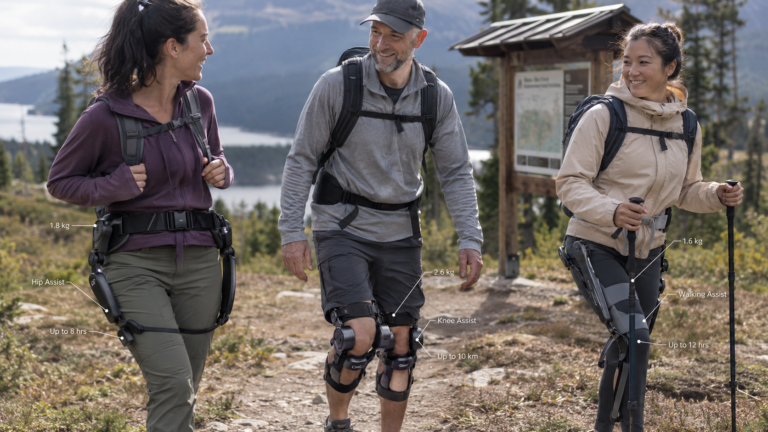
Historically, the public associated exoskeletons with paralysis, military research or heavy industrial work. Lightweight consumer products are creating a different image: wearable assistance for people who can walk but want to walk farther, climb more comfortably or reduce fatigue.
Skip, a company that became independent from Alphabet’s X in 2023, partnered with Arc’teryx to launch MO/GO powered pants for outdoor mobility.[22][23] Other brands are bringing powered hip and lower-limb products into direct-to-consumer channels. The commercial model resembles premium outdoor equipment, e-bikes and assistive wearables more than traditional hospital robotics.
This category could expand the addressable market in four ways:
- Direct payment: purchases do not always depend on clinical reimbursement or enterprise budgets.
- Retail distribution: outdoor, mobility and wellness channels can introduce wearable robotics to a broader audience.
- Higher volumes: smaller, joint-specific devices can be easier to manufacture and ship than full clinical systems.
- Social normalisation: discreet products can make assistance feel like performance equipment rather than a symbol of disability.
The consumer segment is still early. Comfort, battery life, warranty, terrain limits, safety and honest marketing will determine whether initial attention becomes sustained demand. The strategic significance is already visible: a new group of buyers can now encounter exoskeleton technology without entering a hospital or factory.
Capital markets and strategic investment are validating the category
The exoskeleton sector is not yet a mature public-market industry with a dedicated index or many profitable pure-play companies. Even so, the capital picture has changed materially. Large funding rounds, corporate minority investments, acquisitions and public listings are building a financial infrastructure around wearable robotics.
Selected commercial and capital signals, 2024–2026
IKEA reports 400+ SUITX by Ottobock exoskeletons deployed across 14 countries. Arc’teryx and Skip introduce powered outdoor-assistance apparel.
Renault takes a minority stake in Wandercraft. Wandercraft secures US$75 million. Hyundai and Kia begin commercial deliveries of X-ble Shoulder. Ottobock lists in Frankfurt at a €4.2 billion IPO valuation.
Hyundai describes X-ble Shoulder as in mass production. WIRobotics raises approximately US$68 million. Myomo reports 21% second-quarter revenue growth. Lifeward reports continued growth in ReWalk Personal revenue.
Ottobock brings industrial exoskeleton exposure to a major European listing
Ottobock began trading on the Frankfurt Stock Exchange in October 2025 under the ticker OBCK. The offer price was €66 and the IPO valued the company at approximately €4.2 billion.[10][11] Ottobock is a diversified medtech company, not an exoskeleton pure play, but its ownership of SUITX gives public investors exposure to one of the most established industrial exoskeleton businesses.
The listing is strategically important for the ecosystem. It places exoskeleton activity inside a larger listed company with manufacturing, clinical expertise, global distribution and the balance sheet to support product development and acquisitions.
Renault and Wandercraft show how industrial capital can accelerate robotics
Renault Group completed a minority investment in Wandercraft in June 2025 and formed a strategic partnership to apply automotive industrial expertise to the production of exoskeletons and robots.[16] Wandercraft separately announced US$75 million in Series D equity and debt financing.[17]
This is more meaningful than a passive financial investment. Manufacturing scale, supplier management, quality systems and cost reduction are major barriers for robotics companies. An automotive partner can help convert advanced prototypes into reliable products produced at higher volume.
WIRobotics shows that wearable robotics can become a platform
WIRobotics announced a KRW 95 billion, approximately US$68 million, Series B round in May 2026.[18] The company is expanding from wearable robotics into humanoid systems and physical AI. This supports a broader investment thesis: exoskeleton companies can create valuable movement data, controls, actuators and human-robot interaction expertise that extend beyond the original wearable product.
Corporate participation reduces the isolation risk
Samsung’s Catalyst Fund led a US$20 million investment in German Bionic in 2020, Arc’teryx partnered with Skip, Hyundai and Kia built X-ble Shoulder internally, and Ottobock acquired SUITX in 2021.[19][22][31] The individual transactions vary in age and structure, but together they show that wearable robotics is attracting industrial, healthcare, technology and consumer-brand capabilities.
What these investments signal
Strategic capital does not prove that every valuation is justified. It does show that sophisticated companies see reusable value in exoskeleton intellectual property, biomechanics, control systems, distribution and human-motion data. That increases the probability that successful specialists will scale independently, partner with larger groups or become acquisition targets.
Which listed companies provide exoskeleton exposure?
Public-market exposure remains limited and imperfect. Investors should distinguish between direct exoskeleton specialists, diversified medtech groups and adjacent wearable-robotics companies. The table below is an industry map, not a recommendation to buy or sell securities.
| Company | Listing | Type of exposure | Recent commercial signal | Important context |
|---|---|---|---|---|
| Ottobock | Frankfurt, OBCK | Diversified medtech with SUITX industrial exoskeleton business | IPO in October 2025; ongoing global deployments; powered IX BACK VOLTON entered series production | Exoskeletons are one part of a much larger prosthetics, orthotics and patient-care group |
| CYBERDYNE | Tokyo Stock Exchange Growth, 7779 | Direct wearable cyborg and medical HAL exposure | 65 HAL units entered full-scale operation at a Malaysian national rehabilitation centre in 2026 | Commercial performance depends on healthcare adoption, institutional projects and international expansion |
| Lifeward | Nasdaq, LFWD | Direct medical exoskeleton and neurorehabilitation exposure | ReWalk Personal revenue grew 11% year over year in Q1 2026; company also secured new strategic financing in July 2026 | Small-cap, loss-making and increasingly diversified beyond exoskeletons |
| Myomo | NYSE American, MYO | Adjacent powered upper-limb orthosis and wearable medical robotics | Q2 2026 revenue reached US$11.7 million, up 21%, and full-year guidance was raised | MyoPro is an upper-limb orthosis, so it should not be treated as a direct proxy for the entire exoskeleton market |
Ekso Bionics requires a current-status note. Ekso was historically one of the best-known listed exoskeleton specialists. In May 2026, its public parent became ChronoScale following a cloud-business transaction. ChronoScale subsequently classified the legacy Ekso operation as held for sale and discontinued operations while pursuing a divestiture.[32][33] It should therefore not be presented as a current clean public exoskeleton pure play.
What the stock-market landscape tells us
The limited number of public specialists is not evidence that the category lacks value. It shows that the industry is early and that much of the value remains inside private companies or diversified groups. Public exposure is likely to expand through future listings, acquisitions, spin-outs and improved segment reporting.
For Exoskeleton Index, this creates an important intelligence opportunity. Tracking ownership, funding, public listings, acquisitions, revenue signals and strategic partnerships can become as valuable to users as tracking products and technical specifications.
Regional market outlook
North America
North America combines medical reimbursement, FDA pathways, defence research, venture funding and a large industrial customer base. It is likely to remain a leading revenue region, particularly for medical devices and enterprise technology.
Europe
Europe has a dense industrial and medical ecosystem, with important companies in Germany, France, Italy, the Netherlands, Switzerland and the Nordic region. The region also brings strong automotive, aerospace, logistics, occupational-safety and rehabilitation demand. Ottobock’s listing and Renault’s Wandercraft investment strengthen Europe’s position as both a development centre and a source of strategic capital.
Asia-Pacific
Japan, South Korea and China combine robotics expertise, ageing populations, manufacturing capacity and growing consumer-device activity. Hyundai and Kia’s production programme, CYBERDYNE’s HAL ecosystem and WIRobotics’ funding round illustrate different routes to scale. Asia-Pacific may become the fastest-moving region for consumer mobility and lower-cost hardware production.
Emerging markets
Demand for rehabilitation and industrial safety is global, but affordability, distribution and maintenance remain constraints. Large institutional deployments, such as CYBERDYNE’s Malaysian rehabilitation-centre project, may provide a model for national or regional adoption. Local service partners will be as important as hardware price.
Competitive landscape: fragmentation is a feature of an expanding market
No single company leads every part of the exoskeleton market. Medical gait systems, industrial shoulder support, back assistance, hand rehabilitation and consumer walking devices require different technology, evidence and distribution.
| Segment | Representative companies | Near-term route to scale |
|---|---|---|
| Industrial powered systems | German Bionic, SUITX by Ottobock, exoIQ, Comau, Hyundai/Kia Robotics LAB | Enterprise fleets, leasing, service and connected ergonomics |
| Industrial passive systems | HeroWear, Auxivo, Levitate Technologies, Skelex, noonee | Lower-cost deployment in defined lifting, overhead and standing tasks |
| Medical gait rehabilitation | Wandercraft, Lifeward, CYBERDYNE, Ekso Bionics, Fourier Intelligence | Hospital procurement, clinical networks, reimbursement and international distributors |
| Upper-limb and hand systems | Myomo, Bioservo, Harmonic Bionics, Nuada and specialist rehabilitation firms | Indication-specific reimbursement and therapy integration |
| Consumer and outdoor mobility | Hypershell, Dnsys, WIRobotics, Skip, Dephy | Direct-to-consumer sales, outdoor retail and ageing-related mobility |
| Software and enabling technology | Biomechanics, simulation, sensor, actuator and motion-data specialists | Licensing, analytics, components and cross-platform control systems |
Fragmentation often precedes consolidation. Some specialists will remain independent leaders. Others may be acquired by medtech, occupational-safety, robotics, automotive or consumer-equipment groups. A third group may create more value by supplying components, software or data rather than complete devices.
Business models are becoming more investable
One-time device sales can produce irregular revenue, especially when products are expensive and buyers require long pilots. The market is gradually adopting models that improve accessibility and revenue visibility.
- Leasing and subscriptions: reduce upfront procurement costs and include maintenance.
- Paid pilots: turn evaluation into a structured commercial service rather than free experimentation.
- Fleet agreements: allow enterprise customers to scale across sites, countries and job categories.
- Clinical service contracts: combine devices with training, maintenance and workflow support.
- Software and analytics: measure usage, movement and ergonomic exposure.
- Direct-to-consumer sales: open faster channels for lighter mobility products.
- Distributor networks: provide local fitting, service and regulatory support.
These models matter because the eventual market value will not be determined only by the number of frames sold. It will include software, service, training, replacement parts, clinical support and data-driven ergonomics.
Standards and regulation are growth infrastructure
Regulation is sometimes described only as a barrier. In an emerging human-worn robotics market, clear rules can increase trust and reduce buyer uncertainty. ASTM Committee F48, formed in 2017, develops standards for exoskeletons and exosuits across industrial, medical, military, emergency-response and consumer applications.[6]
As terminology, testing, structural integrity, ergonomic assessment and user training become more consistent, buyers will be able to compare products more confidently. This should favour companies with strong engineering, documentation and post-sale support.
Medical regulation creates a higher entry threshold, but it also protects cleared products from undifferentiated competition. Reimbursement can then convert regulatory progress into demand. Industrial standards can play a similar role by helping procurement teams separate credible systems from unsupported marketing.
What must happen for the bull case to compound
The sector does not need every technical problem to disappear. It needs steady progress in the areas that determine repeat purchases and wider deployment.
1. Buyers need outcome data that match the use case
Industrial customers need evidence from the same task and environment they plan to support. Medical buyers need clinically meaningful outcomes for the relevant patient group. Consumer buyers need honest performance claims and real-world testing.
2. Products must become easier to fit, maintain and service
Comfort and reliability are commercial features. Fast fitting, washable textiles, replaceable batteries, local repair and predictable maintenance can matter as much as peak assistance.
3. Distribution must expand
A product without local demonstration, fitting and service will struggle to scale. Partnerships with hospital networks, industrial distributors, medtech providers and retailers can accelerate adoption more efficiently than direct sales alone.
4. Unit economics must improve
Higher volumes, modular designs and common components should reduce production cost. Leasing, reimbursement and subscription models can make products accessible before the full manufacturing cost curve matures.
5. The sector needs better market transparency
Consistent product status, pricing, evidence, ownership, funding and deployment data will help buyers and investors distinguish commercial progress from announcements. This is one of the main roles Exoskeleton Index is positioned to play.
Why these are milestones, not reasons for pessimism
Every early hardware market faces cost, distribution, evidence and service challenges. The bullish question is whether companies are building mechanisms to solve them. In exoskeletons, the answer is increasingly yes: mass production, reimbursement, strategic manufacturing partnerships, recurring service models and larger funding rounds are all developing at the same time.
Exoskeleton market outlook to 2030
Base case
The most defensible base case is sustained double-digit growth led by industrial support, rehabilitation, reimbursed personal mobility and lightweight consumer devices. Under this scenario, the market remains fragmented but several category leaders build meaningful regional or segment positions. Narrow market definitions reach the low billions of dollars in the early 2030s, while broader wearable-robotics activity becomes substantially larger.
Upside case
The upside case requires three developments to reinforce each other: consumer products achieve repeatable demand, medical reimbursement expands across more insurers and countries, and enterprise deployments move from hundreds of devices to thousands per customer group. Lower component costs and AI-based control would then improve product performance while software and service revenue increase market value.
What is less likely by 2030
General-purpose, full-body powered suits are unlikely to dominate civilian volume. Their weight, cost, energy requirements and complexity remain higher than targeted systems. The market can still become large without them. E-bikes did not need to replace every vehicle, and exoskeletons do not need to replace automation, wheelchairs or conventional rehabilitation to build a significant industry.
Exoskeleton Index forecast
By 2030, wearable robotics will be recognised less as one futuristic product category and more as a family of practical mobility and workforce technologies. Industrial, medical and consumer systems will increasingly use shared components, controls and data. The strongest companies will combine specialised hardware with distribution, service, evidence and software. We expect more strategic acquisitions, more public-market visibility and a clearer separation between scaled products and permanently experimental concepts.
Methodology
This analysis was updated using public information available through 6 August 2026. Sources were prioritised in the following order:
- Regulatory and government databases
- Public-company investor relations and securities filings
- Official manufacturer and institutional announcements
- Standards organisations and health authorities
- Commercial market-report summaries with clearly stated scope
- Reputable financial and technology reporting
- Exoskeleton Index’s structured database, separated from external market estimates
Market estimates were not averaged because their definitions are not equivalent. Funding announcements and deployment claims are attributed to the relevant company or institution. Strategic transactions are treated as signals of market confidence, not proof that a company or security will generate positive returns.
The Exoskeleton Index database snapshot used in the original research contained 213 published product records and 271 published company records. These counts change as records are verified, merged, updated or archived. Database coverage should not be interpreted as the total number of products or companies worldwide.
Important limitation
This article is market analysis, not investment, medical, legal or procurement advice. References to listed companies are included to explain industry structure and capital-market development. They are not stock recommendations. Market forecasts are estimates, and company-reported deployments, performance claims and funding figures should be independently verified before a purchase or investment decision.
Frequently asked questions
Is the exoskeleton market a real commercial market?
Yes. Commercial products are sold or leased across industrial, medical and consumer applications. Evidence includes mass-produced systems, multi-country enterprise deployments, reimbursed personal medical devices, public-company revenue and large private funding rounds.
How big is the exoskeleton market in 2026?
Narrow public estimates range from about US$269 million to US$694 million. Broader industrial and wearable-robotics definitions exceed US$1 billion and can reach US$3.52 billion. The difference comes from what each report includes.
Why is Exoskeleton Index bullish?
The bullish view is based on several reinforcing signals: double-digit base-case forecasts, strategic investments by major groups, larger funding rounds, mass production, reimbursement progress, real enterprise deployments and the opening of consumer mobility channels.
Which exoskeleton companies are publicly listed?
Relevant listed companies include Ottobock, CYBERDYNE and Lifeward. Myomo provides adjacent wearable medical robotics exposure. Public-market exposure is still limited, and many leading exoskeleton companies remain private or sit inside diversified groups.
Is Ekso Bionics still a listed exoskeleton pure play?
No. The public parent became ChronoScale in 2026, and the legacy Ekso business was classified as held for sale and discontinued operations as part of a planned divestiture. Ekso remains an important operating brand, but it should not be presented as a current clean listed exoskeleton pure play.
Which segment is likely to grow first?
Task-specific industrial assistance, clinic-based rehabilitation, reimbursed personal mobility and lightweight consumer walking support have the clearest near-term routes to scale. Full-body general-purpose systems are likely to remain a smaller category.
What should buyers compare?
Buyers should compare intended use, task match, body area, powered or passive technology, product status, evidence, fit, user acceptance, regulatory status, local support, training, maintenance, pricing model and deployment requirements.
Browse exoskeleton companies and suppliers
Review exoskeleton applications by industry
Compare relevant exoskeleton products
References
- Grand View Research. Exoskeleton Market Size, Share & Trends Report, 2026–2033.
- Fortune Business Insights. Exoskeleton Market Size, Share & Growth Report, 2026–2034.
- The Business Research Company. Industrial Exoskeletons Market Report, 2026–2030.
- Fortune Business Insights. Wearable Robotic Exoskeleton Market, 2026–2034.
- Fortune Business Insights. Medical Exoskeleton Market, 2026–2034.
- ASTM International. Committee F48 on Exoskeletons and Exosuits.
- NIOSH. Occupational exoskeletons and construction workplace considerations.
- World Health Organization. Rehabilitation.
- World Health Organization. Spinal cord injury fact sheet.
- Ottobock Investor Relations. Share information, ticker OBCK and first trading date.
- Reuters. Ottobock debuts after €4.2 billion Frankfurt IPO, October 2025.
- Ottobock. Exoskeletons for the workplace and SUITX customer base.
- Ottobock. Growth market for exoskeletons and global partner network.
- Ottobock. IKEA deployment of 400+ exoskeletons across 14 countries.
- Ottobock. Smart exoskeletons and digital ergonomics, April 2026.
- Renault Group. Minority investment and strategic partnership with Wandercraft, June 2025.
- Wandercraft. US$75 million Series D financing, June 2025.
- WIRobotics. KRW 95 billion, approximately US$68 million, Series B, May 2026.
- Benhamou Global Ventures. German Bionic US$20 million financing led by Samsung Catalyst Fund, 2020.
- Hyundai Motor Group. First X-ble Shoulder delivery to Korean Air, July 2025.
- Hyundai Motor Group. X-ble Shoulder in mass production at CES 2026.
- Alphabet X. Skip project and spin-out history.
- Arc’teryx. Partnership with Skip and launch of MO/GO powered pants.
- Lifeward. FDA clearance for ReWalk 7, March 2025.
- U.S. FDA. 510(k) record K250904 for Atalante X.
- Lifeward. Full-year 2024 results and ReWalk Personal sales growth.
- Lifeward. First-quarter 2026 financial results.
- Myomo. Second-quarter 2026 financial and operating results.
- Myomo. Availability of MyoPro through Ottobock Care clinics, May 2026.
- CYBERDYNE. Malaysia national neuro-robotics centre and 65-unit HAL deployment, June 2026.
- Ottobock. Acquisition of exoskeleton specialist SUITX, 2021.
- U.S. SEC. Ekso Bionics and ChronoScale business-combination filing, 2026.
- U.S. SEC. Legacy Ekso business classified as held for sale and discontinued operations, 2026.
- CYBERDYNE Investor Relations. Tokyo Stock Exchange Growth listing and stock code 7779.
- Lifeward Investor Relations. Nasdaq listing and corporate profile.
- Myomo Investor Relations. Company profile.
Editorial note: Exoskeleton Index believes wearable robotics has a strong long-term growth opportunity and has stated that perspective openly in this analysis. The article remains independently prepared from public sources. Market forecasts are attributed to their publishers, company claims are labelled or linked to their source, and listed-company references are not investment recommendations.