
Consumer Exoskeleton Comparison 2026: Architecture, Price, Evidence and What the Specs Actually Mean
Consumer exoskeletons are becoming easier to buy. They are not becoming easier to compare.
Two products can both be described as lightweight powered walking exoskeletons while assisting different joints, using different actuator layouts, carrying different battery configurations and reporting performance under completely different conditions. A 2.0 kg system may be quoting the frame alone while another manufacturer reports the complete wearing weight. A 30 km range may describe one battery, two batteries or an Eco-mode estimate. An assistance percentage may refer to metabolic cost, muscle activity, perceived effort or a manufacturer-defined calculation.
Put those numbers into a conventional specification table without context and the table looks precise. It may still be misleading.
This is why Exoskeleton Index does not treat consumer exoskeleton comparison as a simple race for the highest wattage, lowest weight or longest claimed range. The more useful question is whether two numbers were measuring the same thing in the first place.
This Insight introduces the Exoskeleton Index Comparison Methodology: a framework for comparing powered consumer systems by architecture, assisted joint, control approach, weight basis, endurance basis, commercial maturity, regional availability, evidence maturity and source quality.
It is not a ranking of the “best” exoskeletons. Readers looking for product-selection guidance can use our Best Consumer Exoskeletons guide. Readers who already know which models they want to investigate can use the Exoskeleton Index Compare tool.
Key takeaways
- Architecture comes first. A powered hip exoskeleton, a powered knee system and a four-motor hip-and-knee system should not be placed on one performance ladder simply because all three assist walking.
- Weight needs a denominator. “2 kg” is not useful until we know whether it includes the battery, straps, wearable system and both sides of the device.
- Range is not a standardized unit. Kilometres, steps and operating hours can depend on mode, terrain, user mass, assistance level and battery count.
- Power is not assistance. Peak watts, motor torque, metabolic reduction, muscle-activity reduction and equivalent load reduction describe different things.
- Commercial availability matters. Direct retail, regional retail, preorder, deposit, rental and quote-based purchasing are different levels of market maturity.
- Evidence needs its own column. A manufacturer laboratory claim should not be presented as equivalent to independent peer-reviewed evidence or a long-form external field test.
How Exoskeleton Index built this comparison
Exoskeleton Index starts from its own structured database rather than assembling a product list from whichever models happen to rank in a web search.
At the 18 September 2026 snapshot, the public Exoskeleton Index Product Directory contained more than 300 product records. The broader Outdoor, Sports & Consumer Mobility collection contained 51 products. That industry collection is intentionally wider than the normalized table below: it includes systems with different body areas, architectures, levels of commercial readiness and intended uses.
The normalized set is therefore a subset, not “the consumer exoskeleton market.”
Primary-table inclusion criteria
For the main table we screened for currently marketed powered consumer systems whose core architecture provides comparable bilateral hip-oriented assistance and for which enough current first-party information exists to identify commercial status, price, weight basis and endurance basis.
A product can be commercially interesting and still be excluded from that table. WIM S uses a materially different single-actuator architecture. Hypershell Halo adds powered knee assistance to the hip. Dephy Sidekick is ankle focused. DNSYS Z1 and PowrKnee are knee systems. MO/GO integrates powered assistance into apparel. Those systems appear later because their differences are analytically useful, not because they are less important.
Source hierarchy
For specifications and commercial status, Exoskeleton Index prioritizes current manufacturer product pages, manuals and support material. Standards bodies and peer-reviewed research are used for evaluation methodology. Independent testing and credible specialist journalism add external experience where available.
When two current first-party sources disagree, EI does not manufacture a compromise value. Both values are retained until the conflict can be resolved.
Why consumer exoskeleton specifications cannot be compared literally
1. Watts measure electrical or mechanical capability, not user benefit
Peak output is useful technical information. It is not a universal measure of assistance.
A 1,000 W hip-assist system and an 800 W system can use different motors, gear ratios, control strategies, torque limits and definitions of peak operation. More importantly, neither wattage figure tells us directly how much metabolic effort a particular user will save on a particular trail.
The same problem appears when manufacturers report torque. Newton-metres describe rotational force. They are not interchangeable with a percentage reduction in muscle activation, metabolic cost, heart rate, perceived effort or an “equivalent load” claim.
Those measurements may all be valuable. They answer different questions.
2. “Weight” can describe several different products
Weight is currently one of the clearest examples of why normalization matters.
DNSYS describes the DNSYS X1 Carbon as 1.6 kg of mechanical parts. AstroShell Alpha 1 describes approximately 2.0 kg as frame or structural weight. NAVEE EXO S Pro has used a 1.8 kg headline while more detailed regional material distinguishes the net device from the complete configuration with battery and straps.
Hypershell X Pro S provides an even sharper example. Current first-party material reports 2,585 g as the total wearing weight including the battery, while another current Hypershell comparison table lists 2,548 g.
Those differences are exactly why an EI comparison should say what the weight includes, not simply copy a number into a “Weight” column.
3. Kilometres, steps and hours are different endurance languages
Consumer manufacturers currently describe endurance in kilometres, assisted steps, hours and battery combinations.
Hypershell X Pro S is listed at 17.5 km and Hypershell X Max S at 30 km. Hypershell X Ultra S is sold with two batteries and is presented as 30 km × 2. Ascentiz H Pro lists 25 km with one battery and Ascentiz H Ultra 50 km with two. VIGX π and VIGX π Plus describe endurance in assisted steps. NAVEE EXO S Pro advertises up to 40,000 assisted steps.
AlpWalk S1 shows why even one product can require normalization. Its technical specifications state battery life of ≥4 hours under laboratory conditions at 25°C, Smart mode, 30% assistance and 4 km/h. Its FAQ states up to 6 hours at a 30% assist level and 4 km/h, together with up to 20 km of range. Other first-party product material summarizes endurance as 4–6 hours and up to 20 km. These figures may reflect different tests or operating assumptions, but the current material does not provide one sufficiently standardized basis to collapse them into a single directly comparable endurance number.
These numbers should not be sorted from largest to smallest as though they came from one test protocol.
Battery count alone can change the apparent ranking. So can Eco mode, assistance intensity, gradient, terrain, temperature, user weight and whether the quoted figure comes from controlled testing or a manufacturer estimate.
4. Assistance percentages often describe different outcomes
One manufacturer may report reduced physical exertion. Another may report lower oxygen consumption. Another may cite muscle activation, knee loading or a kilogram-equivalent offload.
Even when all of those claims are based on real testing, they should not be converted into a shared “assistance percentage.” A 30% reduction in one outcome is not automatically stronger or weaker than a 20% reduction in another.
For buyers, this means the first question should be: 30% of what, measured how, on whom and under which condition?
The Exoskeleton Index consumer architecture map
Architecture is the first normalization layer because assisted joint and actuator arrangement determine what the device is actually trying to do.
| Architecture | What it means | Current examples |
|---|---|---|
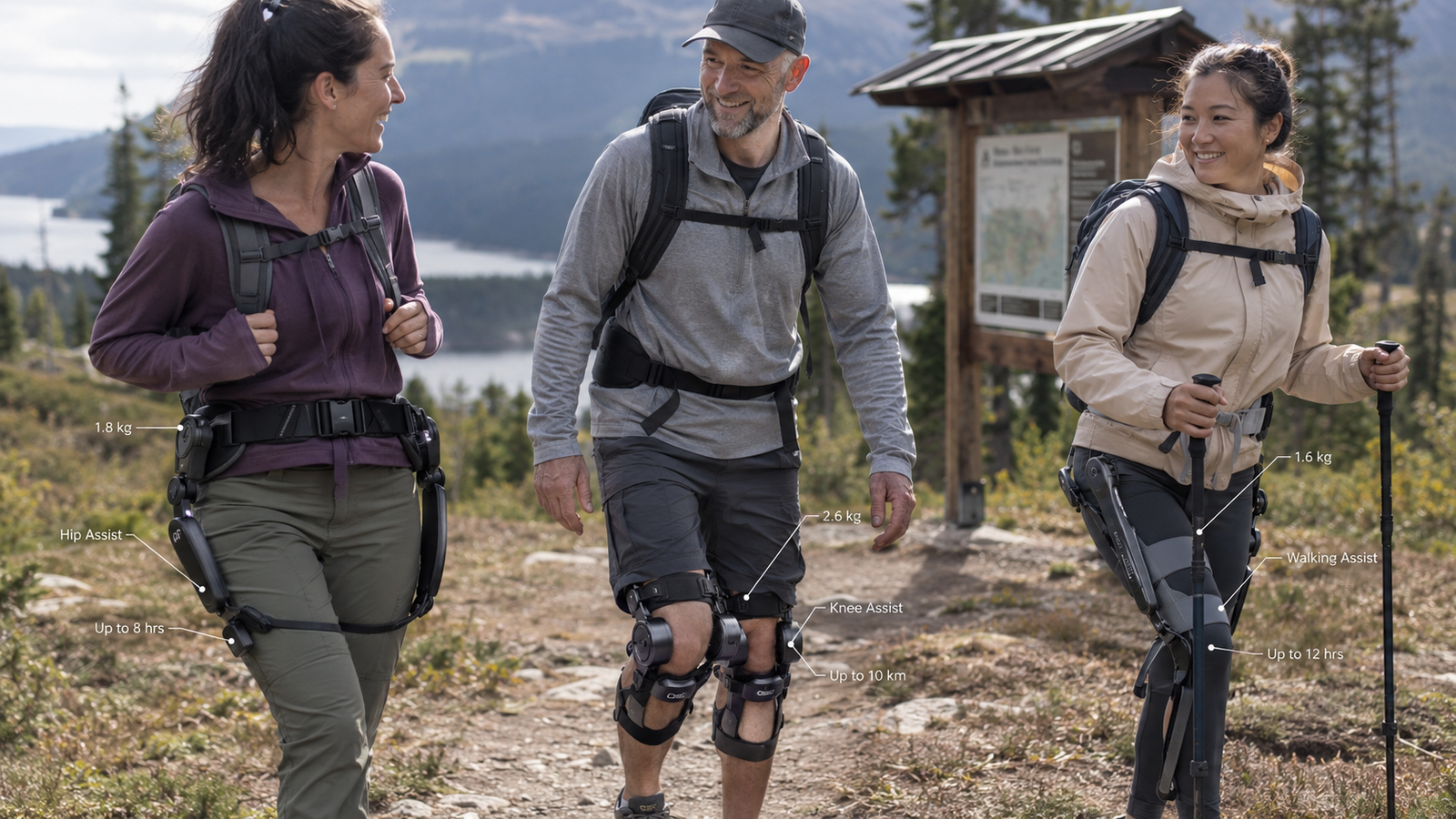
| Bilateral powered hip | Powered assistance applied around both hips during walking, climbing or running | Hypershell X Pro S, X Max S, X Ultra S, DNSYS X1 Carbon, Ascentiz H Pro, H Ultra, VIGX π, π Plus, NAVEE EXO S Pro, AstroShell Alpha 1, TENDEX FX-E7 |
| Single-actuator hip | One central actuator coordinates hip assistance through a different mechanical architecture | WIM S |
| Modular hip / knee | Shared platform supports different powered modules | Ascentiz Exo-Belt ecosystem: H Pro, H Ultra, K Pro and K Ultra |
| Integrated hip + knee | Powered assistance is distributed across both hip and knee joints | Hypershell Halo, Vastnaut One |
| Powered knee | Primary assistance acts around the knee rather than the hip | DNSYS Z1, PowrKnee |
| Powered ankle | Primary powered assistance acts at the ankle | Dephy Sidekick |
| Powered apparel | Actuation is integrated into a soft or garment-like wearable architecture | MO/GO |
| Other / emerging | Architectures or commercial systems that do not yet fit a stable comparison group | Regional and emerging systems including Haier W3, VIATRIX, AlpWalk S1 and Sumbu S3 |
This architecture layer is also why EI keeps a broader Powered vs Passive Exoskeletons resource. Passive systems can solve legitimate mobility or load-management problems, but their operating principles and evaluation metrics differ enough that they should not be inserted into the powered table below.
Normalized powered hip-assist comparison
The table below is a commercial and specification snapshot, not a ranking. Prices were observed around 18 September 2026 and can change by region. Manufacturer endurance figures remain manufacturer claims unless stated otherwise.
| Product | Architecture | Commercial status | Observed price | Reported weight / basis | Endurance / basis | Evidence context |
|---|---|---|---|---|---|---|
| Hypershell X Pro S | Bilateral powered hip | Retail | US$999 / €999 | 2.585 kg total wearing weight incl. battery on one current source; 2.548 kg on another | 17.5 km manufacturer-stated | Manufacturer data + external hands-on at brand/family level |
| Hypershell X Max S | Bilateral powered hip | Retail | US$1,499 / €1,499 | 2.571 kg total wearing weight incl. battery | 30 km manufacturer-stated | Manufacturer data + external hands-on at brand/family level |
| Hypershell X Ultra S | Bilateral powered hip | Retail | US$1,999 / €1,999 | 2.538 kg total wearing weight incl. battery | 30 km × 2; package includes two 72 Wh batteries | Manufacturer data + external hands-on at brand/family level |
| DNSYS X1 Carbon | Bilateral powered hip | Retail | US$889 current snapshot | 1.6 kg mechanical parts | 15 km with one battery | Manufacturer data + independent journalist comparison |
| Ascentiz H Pro | Bilateral powered hip on modular Exo-Belt | Retail | US$1,299 sale / US$1,499 reference | 2.5 kg total weight | 25 km / 15.5 mi, one battery | Manufacturer data + show-floor / journalist hands-on |
| Ascentiz H Ultra | Bilateral powered hip on modular Exo-Belt | Retail | US$1,699 sale / US$1,999 reference | 2.5 kg total weight | 50 km / 31 mi, two batteries | Manufacturer data + show-floor / journalist hands-on |
| VIGX π | Powered hip assist | Retail | US$1,099 / US$1,199 regular | 1.8 kg, single battery | Up to 12,000 assisted steps | Primarily manufacturer evidence |
| VIGX π Plus | Powered hip assist, dual battery | Retail | US$1,399 / US$1,499 regular | 2.1 kg with two batteries on current product page; another current first-party surface lists 2.4 kg | 20,000–24,000 steps across current first-party material | Primarily manufacturer evidence; active spec conflict |
| NAVEE EXO S Pro | Powered single-joint hip/lower-limb assist | Regional retail; stock varies | €1,099 | 1.8 kg headline/net basis; detailed regional material should be used for complete wearing basis | Up to 40,000 assisted steps | Manufacturer data + launch/show coverage |
| AstroShell Alpha 1 | Bilateral powered hip-oriented assistance | Direct retail + US rental program | US$1,199–1,209 current direct promotional price | Approx. 2.0 kg frame/structure weight | Up to 14.9 mi manufacturer-stated; dual-slot hot-swappable battery system | Primarily manufacturer evidence |
| TENDEX FX-E7 | Front-mounted bilateral hip assistance; two independent motors | Public-price + quote-led regional route | US$999 public listing | Approx. 1.3 kg main unit | Up to 25 km manufacturer-stated | Primarily manufacturer evidence |
The table becomes more useful when read horizontally rather than vertically. Ascentiz H Ultra’s 50 km figure, for example, is explicitly associated with two batteries. DNSYS X1 Carbon’s 1.6 kg figure describes mechanical parts. AstroShell Alpha 1’s 2.0 kg value is frame/structure weight. VIGX π Plus reports endurance in steps rather than kilometres.
The point is not that these figures are wrong. The point is that their measurement basis travels with the number.
Consumer systems that should not be forced into the same table
| Product | Architecture / commercial model | Why it sits outside the primary table |
|---|---|---|
| WIM S | Single-actuator hip; regional South Korean retail | Mechanically different from bilateral hip-motor systems; research transfer to current model requires care. |
| Hypershell Halo | Four-motor hip + knee; US$2,299 / €2,299 preorder | Assists a broader lower-limb chain than hip-only systems. |
| DNSYS Z1 | Powered knee; US$1,299 current snapshot | Knee assistance answers a different biomechanical problem. |
| Dephy Sidekick | Powered ankle | Different joint and per-side hardware architecture. |
| MO/GO | Powered apparel / knee; deposit + future delivery | Soft apparel architecture and preorder economics differ from current hip devices. |
| Vastnaut One | Configurable hip-only / hip+knee architecture | Comparable configuration changes with selected module package. |
| PowrKnee | Powered knee | Joint target differs from primary hip set. |
| Haier W3 | Consumer lower-limb system with Chinese experience-store, trial and rental model | Commercial channel and regional deployment model are as important as the hardware. |
| VIATRIX | Powered consumer/outdoor system with China-focused experience and rental ecosystem | Regional commercialization model makes global direct-retail comparison misleading. |
| AlpWalk S1 | Powered hip assist; US$1,099 preorder | Commercially relevant preorder system; current first-party endurance reporting still requires normalization across hours and distance claims, and the evidence basis is not yet stable enough for the primary normalized table. |
| Sumbu S3 series | Emerging consumer system | EI profile absent and current first-party source consistency is not yet strong enough for normalized inclusion. |
Commercial maturity is part of the specification
A product being visible online does not mean that buyers have the same access to it.
The consumer market now includes several commercial models:
- Direct ecommerce: products can be purchased from a manufacturer storefront with a published price.
- Regional retail: purchase exists, but market access, service or inventory is geographically constrained.
- Preorder: price is public but hardware ships in the future.
- Quote-led sales: a buyer must contact the supplier for market-specific pricing, availability or delivery.
- Rental and experience networks: access begins with fitting, trial or short-term use rather than immediate ownership.
This branching is becoming especially visible in China. Haier has developed physical experience locations around products including Haier W3, while ULS Robotics has positioned VIATRIX around “Cyber Hiking” and experience-led commercialization. Those models should not be assumed to represent the entire global market, but they show that consumer exoskeleton commercialization is moving beyond a single ecommerce template.
A 2026 JD Retail consumer-exoskeleton report also points to the importance of trust and service. The study was based on 1,161 surveyed consumers and JD platform data. It reported more than 1,500% year-over-year transaction-value growth on JD in the first half of 2026. That figure describes JD platform activity, not the global exoskeleton market. The same research highlighted fatigue reduction, safety, knee protection, product trials and after-sales support as important consumer considerations.
For broader industry context, see the Exoskeleton Market in 2026 and the Exoskeleton Index Company Directory.
Evidence maturity: a specification table is not an evidence table
Consumer exoskeleton marketing increasingly includes percentages for effort reduction, metabolic savings, joint loading and muscle activity. The existence of a number does not tell the reader how mature the evidence behind it is.
EI therefore separates product specifications from evidence type.
A useful evidence hierarchy can include:
- manufacturer-reported testing;
- manufacturer-affiliated peer-reviewed research;
- independent peer-reviewed research;
- independent long-form field testing;
- journalist hands-on testing;
- show-floor demonstration; and
- products for which meaningful external validation has not yet been located.
WIM S provides an instructive example. Peer-reviewed research exists around WIRobotics’ lightweight hip-exoskeleton architecture. That is more informative than a marketing claim alone. But the authorship is substantially manufacturer affiliated, participant numbers in some reported tests were small, and results from the studied WIM architecture should not automatically be transferred to every current WIM S specification.
The correct label is therefore not simply “scientifically validated.” A more precise description is manufacturer-affiliated peer-reviewed evidence with model-transfer limitations.
Where current first-party specifications still conflict
Conflicts are not necessarily evidence of poor products. Consumer exoskeleton companies are changing pricing, firmware, accessories and hardware quickly, and commercial pages are sometimes updated at different speeds.
But buyers should know when no single stable number exists.
| Product | Issue | Current conflict | EI treatment |
|---|---|---|---|
| Hypershell X Pro S | Weight | 2,585 g total wearing weight including battery vs 2,548 g in another current official comparison | Preserve both until Hypershell synchronizes sources. |
| Ascentiz H Pro | Price | Current direct store price is US$1,299; still-live older/editorial first-party material shows US$1,199 | Use the current checkout value as primary; retain the older first-party value as historical/editorial context rather than treating both as current checkout prices. |
| Ascentiz H + K | Compatibility | Official module guidance says simultaneous use is not yet possible; the IFA 2026 recap says the two modules can be worn together on the same Exo-Belt | Do not state combined H+K compatibility as settled. |
| VIGX π Plus | Endurance | Up to 24,000 and up to 20,000 assisted steps appear in current first-party material | Preserve both and avoid reducing them to one stable endurance figure. |
| VIGX π Plus | Weight | 2.1 kg with two batteries on the current product page; another current first-party surface lists 2.4 kg | Keep the reported basis and source attached to each observation. |
| AlpWalk S1 | Endurance | Technical specifications state ≥4 h under stated laboratory conditions; FAQ material states up to 6 h at 30% assistance and 4 km/h; product/marketing material also states up to 20 km | Preserve the stated conditions and all three formulations. They may describe different operating assumptions, but current material does not provide a sufficiently standardized basis to merge them into one value. |
Some earlier conflicts appear to have resolved. DNSYS X1 Carbon and DNSYS Z1, for example, previously exposed lower promotional prices across official surfaces. At this snapshot the current working values are US$889 for X1 Carbon and US$1,299 for Z1. Those previous observations still matter for price history, but they should not be presented as current offers unless fresh first-party evidence shows them again.
Standards are improving the measurement problem — not eliminating it
The lack of directly comparable consumer specifications is not unique to commercial websites. Evaluation standardization is a broader challenge in wearable robotics.
ISO 18646-6:2026, published in May 2026, specifies performance indices and test methods for lower-limb wearable robots using an anthropomorphic test dummy robot. It is an important step toward more repeatable performance evaluation.
ASTM F3474-25 takes a different angle, providing a framework for functional ergonomic parameters and test metrics across contexts including industrial, medical, military, first-response and recreational exoskeleton use.
Neither standard provides a consumer-product leaderboard, and neither turns peak watts or claimed kilometres into a universally comparable score.
A 2026 peer-reviewed review of lower-limb exoskeleton evaluation reached a closely related conclusion: evaluation metrics remain fragmented and need to cover the human, machine performance and human–robot interaction rather than a single headline specification.
That is also the logic behind EI’s dedicated Exoskeleton Standards & Regulation resource.
What buyers should actually compare
The practical sequence is straightforward.
Start with the task
Are you trying to reduce fatigue on long walks, climb steep terrain, support the knee during descent, compensate at the ankle, carry equipment or extend daily mobility? The answer defines the architecture before specifications enter the discussion.
Compare architecture before output
Once the assisted joint and architecture match, power, torque and control strategy become more meaningful. Comparing a powered ankle to a hip exoskeleton on peak wattage alone does not.
Normalize weight
Look for total wearing weight, battery inclusion and whether the quoted value is for the complete device, frame, mechanical parts or one side.
Normalize endurance
Record battery count, assistance mode and whether endurance is reported in distance, steps or time. Treat dual-battery figures separately from single-battery figures.
Check the actual commercial route
Published price is only one dimension. Region, stock, preorder status, warranty, support and trial availability can matter more to ownership than a US$200 difference in headline price.
Separate claims from validation
Ask whether a performance percentage comes from a manufacturer test, peer-reviewed study or independent real-world evaluation. Then check whether the tested device is actually the model being purchased.
For a wider procurement framework covering fit, safety, trials, maintenance and deployment, use the Practical Exoskeleton Buyer’s Guide.
Continue the comparison inside Exoskeleton Index
No single article should attempt to duplicate the entire Exoskeleton Index database.
Once you know which architecture and metrics matter for your use case, use the Compare tool to place specific models side by side.
Use the Exoskeleton Price Intelligence page for current retail prices, reference prices, deposits, quote-based systems and regional commercial differences.
Browse the Product Directory when you need systems beyond the normalized examples in this article, or explore the Company Directory to investigate manufacturers and suppliers.
If your use case is specifically outdoor walking and hiking, the Best Hiking Exoskeletons guide moves from methodology into use-case selection. For broader consumer buying research, use Best Consumer Exoskeletons.
Conclusion
The consumer exoskeleton market is reaching the point where specification tables look mature before the measurement conventions behind them are mature.
That makes normalization more important, not less.
A useful comparison asks what joint is assisted, how the assistance is produced, what the quoted weight actually includes, how endurance was defined, how the product can be bought and what type of evidence supports the performance claim.
Only after those questions are answered does it make sense to put two numbers side by side.
That is the purpose of the Exoskeleton Index Comparison Methodology: not to remove complexity from wearable robotics, but to make the complexity visible enough that buyers, researchers and industry professionals can compare like with like.
Frequently asked questions
Why can’t exoskeleton wattage be used to rank products?
Peak power describes one aspect of a system’s technical capability. It does not directly measure metabolic benefit, muscle reduction, comfort or real-world assistance, and different products can use different motor, gearing and control architectures.
What does an exoskeleton’s weight include?
It depends on the manufacturer. Published weight may refer to the frame, mechanical parts, the device without battery, total wearing weight, or weight per side. Always check the reporting basis before comparing products.
How should exoskeleton range be compared?
Check whether range is expressed in kilometres, steps or hours; whether it assumes one or two batteries; and whether it comes from a specific assistance or Eco mode. Different range formats should not be converted into a simple leaderboard without equivalent test conditions.
Does peer-reviewed research mean a consumer exoskeleton is independently validated?
Not necessarily. Research may involve manufacturer-affiliated authors, a predecessor architecture or a small sample. Evidence should be described according to who performed the work, which model was studied and what outcome was measured.
Why are knee, ankle and full-leg exoskeletons not ranked with hip-assist products here?
They assist different joints and can use materially different mechanical and control architectures. Separating them avoids treating unlike systems as though they were interchangeable.
How current are the prices in this comparison?
The commercial snapshot was checked around 18 September 2026. Prices, discounts, inventory and regional availability can change quickly, so Exoskeleton Index Price Intelligence and individual product profiles should be checked for the latest recorded offer.