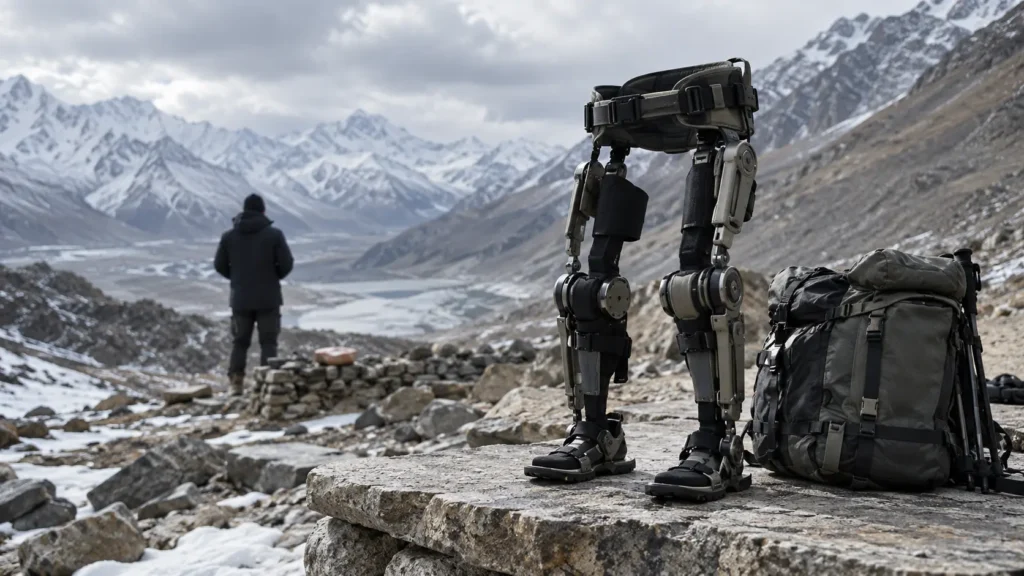

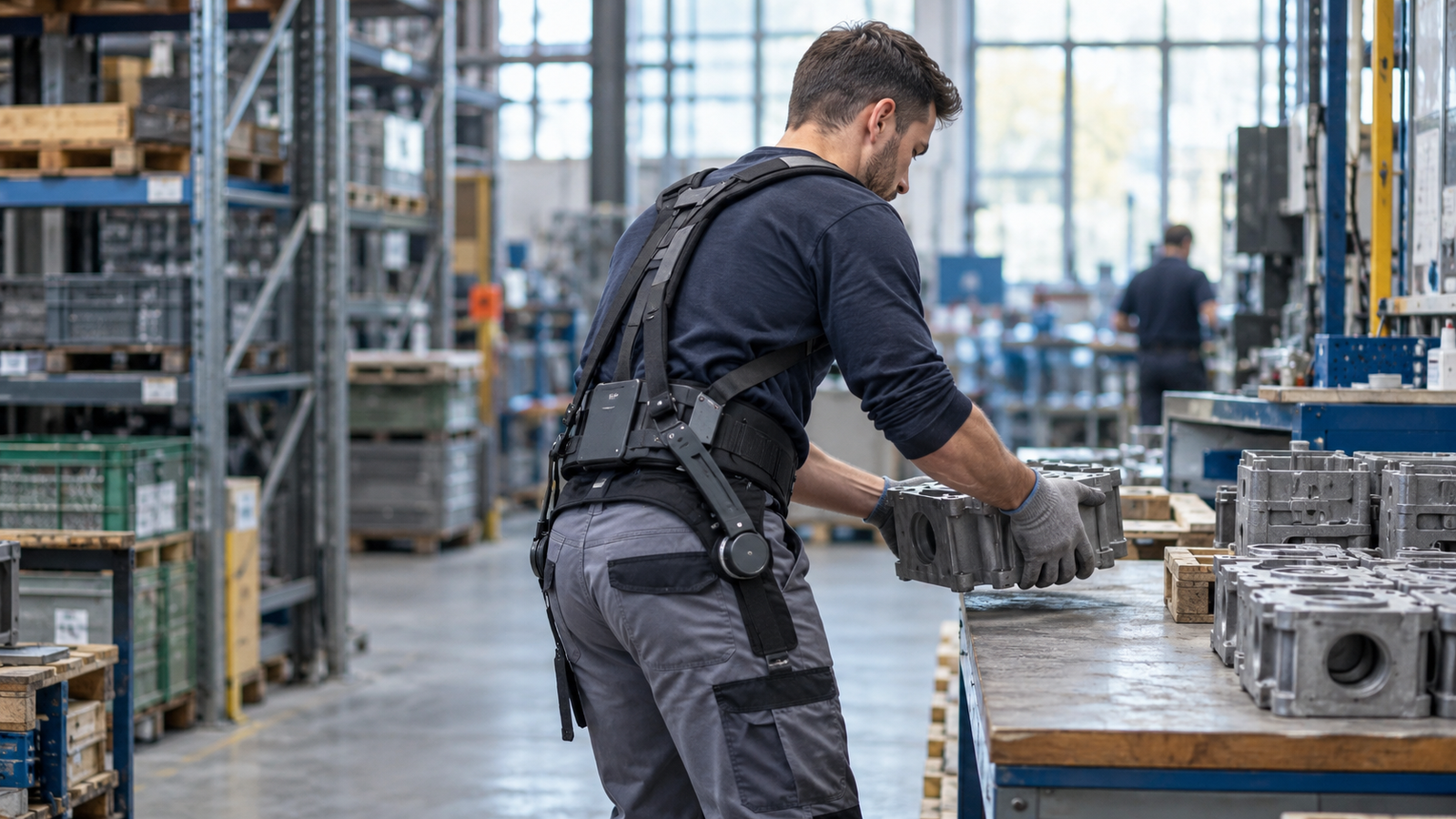
A new systematic review brings together 106 studies of industrial exoskeletons and their sensing systems. The research points to meaningful reductions in selected measures of physical workload. It also shows why these findings cannot yet be translated into a universal claim that exoskeletons improve workplace safety or productivity.
Published in Frontiers in Bioengineering and Biotechnology, the review examines research from 2021 to 2026, covering passive, powered and hybrid support architectures alongside wearable sensors, motion analysis and intelligent control systems.
Where the research is concentrated
Three occupational settings account for nearly seven in ten studies in the review: logistics and material handling, manufacturing and automotive operations, and construction. The distribution is useful for organisations assessing where device development and ergonomic evaluation have been most active.
The remaining studies cover general ergonomic assessment and other work environments. Importantly, the review includes some sensor-based posture assessment systems alongside wearable assistance devices. Its entire dataset should therefore not be treated as 106 field trials of commercially available exoskeletons.
What the findings mean for different tasks
| Workplace task | Body region commonly targeted | What an employer needs to verify |
|---|---|---|
| Repeated lifting and material handling | Back, trunk and sometimes lower limbs | Actual lifting exposure, bending frequency, freedom of movement and any transfer of load |
| Overhead assembly and sustained arm elevation | Shoulders and upper limbs | Arm-support benefit, tool access, reach, precision and compatibility with changing postures |
| Stooping, squatting and construction tasks | Back, hips and lower limbs | Mobility on site, kneeling or crouching, transitions, protective equipment and work interruptions |
These are task-screening considerations, not rankings of specific devices. Employers can explore the associated product landscape through the Exoskeleton Index manufacturing and product directory pages.
Promising results, but not average performance
Among the most favourable individual findings collected by the researchers were reductions of up to 68.2% in measured muscle activity, 34% in spinal compression and 60% in muscle fatigue. One reported productivity improvement reached 59.5%.
Those figures came from different experimental conditions. They are not pooled effects, typical user outcomes or predicted savings for an industrial buyer. The review used qualitative synthesis and descriptive reporting rather than a common meta-analytic effect estimate.
The problem is comparability. Exoskeleton designs, physical tasks, participant characteristics, sensor configurations and evaluation methods differ substantially. Many studies use short or simulated tasks rather than continuous production shifts.
Exoskeleton Index analysis
The commercially important conclusion is not that industrial exoskeletons work equally well everywhere. It is that evidence is increasingly specific to a task, a body region and a measurement method.
For buyers, the selection process should begin with the actual exposure to be reduced. The next step is identifying suitable device architectures, followed by a pilot that measures physical benefit, operational compatibility, worker adoption and total implementation cost.
This aligns with our wider analysis of why workplace exoskeleton pilots fail: a favourable muscle-activity result is only one part of deployment readiness.
What the review does not establish
The research does not establish a general reduction in workplace injuries, long-term musculoskeletal disorders or absenteeism. Those outcomes require larger, sustained workplace studies. The authors also identify problems involving sensor drift, interoperability, worker fit and limited real-world validation.
For organisations, a useful question is whether a supplier’s evidence was collected during a task sufficiently similar to their own. A result from controlled lifting may not transfer to a workstation with twisting, vehicle entry, time pressure or frequent task changes.
What to watch next
Three developments would materially strengthen the case for adoption: longer studies during ordinary shifts, clearer reporting of which workers can comfortably use a device, and standardized measures that allow outcomes to be compared across products and work settings.
Until then, sourcing and evaluation should remain use-case-specific.
Evaluating exoskeletons for a workplace?
Tell us the tasks, industry, body region and deployment location. Exoskeleton Index can help identify relevant products and suppliers, narrow a shortlist and clarify what evidence to request before a pilot.
Discuss your requirementsPrimary source: Risco-Ojeda et al., “Sensor-integrated industrial exoskeletons for ergonomic risk reduction,” Frontiers in Bioengineering and Biotechnology, 22 October 2026. Read the peer-reviewed review.
Reporting note: Study counts reflect the review’s classification. Reported percentage improvements are observations from selected underlying studies, not combined effect sizes.