
Can older adults make an exoskeleton part of daily life?
Helping someone walk with an exoskeleton is one challenge. Making the device practical enough to use day after day is another.
A feasibility study from Aalborg University in Denmark followed older adults asked to integrate a passive hip exoskeleton into their everyday routine over 12 weeks. The results suggest that sustained use is possible for some participants, but that adherence and study completion remain important obstacles.
The research was published on October 8, 2026, in Pilot and Feasibility Studies.
What the researchers tested
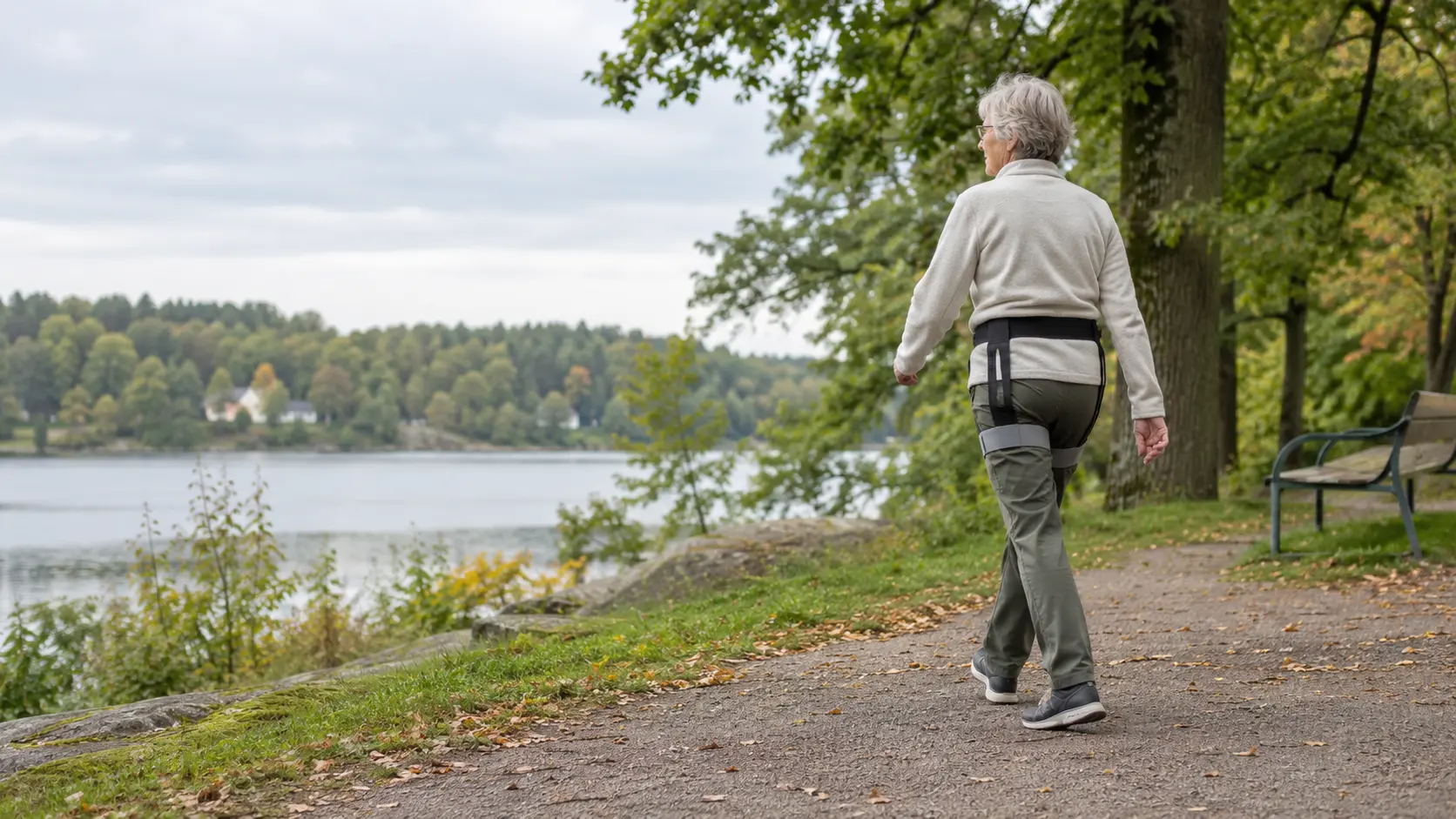
Sixteen adults aged over 65, classified as prefrail and not already using walking aids, received a bilateral passive hip exoskeleton. Unlike a powered walking device, the system provided mechanical assistance without motors.
Participants were asked to wear the exoskeleton for 30 minutes each day over 12 weeks. Researchers monitored their experience and assessed walking performance at baseline, during the intervention and after it ended.
The measurements included cadence, step length, speed and walking-test performance, both with and without the exoskeleton. A six-week post-intervention assessment was also included.
Acceptable to wear does not necessarily mean regularly used
The seven participants who completed the study and follow-up described device wearability and overall experience as acceptable. However, two of those seven did not meet the protocol’s adherence threshold.
That distinction matters. A positive reaction during a trial does not automatically translate into consistent use across weeks or months.
The result also needs careful interpretation. The nine participants who did not complete the protocol and follow-up cannot all be classified as people who rejected the device. Study attrition can reflect different circumstances, and the available results do not establish why every participant stopped.
Did walking performance improve?
The researchers observed changes in several walking measures among the limited participants with follow-up data, but the sample was too small for reliable conclusions about walking speed, cadence, step length or walking distance.
The authors therefore described the intervention as partly feasible and called for randomized controlled research to investigate longer-term outcomes.
What the study does not establish
This was not a controlled demonstration that passive hip exoskeletons improve mobility, prevent falls or increase independence.
The results also cannot be generalized to all older adults or to powered consumer exoskeletons with different designs and assistance mechanisms.
Exoskeleton Index analysis
One of the most important questions for the emerging older-adult mobility market is no longer simply whether assistance can be delivered. It is whether users find the device worthwhile during ordinary life.
Daily adoption depends on more than walking mechanics. Fitting and removal, comfort, clothing compatibility, storage, perceived usefulness and the activities people actually want to perform all influence whether a product becomes part of a routine.
The practical lesson for suppliers and care organisations is to measure continued use alongside mobility outcomes. An exoskeleton that performs well during a six-minute walking test still needs to justify its place in someone’s daily life.
What makes everyday adoption difficult?
The study reinforces the importance of evaluating assistive devices in the context of real routines, rather than only during supervised walking assessments.
Comfort, body fit, clothing compatibility and the effort required to put the system on or remove it can influence repeated use.
A device must work with the activities and environments that matter to the user, not only with scheduled walking exercises.
Long-term use depends partly on whether people experience enough practical value to keep choosing the device.
What this adds to the wider market discussion
Growing interest in consumer mobility exoskeletons makes retention and real-world use increasingly relevant. Sales figures and first-use experiences can indicate demand, but they do not reveal how frequently customers continue using a product after several months.
This study provides an early perspective on adherence, although it concerns a specific passive device and a small prefrail research population. It should not be used as a retention estimate for the wider consumer exoskeleton market.
For a broader breakdown of assistance types, intended users and product-selection considerations, see our guide to exoskeletons for older adults.
What to watch next
The next generation of studies needs larger participant groups, meaningful comparisons, clear reporting of discontinuation reasons and measurements of actual use outside scheduled assessments.
For clinics, care providers and families, matching the device to the person’s mobility needs and environment remains more useful than selecting a product based on headline assistance claims alone.
Exploring exoskeletons for older-adult mobility?
We map available products by body support, assistance type and intended use. Care organisations, research teams and distributors can contact us for relevant supplier identification and evidence-led product shortlists.
Explore suitable products and suppliers Independent market information, not individual medical adviceSources and reporting notes
Primary source. Pîrșcoveanu, Franch and Madeleine, “Assessing the long-term effects of wearing a lower-limb exoskeleton on physical activity and quality of life in pre-frail adults,” Pilot and Feasibility Studies, October 8, 2026. Read the peer-reviewed study.
Funding and limitations. The study reports partial funding from Aalborg Municipality and IMASEN Electrical Industrial Co. Ltd. The authors state that funders did not influence the results or publication. The small sample prevents conclusions about clinical effectiveness.