
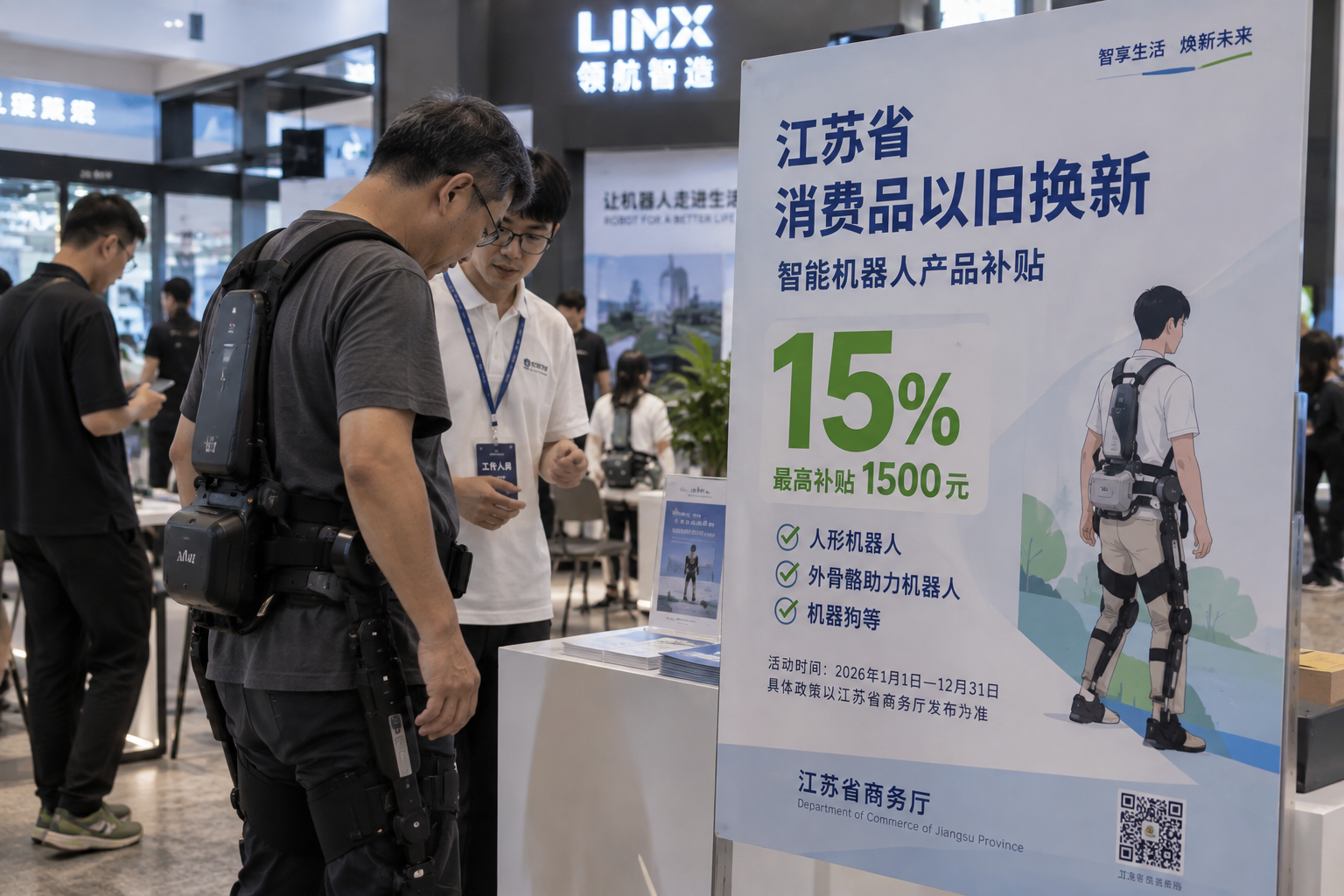
Jiangsu has kept exoskeleton-assist robots inside its 2026 consumer subsidy program, preserving a 15% discount of up to RMB 1,500 per qualifying product under an updated policy that took effect on August 29. A review of the province’s earlier rules shows exoskeletons were already eligible from April, making the latest change a continuation of support rather than the category’s first inclusion.
At a glance
- Region
- Jiangsu Province, China
- Eligible category
- Embodied intelligent robots, explicitly including exoskeleton-assist robots
- Subsidy
- 15% of the final selling price after merchant discounts
- Maximum subsidy
- RMB 1,500 per eligible item
- Purchase limit
- One item per person per subcategory
- Updated policy effective
- August 29 to December 31, 2026, subject to available funds
- Important context
- Jiangsu’s April 17 policy already explicitly included exoskeleton-assist robots
Jiangsu’s updated policy keeps exoskeletons inside ordinary consumer support
On August 28, Jiangsu’s Development and Reform Commission, Department of Finance and Department of Commerce published an updated version of the province’s 2026 consumer trade-in and purchase-support policy.
The official notice reorganizes qualifying products into ten groups of smart home, digital and consumer technologies.
Under the “smart voice-control interaction” category, Jiangsu explicitly lists embodied intelligent robots, including humanoid robots, exoskeleton-assist robots and robot dogs.
Consumers buying a qualifying product can receive a subsidy equal to 15% of the final price after merchant discounts, capped at RMB 1,500 per item. Each person can receive the subsidy for one item in each subcategory.
The revised rules took effect on August 29 and run through December 31, although the program uses limited funds and can end earlier if the allocation is exhausted.
The important correction: exoskeletons were already eligible in April
The August update has been described in provincial coverage as expanding support to intelligent robots, but Jiangsu’s own earlier policy documents show that exoskeleton-assist robots were already inside the program.
An April 17 notice from the Jiangsu Department of Commerce listed “AI+ new-generation intelligent terminals” as an eligible group and explicitly named embodied intelligent robots including humanoid robots, robot dogs and exoskeleton-assist robots.
That earlier policy already offered the same 15% subsidy with a maximum of RMB 1,500 per item.
Exoskeleton Index therefore treats the August policy as a continuation and restructuring of Jiangsu’s exoskeleton eligibility, not the first time the province has subsidized the category.
This distinction matters because it moves the start of Jiangsu’s demand-side support back several months. The province was already treating exoskeleton-assist robots as eligible consumer technology before Beijing introduced its own explicit exoskeleton subsidy in July.
Eligibility is broad in wording, but not automatic for every exoskeleton
The policy language names exoskeleton-assist robots at the category level. It does not mean that every exoskeleton sold in China automatically receives a discount.
Newly eligible goods must have a standardized 13-digit national product code. Products subject to energy- or water-efficiency labeling must also meet the relevant top-tier requirements and be registered in the national efficiency database.
Jiangsu also says the province will apply the same categories and subsidy standards, while individual prefecture-level cities will publish their own implementation details.
For buyers, the practical question is therefore not only whether “exoskeletons” appear in the policy. A specific product still needs to be sold through a participating channel and satisfy the applicable local implementation rules.
Exoskeleton Index analysis
The most important signal is persistence.
One local subsidy can be dismissed as an experiment. Jiangsu’s April eligibility, its continuation through the August policy update and Beijing’s separate July subsidy point to something broader: local governments are beginning to treat at least some consumer exoskeletons as products that belong inside ordinary smart-device support mechanisms.
That is a meaningful change in market infrastructure.
Medical exoskeletons have traditionally moved through hospitals, rehabilitation budgets and specialist procurement. Industrial systems are usually sold to employers. Consumer walking-assist devices need a different ecosystem: retail channels, demonstrations, standardized product identifiers, customer service, financing or discounts, and enough category recognition that an ordinary buyer understands what the product is.
China is starting to build those surrounding mechanisms at the same time that product variety and sales activity are increasing.
Jiangsu is especially useful evidence because its support did not appear only after the latest wave of September product publicity. The category was already in the April program and remains in the updated rules.
That does not prove subsidies are driving exoskeleton demand. The province has not published exoskeleton-specific redemption volumes, participating product counts or spending totals. But it does show that the category has survived a policy revision rather than disappearing after an initial announcement.
Jiangsu and Beijing now form a stronger demand-side pattern
Exoskeleton Index reported this week that Beijing is offering the same 15% consumer subsidy, capped at RMB 1,500, for qualifying exoskeleton robots.
In Beijing, the policy became especially tangible when the China International Rehabilitation Expo published a product list that included an exoskeleton eligible for the discount at the event.
Jiangsu’s structure is different, but the two programs now provide evidence from more than one major Chinese region that exoskeletons are being incorporated into consumer-support policy.
That sits alongside another demand signal: China’s Ministry of Commerce reported that sales value for exoskeleton-assist devices on monitored key platforms rose 39.5% year over year in July 2026.
The subsidy and sales figures measure different things, and neither should be used to prove the other. But together they strengthen the case that China’s consumer exoskeleton segment is developing around real retail activity rather than only technology demonstrations.
What remains unknown
Jiangsu has not published exoskeleton-specific data showing how many consumers have claimed the subsidy, which products are receiving it, how much provincial funding has been spent on exoskeleton purchases or whether the policy has increased sales.
The August notice also does not provide a province-wide list of approved exoskeleton models. City-level implementation rules and participating merchants remain important.
There is another wording inconsistency worth noting. A Jiangsu government explainer published on August 30 described embodied intelligent robots as being included for the first time in the adjusted policy. However, the province’s April 17 notice already explicitly listed exoskeleton-assist robots, humanoid robots and robot dogs. The primary policy documents therefore support continuity rather than first-time inclusion.
Why the policy matters beyond the RMB 1,500 discount
The maximum discount is modest relative to the price of many powered exoskeletons. The bigger signal is classification.
Jiangsu has placed exoskeleton-assist robots alongside consumer smart devices rather than treating the category only as medical equipment or research hardware.
That may become increasingly important as Chinese manufacturers compete on lighter devices, direct sales, tourist rentals, senior mobility and outdoor use.
For broader context, Exoskeleton Index’s China exoskeleton market analysis examines the split between medical, consumer and industrial demand, while our global market report tracks how commercialization is developing across regions.
Sources
- Jiangsu Development and Reform Commission, Department of Finance and Department of Commerce — updated 2026 consumer subsidy policy, August 28, 2026
- Jiangsu Department of Commerce policy reproduced by Nanjing Municipal Government — original 2026 local-category subsidy notice, April 17, 2026
- Jiangsu Provincial Government / Xinhua Daily — explanation of the August policy adjustment, August 30, 2026