
China has produced another unusually concrete signal that consumer exoskeletons are moving beyond prototypes: sales value for exoskeleton-assist devices on monitored key platforms rose 39.5% year over year in July 2026, according to the country’s Ministry of Commerce.
The figure was included in an official assessment of China’s July consumer market published by the Ministry of Commerce on August 20.
It places exoskeleton-assist devices alongside a small group of rapidly expanding intelligent-consumer categories. Sales value for embodied-intelligence robots on the monitored platforms rose 95.1%, while action cameras increased 24.7% and robot vacuum cleaners 19.4%.
The exoskeleton number needs an important qualification: the ministry did not disclose the absolute sales value, unit volume, individual platforms monitored or product-level composition behind the 39.5% increase.
It is therefore not a complete measurement of China’s exoskeleton market.
But it is something the industry has historically had very little of: government-reported evidence that actual consumer spending on exoskeleton-assist products is growing.
At a glance
- Reported growth
- Sales value for exoskeleton-assist devices on monitored key platforms rose 39.5% year over year in July 2026.
- Source
- China’s Ministry of Commerce, using its commercial big-data monitoring.
- Comparison
- Embodied-intelligence robots rose 95.1%, action cameras 24.7% and robot vacuum cleaners 19.4% on the same reported basis.
- Wider policy
- A separate national policy from seven government departments explicitly calls for exoskeleton robots to enter elderly households.
- Existing market signal
- Earlier reporting attributed to IDC estimated roughly 26,000 exoskeleton shipments in China during 2025, with consumer-assistance products accounting for more than 70% of units.
- Evidence boundary
- The Ministry of Commerce has not disclosed absolute exoskeleton sales value, units, participating platforms or detailed methodology.
Government data adds a different kind of evidence to China’s exoskeleton boom
Until recently, most attempts to quantify consumer exoskeleton demand relied on manufacturer announcements, shipment estimates, crowdfunding numbers or specialist market research.
The Ministry of Commerce disclosure is different.
Its July consumer-market update says that, according to the ministry’s commercial big-data monitoring, sales value for 外骨骼助力器 — which can be translated as exoskeleton-assist devices or exoskeleton power-assist devices — increased 39.5% year over year on key monitored platforms.
That wording matters.
The figure describes sales value, not shipments, registrations, production or website interest.
It therefore provides a demand-side signal that consumers or buyers are spending more money within the category.
The ministry included exoskeleton-assist products in a section describing the expansion of new forms of consumption, alongside embodied-intelligence robots and other emerging smart devices.
For an industry that still frequently gets described as futuristic or experimental, appearing inside routine national consumer-market reporting is itself notable.
What the 39.5% figure does — and does not — tell us
The number is strong enough to matter, but not detailed enough to become a complete market estimate.
The Ministry of Commerce does not publish the absolute exoskeleton sales value behind the percentage. It also does not identify the individual platforms included in the monitoring or provide a unit-sales figure.
That means a 39.5% increase cannot be converted into an estimate of total Chinese exoskeleton revenue without additional information.
It also does not tell us exactly which products are driving the growth.
China now has several commercially distinct exoskeleton categories:
- lightweight hip-assist systems for walking and hiking;
- tourist-rental exoskeletons;
- mobility products aimed at older users;
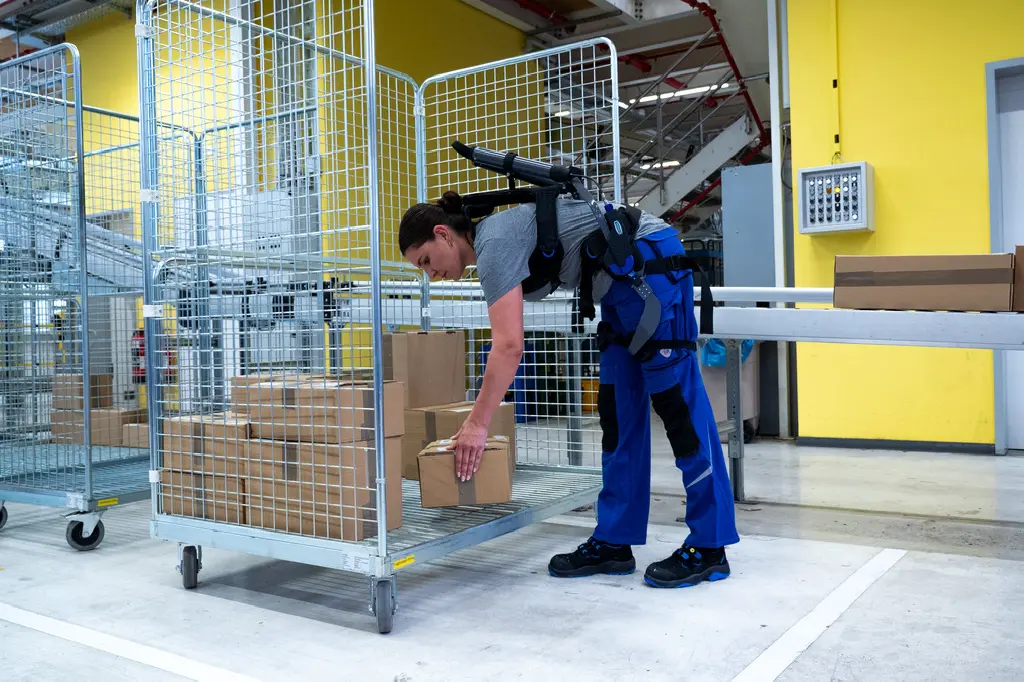
- industrial lifting and support systems;
- and substantially more expensive medical rehabilitation exoskeletons.
The Ministry of Commerce terminology appears most closely aligned with consumer and mobility-assistance devices, but the public release does not provide a product-level breakdown.
The safest interpretation is therefore straightforward: sales value for the exoskeleton-assist category monitored by China’s commerce authorities was materially higher than a year earlier.
National policy is now moving in the same direction
The sales data is more interesting because it is arriving alongside increasingly explicit government policy support.
On August 13, China’s Ministry of Commerce, National Development and Reform Commission, Ministry of Industry and Information Technology and four other departments issued a national policy aimed at expanding and upgrading goods consumption.
One section specifically addresses products for China’s ageing population.
The policy calls for wider application of artificial intelligence and other technologies in age-friendly products and rehabilitation-assistance equipment, and explicitly says authorities should promote exoskeleton robots, electric wheelchairs, smart mattresses and other assistive products into elderly households.
It also encourages retailers to create dedicated age-friendly product areas and expand distribution into supermarkets, hotels, communities, hospitals, pharmacies and elderly-care institutions.
That is considerably more significant than a generic robotics strategy.
It places exoskeletons inside a national consumer and ageing-policy framework focused on getting products into homes and ordinary distribution channels.
Exoskeleton Index analysis
China is beginning to produce the combination the exoskeleton industry has long lacked: measurable sales growth, expanding consumer distribution and explicit public policy support. None of those signals alone proves mass adoption. Together, however, they suggest the market is moving beyond a phase defined mainly by engineering demonstrations. The most important change may be institutional: exoskeletons are increasingly being discussed by Chinese authorities as products that can be sold, subsidized, distributed and used by ordinary consumers rather than as a niche research category.
The new data reinforces China’s 2025 shipment story
The Ministry of Commerce figure follows another important attempt to quantify China’s exoskeleton market.
As Exoskeleton Index reported in August, publicly reported figures attributed to IDC put China’s total exoskeleton robot market above RMB 1.6 billion in 2025, with approximately 26,000 units shipped.
The segment mix was particularly revealing.
Medical rehabilitation reportedly represented the majority of market value, but consumer-assistance products accounted for roughly 19,000 units and more than 70% of reported shipment volume.
The full IDC methodology was not publicly accessible to Exoskeleton Index, so those numbers carry their own evidence boundary.
But the Ministry of Commerce data now points in the same general direction from a completely different measurement perspective.
The IDC-linked figures suggest growing unit volume.
The commerce ministry now reports strong year-over-year sales-value growth on monitored platforms.
Those are two distinct signals, and their alignment makes the consumer segment harder to dismiss as a handful of high-profile product launches.
Beijing has already moved from policy to a point-of-sale subsidy
National policy is also being supplemented by local incentives.
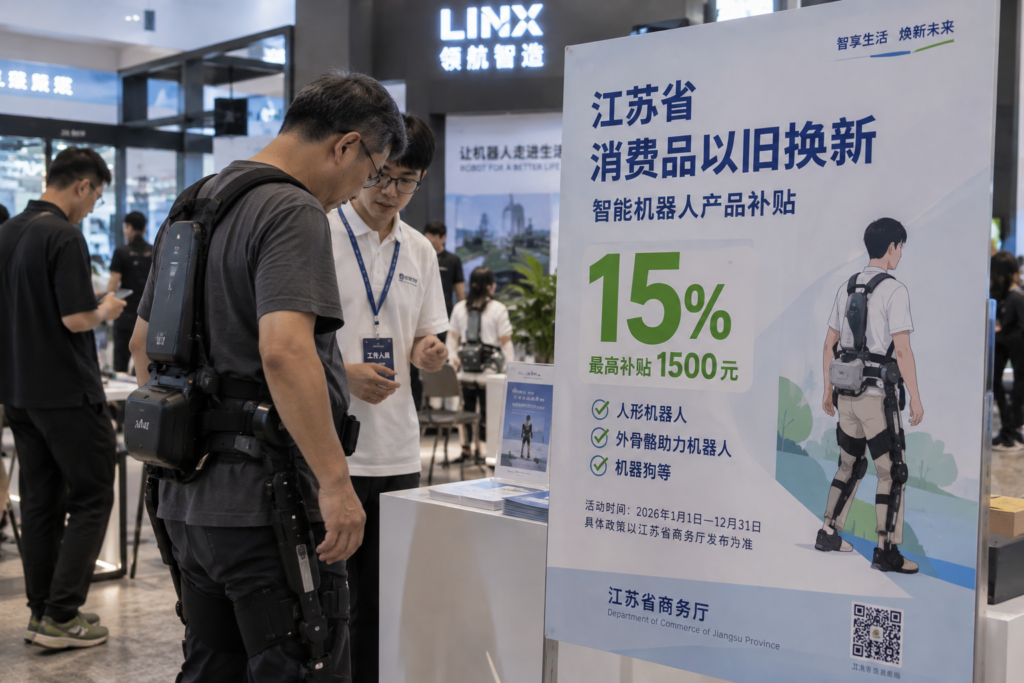
As Exoskeleton Index reported this week, Beijing now explicitly includes qualifying exoskeleton robots in a consumer subsidy program offering 15% off the eligible final purchase price, capped at RMB 1,500 per product.
A product list published for September’s China International Rehabilitation Expo confirmed that the Tuojie Ultra exoskeleton would be among the products offered through that mechanism.
The combination is noteworthy:
- national authorities are tracking exoskeleton-assist sales;
- national policy explicitly promotes exoskeleton robots for elderly households;
- Beijing has created a direct consumer subsidy pathway;
- and Chinese companies are competing across outdoor, elderly-mobility, rental and rehabilitation markets.
That begins to resemble a market ecosystem rather than a technology demonstration cycle.
China may be showing what consumer exoskeleton commercialization looks like
Consumer exoskeleton companies face a challenge that conventional electronics manufacturers do not.
The benefit of an exoskeleton is difficult to communicate through a screen.
A consumer can understand a better camera resolution, faster processor or larger battery from specifications. The value of powered assistance is much harder to appreciate without physically wearing the device.
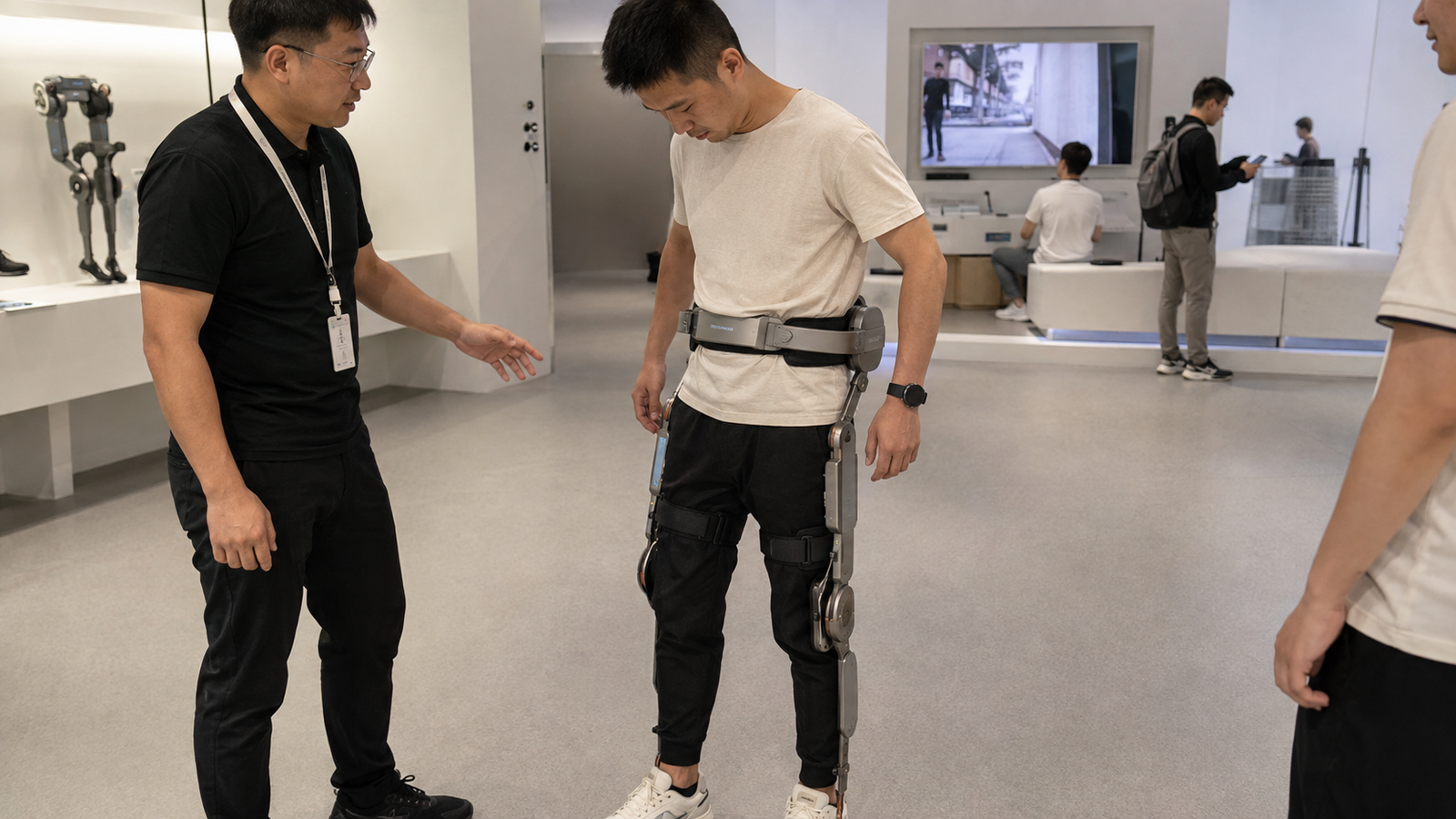
That creates a need for demonstrations, rentals, showrooms, trained retailers and experience-based sales channels.
China is developing several of those layers simultaneously.
Tourist destinations have experimented with exoskeleton rentals. Consumer brands increasingly sell directly online. Experience locations and technology exhibitions allow people to try products. Local subsidies can reduce purchase friction, while national policy is encouraging wider age-friendly distribution.
The resulting model could become important outside China as well.
For consumer exoskeletons to scale internationally, manufacturers will eventually need to solve not only torque, sensing and battery performance, but also the ordinary mechanics of a consumer category: discovery, trial, fit, returns, financing, support and repeat use.
What remains unknown
The Ministry of Commerce figure should not be interpreted as a complete measurement of China’s exoskeleton industry.
The government release does not disclose the absolute sales value behind the 39.5% growth rate, unit sales, individual platforms monitored, participating manufacturers or whether the category definition remained identical to the prior-year comparison period.
It is also not possible from the published data to determine how much of the growth came from higher unit volume versus changing product prices or product mix.
Other questions are equally important: whether the growth persists beyond one month, which brands are capturing demand, how many purchased devices remain in regular use and whether national and municipal policy support materially changes adoption.
The strongest conclusion is therefore directional rather than absolute: official Chinese commerce data now shows meaningful year-over-year growth in exoskeleton-assist spending on monitored platforms, while national and local policy are increasingly supporting the category.
For a technology sector that spent much of the last decade trying to prove there was a market at all, that is a meaningful shift.
Sources
- Ministry of Commerce of the People’s Republic of China, July 2026 consumer-market update, August 20, 2026.
- Ministry of Commerce and six other departments, implementation opinions on expanding and upgrading goods consumption, August 13, 2026.
- Xinhua, analysis of China’s expanding intelligent-consumer market and Ministry of Commerce data, August 24, 2026.
- Exoskeleton Index, China’s Exoskeleton Robot Market Tops RMB 1.6 Billion as Consumer Shipments Accelerate, August 12, 2026.
- Exoskeleton Index, Beijing Is Subsidizing Consumer Exoskeletons at 15% as the Market Moves Mainstream, September 2, 2026.
Explore the ecosystem
Read our detailed analysis of China’s exoskeleton market, see how Beijing’s consumer exoskeleton subsidy works, explore the broader 2026 exoskeleton market analysis, or browse products in the Exoskeleton Index global directory.