
China’s exoskeleton robot market exceeded RMB 1.6 billion in 2025, with roughly 26,000 units shipped, according to newly reported IDC data. The more important finding is the structure behind that headline: medical rehabilitation generated most of the reported market value, while consumer-assist products accounted for more than 70% of unit shipments.
China now has a quantified three-segment exoskeleton market
Chinese technology publication IT Home reported on 4 August that IDC had released a study titled China Exoskeleton Robot Market Share, 2025. The reported framework divides the market into three broad segments: medical rehabilitation, consumer assistance and industrial applications.
That segmentation is useful because those markets behave very differently. A hospital purchasing a powered gait-rehabilitation system is not participating in the same commercial model as a tourist renting a lightweight walking-assist device or a warehouse evaluating an industrial support system.
Putting all three under one headline number can therefore hide more than it reveals. The segment data gives a clearer view of where commercial value and unit volume are actually appearing.
Medical rehabilitation dominates value, not volume
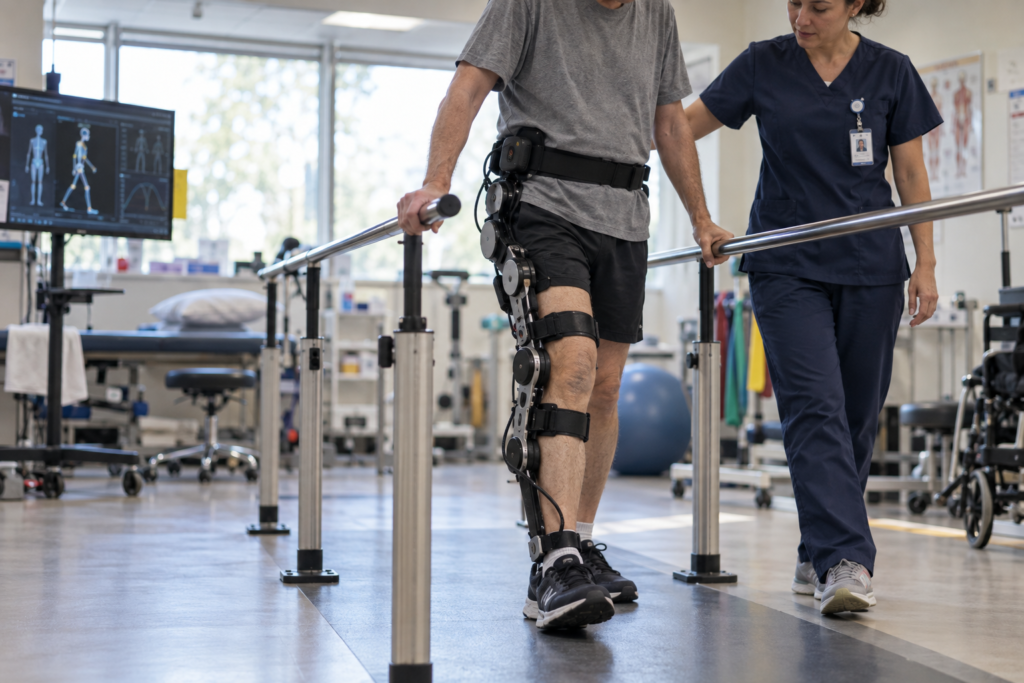
The medical rehabilitation segment was reported at approximately RMB 1.42 billion in 2025 with around 3,200 units shipped. On the approximate segment values reported publicly, medical systems account for close to nine-tenths of market value while representing only about one-eighth of unit volume.
That imbalance is not surprising. Clinical exoskeletons can involve higher-cost powered hardware, specialist fitting, training, servicing and institutional procurement. The main buyers cited in the reporting are hospital rehabilitation departments, specialist rehabilitation hospitals and recovery centres.
IDC reportedly linked the segment’s maturity to population ageing, growing rehabilitation demand, expansion of rehabilitation infrastructure and the localisation of equipment that had historically depended more heavily on imported technology.
For the wider exoskeleton sector, this remains an important commercial base. Medical devices face demanding clinical, regulatory and reimbursement requirements, but successful systems can support substantially higher value per deployment than lightweight consumer devices.
Consumer-assist exoskeletons are driving the volume story
The most striking number is the reported 19,000 consumer-assist units shipped in 2025. That is more than 70% of the 26,000 total units, despite the segment generating only about RMB 110 million in reported market value.
This points to a very different commercialization pathway. Consumer systems are being positioned for walking assistance, hiking, tourism and everyday mobility, with lower hardware prices and rental models opening the technology to people who would never enter a hospital procurement process.
Chinese tourist deployments make that shift visible. Reporting around Mount Tai has described a fleet of 500 lightweight exoskeletons used as rental mobility aids, while similar services have appeared around steep tourist destinations including sections of the Great Wall.
These deployments should not be confused with proof of broad household adoption. Rental usage at a tourist site is a specific use case. But it does show that lower-cost exoskeletons can support business models based on temporary access rather than ownership.
Industrial exoskeletons remain smaller but commercially relevant
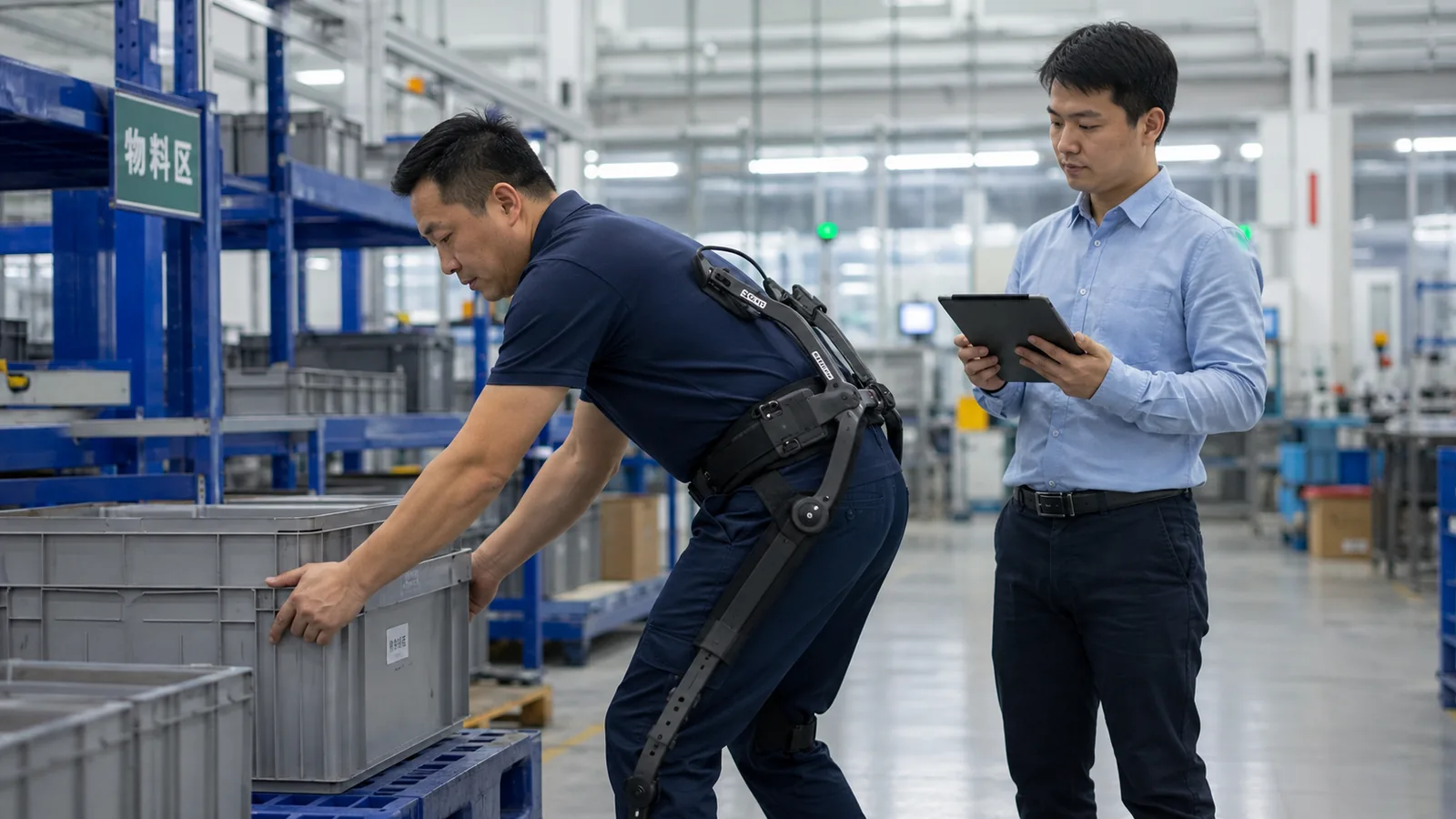
IDC’s reported industrial segment reached approximately RMB 80 million on about 3,800 units. Applications include warehousing, automotive manufacturing, power and energy operations and emergency response.
That makes industrial exoskeletons the smallest of the three reported segments by market value, but the category should not be read simply as “behind” consumer or medical systems. Industrial adoption depends heavily on task fit, worker acceptance, safety processes, procurement cycles and whether a device delivers enough ergonomic or productivity value to justify deployment.
A few thousand reported units across industrial use cases is still meaningful for a category that historically depended on pilots and small evaluation programmes.
The most useful signal is the split between value and volume
The China data illustrates why a single exoskeleton market-size figure can be misleading.
Using the approximate segment figures reported publicly, medical rehabilitation contributes the overwhelming majority of market value, while consumer-assist products contribute the overwhelming majority of shipments. Industrial systems sit between those two models in unit economics and use case.
That suggests the market is not converging toward one dominant exoskeleton format. It is separating into multiple commercial layers:
- higher-value medical systems sold through clinical and reimbursement pathways;
- lower-cost consumer systems competing on usability, weight, price and distribution;
- industrial systems justified by task-specific ergonomic and operational value.
For Exoskeleton Index, that is a bullish signal for the category because it means exoskeleton commercialization is no longer dependent on a single buyer type. The market can grow through several different routes at the same time.
Funding is rising alongside product shipments
Separate reporting of the IDC study says China recorded 19 exoskeleton-sector financing deals worth about RMB 2.2 billion in 2025, compared with eight deals worth RMB 292 million in 2024.
If the reported figures are based on comparable transaction definitions, that would represent a sharp increase in capital entering the sector. It also fits a broader Chinese robotics environment in which battery supply chains, motor manufacturing, electronics, materials and high-volume production capabilities can spill over into wearable robotics.
Capital alone does not prove product-market fit. But funding, shipment volume and expanding deployment models appearing together are more informative than any one signal in isolation.
Sources
- IT Home, reporting IDC’s China Exoskeleton Robot Market Share, 2025, 4 August 2026.
- DigitalToday, China exoskeleton robot market posts record growth, 5 August 2026.
- Cryptopolitan, China’s exoskeleton sales hit a record, 4 August 2026.
Explore the ecosystem
Browse the global exoskeleton product directory, explore exoskeleton companies, or read the full Exoskeleton Market 2026 analysis.