
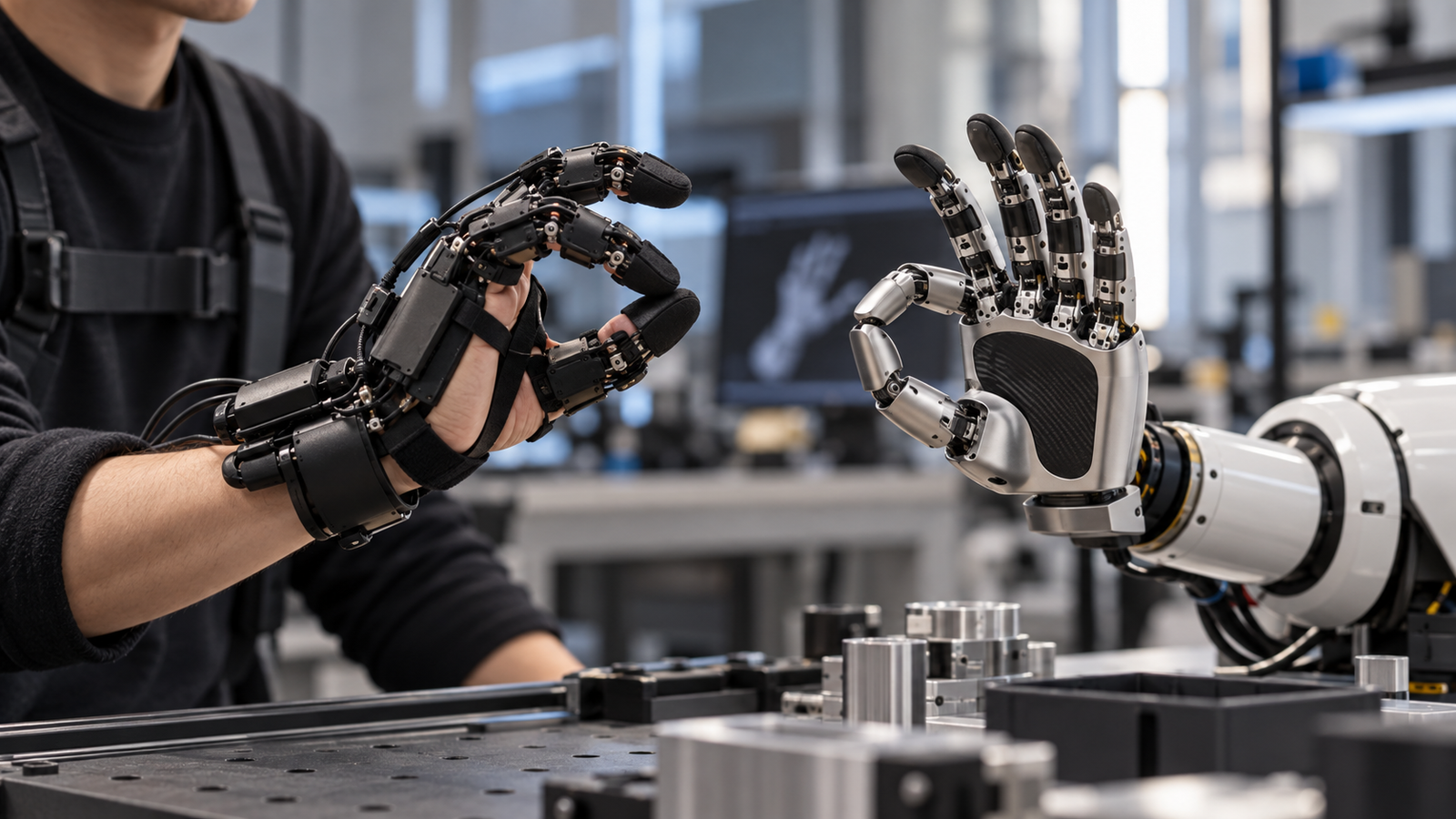
Chestnut Robotics has launched Aero UMI, a wearable hand exoskeleton designed to capture human manipulation data for its new 18-DOF Aero Hand. The unusual part is that the exoskeleton and robot hand were designed around matching kinematics, allowing human demonstrations to map more directly into the robot’s action space and turning wearable robotics into infrastructure for Physical AI training.
- Company
- Chestnut Robotics
- Location
- Santa Clara, California, United States
- Wearable system
- Aero UMI
- Purpose
- Human manipulation data collection and robot teleoperation
- Paired robot hardware
- Aero Hand
- Aero Hand
- 18 degrees of freedom, human-hand-sized
- Joint sensing
- Direct magnetic encoders
- Claimed joint measurement accuracy
- 0.1°
- Kinematic relationship
- Aero UMI uses a URDF designed to match Aero Hand
- Modes
- Training-data collection and teleoperation
- Launch
- IROS 2026, Pittsburgh
- Evidence status
- Product launch and manufacturer specifications. Independent autonomous manipulation benchmarks have not yet been published.
The exoskeleton is designed to collect data, not assist the wearer
Aero UMI represents a very different use of exoskeleton technology from the rehabilitation, industrial and consumer systems normally covered by Exoskeleton Index.
It is not designed to make a human hand stronger or reduce physical effort.
Its primary job is to measure what the wearer does.
An operator wears the hand exoskeleton while performing manipulation tasks. Magnetic encoders measure the movement of individual joints, producing demonstrations that can be recorded as training data for robotic manipulation.
Chestnut Robotics lists direct joint measurement accuracy of 0.1°.
The same wearable system can also operate as a teleoperation interface, allowing the operator’s movements to directly control the company’s Aero Hand.
That combination places Aero UMI somewhere between a conventional exoskeleton, a motion-capture system and a robot controller.
Aero UMI and Aero Hand were designed as one system
The central idea behind the launch is not simply that Chestnut built a wearable controller for a robotic hand.
The company says it designed both pieces of hardware together.
Aero Hand is an 18-degree-of-freedom, human-hand-sized dexterous robotic hand using a hybrid drivetrain combining tendon, direct and linkage actuation.
Aero UMI uses a URDF that Chestnut says matches the robotic hand.
URDF, or Unified Robot Description Format, is commonly used in robotics to describe the links, joints and geometry of a robotic system.
Matching those structures can matter significantly when human demonstrations are being used to teach a robot.
A human hand and a robotic hand normally have different joint structures, movement ranges and mechanical constraints.
Motion captured from the human therefore often needs to be translated, or retargeted, into movements the robot can actually execute.
Chestnut’s approach is to reduce that translation problem by making the data-capture hardware resemble the deployment hardware as closely as possible.
Chestnut calls this a “zero embodiment gap”
The company describes the relationship between Aero UMI and Aero Hand as having a “zero embodiment gap.”
The embodiment gap refers to the mismatch between the system generating a demonstration and the robot expected to reproduce it.
If the human demonstration is recorded using one geometry and the robot operates using another, additional software has to determine how one movement should translate into the other.
Chestnut argues that designing the exoskeleton and robotic hand around the same morphology can reduce that problem.
The concept is compelling, but the terminology needs to be interpreted carefully.
Matching kinematics does not automatically mean every human manipulation transfers perfectly to the robot.
Force production, mechanical compliance, tactile sensing, friction, joint limits, object contact and control-policy performance can still differ between the wearable system and the robotic hand.
For that reason, Exoskeleton Index is treating “zero embodiment gap” as company positioning rather than an independently established performance result.
The harder problem may increasingly be the training data
Dexterous robotic hands create a difficult learning problem.
A simple parallel gripper may only need to decide how far to open, where to position itself and when to close.
A high-degree-of-freedom hand has many more possible configurations.
Each finger can move across multiple joints while contact forces change continuously as an object is grasped, repositioned, rotated or released.
That creates a much larger action space for a robot-learning system.
Chestnut’s position is that the shortage of high-quality manipulation demonstrations is becoming one of the major bottlenecks in dexterous robotics.
The company says Aero UMI was therefore designed around extended data collection rather than short laboratory demonstrations.
Its product material emphasizes weight and ergonomics because an operator may need to wear the system for long periods if meaningful training datasets are to be produced.
Chestnut argues that if a data-collection rig cannot be worn comfortably for a full working shift, the data pipeline itself becomes difficult to scale.
That remains a manufacturer claim. Public independent studies evaluating all-shift comfort or operator fatigue with Aero UMI have not yet been published.
The same hardware can intervene when autonomy fails
Aero UMI has another role beyond collecting demonstrations.
It can also directly teleoperate Aero Hand.
That means a human operator can use the same hardware to take control when an autonomous system encounters a task or situation it cannot complete reliably.
This creates a potentially useful loop.
A human demonstrates a task using the wearable system.
The resulting data can be used to train a manipulation policy.
The robot then performs the task autonomously.
If it encounters an edge case, a human can intervene through the same exoskeleton interface.
That intervention can potentially become another demonstration for future training.
In that architecture, the wearable device does not disappear once the robot becomes autonomous.
It remains part of the data and operational infrastructure around the robot.
Aero Hand is being positioned for real-world deployment
The other half of the system is designed around a different constraint: durability.
Chestnut describes Aero Hand as an 18-DOF human-hand-sized platform built for real-world deployment rather than laboratory manipulation alone.
The drivetrain combines tendon, direct and linkage actuation, with each mechanism used in different parts of the hand.
The company lists a lifetime of more than three million cycles.
Its wider company material also lists sub-millimeter precision, 0.1 N tactile sensitivity and a 20 kg payload for the Aero Hand platform.
Those numbers are manufacturer specifications and have not been independently validated by Exoskeleton Index.
The larger idea is that the hand and the wearable data collector are being developed together around one commercial problem.
Chestnut wants the hardware generating the demonstrations and the hardware performing the final work to remain closely aligned.
Exoskeleton Index analysis
Aero UMI illustrates an important expansion in what exoskeleton technology can be used for.
Traditional wearable robotics transfers mechanical assistance from a machine to a person.
Physical AI is creating another direction of value:
transferring high-quality human movement information from the person into a robotic system.
That could become an increasingly important market for wearable robotics.
AI models capable of controlling robots need physical-world data.
For dexterous manipulation, video alone does not provide every piece of information required to understand finger configuration, contact, force and object interaction.
A wearable exoskeleton can directly measure parts of that interaction while preserving the operator’s natural ability to manipulate objects.
The commercial value of this type of exoskeleton therefore looks very different from an industrial back-support system or walking-assistance device.
Performance may eventually be measured in metrics such as:
- usable demonstrations collected per operator-hour;
- joint-measurement accuracy;
- calibration time;
- operator fatigue during long data-collection sessions;
- retargeting or preprocessing requirements;
- the percentage of demonstrations that transfer successfully to the robot; and
- the performance of autonomous policies trained from the resulting dataset.
That is a significant shift.
The exoskeleton becomes less of an end product and more of a piece of infrastructure inside the robot-learning pipeline.
Chestnut is not alone in exploring this direction.
At the same IROS 2026 event, Sharpa introduced the AE01 haptic exoskeleton glove for robot teleoperation and embodied-AI data collection.
The convergence is worth watching.
As manipulation models become more capable, the demand for reliable human demonstration data may create an entirely separate wearable-robotics market alongside medical, industrial and consumer assistance.
The launch also shows how Physical AI is changing exoskeleton design
A conventional assistive exoskeleton is optimized around the person wearing it.
Comfort, assistance torque, movement freedom, weight, battery endurance and biomechanics usually dominate the design.
A data-capture exoskeleton has another constraint.
It also has to represent the robot that will eventually use the data.
Those objectives can conflict.
A system that follows the human hand perfectly may not match the robot. A system designed only around the robot’s geometry may become uncomfortable or unnatural for the human operator.
Chestnut’s paired architecture is therefore an interesting engineering experiment in finding a common physical interface between the two.
If the approach works, co-designing demonstration hardware and deployment hardware may reduce one of the translation layers currently required in robot learning.
Whether that produces materially better autonomous manipulation remains the key unanswered question.
What remains unverified
The Aero UMI launch is currently supported primarily by Chestnut Robotics’ own technical specifications and demonstrations.
The company’s description of a “zero embodiment gap” has not yet been supported by an independent benchmark comparing Aero UMI with conventional motion-retargeting or teleoperation approaches.
Public material reviewed by Exoskeleton Index also does not yet show an autonomous Aero Hand policy trained from Aero UMI demonstrations completing a defined benchmark against alternative data-collection methods.
The listed 0.1° joint accuracy and Aero Hand lifetime of more than three million cycles are manufacturer specifications.
Independent endurance testing has not been identified.
Chestnut also emphasizes the ergonomics of Aero UMI for extended data collection, but no public study currently establishes how long operators can comfortably wear the system or how fatigue affects data quality over a full shift.
Public pricing and detailed commercial delivery timelines for the Aero UMI and Aero Hand pairing have not been disclosed in the product material reviewed by Exoskeleton Index.
What to watch next
The most important evidence will come from trained autonomous policies rather than teleoperation demonstrations.
A responsive wearable interface can show that the exoskeleton accurately controls the hand.
The harder question is whether demonstrations recorded through Aero UMI allow Aero Hand to learn complex manipulation tasks more quickly, more reliably or with less preprocessing than competing approaches.
Useful future benchmarks would compare data-collection efficiency, retargeting requirements, policy success rates and operator workload.
Performance across different users and hand sizes will also matter because a system intended for scaled data collection cannot depend on one highly calibrated operator.
Durability will be equally important.
If Chestnut intends Aero Hand for industrial deployment and Aero UMI for repeated data collection, both sides of the system need to remain reliable across substantially more use than a research demonstration.
The broader development is already clear.
Exoskeletons are beginning to play a role not only in helping humans perform physical tasks, but also in teaching robots how those tasks are performed.
If Physical AI continues moving from simulation toward large-scale real-world data collection, wearable robotics may become one of the interfaces connecting those two worlds.
Browse the wider Exoskeleton Product Directory or explore more wearable robotics news and research from Exoskeleton Index.