
Beijing is now subsidizing eligible consumer exoskeleton purchases, adding another concrete sign that wearable robotics is moving beyond the early-adopter stage in China.
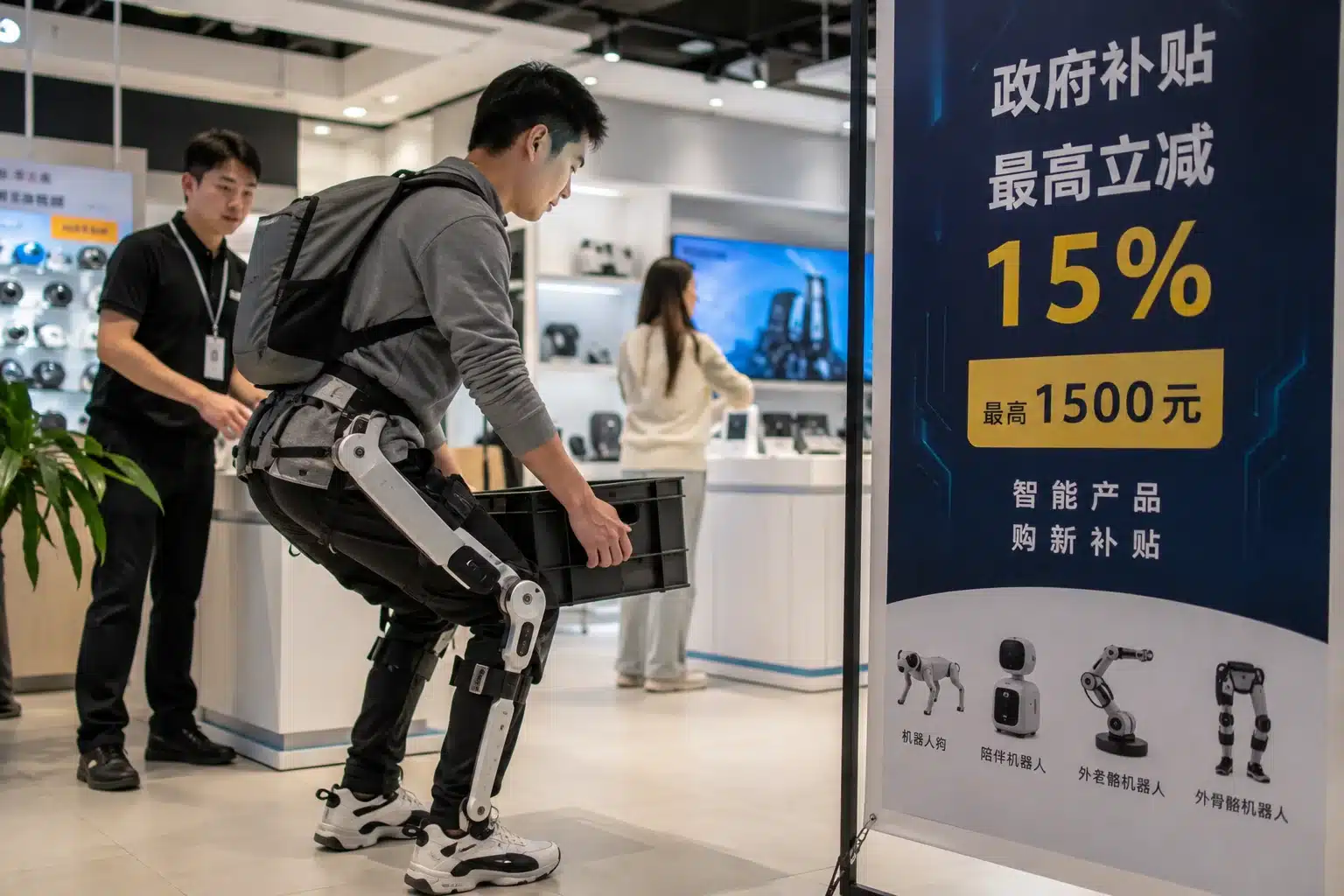
The city is offering consumers a 15% subsidy on qualifying exoskeleton robots, explicitly recognizing wearable exoskeletons as part of a wider category of intelligent consumer products that also includes robot dogs, companion robots and elder-care robots.
The policy itself took effect in July. A fresh announcement on August 31 made the opportunity considerably more tangible: the China International Rehabilitation Expo listed the Tuojie Ultra exoskeleton robot among products that can receive the subsidy at its September 3–5 consumer assistive-technology marketplace in Beijing.
For the exoskeleton industry, the significance goes beyond the value of the discount.
Beijing is effectively treating an exoskeleton as something a private consumer can discover, try, purchase and receive government support to own. That is a very different market position from the clinical and research environments that historically dominated wearable robotics.
At a glance
- Consumer subsidy
- 15% of the eligible final purchase price.
- Maximum support
- RMB 1,500 per qualifying item.
- Eligible category
- Beijing explicitly includes exoskeleton robots within its embodied-intelligence consumer category.
- Fresh development
- The Tuojie Ultra appears on the August 31 list of products eligible for subsidy at the China International Rehabilitation Expo.
- Purchase channels
- Participating online and offline retailers.
- Scope
- This is a Beijing municipal program for qualifying products and merchants, not a nationwide discount on every exoskeleton sold in China.
Beijing has officially put exoskeletons into a consumer-product category
The Beijing Municipal Bureau of Commerce expanded the city’s 2026 consumer subsidy program with ten additional categories of intelligent and household products.
One of those categories is officially described as embodied intelligent robots.
The policy then becomes unusually specific. It includes companion robots, robot dogs, elder-care robots and exoskeleton robots.
Consumers purchasing qualifying products through participating businesses can receive an immediate discount equivalent to 15% of the final selling price, up to RMB 1,500 per item.
The discount can be used through qualifying online and physical retail channels. That makes the scheme fundamentally different from a hospital procurement program, research grant or specialist disability fund: it is designed around ordinary consumer purchasing.
The August 31 product list turns policy into an actual exoskeleton purchase
A policy category can remain theoretical until real products begin moving through it.
That is why the August 31 announcement from the China International Rehabilitation Expo is especially interesting.
The exhibition is running a consumer assistive-technology marketplace at the China National Convention Center in Beijing from September 3 to 5. Its newly published list of subsidized products includes the Tuojie Ultra exoskeleton robot alongside electric wheelchairs and other intelligent mobility products.
According to the organizer, qualifying purchases made through the event can receive the same 15% subsidy, subject to the RMB 1,500 ceiling and final eligibility verification.
That creates a commercially meaningful scenario: a consumer can experience an exoskeleton, decide to buy it and use a government-backed discount at checkout.
The subsidy is modest. The market signal is not.
RMB 1,500 will not transform the economics of every exoskeleton purchase.
Higher-end powered systems can cost substantially more, and purchasing decisions still depend on comfort, usefulness, reliability, battery endurance, service and whether consumers understand what the product actually does.
But the financial value of the subsidy is only one part of this story.
Government consumer programs also help define which technologies are considered sufficiently real and commercially relevant to deserve their own product category.
The exoskeleton industry has spent years moving through a familiar progression:
- laboratory prototypes;
- medical and rehabilitation systems;
- industrial pilots;
- specialist outdoor products; and
- increasingly, products aimed directly at ordinary consumers.
Beijing’s policy suggests the next stage may include something the sector has rarely had before: public policy actively supporting consumer demand.
Exoskeleton Index analysis
The strongest signal here is not that consumers can save RMB 1,500. It is that exoskeletons are beginning to acquire the surrounding infrastructure of a real consumer market. Successful technology categories need more than good hardware: they need distribution, demonstrations, financing, service, customer education and enough visibility that buyers understand why the category exists. China is beginning to assemble several of those layers around wearable robotics at the same time. Government subsidy eligibility, physical experience centers, tourist-rental models and rapidly growing consumer shipments point toward a market that is becoming structurally more mature rather than simply producing more prototypes.
China’s consumer exoskeleton market was already accelerating
The subsidy arrives against a much broader expansion of China’s wearable-robotics market.
As Exoskeleton Index recently reported, figures attributed to IDC put China’s exoskeleton robot market above RMB 1.6 billion in 2025, with approximately 26,000 units shipped across medical rehabilitation, consumer assistance and industrial applications.
The most striking part of those figures was the shipment mix.
Consumer-assistance exoskeletons reportedly accounted for more than 70% of total unit shipments.
Medical systems still generated considerably more revenue per device, but the figures suggested that consumer exoskeletons were already beginning to reach volumes that conventional clinical systems had not.
The market is also becoming increasingly diverse.
Chinese companies are pursuing lightweight walking-assist systems, hiking-focused exoskeletons, mobility products for older adults, tourist-rental systems and higher-output outdoor devices.
That diversity matters because there may ultimately be no single “consumer exoskeleton market.”
Walking assistance for an older adult, a hiking device for a healthy outdoor user and a rental exoskeleton at a mountain attraction solve very different problems.
The real barrier may be convincing consumers to try one
Consumer exoskeletons have an unusual sales problem.
An exoskeleton’s primary value is physical. Specifications alone cannot easily communicate what it feels like when a motor adds torque to the hip, assists a step or reduces the effort of climbing.
That makes physical demonstrations unusually important.
China is beginning to build infrastructure around that challenge.
Exoskeleton companies are appearing at mainstream robotics and consumer-technology events. Dedicated experience stores are emerging. Some tourist destinations offer wearable robots as rentals rather than requiring visitors to purchase them.
The Beijing subsidy adds another layer to that commercialization pathway: discover → experience → compare → purchase → receive support.
That is a much more mature market structure than simply launching another prototype online.
What remains unknown
Beijing’s policy is an encouraging market signal, but several important questions remain.
It is not yet clear how many exoskeleton purchases will use the subsidy, whether subsidy eligibility will materially increase unit sales, or whether other Chinese cities and provinces will introduce similar incentives.
It also remains to be seen whether manufacturers begin using subsidy eligibility in mainstream retail marketing and whether exoskeleton support becomes connected to broader ageing, tourism or intelligent-mobility initiatives.
The program is local. This is a Beijing municipal subsidy, not a blanket national discount covering every exoskeleton sold in China. Products must meet eligibility requirements and be sold through participating channels. The more significant conclusion is that Beijing has formally recognized qualifying exoskeleton robots as a subsidizable consumer category, and real products are beginning to be sold through that framework.
Sources
- Beijing Municipal Bureau of Commerce, expansion of Beijing’s 2026 consumer subsidy program, July 2026.
- Beijing Municipal Government, official explanation of the subsidy rules.
- China International Rehabilitation Expo, second list of subsidized assistive and intelligent products, August 31, 2026.
- Exoskeleton Index, analysis of China’s exoskeleton market and 2025 shipment data.
Explore the ecosystem
Read our analysis of China’s rapidly expanding exoskeleton market, explore the broader 2026 exoskeleton market analysis, browse outdoor, sports and consumer mobility exoskeletons, or explore products in the global Exoskeleton Index database.