
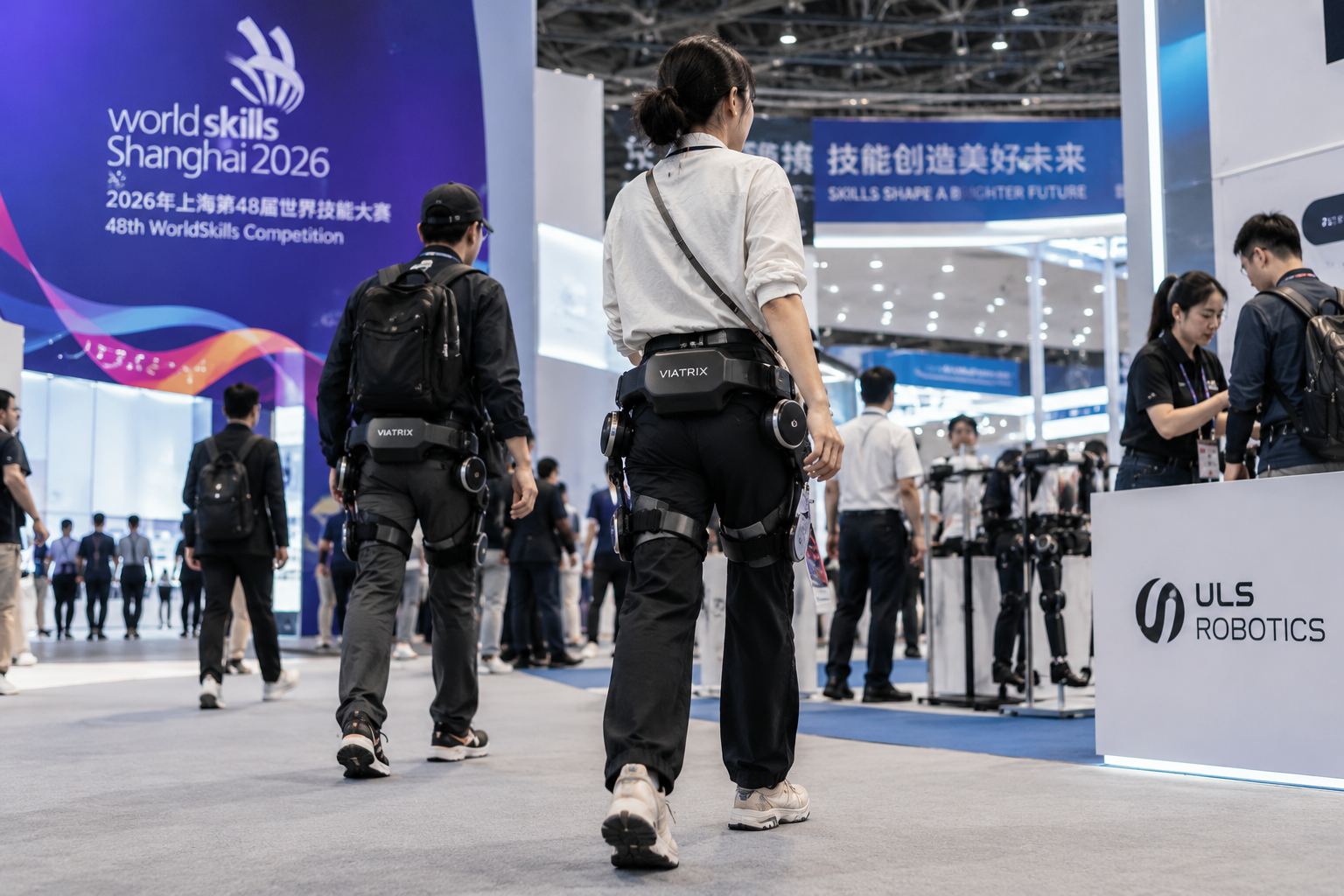
Visitors at WorldSkills Shanghai 2026 could rent a ULS Robotics VIATRIX X powered exoskeleton and use it while walking around the exhibition, while a separate experience area let attendees test industrial exoskeletons during simulated logistics tasks. The technology itself is not the only interesting part: the event turned a consumer exoskeleton from something demonstrated at a booth into something ordinary visitors could temporarily use for the activity it was designed to support.
- Event
- WorldSkills Shanghai 2026
- Competition
- 48th WorldSkills Competition
- Location
- National Exhibition and Convention Center, Shanghai, China
- Public competition dates
- 23–26 September 2026
- Company
- ULS Robotics
- Consumer device
- VIATRIX X
- Access model
- On-site rental access for visitors walking around the exhibition
- Industrial experience
- FIT-series exoskeletons used in simulated logistics tasks
- Reported industrial load
- Approximately 20 kg
- Early participation
- More than 100 combined user experiences per day across the consumer and industrial areas during the first two days, according to event staff cited by Xinmin
- Rental pricing
- Not publicly disclosed
Visitors could wear the exoskeleton while moving around the exhibition
Consumer exoskeletons are usually demonstrated in fairly controlled ways.
A visitor puts on the device at a booth, walks a short distance, talks to a representative and takes it off again.
WorldSkills Shanghai used a different format.
During the 48th WorldSkills Competition, visitors at the National Exhibition and Convention Center could access a consumer exoskeleton rental service in the venue’s north entrance hall.
The device was identified by Chinese reporting as ULS Robotics VIATRIX X, a powered lower-limb exoskeleton launched immediately before the event.
Rather than limiting the experience to a small demonstration zone, visitors could wear the system while moving around the exhibition.
Xinhua described the experience as using an exoskeleton for a “cyber exhibition tour,” with the device assisting the wearer while they walked through the venue.
That makes the deployment more interesting than a conventional product demonstration.
The exoskeleton was being used during the ordinary activity it was designed to support: sustained walking.
Users could feel assistance as the system detected their movement
Xinmin reported first-hand impressions from both an international visitor and a journalist who tested the VIATRIX X.
A Czech visitor said the device itself still had noticeable weight but made stepping easier.
The journalist described the system recognizing the intention to lift the leg and then providing assistance during the movement.
Those observations are anecdotal rather than controlled performance evidence.
They do, however, illustrate why physical access may be especially important for consumer exoskeletons.
Specifications such as device weight, assistance mode or range cannot fully communicate what powered assistance feels like when the system is attached to a person’s hips and legs.
Fit, timing, perceived weight, movement freedom and the sensation of the assistance all have to be experienced physically.
VIATRIX X had been launched just before WorldSkills
ULS Robotics announced VIATRIX X on 22 September, immediately before the WorldSkills competition opened to visitors.
The company positions the device as a powered consumer exoskeleton for hiking, walking and outdoor mobility.
ULS lists the device at 2.58 kg excluding the battery and states a range of more than 25 km and maximum endurance of approximately 6–7 hours, depending on configuration and operating conditions.
The product uses the company’s Float360 floating hip architecture and a gait-recognition system that ULS says predicts movement intent and adjusts assistance accordingly.
It includes normal assistance, resistance and Boost modes.
Those performance figures are manufacturer specifications rather than measurements from the WorldSkills rental experience.
The Exoskeleton Index VIATRIX X profile tracks the current specification and evidence status separately.
The same event showed a very different exoskeleton market
WorldSkills also hosted a second hands-on exoskeleton experience.
Near the logistics and freight-forwarding competition area, visitors could wear industrial ULS Robotics exoskeletons while completing simulated workplace tasks.
Xinhua reported participants testing the technology while lifting loads of approximately 20 kg.
Xinmin described activities including picking up boxes, lifting them and performing palletizing-style movements using FIT-series systems.
That created an unusually clear comparison inside one event.
On one side, a powered exoskeleton was being presented as consumer mobility equipment that could make walking around a large venue easier.
On the other, industrial exoskeletons were being demonstrated as equipment for physically demanding workplace tasks.
Both belong to wearable robotics, but the buying logic is completely different.
An industrial system is normally selected around a defined task, workforce, ergonomic problem and deployment process.
A consumer system has to convince an individual that the benefit is useful enough to justify buying, renting or repeatedly accessing the device.
The access model may be more interesting than the hardware
Consumer exoskeleton manufacturers face an unusual commercialization problem.
Most potential customers have never worn an exoskeleton.
That makes the category difficult to sell using specifications alone.
A customer considering a bicycle already understands what riding a bicycle feels like.
A customer considering a pair of skis understands the activity even if they have not used that particular model.
Powered walking assistance is different.
The consumer first needs to understand what the technology actually does to their movement.
That makes demonstrations, rentals and experience centers potentially important parts of the sales channel rather than optional marketing activities.
WorldSkills provided a simple example of that model.
A visitor did not need to purchase unfamiliar wearable hardware before discovering whether they liked the sensation of using it.
They could temporarily access the technology, walk with it and evaluate the experience directly.
ULS Robotics is already building around experience and rental
The WorldSkills deployment also fits a broader commercialization strategy from ULS Robotics rather than appearing as an isolated event experiment.
Earlier in 2026, the company began promoting what it calls “Cyber Hiking” around its VIATRIX consumer platform.
ULS has organized outdoor experience events across multiple Chinese locations and announced plans with partner VOTO TECH for a dedicated VIATRIX experience center in Shanghai.
The company describes its consumer strategy as combining community activity, physical experience locations and an integrated rental-and-sales model.
That context matters.
The WorldSkills rental format was therefore not simply an exhibition organizer finding a novel way to entertain visitors.
It sits inside a broader attempt to build a physical access layer around consumer exoskeletons.
Exoskeleton Index analysis
The strongest signal from WorldSkills is not that visitors were curious enough to try an exoskeleton.
Wearable robotics has attracted crowds at exhibitions for years.
The more interesting change is how the product was made accessible.
VIATRIX X was not presented only as technology to inspect at a booth.
Visitors could temporarily use it while performing the normal activity the product is supposed to assist.
That begins to move consumer exoskeletons from demonstration toward a service model.
For this part of the market, that could be important.
A powered walking exoskeleton is a relatively high-consideration product with unfamiliar ergonomics and a benefit that is difficult to understand without actually wearing it.
Rental can reduce that barrier.
It can also create use cases that do not require ownership.
A tourist may want powered assistance for one mountain route. A visitor may want it for one large exhibition. A recreational user may want it for a weekend trip.
In those situations, the customer may value access to the device without wanting to own one.
China is already producing several examples of this logic.
Consumer exoskeleton rentals have appeared at tourist attractions, while experience centers and outdoor events are creating other opportunities for people to use the technology temporarily.
That aligns with a wider shift identified in Exoskeleton Index’s analysis of the Chinese exoskeleton market, where consumer systems are increasingly contributing to shipment volume and experimenting with different routes to market.
The unresolved question is whether these experiences can become repeatable businesses rather than promotional activations.
WorldSkills does not answer that.
But it provides another example of consumer exoskeleton commercialization moving beyond the conventional model of selling a piece of hardware directly to an individual.
More than 100 users a day tested the two experience formats
Xinmin reported that during the first two days of WorldSkills, the two ULS Robotics experience areas together received more than 100 user experiences per day.
The participants reportedly included overseas competitors and international industry specialists.
That number needs to be interpreted carefully.
It combines both the consumer VIATRIX X experience and the industrial FIT-series demonstration.
It therefore should not be reported as more than 100 VIATRIX X rentals per day.
Nor does it establish commercial demand.
An international exhibition offers unusually high foot traffic and strong curiosity around unfamiliar technology.
What the figure does show is that a meaningful number of visitors were willing to put on the systems and experience them physically rather than simply observe them.
Rental could solve part of the consumer exoskeleton discovery problem
For a consumer category this new, discovery is not simply an advertising problem.
It is an experience problem.
Before buying, a potential user may need answers to questions that cannot be resolved from a specification sheet:
- Does the assistance feel natural?
- How quickly does the system respond?
- Does the device interfere with turning or larger steps?
- Is the weight noticeable after extended use?
- How long does fitting take?
- Does assistance remain useful on the terrain the person actually wants to walk?
Rental and physical trial models allow those questions to be answered before ownership.
That is one reason Exoskeleton Index treats commercial access as part of product maturity rather than looking only at technical performance.
Our Consumer Exoskeleton Comparison 2026 similarly separates direct retail, regional access, rental, trial and preorder models because they represent different levels of market accessibility.
What remains unverified
Public reporting confirms that WorldSkills visitors could access a consumer exoskeleton rental service and use VIATRIX X while moving around the exhibition.
However, the reports reviewed by Exoskeleton Index do not disclose whether visitors paid a rental fee, how much any rental cost, whether a deposit was required or how long each user could keep the device.
For that reason, the event should not be treated as evidence of proven rental economics.
The size of the VIATRIX X fleet at WorldSkills has also not been publicly disclosed.
The reported figure of more than 100 user experiences per day during the first two days combines the consumer rental area and industrial exoskeleton experience area.
It cannot be used to calculate VIATRIX X utilization on its own.
No public information reviewed by Exoskeleton Index establishes how many users subsequently purchased a VIATRIX X or whether WorldSkills participants were surveyed about purchase intent.
The event therefore provides evidence of a real access model and real-world user interaction, but not yet evidence that short-term rental is commercially sustainable at scale.
What to watch next
The next meaningful signal will be whether this access model continues outside major exhibitions.
ULS Robotics has already announced physical experience and rental initiatives around its wider VIATRIX strategy, so repeat deployment will be more important than another one-off event.
Tourist attractions, hiking destinations, large parks, outdoor retailers and mobility experience centers are logical environments for the model.
The operational numbers will matter.
A serious rental business needs to understand utilization rate, fitting time, battery turnover, cleaning, maintenance, damage, staff requirements and the amount of instruction required before a first-time user can safely operate the equipment.
Conversion will matter too.
Some users may rent because they eventually want to buy a device.
Others may prefer rental precisely because their need is temporary.
Those are two different markets.
If manufacturers can support both, consumer exoskeleton commercialization may begin to resemble other outdoor equipment categories where ownership, rental and guided experiences coexist.
WorldSkills Shanghai offered a small but unusually visible example of what that future could look like.
Explore the VIATRIX X product profile, compare current systems in the Consumer Exoskeleton Comparison 2026, or browse the wider Exoskeleton Product Directory.
Sources
- Xinhua: Visitors experience consumer and industrial exoskeleton robots at WorldSkills Shanghai, 28 September 2026
- Xinmin Evening News: Visitors use VIATRIX X to walk around WorldSkills Shanghai, 24 September 2026
- WorldSkills International: WorldSkills Shanghai 2026 begins, 23 September 2026
- ULS Robotics: VIATRIX X official product specifications
- ULS Robotics: VIATRIX consumer experience, rental and Cyber Hiking strategy, 17 June 2026