
China’s latest exoskeleton sales signal
China’s Ministry of Commerce has reported a 46.4% year-over-year increase in sales value for exoskeleton-assist devices on key monitored platforms during the first nine months of 2026. The figure extends the picture beyond the single-month growth signal Exoskeleton Index covered earlier this year.
The October 23 disclosure is notable because it measures reported spending within a monitored product category. It is not, however, a count of devices sold or an estimate of the entire Chinese exoskeleton market.
What the new China sales figure actually measures
In its review of the country’s consumer market for the first three quarters of 2026, the Ministry of Commerce placed 外骨骼助力器, or exoskeleton-assist devices, among fast-growing intelligent and health-related consumer categories. It reported a 46.4% rise in their sales value on key monitored platforms. In the same section, the ministry reported a 22.6% increase for embodied-intelligence robots.
These are growth rates for reported sales value. They do not establish how many exoskeletons were purchased, whether prices changed, or which manufacturers benefited. The ministry’s public summary does not identify the platforms covered or define the product category in enough detail to distinguish outdoor walking aids from other forms of assistance.
Nevertheless, a nine-month reporting window provides a broader view of spending than an isolated holiday, launch or crowdfunding campaign.
How it relates to China’s 39.5% July increase
Exoskeleton Index previously covered the ministry’s finding that exoskeleton-assist sales value rose 39.5% year over year in July 2026. The new 46.4% figure refers instead to the cumulative January–September period.
A reporting-period distinction
46.4% and 39.5% describe different reporting windows. Their numerical difference does not prove that growth accelerated between July and September. What they do show is positive year-over-year growth in both a monthly snapshot and a wider nine-month measure.
The ministry’s comparison categories also changed. Its July release highlighted a particularly strong monthly increase in embodied-intelligence robots; the January–September release gives that category a 22.6% nine-month growth rate. These separate periods should not be combined into a single competitive ranking.
Sales data are one part of a larger market story
China already has other, differently scoped indicators of exoskeleton activity. Market figures attributed to IDC put China’s 2025 exoskeleton robot market above RMB 1.6 billion and shipments at approximately 26,000 units, with consumer-assistance products representing a large share of unit volumes. Those estimates cover a broader market and cannot be directly multiplied by the ministry’s 46.4% growth rate.
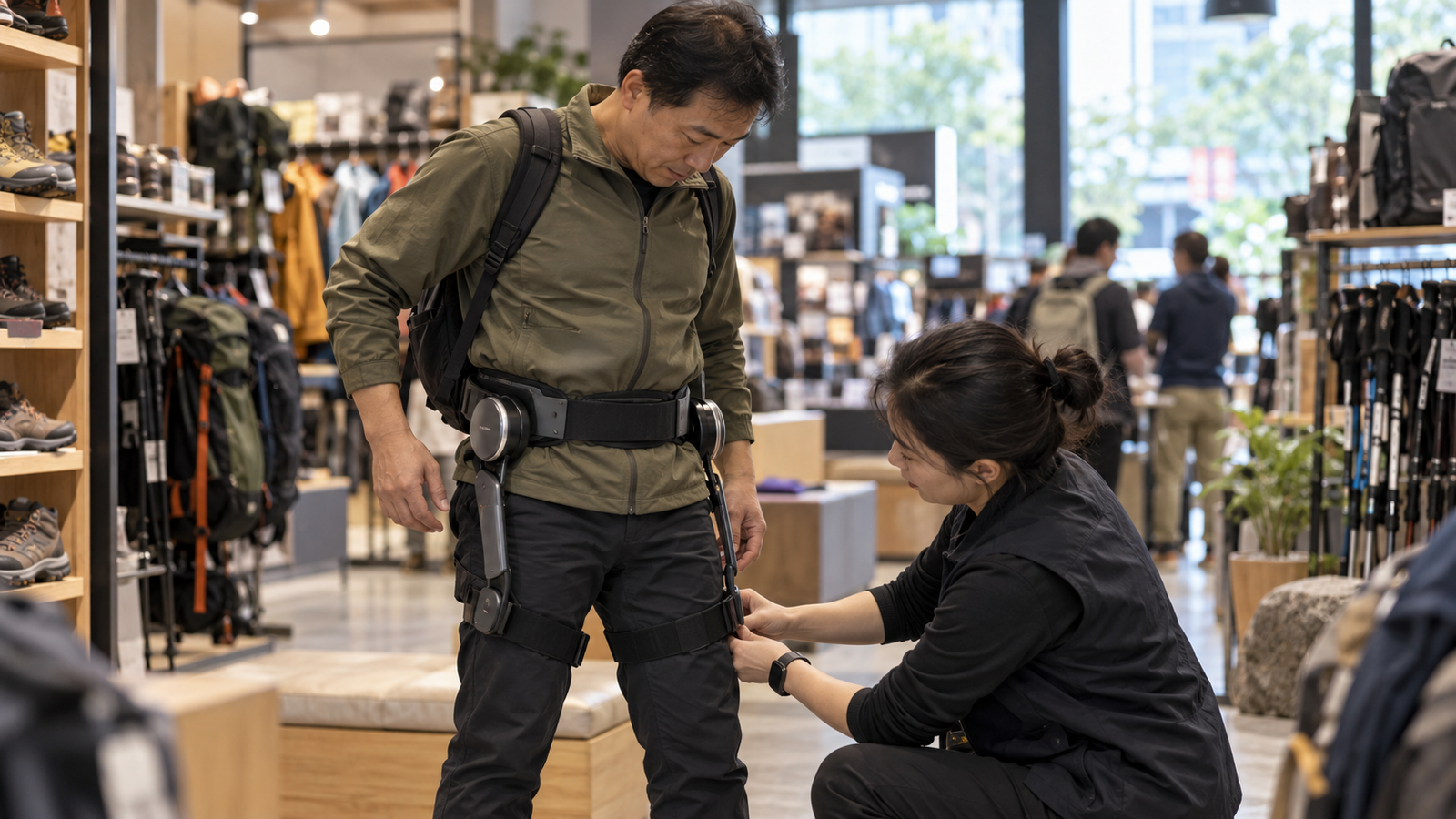
Distribution and public policy are changing as well. Beijing has introduced a 15% subsidy for eligible consumer exoskeletons, while a national multi-department policy has explicitly called for exoskeleton robots to reach older people’s homes. More experimental channels, including short-term consumer rentals in Shanghai, are also being tested.
Those developments help explain why the category is worth monitoring. They should not be presented as proven causes of the reported sales increase; the published data do not support that attribution.
Exoskeleton Index analysis
A stronger demand signal, still an incomplete market picture. The most important change is not simply a higher percentage. It is that exoskeleton-assist devices are appearing repeatedly in official consumer-sales reporting, rather than only in manufacturer announcements or technology demonstrations.
For manufacturers, distributors and investors, the next useful evidence will be less dramatic but more revealing: actual revenue and unit counts, the split between consumer and professional devices, repeat purchases, returns and the contribution of physical retail or rental channels. Until those are available, 46.4% is a credible monitored-platform growth indicator, not proof of mass adoption.
What to watch next
- Whether the ministry reports a full-year 2026 figure for the same device category and platform basis.
- Whether unit-sales and average-selling-price data become available alongside sales value.
- How subsidies, retail availability and rental trials translate into sustained use rather than one-time purchases.
Sources and reporting notes
China Ministry of Commerce, consumer-market review for the first three quarters of 2026, published October 23, 2026 (Chinese).
Translation note: 外骨骼助力器 is rendered here as “exoskeleton-assist devices.” Market context is linked to Exoskeleton Index’s earlier reporting.