
What if an exoskeleton could tell you where to go?
Exoskeletons are usually designed to help a person move: supporting a joint, reducing effort or assisting an impaired movement. XoNav explores a different role. Its motors communicate where and when to move by applying gentle physical cues at the hips.
The research system can suggest a left or right turn, encourage continued walking, or apply resistance that the wearer interprets as a request to slow down or stop. Unlike a phone’s spoken directions or a vibrating wristband, the guidance is felt directly through the joints involved in walking.
How the system communicates through the hips
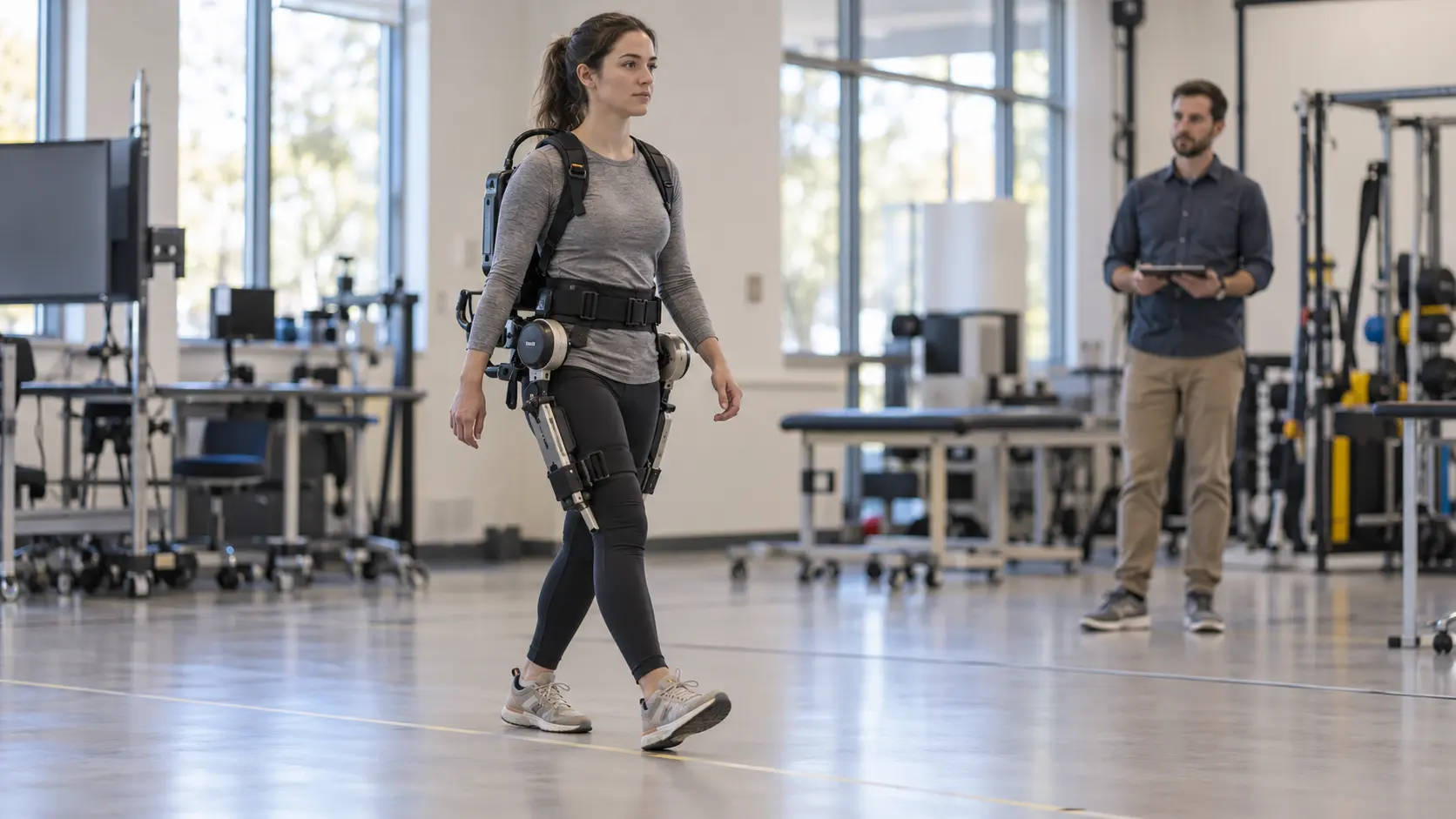
XoNav uses four actuators, with two degrees of freedom on each side. The forward-and-backward hip actuators deliver cues for advancing and braking. The side-to-side actuators produce steering cues. A classifier using two thigh-mounted inertial sensors identifies stages of the walking cycle, allowing the guidance to be synchronized with movements the user has already initiated.
The timing matters. A turn cue delivered at the wrong point in a step could be confusing or destabilizing. The researchers therefore designed the system to convey an instruction without initiating an unsolicited step, and to suppress guidance while the wearer is standing still.
A brief, gait-timed outward movement at the hip communicates which way to turn.
Resistance during forward thigh movement makes the instruction physically perceptible.
A human-in-the-loop process tunes cue strength for detectability, comfort and a defined safety bound.
What the blindfolded study actually showed
Ten healthy, sighted men walked blindfolded along three indoor paths shaped like a U, an N and a figure eight. They completed 150 guided trials in total. In this main experiment, a trained human operator selected the navigation commands. The researchers used this arrangement to test whether the physical cues worked without introducing errors from autonomous mapping and route planning.
The 98.8% value describes corridor adherence across defined indoor routes. It is not a 98.8% success rate for independent navigation, a measure of obstacle avoidance, or a clinical outcome in people with blindness.
The researchers also observed improvement across repeated trials. Average progression speed increased from about 0.24 to 0.29 m/s, suggesting that participants became more familiar with the guidance. Those walking speeds and the controlled setting matter when considering the practical significance of the result.
Autonomous navigation was tested separately, with important limitations
To explore whether the concept could eventually operate without a human issuing instructions, the team added a body-worn camera and a robotics navigation stack for indoor mapping, planning and obstacle detection.
Three participants completed a further 24 autonomous-navigation trials. Fourteen of 15 ordinary start-to-goal trials reached the target. In trials with a newly introduced obstacle, eight of nine successfully followed a replanned route. But two nominal trials involved light furniture contact, one nominal trial failed following localization drift, and a delayed obstacle registration caused a collision in another test.
These results are informative precisely because they show the limits of the approach. A haptic cue may be understandable to the wearer while the computer generating the instruction still makes a navigation error.
Exoskeleton Index analysis
The important shift is from movement assistance to movement communication. XoNav treats an exoskeleton as an interface through which a navigation system can give the body a physical suggestion, rather than as a device whose main output is additional walking power.
That creates an intriguing research direction for navigation when visual or audio cues are unavailable or competing for attention. It also introduces a different safety problem: instructions must be recognizable without compromising the wearer’s control, and autonomous perception errors must not become unsafe physical cues.
For now, XoNav belongs firmly in the research category. EI’s research and education directory provides context for distinguishing experimental control platforms from deployable mobility products.
What the study does not establish
No people with diagnosed visual impairment participated in the reported study, and the system was not compared with a white cane or guide dog. The participants were sighted, the setting was controlled and indoor, and the manuscript is a preprint. It does not establish real-world safety, independent outdoor wayfinding or clinical effectiveness.
What to watch next
The next meaningful tests would involve people with visual impairment, comparison against established mobility aids, more varied indoor and outdoor conditions, and independent evaluation of obstacle detection and failure handling. Reducing weight and improving fit will also matter before this approach can move beyond a laboratory demonstration.
The study nevertheless raises a useful question for wearable robotics: if an exoskeleton can help someone move, could it also help someone interpret the world around them?
Sources and reporting notes
Sarkar, D., Sen, S. and Arora, A., October 19, 2026. XoNav: An Exoskeleton as a Personalized Haptic Interface for Assisted Navigation. Original preprint; the source for hardware specifications, user counts, trial methods and reported results.
Exoskeleton Index reporting note. Operator-guided corridor adherence and the separate autonomous-navigation results are deliberately reported as different experiments. The authors’ proposed assistive applications are research directions, not validated clinical uses. Study results have not been independently reproduced in the sources reviewed.