
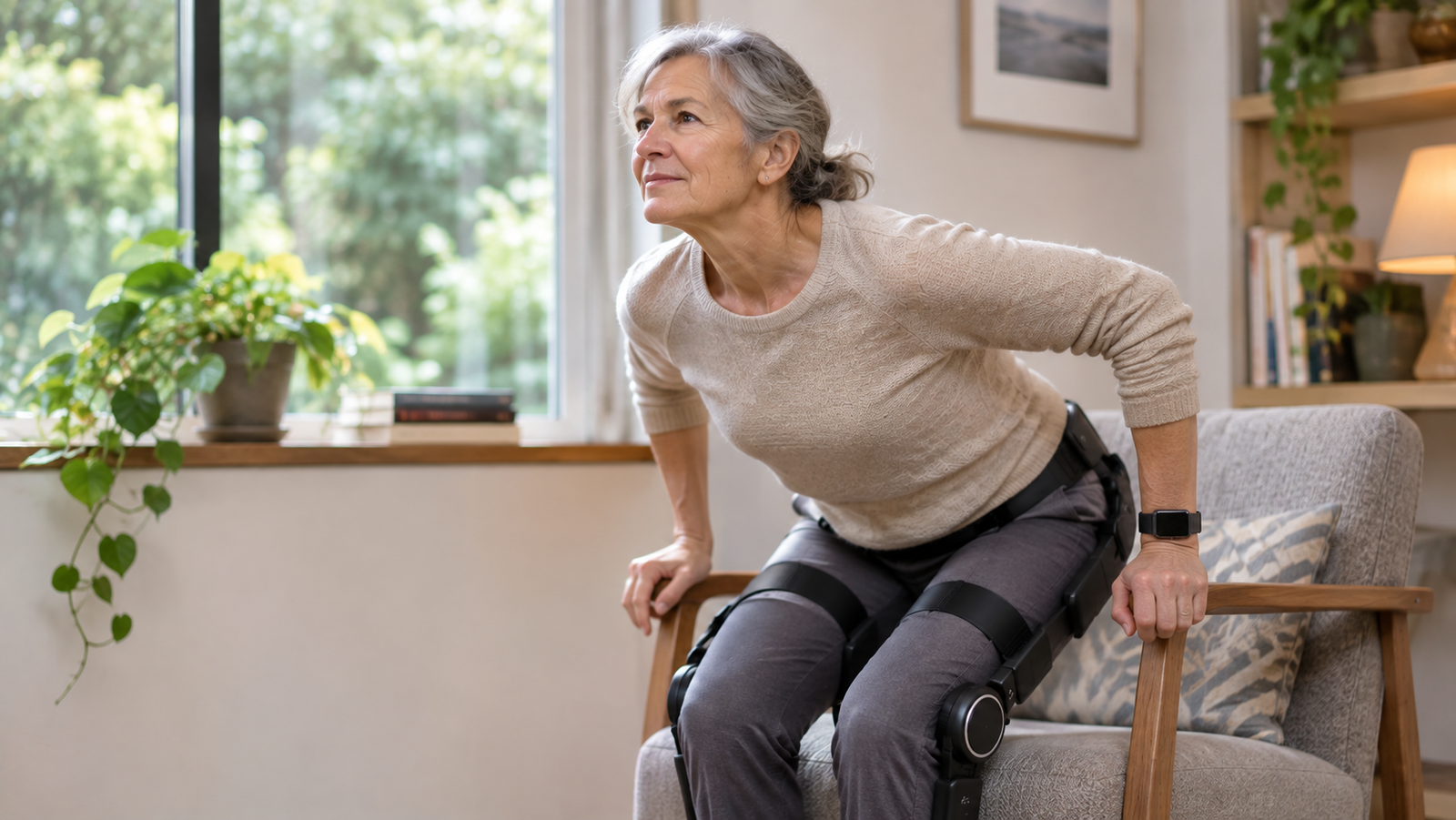
A person may be able to walk through a supermarket, travel independently and manage daily activities once upright, yet still struggle with the few seconds it takes to get out of a chair. Getting safely back down can be just as difficult.
Powered exoskeletons are moving beyond specialist rehabilitation. Manufacturers now discuss help with walking, stairs, squatting and standing. Yet walking assistance may do little to lift someone from an ordinary seat, and rising successfully tells us nothing about how safely the person can sit again.
This investigation examines those two movements separately. It asks which devices have documented transfer functions, what clinical studies actually measure, and whether those functions remain useful outside controlled settings.
A short summary of the devices, evidence and everyday challenges.
Does it actively help someone leave the seat?
Can it control the return to sitting?
Who, or what, still has to help?
Will it fit and work in everyday settings?
The critical seconds between the chair and the feet
Rising requires a sequence: the trunk moves forward, weight shifts onto the feet and the hips and knees extend as the body leaves the seat. At seat-off, the user loses support from the chair. An exoskeleton must deliver assistance at the right moment without disturbing balance.
Lowering demands a different control strategy. The joints bend under load while the body slows toward a seat whose height, position and stability may vary. Supporting the descent is not the same as merely permitting the device to enter a sitting posture.
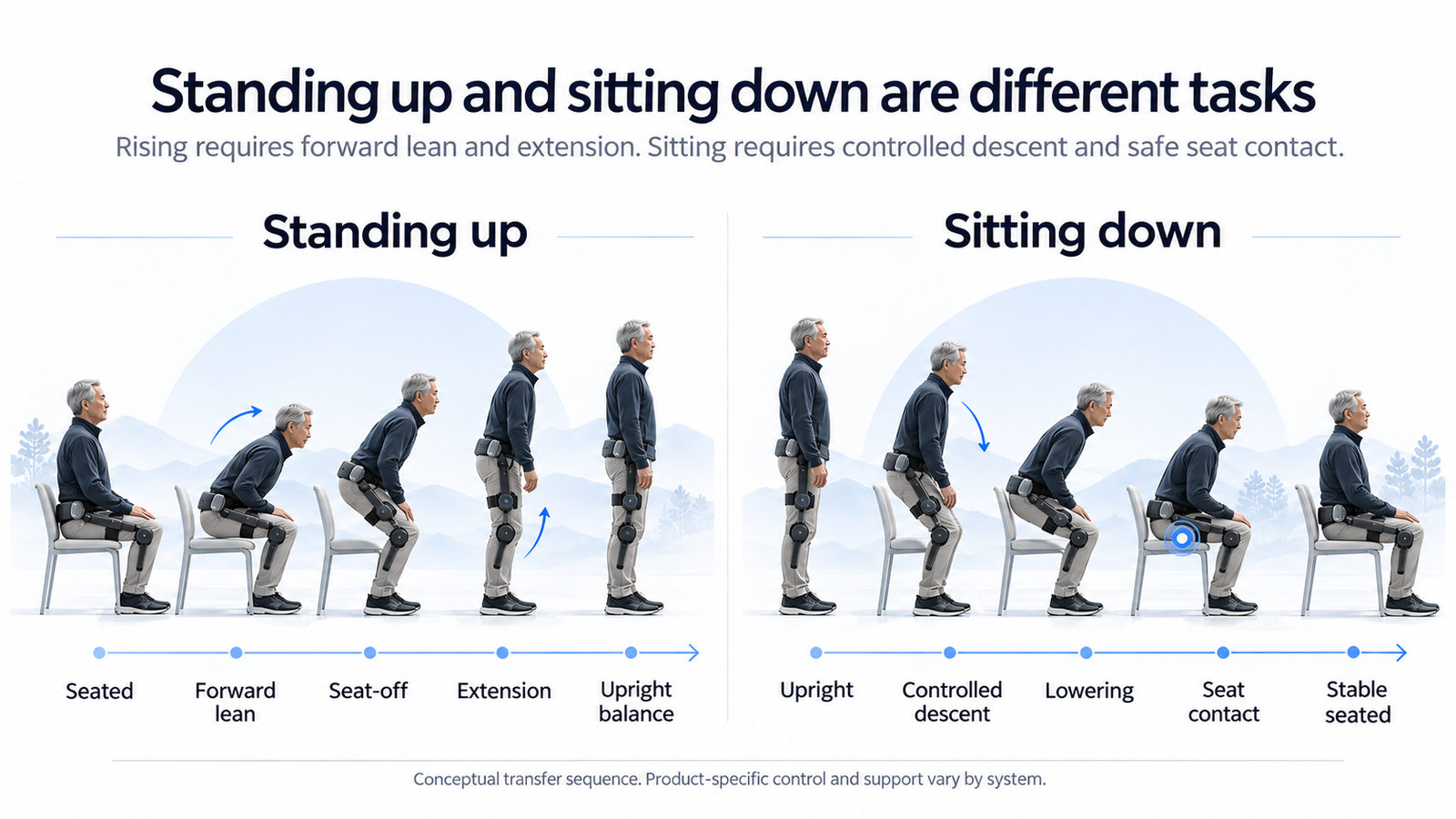
Timing matters as much as power. Assistance that begins too late may leave the hardest part of standing unsupported. Assistance that does not follow the user’s intent or posture can make the movement less natural. And even when a device holds the user upright, someone else may still be needed to position the chair, initiate the transition or steady the wearer.
A familiar phrase can describe very different functions
Product descriptions often compress several very different capabilities into the words sit-to-stand. An electrically actuated knee brace, a full medical walking exoskeleton and a rehabilitation frame with a powered seat may all be relevant to rising, but they solve different parts of the problem.
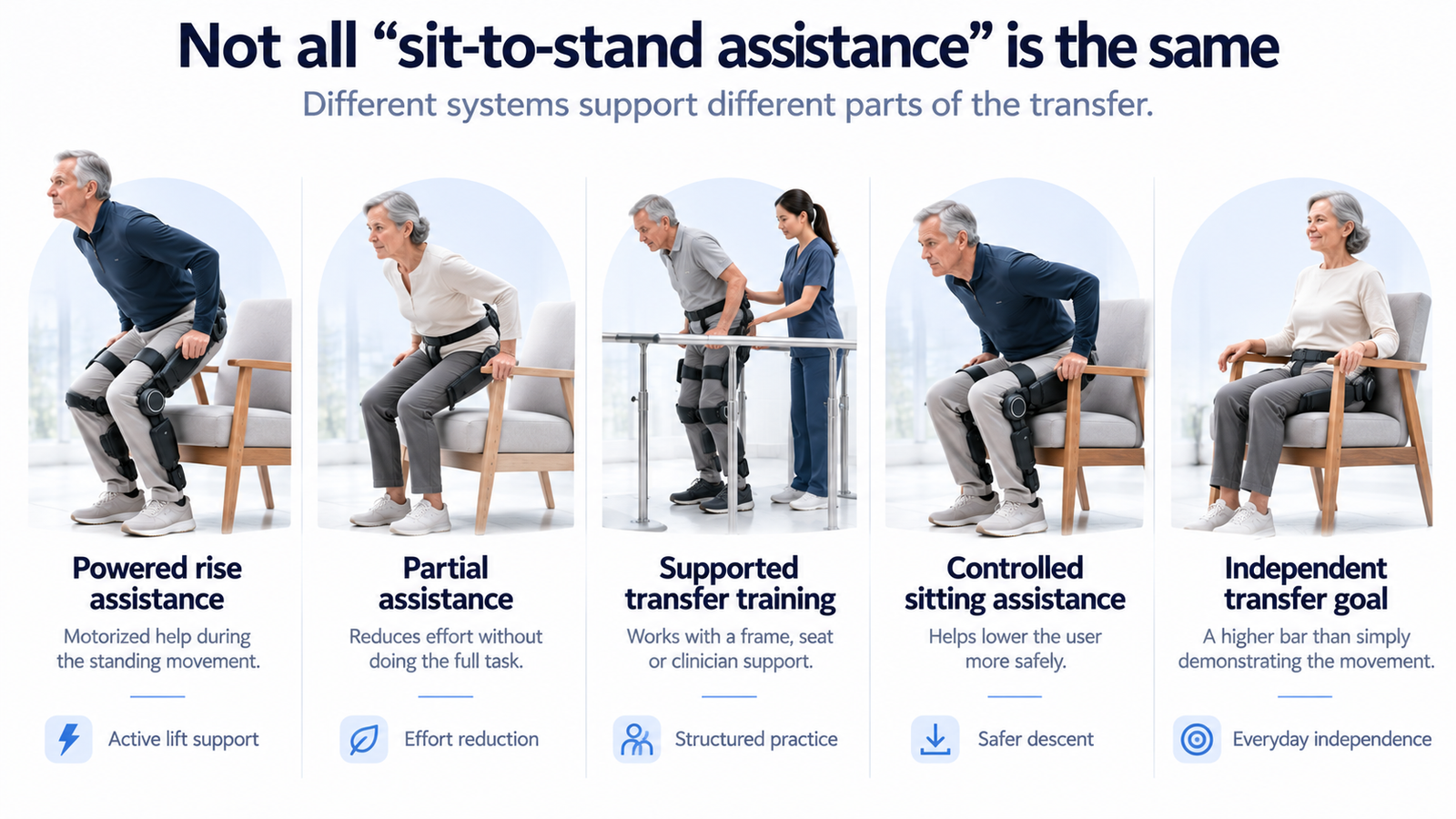
These distinctions change how we interpret a successful demonstration. With powered rising, the question is how much lift the motor supplies and what the wearer still contributes. In supported rehabilitation, the frame, seat or clinician may be doing essential work. With controlled lowering, the challenge is regulating descent and landing rather than merely entering a sitting posture.
This vocabulary is especially important when reading manufacturer claims. A laboratory demonstration with a healthy volunteer, an assisted movement in parallel bars and a person with marked weakness rising from a public toilet are not interchangeable tests.
Which exoskeletons support standing and sitting in 2026?
The most clearly documented chair-transfer functions are still concentrated in clinical rehabilitation and prescription-based personal mobility. They can be meaningful technologies without meeting the requirements of somebody looking for discreet, independent help with everyday seating. The comparison below describes what is documented, not an independently verified ranking of transfer performance.
Swipe sideways to see all comparison columns.
| System | Setting | Transfer capability | What still matters |
|---|---|---|---|
| EksoNR | Clinical | Assisted standing and sitting sequences within structured rehabilitation. | Operated in a professional setting. A clinical mode is not evidence of an independent home or toilet transfer. |
| ABLE Exoskeleton | Clinical / study | Both transitions evaluated in spinal-cord-injury training. | In a 2024 feasibility study, most participants still needed at least supervision or physical assistance to rise. |
| Ekso Indego Personal | Personal medical | Programmed standing and sitting as part of a trained personal mobility system. | User selection, support devices and companion training remain essential; not an ordinary direct-to-consumer product. |
| ReWalk 7 Personal | Personal medical | Sit/stand transitions within a prescribed personal walking pathway. | Trained-companion and user requirements apply. Research on earlier ReWalk generations is not a ReWalk 7 transfer-outcome study. |
| Wandercraft Eve | Personal medical | Personal self-balancing upright mobility with trained transfer procedures. | U.S. FDA-cleared for an eligible SCI population, but Wandercraft requires a trained companion. Self-balancing upright does not mean independent seating. |
| FREE Walk | Structured assistive | Manufacturer publishes step-by-step rising and sitting procedures. | Uses crutch positioning, deliberate body lean and training. Published instructions are not a clinical independence rate. |
| ANGEL LEGS M20 | Clinical | Manufacturer lists stand-up and sitting among its training modes. | Professional setup and support; strict model-specific fit ranges. Relevant to rehabilitation, not an unsupervised consumer toilet transfer. |
| ExoAtlet II | Clinical | Standing and sitting timing described in older model-specific documentation. | Do not transfer ExoAtlet II operating evidence to the newer Plus or pediatric SOFIA by brand association. |
| Keeogo | Partial assistance | Knee-focused powered assistance for users with residual movement. | In a 2026 neuromuscular study, reduced loading did not translate into better group-level task performance. |
| MyoSuit | Partial assistance | Hip-and-knee assistance during walking and repeated chair transfers. | In 17 adults with neuromuscular disease, group-level repeated-transfer performance was worse when wearing it. |
Scope: illustrative, evidence-qualified selection; not a complete market census. “Programmed transition” describes functionality, not verified independence, daily-life suitability or unrestricted regional access. Manufacturer manuals, intended-use documents and clinical studies should be read for the exact model and user population.
Clinical capability and personal usefulness are different
For a rehabilitation team, a controlled, repeatable stand with a harness and therapist support can be a worthwhile training intervention. For someone seeking help at a restaurant, the same requirement for a harness or a second person changes the proposition entirely. That is why the table distinguishes where a movement is performed and who helps, rather than presenting a simple yes/no feature column.
Consider Eve. Its self-balancing technology removes some continuous reliance on crutches while upright, and the FDA record K260381 confirms clearance in the United States. But use still requires clinical assessment, fitting and a trained companion within arm’s reach. This is a significant personal-mobility development, not evidence that the wearer can independently rise from any chair.
FREE Walk illustrates a different approach: its manufacturer describes moving crutches behind the wearer and leaning back approximately 10–15 degrees to initiate the sitting procedure. This is unusually useful operational detail, because it exposes the role of the user’s upper limbs and training. It also highlights why a device’s transition procedure matters more than a marketing line saying “sit and stand.”
New approaches are emerging. The transfer evidence is still limited
Newer powered hip-and-knee and knee-focused products could eventually fill a gap between lightweight walking assistance and high-support medical rehabilitation. Their architectures are relevant; their transfer-specific evidence often remains much less mature than their product announcements.
Vastnaut One 4×4
Its four powered joints are relevant to chair rising. In correspondence shared with EI by a reader, Vastnaut said that powered rising is supported while controlled sitting is still being refined. This is a manufacturer account, not independent transfer testing.
Evidence still needed Fit, procurement and outcomes in people with substantial weakness.
RoboCT GoGo-K Ultra
RoboCT’s 3 November announcement explicitly refers to rising from sitting alongside stair assistance. It does not report a transfer trial in people with weakness or separate controlled-chair-descent outcomes.
Evidence still needed Whether a stair-descent feature translates to safe sitting. It should not be assumed.
EBOT Quicker
Quicker is marketed for movement assistance, with advertised chair-transfer functionality. Its positioning is relevant to consumers, but a published claim is not an independently measured functional outcome.
Evidence still needed Controlled lowering, repeatability and results in the intended user populations.
The regional landscape is broader still. China’s Xiangyu S-RG-E01 and S-RG-E02 integrate a height-adjustable seat within a rehabilitation training frame; such a setup must not be presented as wearable-only lift assistance. Buffalo Cloud Home, India’s Astrek Unik Exo and JLT ProWalk also merit monitoring, but product advertising alone is not evidence of independent transfers.
There is a similar version problem in medical systems. ExoAtlet Plus and ExoAtlet SOFIA have distinct identities and intended populations; the second is pediatric. Gogoa HANK and UAN.GO require their own model- and intended-use analysis. We should not infer consumer availability or independent use from the existence of a clinical function.
Not everything relevant is a wearable lifting exoskeleton. Japan’s Qolo T is a commercially offered standing-training apparatus, distinct from the Qolo-1/2/3 research prototypes and the developing Qolo mobility concept. Ottobock C-Brace can provide controlled knee resistance during sitting without actively lifting the person from the seat. These technologies address neighboring problems and should not be ranked in the same product table as medical walking exoskeletons.
An overlooked user, and a difficult fit problem
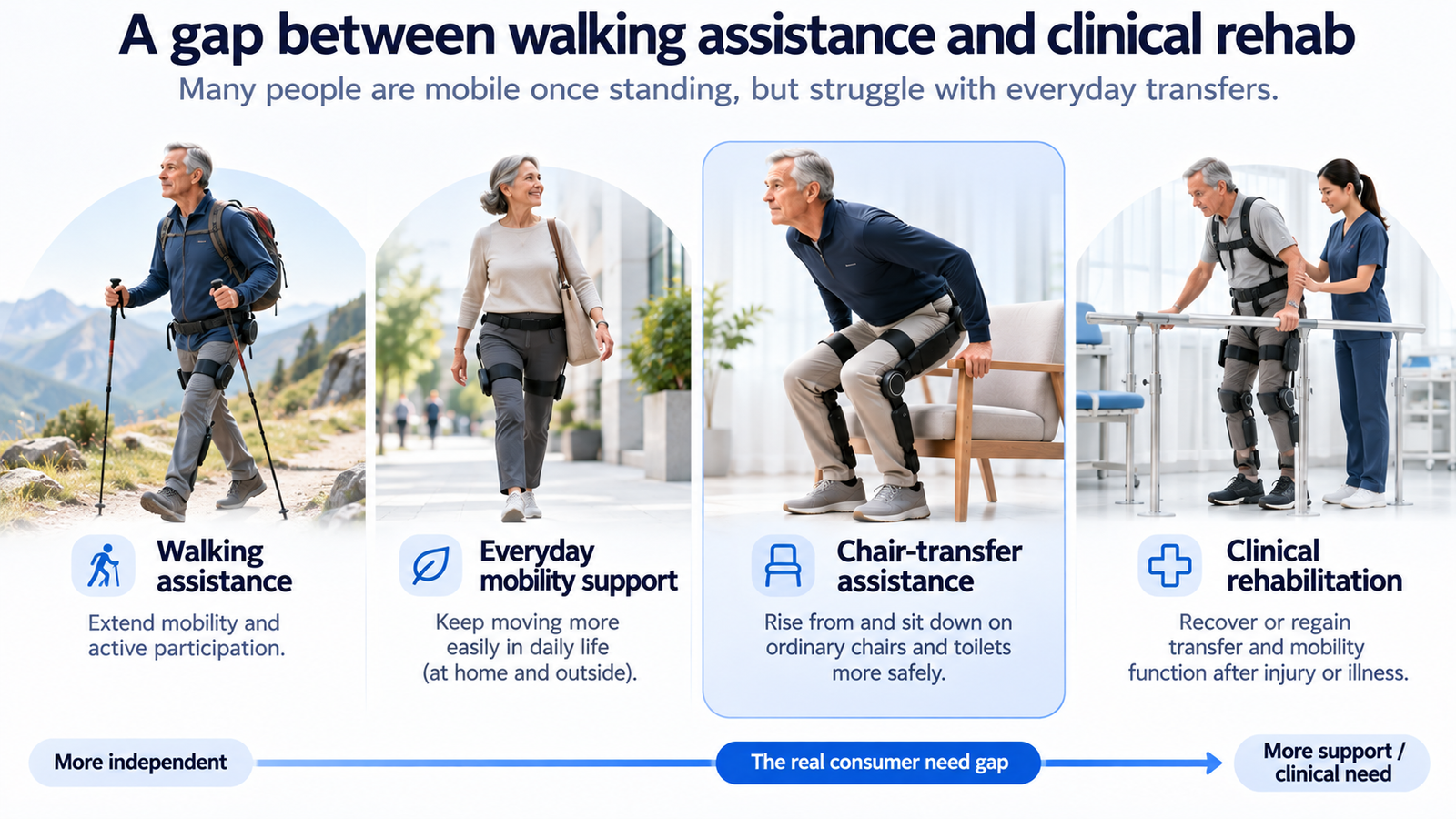
Most conversations about lower-limb exoskeletons begin with walking. Yet there is another identifiable use case: people who remain mobile once standing but have difficulty getting out of an ordinary chair or lowering themselves onto one. They may be looking for practical assistance, not rehabilitation.
This is neither the typical active hiker nor necessarily the wheelchair user learning to walk with intensive professional support. It is a group whose needs can disappear between product categories, especially when companies optimize devices for outdoor mobility or clinical gait training rather than everyday seated transfers.
Fit is not just height and weight
For any wearable robot, total body mass is only one part of the eligibility calculation. Thigh and shank lengths affect joint alignment; waist and hip circumference affect attachment and comfort; trunk control and upper-limb strength may determine whether a crutch-based system can be used. Even someone nominally inside a weight limit can be unsuitable if the frame cannot be fitted correctly or if the device obstructs seating.
The ANGEL LEGS M20 manufacturer specifications illustrate why even a single product family requires model-level fitting data.
These are distinct variants. Neither range should be generalized to every Angel Robotics system or used as evidence of independent transfers.
For the emerging consumer category, the unanswered questions are often more basic: does the manufacturer report a tested user-weight range for the exact model, are broader body shapes actually fitted during development, and does the system remain comfortable and mechanically aligned while seated? Published motor torque, a nominal maximum load or photographs of taller users cannot answer those questions.
Function must survive everyday logistics
There are practical problems that rarely appear in marketing videos. Can the user put on the device without assistance? Can clothing be managed when using a toilet? Does the equipment fit between walls, armrests or handrails? How does the person recover from an incomplete rise? Does a low or deep cushion interfere with the exoskeleton’s mechanical path?
The answers may vary with fatigue. A person can complete a transfer early in the day and struggle later after walking, shopping or travelling. A meaningful suitability assessment must examine repeated performance, not just a first successful attempt.
What does the human research actually show?
The evidence is strongest when studies report who was tested, what task was measured and whether performance improved. Reduction in muscle activation is not the same endpoint as faster rising, less physical help, safer lowering or greater everyday independence.
Two encouraging studies, two different populations
Neither is a market-ready guarantee. Both show why transfer-specific testing matters.
Powered knee assistance
A knee exoskeleton driven by muscle activity helped participants rise faster and distribute weight more symmetrically. Peak affected-side quadriceps activation also fell by 32%.
Reliable unsupervised chair or toilet transfers, controlled descent or commercial availability of the research prototype.
Soft hip exosuit
In a feasibility experiment, powered assistance increased the number of sit-to-stand repetitions in one minute compared with wearing the system without power. The study also examined the lowering phase.
A consumer product that works independently on low sofas, public toilets or across all levels of physical impairment.
When help at the joint does not help the task
In 17 adults with neuromuscular diseases, MyoSuit reduced or altered some muscle activity, yet the group completed fewer 30-second sit-to-stand repetitions while wearing it: approximately 6.5 with the device versus 7.0 without. Walking-task performance also worsened at group level. The investigators discussed the paradox that added equipment mass and changed compensatory movement can undermine assistance for people with severe weakness.
A separate study of Keeogo enrolled 23 adults with neuromuscular disease and likewise found that unloading certain muscles did not necessarily improve measured performance. One participant fell during familiarization without injury. These results do not mean either product is ineffective for every person; they do mean that assistance must be evaluated functionally in the intended population.
Making a movement less demanding for a muscle is not the same as making the movement more independent for a person.
Clinical training can improve without removing the need for help
The 2024 ABLE personal-use feasibility study offers a rare, concrete picture of transfer independence. Ten people with spinal cord injury completed a supervised training protocol. At the final assessment, nine were evaluated for the basic sit-to-stand skill.
What assistance did participants still need?
Participants generally needed less assistance for the return to sitting. Results are from a small supervised study, not a population-wide independence rate.
It also shows why the term personal exoskeleton needs context. A personal-use development program is not synonymous with a device that the wearer can operate entirely alone, especially during transfers or in emergencies.
Why controlled sitting deserves its own safety evidence
It is tempting to assume that because gravity helps the body move downward, sitting should be easier than standing. But controlled descent requires active management: the wearer must bend at the right time, avoid collapsing too quickly and meet a chair that may be lower, softer or narrower than expected.
A useful exoskeleton could accomplish that through different engineering approaches. A powered controller may drive or resist knee and hip movement; a hydraulic orthosis may regulate knee flexion; a spring-assisted system may help manage loading. These approaches can be valuable, but none should be equated automatically with independent seating or fall prevention.
In a 2026 spring-assisted Qolo study, the authors reported no intervention-related injuries or falls, but recorded a failure of the locking mechanism to release during a stand-to-sit movement. Staff intervened to lower the participant using the available safety support. The study’s lesson is not that Qolo is unsafe; it is that technical problems during descent must be captured and reported, even when supervision prevents injury.
The study concerns a supervised standing-training configuration. Its findings must not be transferred automatically to the commercial Qolo T or other Qolo prototypes.
Consider also an unexpected pause halfway down, the chair moving, an incorrect body position, or a power interruption. These are distinct failure conditions. For a product intended for independent use, the key questions are whether the system enters a predictable safe state, whether the wearer can recover without physical intervention and what the manufacturer requires a companion to do.
The adjacent example of Ottobock C-Brace is instructive: electronically controlled hydraulic resistance can facilitate controlled knee flexion when sitting, but the orthosis does not provide powered seat-to-stand lifting. The sitting function and the rising function should be assessed separately, even when the user needs both.
From a laboratory chair to the public toilet
Standardizing a chair is good experimental practice. It makes it easier to compare trials. But it also strips away many of the conditions that determine whether a transfer succeeds in everyday life.
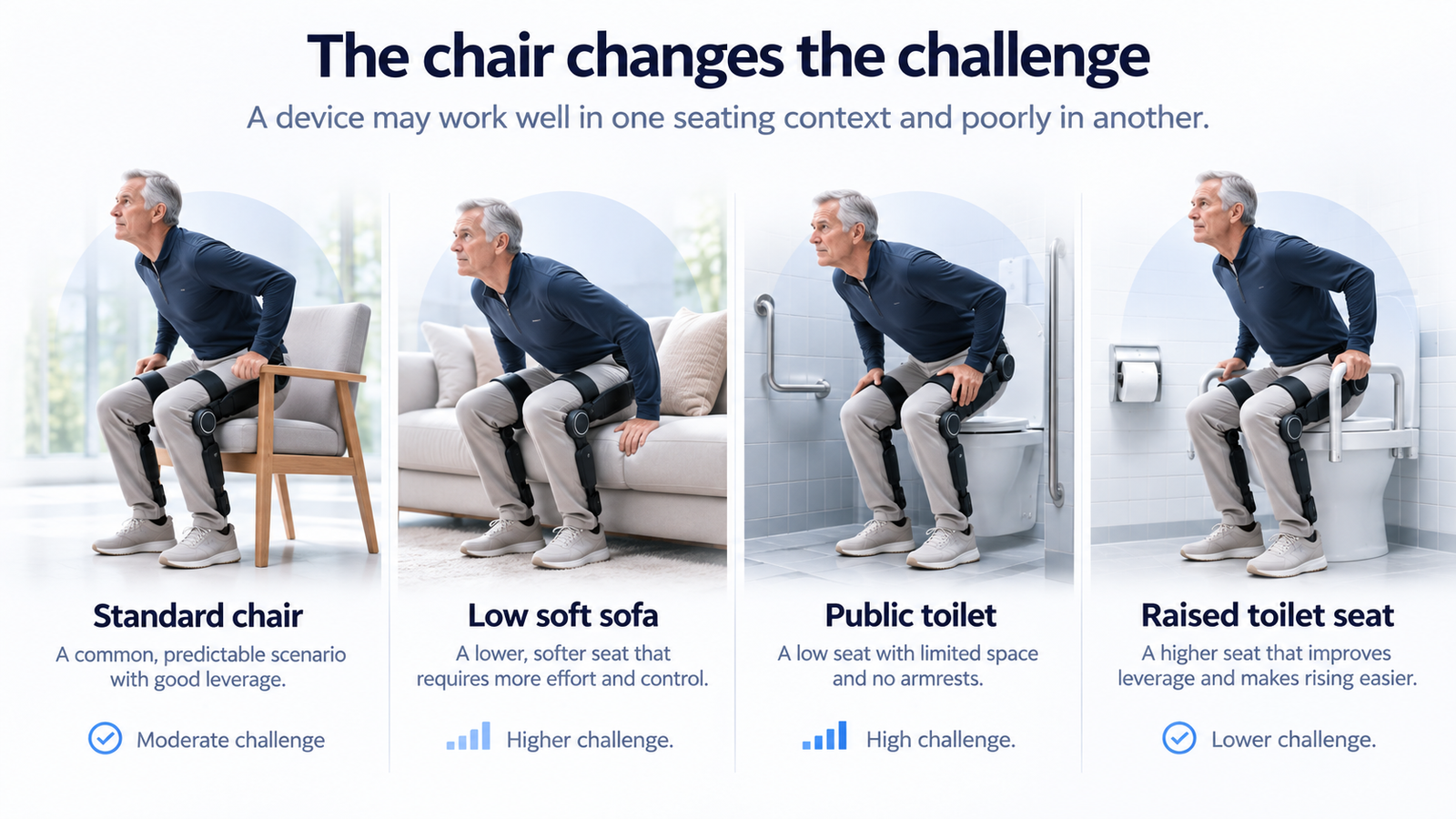
A lower surface generally increases the distance the body must rise and can change the strength and balance required. Soft upholstery compresses. Armrests offer potential leverage but may restrict the space around an exoskeleton. Public toilets introduce further constraints: limited room to position the feet, lack of arm support, clothing management and hygiene, all potentially without a companion.
The 2026 older-adult soft-exosuit study used a standardized 46 cm armless chair. That makes its controlled experiment interpretable. It does not establish that the device works in a narrow bathroom or from a low sofa after the wearer has been active for several hours.
Seat height also illustrates why the outcome needs to be reported in context. A successful transfer from a raised seat cannot simply be generalized to a lower one. Trials should disclose the chair’s dimensions and whether external supports were used, rather than treating “sit-to-stand success” as a universal capability.
What published tests still need to tell us
Exoskeleton testing is not an unregulated methodological blank slate. Standards such as ASTM F3517-21 provide a structured method for documenting movement tests, while ASTM F3474-25 addresses functional ergonomic parameters. These are useful foundations, but they do not automatically produce comparable consumer-facing evidence for a weak user rising from a low toilet and returning safely to the seat.
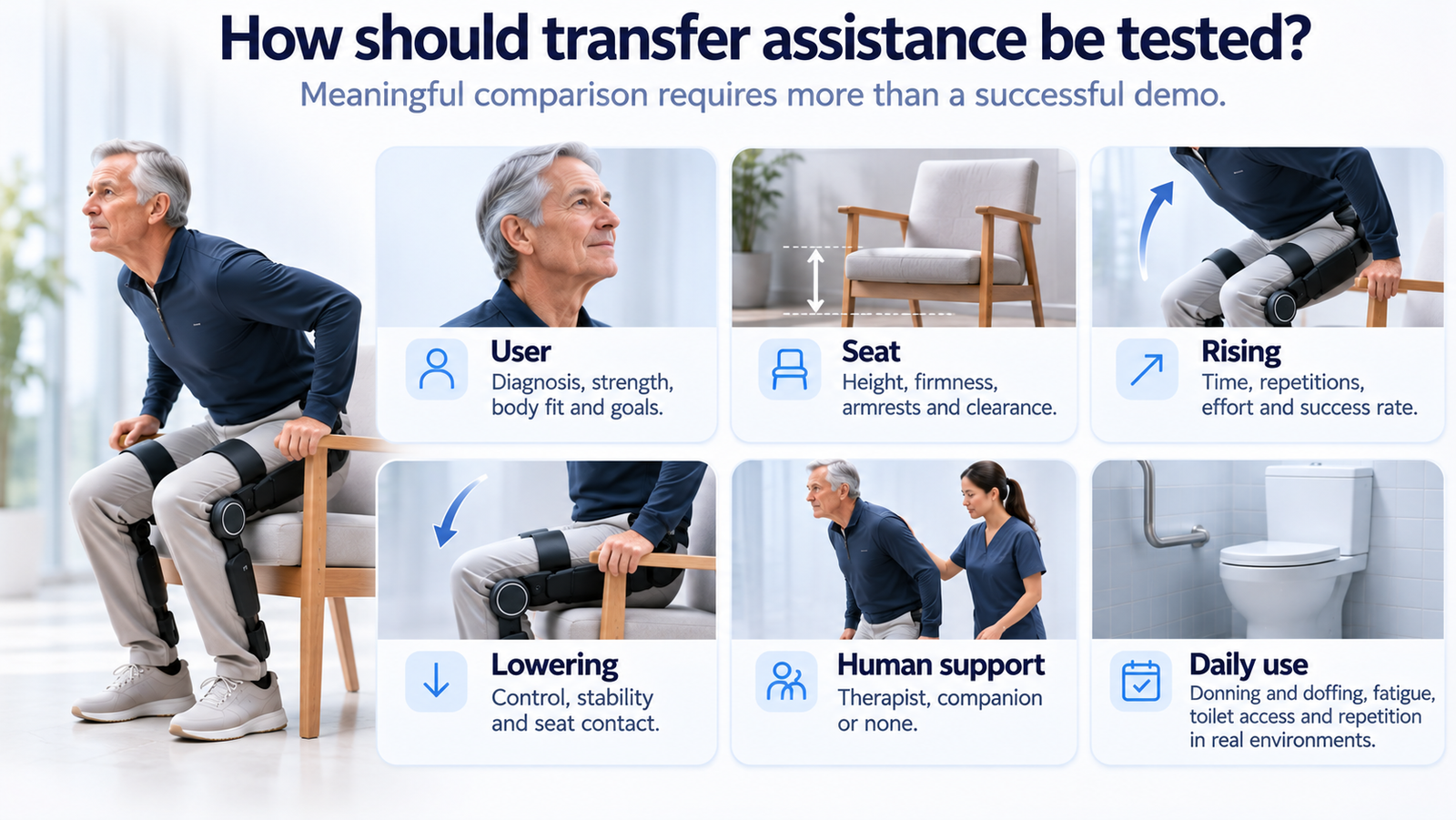
A meaningful published test must state more than the device assisted standing. The six dimensions below form an EI editorial framework for reading studies and questioning manufacturers; it is not a certification scheme or a replacement for clinical assessment.
Beyond performance: who had to help?
Time, joint torque, muscle activation and successful repetitions are valuable measurements. Yet a comparison is difficult to interpret without knowing how much external help was needed. A transfer report should specify the level of assistance separately for rising and lowering.
What changed?
Transfer time, repetitions, effort, symmetry, success and quality of descent.
Who made it possible?
Independent, supervision only, minimal physical assistance, substantial assistance or unable.
Repeated trials, representative seat geometries, fit range, user fatigue and device recovery behavior matter as well. A result obtained only with an external lifting seat, a harness, therapist input or a rigid research chair should say so clearly. The absence of negative events in a small supervised trial should not be interpreted as proof of safety in an unsupervised household.
Crucially, evidence in healthy adults can demonstrate mechanical feasibility, but cannot substitute for testing people with the functional limitations a device is marketed to address. That distinction becomes more important when claims concern independent everyday use rather than exercise or rehabilitation.
What can people actually buy, trial or access?
Availability means very different things across this market. Hospitals can obtain rehabilitation systems that are not intended for unsupervised personal use. Prescription-based mobility devices follow fitting and training pathways, while consumer wearables may be sold online without evidence of clinical chair-transfer benefit.
Clinical assessment
Evaluation and supervised training when neurological impairment or balance limitations require structured support.
Prescribed personal mobility
Individual eligibility, fitting, training and sometimes a trained companion for use beyond the clinic.
Consumer wearables
Online purchase or direct trial, often restricted to people who can already walk and balance independently.
These routes have different purposes and safeguards. A consumer mobility wearable should not be mistaken for a substitute for a prescribed medical device.
Price alone is a poor filter. It does not reveal whether the device fits, whether a trained companion is mandatory, whether a particular transfer has been tested, whether the product is approved for use in the buyer’s region, or whether it can be serviced and trialed locally. For broader context, see the EI 2026 exoskeleton price guide and consumer exoskeleton comparison.
The Exoskeleton Index view
The decisive question for the next generation is not whether wearable motors can generate assistance. We already know they can. The harder question is whether they can make an ordinary transfer more dependable for the people who need it, using ordinary seating, without introducing a new dependence on equipment, training or another person’s physical help.
The evidence points in several directions at once. Certain research systems improve rising performance. Clinical exoskeletons can make supervised transfers possible. Other studies show that reducing muscular work can coincide with worse task results. Meanwhile, controlled descent, fitting for a broader range of bodies and realistic toilet or chair use remain underreported.
That does not make the field less promising. It makes the next research and product-design priorities more specific. The test of useful transfer assistance is not the first impressive stand. It is the reliable ability to rise and sit again, under clearly described conditions, in the places where everyday life happens.
Related reading: Exoskeletons for Older Adults in 2026: What Can You Actually Buy, Rent or Trial?
Frequently asked questions
Can an exoskeleton help someone stand up from an ordinary toilet?
Some systems provide powered or programmed rising assistance, but a clinical demonstration does not establish compatibility with a particular toilet. Seat height, body fit, arm support, clearance, clothing access and the need for a companion must be assessed for the exact system and intended user.
Is a device that helps someone stand necessarily able to help them sit down?
No. Controlled lowering uses different movement control and safety requirements. Manufacturers should disclose whether descent is powered, actively resisted, passively controlled, dependent on external support or not evaluated.
Can someone use a personal medical exoskeleton alone?
Not necessarily. Several personal systems require a trained companion or specific supports. “Personal” refers to a use pathway, not a promise of independent transfers or unsupervised operation.
Does a high motor torque specification prove that a device will lift someone from a chair?
No. Actuator performance does not establish safe or successful whole-body transfer performance. Joint placement, timing, fit, posture, residual strength and the need for arm or external support all matter.
Why are height and weight limits so different between products?
Powered joint architecture, frame geometry, attachment points, loads, intended population and clinical indications vary. Even within a single product family, different sizes may have substantially different limits.
Are there standardized exoskeleton transfer tests?
There are relevant standards for documenting exoskeleton movement and ergonomic testing, but the evidence currently published does not provide a simple universal consumer score for independent rising and safe sitting across products and real seating environments.
Methodology and selected sources
Exoskeleton Index reviewed peer-reviewed studies, manufacturer documentation, regulatory information and current product materials available through 9 November 2026. We distinguish observed human outcomes from operating modes, manufacturer claims and research-only prototypes. Model versions, fitting limits and geographic access are not assumed to be transferable across an entire brand.
Our comparisons are selective, not an exhaustive commercial catalogue. The absence of independently published transfer evidence is not proof that a device cannot perform the task. Conversely, an advertised sit-to-stand function is not evidence that an intended user can operate it independently from every seat.
- Trott et al. (2026) , scoping review of 467 active lower-limb devices.
- Li et al. (2026) , review of 54 sit-to-stand designs and EMG meta-analysis.
- Powered knee exoskeleton after stroke (2025) , direct sit-to-stand outcomes in eight survivors.
- Soft hip exosuit in older adults (2026) , one-minute chair-rise feasibility experiment.
- ABLE personal-use feasibility study (2024) , support levels for everyday skills and transfers.
- Keeogo in neuromuscular diseases (2026) , biomechanical and functional performance.
- MyoSuit in neuromuscular diseases (2026) , repeated sitting/standing and walking outcomes.
- Qolo spring-assisted standing-training feasibility (2026) , 181 sessions and detailed safety reporting.
- FREE Bionics , manufacturer rising/sitting operation procedures and training information.
- Angel Robotics , M20 sizes, modes and rehabilitation support.
- U.S. FDA K260381 and Wandercraft Eve user information.
- RoboCT announcement (3 November 2026) , GoGo-K Ultra manufacturer claims.
- ASTM F3517-21 and ASTM F3474-25 , movement-test and ergonomic frameworks.
Contributor acknowledgment: Questions and correspondence from Mark Bell, author of the Sit-to-Stand Independence series, helped shape the consumer perspective of this investigation. Identifiable family medical and measurement information is not included pending explicit permission.