
China has moved exoskeleton robots into national consumer policy for the country’s aging population, with a new seven-department plan explicitly calling for the devices to enter elderly households and for age-friendly products to reach supermarkets, communities, hospitals, pharmacies and care institutions.
At a glance
- Policy
- Implementation Opinions on Promoting the Expansion and Upgrading of Commodity Consumption
- Public release
- August 31, 2026
- Issuing bodies
- Seven departments led by China’s Ministry of Commerce
- Exoskeleton provision
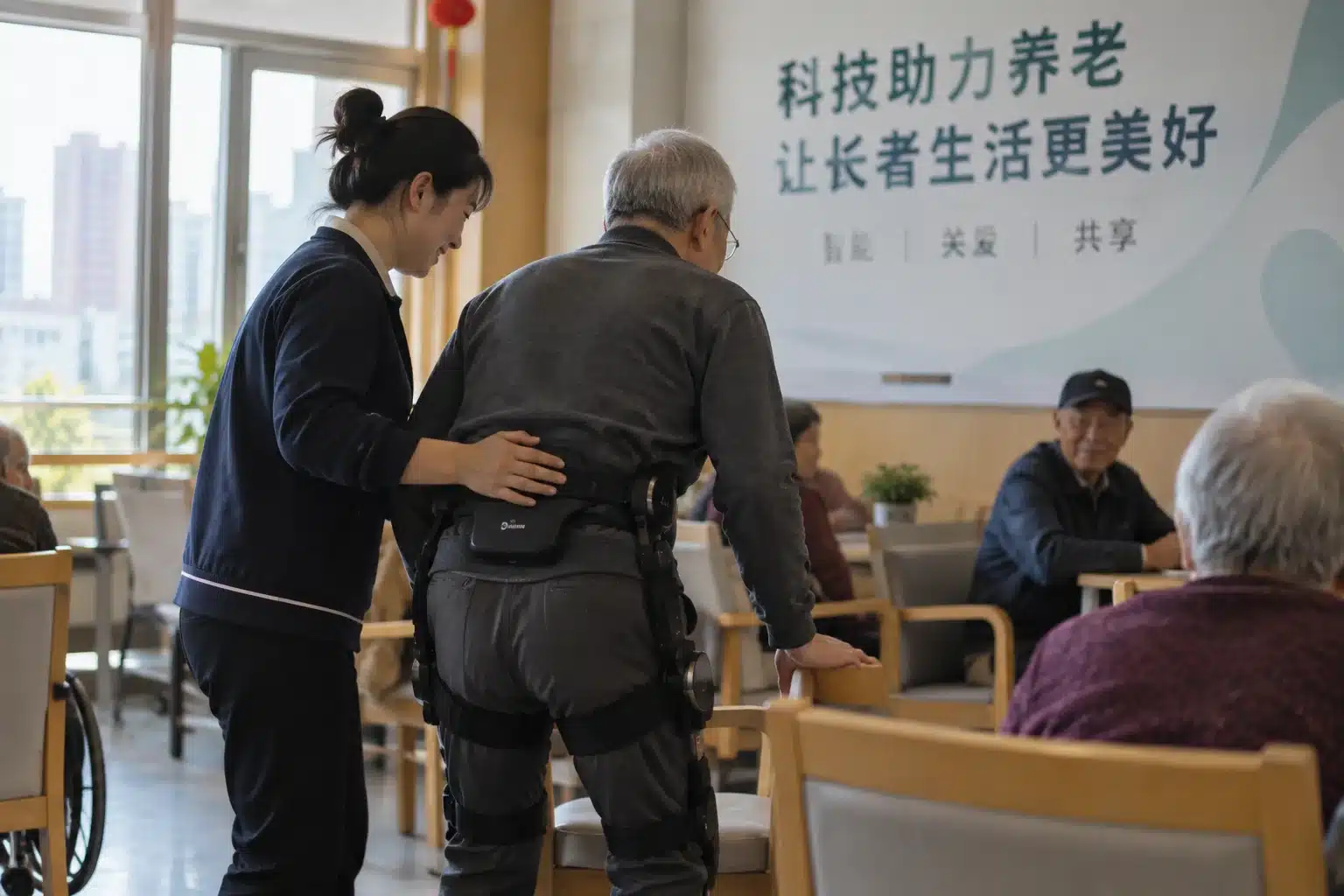
- Promote exoskeleton robots and other age-friendly products into elderly households
- Distribution push
- Encourage age-friendly products in supermarkets, hotels, communities, hospitals, pharmacies and elderly-care institutions
- Additional policy direction
- Explore a certification system for “silver” products and expand AI and brain-computer technologies in rehabilitation and age-friendly products
- Policy horizon
- Part of China’s 15th Five-Year Plan period, with broader consumer targets through 2030
Exoskeletons are now named inside a national consumer strategy
On August 31, China’s Ministry of Commerce, National Development and Reform Commission, Ministry of Industry and Information Technology, Ministry of Finance and three other national departments publicly released a 20-measure plan to expand and upgrade consumer-goods spending.
The exoskeleton language appears in the section devoted to the silver economy.
The official Ministry of Commerce text calls for stronger R&D in key technologies and components, wider use of artificial intelligence and brain-computer technologies in age-friendly and rehabilitation products, and greater promotion of high-quality products listed in China’s elderly-products catalogue.
It then names exoskeleton robots directly alongside electric wheelchairs, smart mattresses, health-monitoring systems, transfer equipment and bathing-assistance products, with the stated objective of bringing those technologies into elderly households.
This is not a product subsidy or a procurement award. It is national market-development policy.
The policy goes beyond the home
The same section also focuses on where older consumers will encounter these products.
China is encouraging commercial distributors to establish dedicated areas for age-friendly goods and to move products into supermarkets, hotels, residential communities, hospitals, pharmacies and elderly-care institutions.
The plan also proposes exploring a certification system for silver-economy products.
That distribution language is important for consumer exoskeletons. A device can be technically ready for sale and still struggle commercially if customers do not know where to try it, how to compare it or whether a product is suitable for their needs.
On September 3, the Ministry of Commerce reinforced the point in its regular press conference. When asked about the new consumer plan, ministry spokesperson Huang Ling specifically cited exoskeleton robots, smart mattresses and health-monitoring products as examples of goods being promoted for older consumers.
This adds a national layer to local exoskeleton support
The new policy arrives as several Chinese regions are already treating exoskeletons as consumer products rather than only medical or research equipment.
Beijing is currently offering a 15% subsidy on qualifying consumer exoskeletons, capped at RMB 1,500. Jiangsu has also kept exoskeleton-assist robots within its 2026 smart-product support program.
At the same time, China’s Ministry of Commerce reported that sales value for exoskeleton-assist devices on monitored key platforms rose 39.5% year over year in July.
Those are different data points and should not be collapsed into a single growth claim. Local subsidies measure policy support. The Ministry’s platform figure measures sales value across a monitored channel. The new seven-department plan sets a national direction for distribution and household adoption.
Taken together, however, they show that the surrounding commercial infrastructure is becoming more developed.
Exoskeleton Index analysis
The most significant phrase in the new policy is not “exoskeleton robot.” It is “enter elderly households.”
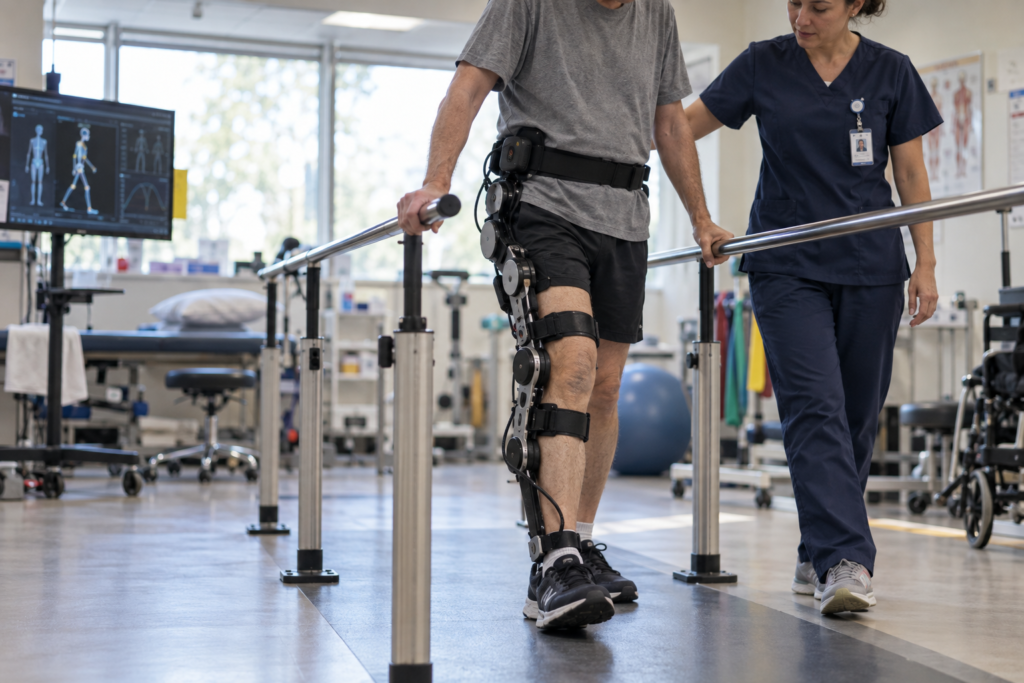
For years, China’s exoskeleton sector has had strong medical, rehabilitation and industrial research activity. The consumer market requires a different model: devices need to be understood by ordinary buyers, distributed through accessible channels, supported after purchase and positioned around everyday mobility rather than only clinical treatment.
The national plan begins to address that surrounding system.
Dedicated retail areas can create opportunities for demonstrations. Hospitals and pharmacies can provide trusted channels for health-related mobility products. Communities and elderly-care institutions can become places where older users encounter the technology without first searching for a robotics company. A future certification system could also help buyers distinguish between products in a category where technical claims and intended uses vary widely.
This does not mean China has solved the consumer exoskeleton business model. Home use raises difficult questions around fitting, balance, fall risk, training, charging, service, product liability and the boundary between general consumer mobility and regulated medical use.
But national policy is now treating exoskeletons as part of the silver-economy product mix rather than an exotic technology category. That is a meaningful change in how the market is being framed.
China is building several demand-side mechanisms at once
The broader pattern is becoming clearer.
China now has national policy promoting household adoption, provincial and municipal consumer subsidies, retail and exhibition channels, rapidly expanding domestic product supply and measurable sales growth on monitored e-commerce platforms.
The country’s exoskeleton market was already unusual in 2025 because consumer-assist products accounted for a large share of reported unit shipments even while medical rehabilitation generated more market value. Exoskeleton Index examined that split in our China exoskeleton market analysis.
The 2026 policy developments suggest that government attention is increasingly extending from supply and technology development toward actual consumption.
That matters because consumer exoskeletons will not scale through R&D alone. They need routes to market.
What remains unknown
The national plan does not allocate a specific exoskeleton budget, name eligible manufacturers, define technical standards for household exoskeletons or establish a nationwide purchase subsidy.
It also does not specify which types of exoskeleton should enter elderly homes. Consumer walking-assist devices, rehabilitation exoskeletons and medical mobility systems can differ substantially in intended use, supervision and regulatory requirements.
The proposed silver-product certification system is still described as something to explore, not a completed certification regime.
Most importantly, the policy does not provide a forecast for exoskeleton sales or evidence that household adoption will occur at scale. Its significance is directional: a national consumer strategy now explicitly includes the category.
What to watch next
The next proof points will be practical rather than rhetorical: whether exoskeletons enter national elderly-product catalogues in larger numbers, whether dedicated retail channels begin carrying them, whether certification criteria are developed and whether additional provinces translate the national direction into subsidies or procurement.
Another question is whether manufacturers build products specifically around older consumers rather than adapting hiking or general walking-assist systems for the silver economy.
For the broader healthcare and mobility landscape, see Exoskeleton Index’s Healthcare & Rehabilitation sector and our 2026 global exoskeleton market analysis.
Sources
- Ministry of Commerce of China — seven-department implementation opinions on expanding and upgrading commodity consumption, released August 31, 2026
- Ministry of Commerce of China — regular press conference, September 3, 2026
- Ministry of Commerce of China — July 2026 consumer-market update including exoskeleton-assist sales growth