
A lower chair, a harder movement
Getting up from a chair becomes increasingly demanding as the seat gets lower. For older adults with reduced lower-limb strength, a few centimetres can make the difference between completing a movement and needing assistance.
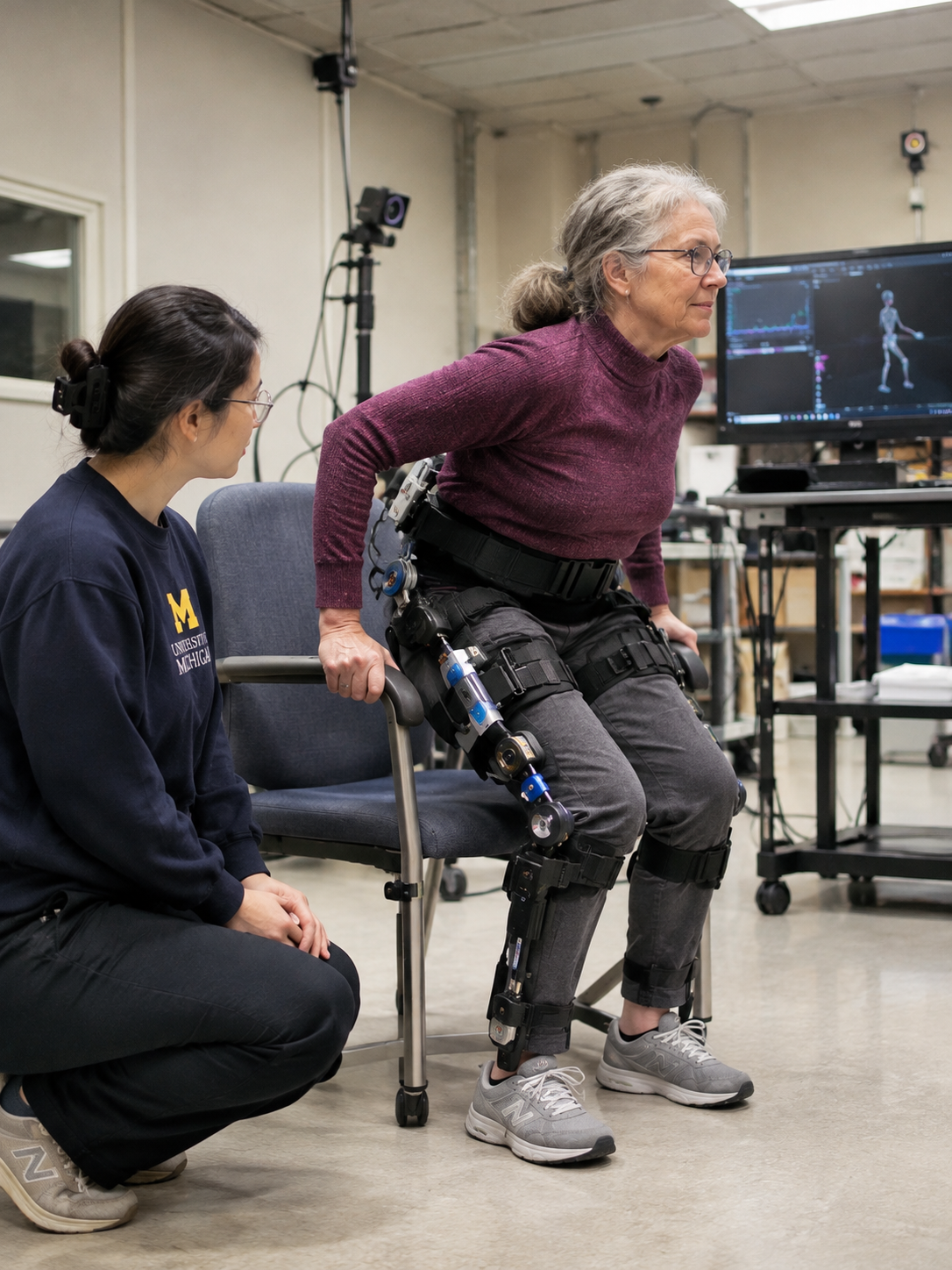
Newly posted clinical-trial results from the University of Michigan offer an unusually practical way to evaluate what a powered orthosis can contribute.
In the study’s older-adult group, the reported average minimum chair height for a successful rise was 16.00 inches without assistance, compared with 14.25 inches while wearing the powered orthosis.
That is a difference of 1.75 inches, or approximately 4.45 centimetres.
It is a promising functional observation because it focuses on what participants could actually accomplish, rather than measuring only changes in muscle activity or joint torque.
However, this was a small, controlled laboratory investigation. The result does not establish that users could perform independent transfers at home, avoid falls or achieve lasting improvements in daily mobility.
What did the trial results show?
ClinicalTrials.gov, NCT05240014. Results posted November 18, 2026. Reported values: 16.00 ± 2.31 inches without the orthosis and 14.25 ± 2.63 inches with assistance.
The public registry presents descriptive group averages for this outcome. It does not provide a separate statistical significance test for the chair-height difference in the displayed results.
That means the figures should not be interpreted as proof that the intervention produces a statistically established improvement across the wider older-adult population.
The full investigation enrolled 27 participants across several experimental groups. Nine older adults were enrolled in the relevant group, with eight completing the reported study sequence.
Participants performed tasks with and without powered assistance, allowing researchers to compare performance under different experimental conditions.
Beyond chair height: what happened to joint loading?
The study also evaluated how powered assistance affected the biological torque required during different movements.
Biological joint torque is an estimate of the torque supplied by the person’s body, rather than by the robotic device. Reducing that demand is one of the principal goals of partial-assistance exoskeletons.
During sit-to-stand, the reported biological torque decreased from approximately 0.780 to 0.634 Nm/kg. The registry also reports lower values during stair ascent, from approximately 1.205 to 0.980 Nm/kg.
Similar reductions were reported in several walking and ramp-ascent conditions.
These findings are consistent with the intended function of the powered orthosis: supplying part of the mechanical effort while the person continues to initiate and control movement.
Nevertheless, reduced estimated biological torque is not the same as improved muscle strength, improved balance or a lower risk of falling.
Nor does the newly posted record establish faster walking. Although gait speed was listed among the study outcomes, the public results do not provide corresponding measurements for that endpoint.
What is actually new in the November release?
The University of Michigan research programme has been underway for several years. The clinical trial was registered in 2022 and completed in 2025.
Related findings were already published in September 2026, in IEEE Transactions on Neural Systems and Rehabilitation Engineering.
That paper examined a bilateral hip-exoskeleton configuration in eight older adults. The researchers investigated a controller designed to provide assistance across different activities without relying on a separate predefined control mode for each task.
Across the evaluated movements, the paper reported a 24.7% reduction in biological positive work at the hip, alongside a 9.3% reduction for the lower limb overall.
Those percentages are September findings, not newly discovered November results.
What changed on November 18 was the publication of structured trial outcomes in the ClinicalTrials.gov registry, including the minimum successful chair-height comparison.
That provides another way to understand the research. Biomechanical measurements indicate how much mechanical demand the device changes; functional measurements help show whether that change affects a specific activity.
Both are useful, but neither alone establishes long-term clinical effectiveness.
Inside M-BLUE: Michigan’s modular exoskeleton platform
The research comes from the University of Michigan’s Locomotor Control Systems Laboratory, which developed the Modular Backdrivable Lower-limb Unloading Exoskeleton, or M-BLUE.
The platform was detailed in a 2022 research publication and includes modular powered configurations for the hip, knee and ankle.
Rather than building an entirely separate system for each joint, the researchers developed a modular architecture that can be adapted to different research questions and tasks.
One of the design principles is backdrivability: the ability of a person to move the robotic joint without encountering excessive mechanical resistance.
The platform uses low-impedance powered actuation to help preserve voluntary movement while generating assistance.
This is particularly relevant to daily activities that do not follow a perfectly repetitive movement pattern.
Walking on level ground, climbing stairs and rising from a chair require different joint mechanics. The laboratory’s research explores controllers that adapt to these varying demands without constantly requiring the user or therapist to select a new movement mode.
M-BLUE remains a research platform. The existence of published hardware designs and clinical experiments should not be interpreted as evidence that it is available for commercial purchase, clinical deployment or home use.
Why this result matters for sit-to-stand research
Much of the available evidence on lower-limb exoskeletons focuses on muscle activity, joint loading and metabolic cost.
Those measurements are valuable, but they do not necessarily demonstrate whether a person can complete a movement that was previously difficult or impossible.
A related issue was examined in our review of 54 sit-to-stand exoskeleton designs, based on a systematic review published in November 2026.
That research found reductions in measured muscle activation across several powered-device categories, but also highlighted the limitations of using those measurements as substitutes for real functional outcomes.
It emphasized another important distinction: standing up and sitting down are different mechanical tasks.
Rising requires enough force to lift the body, while sitting requires controlled lowering and balance. An exoskeleton that helps someone stand does not automatically provide equivalent assistance during descent.
Michigan’s chair-height measurement is therefore particularly relevant. It tests a functional threshold for rising, rather than relying only on the amount of measured unloading.
However, the current results do not establish equivalent benefits during controlled sitting or repeated everyday transfers.
How does this fit with other older-adult exoskeleton studies?
Recent research has started to examine a wider range of outcomes beyond short laboratory measurements.
For example, another study covered by Exoskeleton Index in November investigated eight weeks of exoskeleton-assisted walking and exercise in older adults.
That investigation reported improvements in several gait measures and self-reported exercise confidence after repeated supervised sessions.
It examined a different product, intervention and participant population from the Michigan research. The findings should not be directly compared as evidence that one exoskeleton performs better than another.
Together, these studies illustrate why researchers need different outcome measures.
A single-session chair-rise experiment can investigate immediate mechanical assistance. A multiweek exercise study can explore changes associated with repeated training and user experience.
Neither automatically establishes whether a person can use an exoskeleton independently, comfortably and safely in everyday life.
Exoskeleton Index analysis
The most interesting aspect of Michigan’s newly posted results is their focus on a simple and recognizable functional limitation.
For someone struggling to rise from a low chair, a reduction in joint torque is useful only if the assistance translates into a movement that becomes easier, safer or more achievable.
Minimum successful chair height offers a practical measurement of that possibility.
At the same time, the study demonstrates how cautiously laboratory results must be interpreted.
Standing from an adjustable chair in a supervised setting is different from rising from a soft sofa, a low toilet or an unfamiliar seat.
Real environments introduce additional demands: stability, space constraints, arm support, device fit, controlled descent and repeated use.
These distinctions are central to our Sit-to-Stand Exoskeletons Insight, which examines the technologies and evidence behind assisted standing and sitting, including why laboratory success does not necessarily translate into independent transfers.
Michigan’s modular approach is also technically interesting because different joints contribute differently to everyday movements. An architecture capable of supporting several configurations may help researchers investigate which assistance strategy is most useful for a particular task.
But before this becomes a practical mobility solution, the evidence must extend beyond a small group of participants and a controlled laboratory.
The next meaningful step is to determine whether measurable assistance leads to consistent, safe and useful improvements across real environments and repeated daily use.
Could Michigan’s research become a commercial product?
There is a commercial connection, although its significance should not be overstated.
The September research paper discloses that Robert Gregg has an equity interest in Motaris Inc., a company that has optioned intellectual property related to the research.
Motaris describes its business as developing wearable robotics technology for frontline workers, including applications in logistics, warehousing and retail.
This suggests potential interest in translating related engineering into industrial applications.
It does not confirm that Motaris sells M-BLUE, manufactures the specific trial device or plans to launch an older-adult mobility product.
That is an important distinction for readers exploring commercial options.
Our Exoskeletons for Older Adults Insight separates experimental research systems from products that can already be purchased, rented or trialled.
For now, M-BLUE belongs in the research category, not among confirmed consumer-ready mobility devices.
What needs to happen next?
The newly posted Michigan trial results contribute a useful functional measurement to research on partial-assist lower-limb exoskeletons.
The next questions involve reproducibility across larger groups, performance with different chair types, controlled sitting, balance and repeated everyday transfers.
Researchers will also need to clarify the contribution of the different M-BLUE configurations and determine whether the observed laboratory benefits remain useful outside the original experiment.
The value of this result is that it measures what participants could do, not only how much mechanical effort the device reduced.
Whether that advantage can translate into dependable everyday mobility remains the more important question for future studies.
Can exoskeletons really help people stand up and sit down?
Explore current products, research evidence and real-world limitations of powered and passive sit-to-stand assistance. Our independent Insight distinguishes demonstrated functions from capabilities that still require validation.
Explore the Sit-to-Stand Insight Independent research, technology and product analysis.Sources and reporting notes
New clinical-trial results. ClinicalTrials.gov — NCT05240014 . Results posted November 18, 2026. Participant flow, chair-height measurements, biological torque and other trial outcomes.
Trial record and update history. NCT05240014 structured results and record history . Details of reported trial outcomes and registration changes.
Earlier peer-reviewed research. Zhang et al., IEEE Transactions on Neural Systems and Rehabilitation Engineering, 2026 . Versatile Exoskeleton Control Supports Elderly Joint Energetics During Hip-Intensive Tasks. DOI: 10.1109/TNSRE.2026.3732581.
M-BLUE research platform. Nesler et al., IEEE Robotics and Automation Letters, 2022 . Modular powered hip and knee orthoses, low-impedance actuation and platform engineering.
Laboratory documentation. University of Michigan — Locomotor Control Systems Laboratory . M-BLUE configurations, task-adaptive control and related studies.
Additional platform resources. LocoLab hardware and data resources . Public research documentation and hardware resources.
Commercial context. Motaris official website . The September publication also discloses the relevant researcher equity interest and intellectual-property option relationship.
Related evidence. Exoskeleton Index — Review of 54 Sit-to-Stand Designs . Summary of the November 2026 systematic review and meta-analysis, including limitations of muscle activation as a functional endpoint.
Reporting boundary. The chair-height comparison is a descriptive laboratory finding in a small group of older adults. The clinical registry and related September paper describe different joint configurations. The evidence does not establish lasting functional improvement, independent everyday transfers or commercial availability.