
From human demonstrations to autonomous robot tasks
Teaching a robot to manipulate everyday objects is considerably harder than showing it what the finished movement should look like. The robot must coordinate individual fingers, maintain contact, adjust forces and complete several actions in the correct sequence.
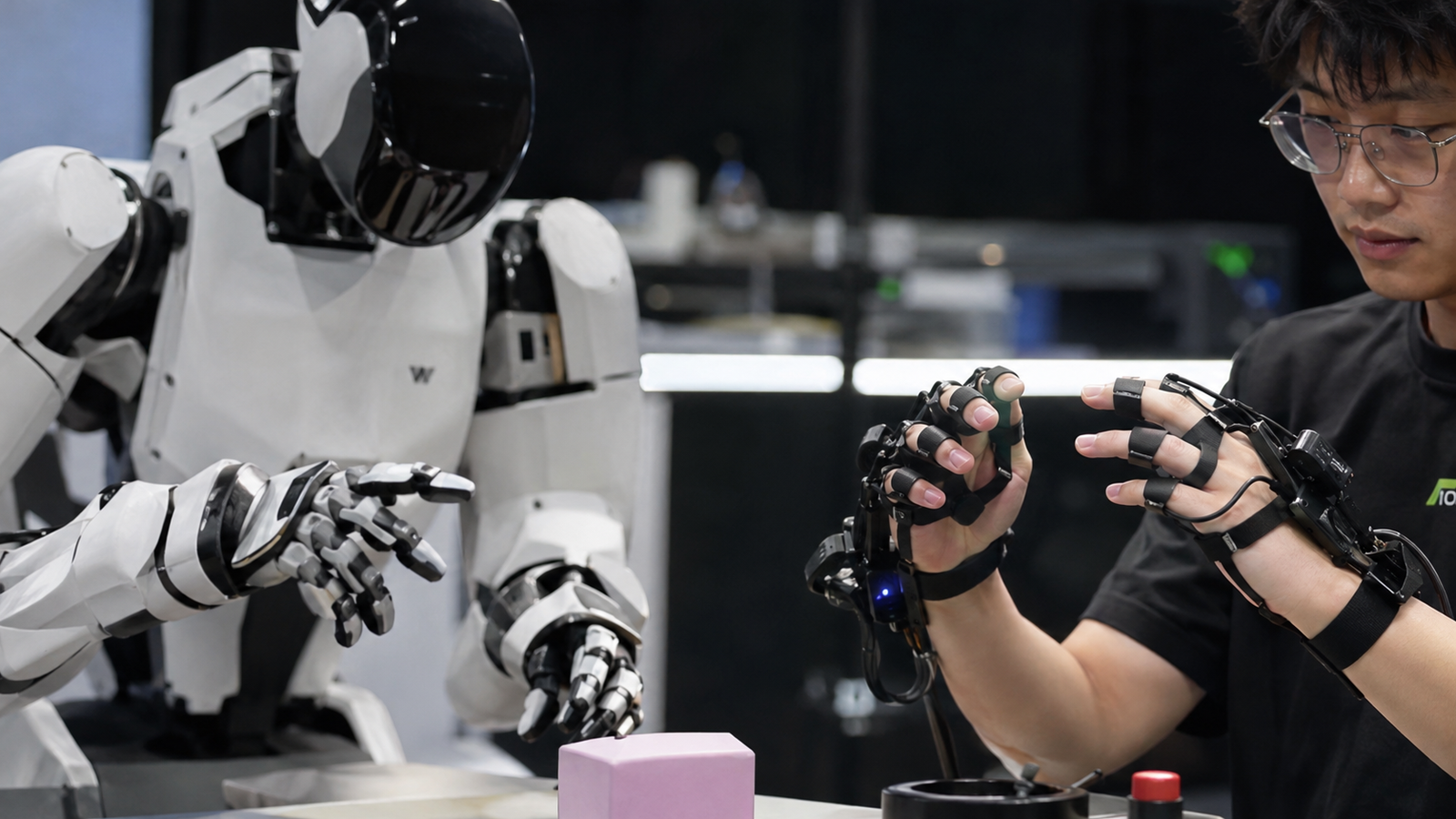
On November 16, 2026, Chinese robotics company ROBOTERA announced the commercial launch of XHAND 1 Pro-U, a five-fingered robotic hand featured in NVIDIA’s GR00T 2 research. The hand was used in demonstrations where a wearable exoskeleton captured human movements and an AI model learned to reproduce manipulation tasks on a robot.
The basic concept of using an exoskeleton to collect training data is not new. What makes this development more interesting is the combination of commercially offered robot hardware, NVIDIA’s learning system and reported autonomous task results.
ROBOTERA says the XHAND 1 Pro-U is available for commercial orders, beginning with 40 units. That figure refers to the robotic hands, not wearable exoskeletons or verified completed deliveries.
Hardware specifications and availability are company-reported. The demonstration involved NVIDIA’s research system, not a consumer assistive exoskeleton.
What NVIDIA’s DexUMI demonstration adds
NVIDIA’s GEAR DexUMI is a wearable hand exoskeleton designed to capture dexterous human demonstrations. Its mechanical linkages correspond closely to the joints of the target robotic hand, reducing the amount of movement translation required between the two systems.
The wearable uses magnetic joint encoders, fingertip sensors and a wrist camera to record both hand movement and physical interaction with objects. According to NVIDIA’s technical documentation, each wearable hand measures 15 finger-joint movements and normal and shear forces at five fingertips.
The recorded demonstrations were used to post-train NVIDIA’s GR00T 2 model. A Tianji dual-arm robot fitted with two ROBOTERA hands then attempted the corresponding tasks autonomously.
The notable distinction is that the demonstrations were collected through the wearable system, rather than by remotely controlling the target robot through the task. NVIDIA states that these particular tasks were learned from DexUMI demonstrations without additional task-specific robot teleoperation data.
Three tasks, with measurable results
The system was demonstrated on three manipulation sequences, each involving multiple coordinated actions rather than a single isolated grasp.
Preparing banana yogurt
Handling a knife, slicing a banana, removing a lid and transferring ingredients into a bowl.
Scooping granola
Coordinating container handling and controlled scooping during a two-handed food-preparation task.
Lighting a lamp
Striking a match, lighting a lamp and extinguishing the match in water through a multi-step sequence.
ROBOTERA reports overall success rates of 60% for banana yogurt, 80% for granola and 75% for the match-and-lamp task. NVIDIA’s GR00T 2 research page confirms the demonstrations and the use of ROBOTERA hands, although those specific percentages come from ROBOTERA’s commercial announcement.
The tasks are particularly interesting because they include tool handling, changing contact conditions and sequential two-handed actions. They require more than simply closing fingers around an object.
However, these results remain limited to the reported evaluation conditions. They do not establish that the system can reliably manipulate unfamiliar objects, operate in arbitrary environments or perform unrestricted household tasks.
How does this differ from Chestnut Robotics’ Aero UMI?
Exoskeleton Index previously covered Chestnut Robotics’ Aero UMI, introduced in September 2026. Both developments use wearable exoskeleton technology to narrow the gap between human demonstrations and robotic manipulation.
Chestnut’s architecture pairs Aero UMI with its 18-degree-of-freedom Aero Hand. The wearable and robotic hardware were designed together around matching kinematics. The company also positions Aero UMI as an interface for direct robot teleoperation.
NVIDIA’s DexUMI takes a related approach, but the current ROBOTERA announcement adds a clearly documented autonomous learning workflow involving GR00T 2 and a commercially offered robotic hand.
That is an important difference in the available evidence, not proof that either system is technically superior. The two platforms have different hardware configurations, and no independent head-to-head benchmark has established which collects better data or trains more reliable robot policies.
The comparison also highlights the distinction between direct control and autonomous learning. As explored in our coverage of exoskeleton-based robot control aboard the International Space Station, wearable systems can serve as interfaces between human operators and remote machines. DexUMI’s primary role here is different: collecting demonstrations so a robot can subsequently perform tasks without continuous human control.
Why ROBOTERA is commercialising the hand
XHAND 1 Pro-U uses a 16-degree-of-freedom mechanical design with five articulated fingers. ROBOTERA describes improvements in thumb positioning, finger movement and palm-side tactile sensing intended to support more varied manipulation tasks.
Matching the robotic hand to the demonstration hardware may reduce some of the retargeting work involved in training, while helping preserve useful finger movement and contact information.
But mechanical correspondence alone does not guarantee successful transfer. Differences in actuation, force control, contact friction and object behavior can still produce failures during autonomous execution.
The commercial release gives robotics developers an opportunity to access hardware associated with the demonstrated research. Whether that leads to broader adoption will depend on pricing, availability, integration effort, durability and repeatable performance outside the original experiments.
Exoskeleton Index analysis
The most meaningful part of ROBOTERA’s announcement is not the existence of another dexterous robotic hand.
It is the increasingly complete connection between wearable data collection, robot learning and commercial hardware.
Our earlier coverage of Chestnut Robotics demonstrated the growing interest in designing exoskeletons and robotic hands as paired systems. NVIDIA’s GR00T 2 work goes further by showing specific autonomous manipulation tasks learned from wearable demonstrations, with reported success rates.
That provides a more concrete research outcome, although the absence of standardized comparisons still limits conclusions about how much the wearable architecture improves training efficiency or reliability.
The broader implication for wearable robotics is significant. Exoskeletons are becoming not only devices that assist humans, but also instruments for generating physical-world training data.
The practical questions are now about scale: how quickly operators can collect useful demonstrations, how comfortably the wearable can be used for extended sessions, how much calibration is required and how reliably learned skills transfer to robots.
For companies investing in Physical AI, the quality and economics of that data pipeline may become just as important as the robotic hand itself.
From impressive demonstrations to repeatable robot skills
The next step for ROBOTERA and NVIDIA’s wearable-to-robot approach will be demonstrating consistent performance across a broader range of tasks, users, objects and environments.
Independent comparisons could also help establish whether mechanically matched hand exoskeletons offer measurable advantages over conventional teleoperation and other demonstration-capture methods.
For now, the XHAND 1 Pro-U launch connects a promising research approach with an identifiable commercial product. The demonstrations suggest that wearable exoskeletons can provide useful training data for complex manipulation, while also showing how much work remains before those skills become broadly reliable.
Another approach to teaching robots through wearable exoskeletons
In September 2026, Chestnut Robotics introduced Aero UMI, a wearable hand exoskeleton designed alongside its matching 18-DoF Aero Hand. Explore the hardware architecture, human-to-robot movement mapping and remaining technical challenges.
Read the Chestnut Robotics Article Independent analysis of wearable robotics and Physical AI.Sources and reporting notes
ROBOTERA commercial announcement. ROBOTERA, November 16, 2026 . XHAND 1 Pro-U specifications, initial commercial availability, hardware positioning and company-reported task success rates.
NVIDIA research. GR00T 2: Scaling Robot Foundation Models for Generalization, Dexterity and Adaptation . Independent project documentation confirming the DexUMI-to-ROBOTERA demonstration workflow and the three manipulation tasks.
NVIDIA technical white paper. GR00T 2 research paper, November 2026 . Experimental architecture, demonstration sequences and research context.
Wearable hardware documentation. NVIDIA GEAR DexUMI documentation . Joint sensing, fingertip-force measurement, wearable architecture and data collection.
Earlier related technology. Original DexUMI research . Historical context for wearable manipulation-data systems.
Exoskeleton Index reporting. Chestnut Robotics Aero UMI, September 30, 2026 . Related wearable-to-robot architecture and limitations of current evidence.
Reporting boundary. The 40-unit initial release concerns robotic hands, not wearable exoskeletons or completed deliveries. The 60%, 80% and 75% task success figures are reported by ROBOTERA and should not be interpreted as general autonomous manipulation capability. No head-to-head performance comparison with Chestnut Robotics has been established.