
Hunan Yijiang Medical says its newly launched “invisible” walking-assistance robot has generated more than CNY 150 million in intent orders, roughly US$22.4 million, after its debut at China’s largest rehabilitation and assistive-technology exhibition. The figure is not booked revenue, but if the company’s reported deposits and order interest convert into deliveries, it would represent a notable commercial signal for China’s rapidly developing assistive exoskeleton market.
- Company
- Hunan Yijiang Medical Technology
- Product
- Company-described “invisible” walking-assistance robot
- Launch venue
- 2026 China International Welfare Expo and China International Rehabilitation Expo, Beijing
- Reported intent orders
- More than CNY 150 million, approximately US$22.4 million
- Reported first transaction
- CNY 300,000, approximately US$44,700. The source does not establish this as a single-device price.
- Reported deposits
- Company says prepayments have been received for more than 1,000 units
- Form factor
- Company says the thickest section is about 2 cm and can be hidden under ordinary trousers
- Evidence status
- Commercial figures are company-reported and were published by the Hunan provincial industry authority. They are not audited sales or recognised revenue.
The number is large enough to matter, but it needs the right label
Yijiang’s commercial claim appeared in a 14 September report published by the Hunan Provincial Department of Industry and Information Technology. The report quotes company vice general manager Duan Rongqiong as saying the walking-assistance robot made its market debut at the Beijing expo, produced a CNY 300,000 first transaction and has since accumulated more than CNY 150 million in intent orders.
At the 15 September 2026 exchange rate used for reader context, CNY 150 million is approximately US$22.35 million, while CNY 300,000 is approximately US$44,700. The CNY 300,000 figure is an order value. The available source does not say that one robot costs CNY 300,000, so it should not be interpreted as a unit price.
The same report says prepayments have already been received for more than 1,000 units. That is potentially more meaningful than a simple expression of interest, but it still does not tell us how many orders are binding, how large the deposits are, when deliveries are scheduled or what cancellation terms apply.
For that reason, Exoskeleton Index is treating the announcement as a commercial demand signal, not as evidence that Yijiang has already generated CNY 150 million in recognised sales.
A walking-assistance device designed to disappear under clothing
The product is being marketed around a very different visual proposition from conventional rigid rehabilitation exoskeletons.
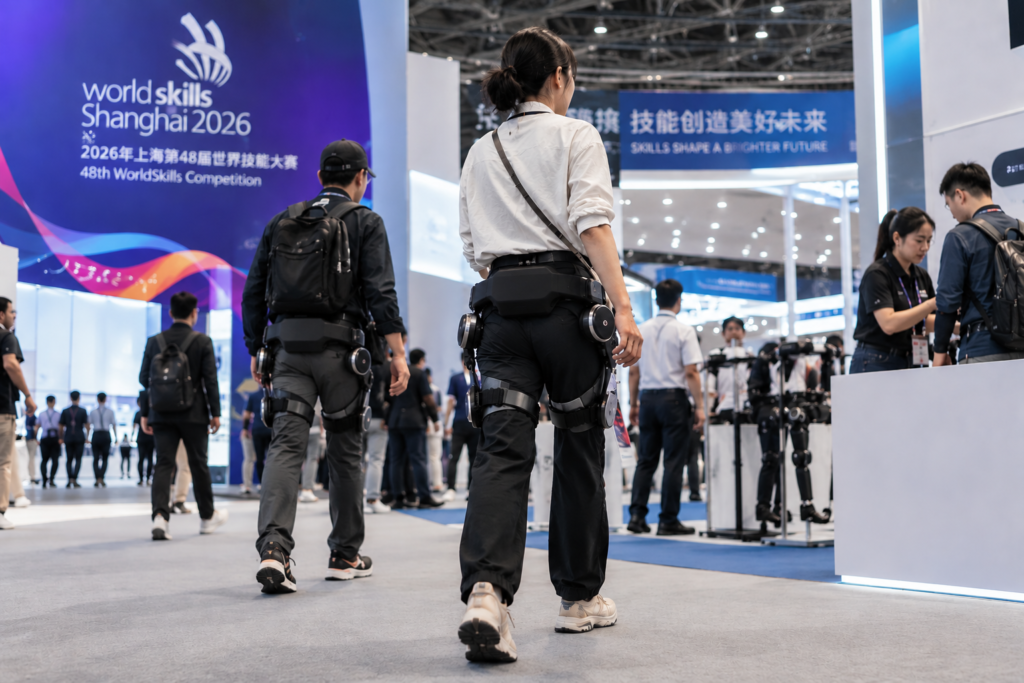
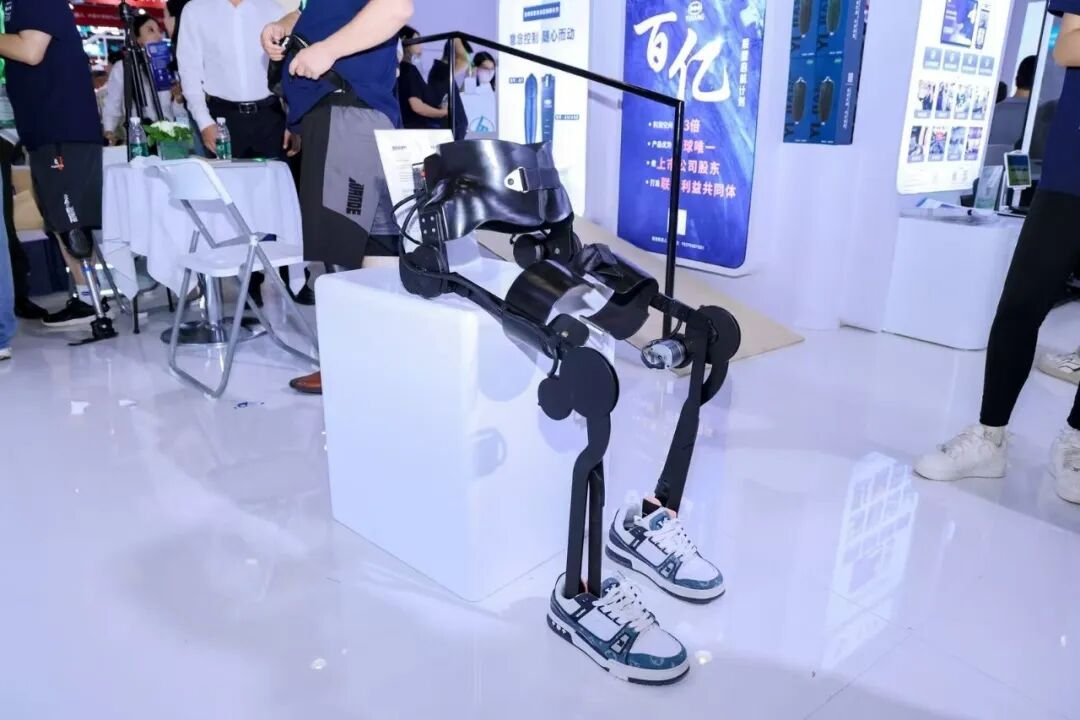
Yijiang says the thickest section of the system is only about 2 cm and that the device sits close enough to the leg to be hidden beneath ordinary trousers. The company uses the term “invisible robot” to describe that low-profile form factor. The device is not literally invisible.
According to the company, its control system uses a predictive assistance algorithm to detect walking intent and provide power as movement begins. Yijiang says the system can adapt assistance across slow walking, faster movement and everyday situations including stairs.
Those performance descriptions remain manufacturer claims. The public material reviewed by Exoskeleton Index does not yet provide independent testing, detailed torque specifications, battery endurance, total system weight, a public retail price or a full regulatory profile for the new device.
The launch happened inside a much larger Chinese assistive-tech market
The commercial context around the Beijing launch is important.
The 2026 China International Welfare Expo and China International Rehabilitation Expo ran from 3 to 5 September at the China National Convention Center. Official event material says more than 500 companies and institutions participated, with more than 50,000 visitors and over 10,000 rehabilitation and assistive-technology products and innovations represented.
The exhibition also placed unusual emphasis on robotics, artificial intelligence and brain-computer interfaces. That matters because Yijiang was not introducing its product into an isolated exoskeleton event. It was entering a large purchasing and distribution environment spanning rehabilitation, ageing, disability support and home-care technology.
Yijiang also told Chinese media that its wider business now reaches more than 30 countries and regions, including Russia, Ukraine and Hungary, using both direct sales and distribution. The company said it expects overseas markets to become an important growth driver.
Exoskeleton Index analysis
The most interesting part of this story is not the “invisible robot” label. It is the possibility that China’s assistive exoskeleton market is beginning to produce meaningful order pipelines around products intended for everyday use.
That possibility fits a broader pattern we have been tracking throughout 2026.
China’s national consumer plan now explicitly calls for exoskeleton robots to enter elderly households. Provincial programmes have added consumer subsidies for assistive exoskeleton products, while Ministry of Commerce data showed a 39.5% year-over-year increase in exoskeleton-assist sales value on monitored key platforms in July.
Those datasets describe different parts of the market and should not be combined into one growth rate. But the direction is increasingly consistent: exoskeletons are appearing simultaneously in policy, retail channels, elderly mobility, accessible transport and rehabilitation purchasing.
Yijiang’s reported order interest adds another layer. If significant volumes move from deposits to delivered units, the company would provide a useful case study in whether lower-profile assistive systems can scale beyond demonstrations and specialist clinics.
The next question is therefore not whether CNY 150 million sounds impressive. It is how much of that pipeline converts into delivered devices, at what price and through which customer channels.
What remains unverified
The available information does not disclose the buyer mix behind the reported CNY 150 million in intent orders, the average order value, the share represented by domestic versus overseas customers, the size of the deposits received or the expected delivery schedule.
It also does not provide an independently verified unit sales figure.
Because the commercial numbers originate from company statements, Exoskeleton Index is not treating intent orders as booked revenue or completed sales. The strongest confirmation would be evidence of shipments, disclosed contract awards, distributor orders with quantities or later financial reporting.
What to watch next
Three developments would materially strengthen the story.
First, Yijiang needs to publish a clearer product specification and commercial offer, including weight, battery endurance, assistance level, fitting range, price and regulatory status. Second, the company’s reported deposits need to convert into identifiable deliveries. Third, its international expansion claims should start appearing through named distributors, procurement records or customer deployments.
If those pieces arrive, the Beijing launch could prove to be more than a strong trade-show response. It could mark the emergence of another commercially relevant Chinese wearable-robotics supplier.
For wider market context, see Exoskeleton Index’s 2026 exoskeleton market analysis and our new Exoskeleton Price Intelligence guide.