
Less energy to run. But does it make you faster?
A wearable device weighing only a few dozen grams could sound too simple to make a meaningful difference to running. Yet a new Stanford study suggests that an elastic band connecting a runner’s shoes can reduce the energy required to maintain a fast pace.
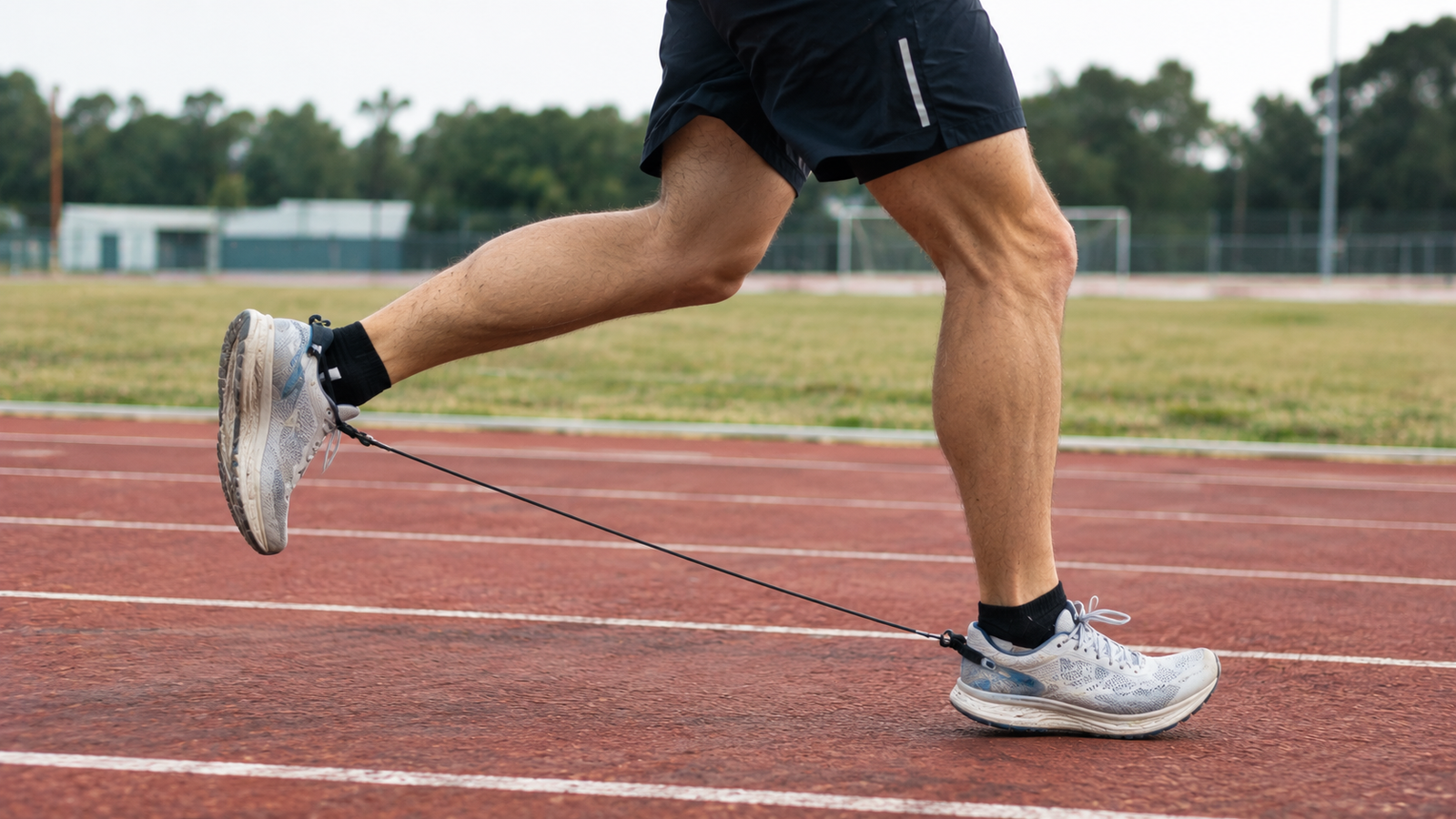
The device is called an exotendon. It does not use motors, sensors or software to push the wearer forward. Instead, it stretches and recoils as the legs move, returning some mechanical energy during the running cycle.
In experiments published on November 20 in PLOS Computational Biology, researchers reported a 5.7% reduction in metabolic energy cost at a treadmill speed of four metres per second with one exotendon design. That is about 14.4 km/h, or a 4:10-minute-per-kilometre pace.
But the team’s follow-up track trial did not establish that the device made runners reliably faster over 5 km. The distinction between using less energy at a fixed speed and finishing a race faster is central to what the study actually demonstrates.
Results are from a small, peer-reviewed experimental study. The 5.7% figure concerns net metabolic energy expenditure at a set treadmill speed, not a 5.7% improvement in race pace or finishing time.
How can an elastic band help with running?
An exotendon links the shoes and alternately stretches and relaxes as the feet separate and move through the gait cycle. Like a spring, it can store energy as it is stretched and release energy as it recoils.
This is a very different mechanical approach from the powered hip-assistance devices compared in our Consumer Exoskeleton Insight. Those systems use actuators and control electronics to deliver assistance. The Stanford prototype is passive, extremely light and intended for an experimental running task.
Its apparent simplicity does not make the design problem trivial. A band that is too short, too stiff or too compliant may change stride mechanics without reducing effort. The researchers therefore tested whether a digital model of a runner could narrow down the useful combinations before physical trials.
Researchers screened 25 designs before testing four
The Stanford team built a muscle-driven simulation of running at four metres per second. By varying exotendon length and stiffness, they assessed 25 potential configurations and selected four with different predicted outcomes for testing.
25 simulated versions
A computer model screened length-and-stiffness combinations before experiments with runners.
One clear winner
The previously studied medium-length, medium-stiffness design produced the significant average energy saving.
Best on paper was not best in use
The long, stiff design predicted to save the most energy did not deliver a significant measured reduction.
Eleven runners completed treadmill testing after familiarisation and at-home training. Each ran with four designs and without the device while the researchers measured oxygen consumption and carbon dioxide output to estimate metabolic cost.
For the original medium-length, medium-stiffness exotendon, energy cost fell by an average of 5.7%, a statistically significant result. None of the other three configurations produced a statistically significant average reduction under the study’s testing conditions.
The simulation had predicted a 10% saving for the original design and as much as 12% for a longer, stiffer alternative. The latter did not perform as predicted. The authors suggest that changes in the way people coordinated their steps, including wider foot placement, may have offset the intended mechanical benefit.
That mismatch matters beyond running. Models can identify promising hardware, but human adaptation, comfort and stability can determine whether the predicted assistance actually helps.
Eight runners were quicker over 5 km. Why isn’t that proof?
Ten participants completed two maximal 5 km runs on the Stanford track: one without the device at the beginning of the protocol and another with their individually best-performing exotendon at the end.
Eight of the ten recorded a faster second run. The mean time change was 13.5 seconds quicker, but outcomes varied substantially. One participant ran 67 seconds faster, while another finished 31 seconds slower.
Across the group, the difference in finishing time was not statistically significant (P = 0.3). A small sample, an unblinded before-and-after sequence and the variation between runners limit what can be concluded about speed. The two time trials were not a larger, counterbalanced race-performance study.
There were other measurable changes. Average heart rate was 3.9 beats per minute lower, and cadence increased by 15.9 steps per minute during the exotendon trial. Both differences were statistically significant in this sample. They are interesting signs of altered physiological demand and movement, but they do not independently establish improved competitive performance.
Why the simulation result may be the bigger story
The exotendon is visually unusual, but the research also demonstrates a more general way to develop assistive technology: use simulations to eliminate unlikely designs, then conduct focused human experiments.
Testing every possible combination of band length and stiffness with every runner would be physically demanding and slow. By narrowing 25 configurations to four, the research team reduced the amount of experimental running required while still finding a design that delivered measurable energy savings.
The same design philosophy is relevant to powered exoskeletons, where assistive torque, timing, fit and movement strategy interact. Our coverage of next-generation exoskeleton control explores another aspect of this wider challenge: finding assistance that responds usefully to real human movement rather than an idealized pattern.
The Stanford work also illustrates why a manufacturer or research team should not publish a simulated percentage as though it were a measured user outcome. In this study, the numerically best model prediction did not translate into the best observed result.
Exoskeleton Index analysis
This research is an unusually clear demonstration that less mechanical complexity can still produce a measurable effect. A simple elastic component, worn between the feet, reduced energetic cost at a demanding running speed.
Yet it would be a mistake to interpret the result as an imminent breakthrough in competitive running. Only 11 runners were assessed in the lab, the 5 km trial involved ten, and the experimental design was not sufficient to establish a repeatable race-time advantage. Practical issues, including safe use on different terrain, extended adaptation and performance across varied running styles, remain open.
There is a broader lesson here for the exoskeleton sector: energy saved, assistance delivered and real-world performance are different measurements. Each answers a useful question, but none should be presented as interchangeable with the others.
For engineers, the most promising direction may be more personalized simulation that accounts for the way individual runners adapt. For buyers and readers, it is another reason to look for independent measurements that match the outcome actually being promised.
What happens next?
Future research could test whether more personalised exotendon dimensions, longer adaptation periods and better-matched race-speed training produce consistent performance gains. The authors also identify limitations in their simulation’s ability to capture three-dimensional changes in stepping and individual coordination.
The device remains a research prototype, not a proven commercially available running-performance product. Its most compelling result is more precise: at the tested speed, one lightweight passive design helped a small group of runners use less energy.
How does a passive exotendon compare with a powered exoskeleton?
Explore the mechanical architectures, control strategies and evidence standards that distinguish different categories of wearable robotics.
Read our Exoskeleton Technology GuideIndependent explanations, research and market context.Sources and reporting notes
Primary peer-reviewed study. Stingel J. et al., “Simulation-guided design of exotendons to reduce the energetic cost of running,” PLOS Computational Biology, November 20, 2026. DOI: 10.1371/journal.pcbi.1014203. The publisher identifies this edition as an uncorrected proof.
Open research materials. Stanford authors’ code and supporting materials repository, linked by the journal.
Reporting boundary. The measured 5.7% reduction applies to treadmill running at 4 m/s with the medium-original configuration. The 5 km time difference was not statistically significant. The study did not evaluate a consumer product launch or establish a general race-performance benefit.
Less energy to run. But does it make you faster?
A wearable device weighing only a few dozen grams could sound too simple to make a meaningful difference to running. Yet a new Stanford study suggests that an elastic band connecting a runner’s shoes can reduce the energy required to maintain a fast pace. The device is called an exotendon. It does not use motors, sensors or software to push the wearer forward. Instead, it stretches and recoils as the legs move, returning some mechanical energy during the running cycle. In experiments published on November 20 in PLOS Computational Biology, researchers reported a 5.7% reduction in metabolic energy cost at a treadmill speed of four metres per second with one exotendon design. That is about 14.4 km/h, or a 4:10-minute-per-kilometre pace. But the team’s follow-up track trial did not establish that the device made runners reliably faster over 5 km. The distinction between using less energy at a fixed speed and finishing a race faster is central to what the study actually demonstrates.Results are from a small, peer-reviewed experimental study. The 5.7% figure concerns net metabolic energy expenditure at a set treadmill speed, not a 5.7% improvement in race pace or finishing time.