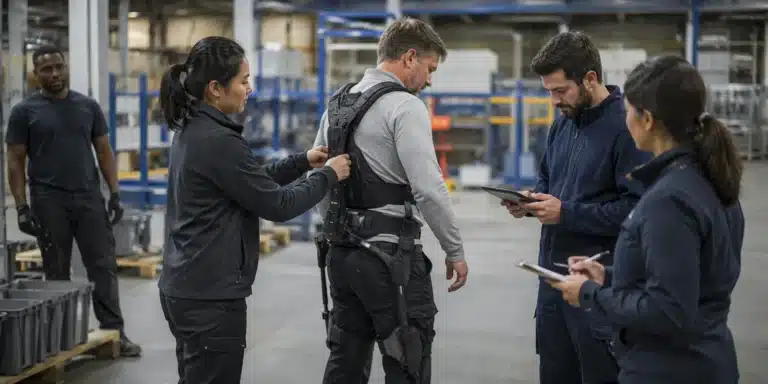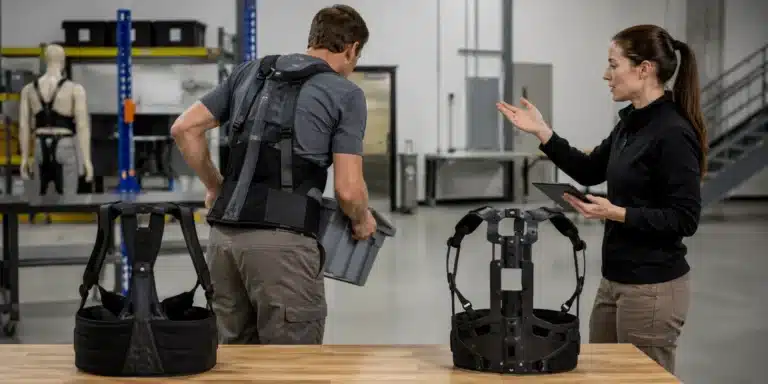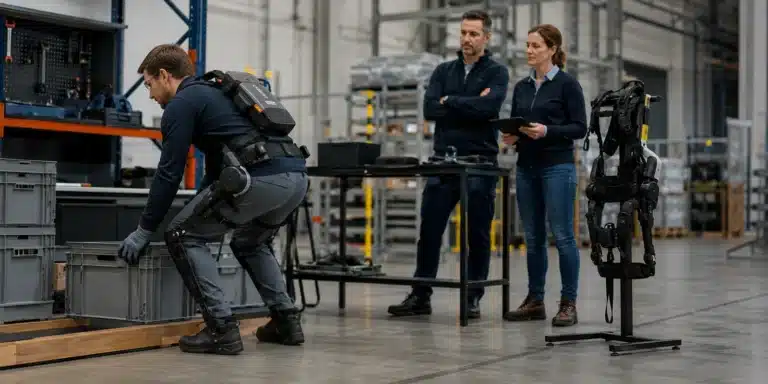

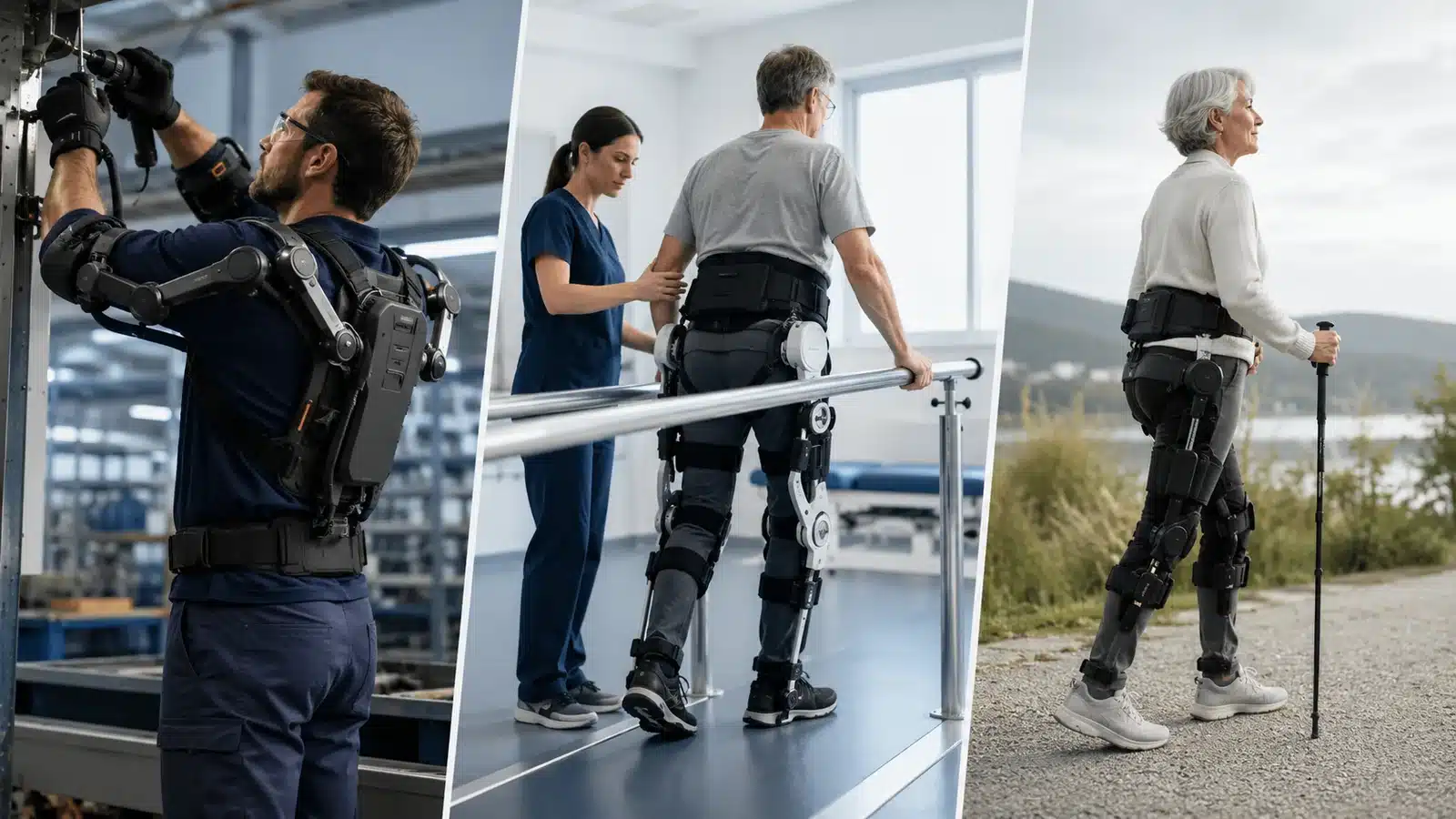
An exoskeleton is a wearable physical system that interacts mechanically with the body to assist, enable, train or augment movement. That broad definition covers very different technologies: a passive shoulder support used during overhead assembly, a powered gait-training robot in a rehabilitation clinic, a soft textile exosuit that assists walking, and a research platform built to study human movement. Treating all of these systems as one product category creates confusion. Their mechanisms, users, risks, evidence and evaluation methods are not interchangeable.
Key takeaways
- Exoskeletons are not one single technology. They may be rigid, soft or hybrid; passive, powered or semi-active; and designed for occupational, clinical, mobility, research, defense or consumer use.
- Effectiveness is task-specific. A device that reduces shoulder muscle activity during overhead work may be unsuitable for lifting, walking or confined-space tasks.
- Short-term biomechanical improvements do not automatically prove injury prevention. Occupational research remains dominated by laboratory and short-duration evaluations.[6][7]
- Clinical evidence is more developed in selected rehabilitation settings, but results still depend on patient selection, training dose, device type and the comparison treatment.[9][10]
- Fit, training, acceptance and risk assessment are central. Assistance level alone is not enough to determine whether a device is safe or useful in practice.[13][14]
What is an exoskeleton?
In practical terms, an exoskeleton is a wearable device that transfers forces between a mechanical system and the human body. It may support a posture, assist a joint, redistribute load, guide a movement, or provide enough powered assistance to help a person complete an action that would otherwise be difficult or impossible. ASTM International maintains a dedicated terminology standard, ASTM F3323-24, to create a common vocabulary for exoskeletons and exosuits across industrial, military, emergency-response, recreational and medical applications.[1]
The word exoskeleton often suggests a rigid external frame, but the field also includes exosuits that use textiles, straps, cables and other compliant components. Many systems are hybrid: they combine rigid structural parts with soft interfaces, or combine passive springs with electronic sensing. The boundary between an exoskeleton, exosuit, wearable robot, orthosis and powered mobility aid can therefore depend on the intended use and the terminology adopted by a specific standard, regulator or research group.
A useful working definition
For market and technology research, Exoskeleton Index treats an exoskeleton or exosuit as a wearable system that creates a deliberate mechanical interaction with the user in order to assist, enable, train, protect or augment physical activity. This excludes ordinary protective clothing and conventional handheld tools, but includes passive and powered devices, rigid and soft systems, and products used in work, rehabilitation, mobility, research and other defined applications.
There is still no single universal classification system covering every device. ASTM’s F48 committee continues to develop terminology, capability, fit, risk, performance and test-method standards, and a proposed ASTM classification work item remains under development.[2] This is one reason buyers should compare products through several dimensions rather than relying on a single label such as “industrial exoskeleton” or “wearable robot.”
How exoskeletons work
An exoskeleton works by creating forces or moments around one or more body regions. The device must first attach to the user through interfaces such as straps, cuffs, shells, shoes, harnesses or textile anchors. It then generates, stores, redirects or transmits mechanical energy. The user and device form one coupled system, which means the result depends not only on the hardware but also on fit, alignment, control, training, task and user behavior.
Mechanical structure and load paths
Rigid systems use frames and articulated joints to transmit force. Their mechanical joints are ideally aligned with the user’s anatomical motion, although human joints do not always rotate around one fixed axis. Misalignment can create pressure, restricted movement or unwanted forces. Soft exosuits avoid large rigid frames and apply forces through textiles and cables, but they still require carefully designed anchor points because soft interfaces can slip, compress tissue or distribute forces unevenly.
The most important design question is not simply “how much assistance does the device provide?” It is also where the load goes. A back-support device may reduce demand at the lower back while increasing pressure at the thighs or chest. A shoulder device may reduce deltoid activity during overhead work while affecting trunk posture or freedom of movement. Evaluation must therefore consider the whole user-device-task system rather than one assisted joint in isolation.
Actuation and energy storage
Powered devices use motors, hydraulics, pneumatics or other actuators. Sensors may estimate joint angle, force, pressure, gait phase, muscle activity or user intent. A controller then determines when and how much assistance to provide. Some systems use pre-programmed movement patterns, while others adapt assistance using real-time signals.
Passive devices do not use powered actuators to generate assistance. Springs, elastic elements, gas springs, dampers, counterweights and linkages store or redirect energy. Passive systems are often lighter and mechanically simpler, but their support can be less adjustable and may resist movements outside the target task.
Between those categories are semi-active or pseudo-passive systems. These may use batteries and electronics to change stiffness, lock or unlock a mechanism, or adjust assistance without continuously driving the user’s movement.
Powered, passive, soft and hybrid systems
| System type | How assistance is created | Potential strengths | Typical limitations |
|---|---|---|---|
| Passive exoskeleton | Springs, elastic components, counterweights or mechanical linkages | Lower weight, no charging, simpler maintenance, useful for repeatable task support | Assistance may be less adaptive; can resist non-target movements; support is highly task-dependent |
| Powered exoskeleton | Motors, hydraulics, pneumatics or other actuators controlled by electronics | Adjustable assistance, active movement support, greater potential for gait or strength assistance | Higher weight and complexity, battery dependence, control and failure risks, more training and maintenance |
| Soft exosuit | Textiles, cables, elastic elements and soft interfaces | Lower profile, flexibility, reduced rigid mass around joints | Force transmission and anchor stability can be difficult; fit and pressure distribution remain important |
| Hybrid or semi-active system | Combination of rigid and soft structures, or passive support with electronic adjustment | Can balance structure, comfort and adaptive support | Category is broad; performance and maintenance requirements vary substantially |
None of these categories is automatically superior. The correct design depends on the target task, required assistance, duration of use, movement variability, environment, user population and acceptable maintenance burden. A powered clinical gait device and a passive shoulder support solve fundamentally different problems.
How exoskeletons are classified
A useful comparison requires several layers. Exoskeleton Index structures product records around dimensions such as body area, power type, technology, intended application, commercial status, use case and evidence confidence.
By body area
- Back and lumbar: lifting, trunk flexion, prolonged bending and posture support
- Shoulder and upper body: overhead work, tool support and sustained arm elevation
- Arm, hand and grip: rehabilitation, grip assistance, tool handling and dexterity support
- Hip and lower limb: walking assistance, gait training, load carriage and mobility
- Knee: crouching, squatting, standing, stairs and recreational movement
- Neck: head and neck posture during inspection or overhead tasks
- Full body: systems that coordinate assistance across several body regions
By intended application
- Occupational ergonomics and worker assistance
- Medical rehabilitation and gait training
- Personal mobility and activities of daily living
- Research and education
- Defense, emergency response and public safety
- Outdoor, sports and consumer mobility
By development and commercial status
A published prototype, clinical research device and commercially supported product should not be treated as equivalent. Buyers should distinguish between research evidence, regulatory status, production availability, geographic distribution, training support, maintenance capacity and long-term supplier continuity.
Occupational and industrial exoskeletons
Occupational exoskeletons are intended to support workers during defined physical tasks. Common applications include overhead assembly, lifting and lowering, prolonged trunk flexion, tool handling, squatting, kneeling, carrying and standing support. The sectors most frequently discussed include manufacturing, logistics, construction, agriculture, healthcare work and maintenance.
The strongest short-term evidence often concerns changes in biomechanical or physiological measures such as muscle activity, joint moments, posture, perceived exertion and endurance time. A 2024 systematic review included 49 occupational studies published between 2014 and 2024. It found a growing body of research on active and passive systems, but also noted that laboratory evaluations dominate the literature and that discomfort and ergonomic limitations remain concerns.[6]
What occupational evidence can currently show
A study may demonstrate that a specific exoskeleton reduces muscle activity or changes joint loading during a specific task. That is useful evidence about immediate biomechanical response. It does not, by itself, establish that the device prevents injuries, remains beneficial across a full shift, improves productivity, or works for every body size and work environment.
A NIOSH-authored critical review concluded that sufficient evidence is still lacking to support broad claims of safe and effective industrial exoskeleton use across workplaces. It highlighted the need to evaluate benefits and residual risks through in vitro, in vivo and in silico methods, and to expand long-term and realistic workplace testing.[7]
Productivity and economic claims require particular caution. A systematic review identified 15 studies that assessed quality or productivity measures such as endurance time, task completion time, errors and completed work cycles. The effect depended on task characteristics, and none of the included studies directly evaluated the economic implications of occupational exoskeleton use.[8] An ROI calculator can therefore help structure assumptions, but it should not be presented as proof of financial return.
Claims to avoid
- “This exoskeleton prevents back injuries.”
- “Lower muscle activation proves long-term injury reduction.”
- “The device increases productivity by a fixed percentage.”
- “A successful laboratory test guarantees workplace success.”
More accurate wording is that a device may reduce selected physical demands during a defined task, subject to fit, user response, training and field validation.
Medical and rehabilitation exoskeletons
Medical exoskeletons may support repetitive rehabilitation training, guide joint movement, help a user stand or walk, or assist upper-limb function. Their intended users can include people recovering from stroke, spinal cord injury, neurological disease, surgery or other mobility impairments. Some devices are used only under professional supervision, while others are designed for personal mobility after training and assessment.
The clinical objective is not always to replace conventional therapy. A device may increase the number of repetitions, provide consistent movement assistance, measure performance or enable overground practice. Outcomes can include walking speed, walking distance, balance, motor scores, range of motion, spasticity, activities of daily living, cardiorespiratory response and user acceptance.
Spinal cord injury
A 2025 systematic review and meta-analysis included 13 controlled trials and 247 participants with spinal cord injury. It reported statistically significant improvements across several motor and walking outcomes after exoskeleton robotic training, although heterogeneity was high for some measures and uncertainty remained around intervention timing and dose.[9]
A separate 2025 meta-analysis of randomized controlled trials compared robotic exoskeleton gait training with conventional gait training. It found advantages in selected measures such as walking stability and functional scores, but did not find clear superiority for walking speed and distance. The authors recommended interpreting robotic training as part of rehabilitation rather than assuming it universally replaces conventional treatment.[10]
Upper-limb rehabilitation
A 2025 systematic review of portable upper-limb exoskeletons included five studies and 70 patients. The reviewed devices showed promising changes in motor function, range of motion, spasticity and kinematic measures, with high adherence and no severe adverse events reported in the included studies. The authors also emphasized moderate risk of bias, small samples and limited comparison with conventional rehabilitation.[11]
Acceptance and implementation
Clinical effectiveness is only one part of implementation. A 2026 systematic review of rehabilitation exoskeleton acceptability included 25 studies, 252 people with spinal cord injury and 70 healthcare professionals. Acceptance was generally favorable, but only three studies focused on healthcare professionals, and the review stressed realistic expectations, appropriate user selection and more standardized measurement of acceptability.[12]
A rehabilitation exoskeleton can be clinically promising and still fail in practice if it is difficult to fit, exhausting to set up, incompatible with the care pathway, or poorly accepted by users and professionals.
Personal mobility, outdoor and consumer systems
Personal mobility systems are intended to help a user stand, walk or complete daily activities outside a conventional therapy session. Outdoor and consumer products may instead target hiking, skiing, knee support, endurance or recreational movement. These categories should be separated from medical rehabilitation because the user population, supervision, claims, regulatory status and risk profile can differ.
Consumers should be cautious with terms such as “robotic knee,” “walking booster” or “AI exoskeleton.” Marketing language may describe a genuine powered wearable device, a passive brace, a smart orthosis or a product with limited independent evidence. The most useful questions are what body region is assisted, how force is generated, what task was tested, who participated, what outcomes changed and whether the device is commercially and technically supported.
Research, defense and emergency-response applications
Research platforms help universities and laboratories study control systems, biomechanics, human-robot interaction and rehabilitation methods. They may be highly configurable but not intended for routine commercial deployment. Defense and emergency-response systems can target load carriage, endurance, heavy tools, casualty handling or mobility in demanding environments. These use cases introduce additional requirements around reliability, environmental exposure, compatibility with protective equipment, rapid donning, communication systems and failure behavior.
The maturity of these categories varies widely. Some products have established commercial support, while others remain research prototypes, limited pilots or development programs. A credible profile should identify the current status rather than treating every announcement as a market-ready system.
What the evidence currently supports
| Claim area | What the evidence can support | Main limitation | Current confidence |
|---|---|---|---|
| Immediate biomechanical effects | Some devices reduce selected muscle activity, joint moments or perceived exertion during defined tasks | Effects vary by device, task, user and measurement method | Moderate for selected tasks |
| Occupational injury prevention | A plausible objective, supported indirectly by changes in risk-related measures | Long-term injury outcomes and broad workplace evidence remain limited | Limited |
| Productivity | Some task-specific studies report changes in endurance, completion time or work cycles | Results are inconsistent and task-dependent | Limited to moderate |
| Economic return | Can be modeled using transparent assumptions | Direct economic evidence in occupational studies is scarce | Insufficient |
| SCI rehabilitation | Meta-analyses report improvements in selected functional and motor outcomes | Heterogeneity, training protocols and comparator treatments affect conclusions | Moderate for selected outcomes |
| Upper-limb rehabilitation | Promising changes in motor function and range of motion in small studies | Small samples and moderate risk of bias | Emerging |
| User acceptance | Often favorable in rehabilitation studies | Measurement is not standardized and professional perspectives are under-studied | Promising but incomplete |
Risks and limitations
Exoskeletons change how forces, movement and attention are distributed. A benefit at one body region can be accompanied by a new demand elsewhere. Potential concerns include:
- Pressure points, skin irritation and discomfort
- Poor fit or misalignment with anatomical joints
- Restricted movement and reduced ability to react quickly
- Load transfer to other joints or body regions
- Balance, stumbling and fall risk
- Thermal discomfort and heat accumulation
- Increased cognitive demand or reduced situational awareness
- Interference with tools, vehicles or personal protective equipment
- Battery, software, actuator or sensor failure
- Time required for fitting, cleaning, charging and maintenance
- Unequal fit across body sizes, shapes and levels of ability
- Overconfidence in assistance or unrealistic expectations
ASTM’s fit-accommodation guide states that poor fit can contribute to discomfort, distraction, stress, non-use, accidents and unacceptable risk.[13] ASTM’s task-specific implementation guide similarly treats risk assessment as a necessary process and explicitly separates acute observable risks from unresolved chronic, cumulative and financial questions.[14]
Standards and test methods
The standards landscape is expanding rapidly. ASTM Committee F48, formed in 2017, develops voluntary consensus standards covering terminology, safety, performance, ergonomics, task testing, maintenance, information technology and risk management across active and passive systems.[2]
Its active human-factors portfolio includes standards or guides on user training, ergonomic parameters, risk assessment, fit, cognitive fit, low-back loading, digital human modeling and risk management. The task-performance portfolio includes gait, stairs, obstacles, confined spaces, load handling, logistics, tool handling, crawling, inclined planes and ladders.[15]
ISO 18646-6:2026
Published in May 2026, ISO 18646-6 specifies performance criteria and test methods for lower-limb wearable robots using an anthropomorphic test dummy robot. It covers powered and non-powered systems attached to the lower limbs, but excludes systems that operate from biosignals such as electromyography.[3]
ISO 5363:2024
ISO 5363 specifies test methods for exoskeleton-type walking rehabilitation robots used as medical electrical equipment. It does not apply to passive or non-powered exoskeletons.[4]
ISO/CD 25563
ISO/CD 25563 is under development. It addresses the workplace process for identifying needs, selecting, assessing and deploying wearable physical-assistance devices. Its scope is occupational use and excludes medical rehabilitation, games, sport and leisure. Because it remains a committee draft, it should be described as developing guidance rather than an established published standard.[5]
Why standardized testing matters
A repeatable test can compare a defined performance characteristic under controlled conditions. It does not replace field evaluation with representative users. The strongest evaluation programs combine mechanical testing, human testing, task performance, fit, comfort, acceptance, risk assessment and longer-term observation.
How to evaluate an exoskeleton
A good evaluation begins with the problem, not the product. “We want to use exoskeletons” is not a sufficient objective. The team should define the exact task, user population, physical demand, desired outcome and unacceptable trade-offs.
- Define the task precisely. Record posture, load, repetition, duration, environment, tools, protective equipment and movement variability.
- Identify the target outcome. Examples include lower perceived exertion, reduced muscle activity, longer endurance, safer posture, improved gait practice or greater independence.
- Select the correct body-area and assistance category. Do not choose a device because it is popular in another task.
- Compare multiple products. Evaluate assistance mechanism, weight, fit range, commercial status, training, maintenance and supplier support.
- Include representative users. Body dimensions, sex, age, ability, experience and work technique may influence fit and response.
- Measure benefits and new constraints. Review comfort, pressure, mobility, balance, work quality, completion time, cognitive demand and non-target body regions.
- Use realistic exposure. A short demonstration cannot represent repeated use across a shift or rehabilitation program.
- Train users and supervisors. Donning, adjustment, cleaning, inspection, emergency procedures and reporting should be defined.
- Start with a controlled pilot. Establish stopping criteria, incident reporting and a comparison condition.
- Avoid overgeneralization. A positive result applies to the tested device, configuration, users and task unless further evidence supports broader claims.
Explore products, companies and industries
Exoskeleton Index organizes products and suppliers into structured records so readers can move from general research to specific technologies and market participants.
References
- ASTM International. ASTM F3323-24: Standard Terminology for Exoskeletons and Exosuits. 2024. DOI: 10.1520/F3323-24.
- ASTM International. Committee F48 on Exoskeletons and Exosuits. Current committee scope, subcommittees, standards and work items. Official committee page.
- International Organization for Standardization. ISO 18646-6:2026, Robotics — Performance criteria and related test methods for service robots — Part 6: Lower-limb wearable robots. Published May 2026. Official standard page.
- International Organization for Standardization. ISO 5363:2024, Robotics — Test methods for exoskeleton-type walking RACA robot. Published April 2024. Official standard page.
- International Organization for Standardization. ISO/CD 25563, Ergonomics — Process for the integration of wearable physical assistive devices (exoskeletons). Committee Draft, under development. Official project page.
- Cardoso A, Ribeiro A, Carneiro P, Colim A. Evaluating Exoskeletons for WMSD Prevention: A Systematic Review of Applications and Ergonomic Approach in Occupational Settings. International Journal of Environmental Research and Public Health. 2024;21(12):1695. DOI: 10.3390/ijerph21121695.
- Zheng L, Lowe B, Hawke AL, Wu JZ. Evaluation and Test Methods of Industrial Exoskeletons In Vitro, In Vivo, and In Silico: A Critical Review. Critical Reviews in Biomedical Engineering. 2021;49(4):1–13. DOI: 10.1615/CritRevBiomedEng.2022041509.
- Fournier DE, Yung M, Somasundram KG, Du BB, Rezvani S, Yazdani A. Quality, productivity, and economic implications of exoskeletons for occupational use: A systematic review. PLOS ONE. 2023;18(6):e0287742. DOI: 10.1371/journal.pone.0287742.
- Guo S, Yang Y, Wang M, et al. Effects of an exoskeleton robot on motor function in patients with spinal cord injuries: a systematic review and meta-analysis. Systematic Reviews. 2025;14:218. DOI: 10.1186/s13643-025-02974-1.
- Liu S, Chen F, Yin J, Wang G, Yang L. Comparative efficacy of robotic exoskeleton and conventional gait training in patients with spinal cord injury: a meta-analysis of randomized controlled trials. Journal of NeuroEngineering and Rehabilitation. 2025;22:121. DOI: 10.1186/s12984-025-01649-1.
- Carnevale A, Nicodemi G, Pisani MG, et al. Portable exoskeletons for upper limb rehabilitation: A systematic review. Journal of Experimental Orthopaedics. 2025;12(3):e70416. DOI: 10.1002/jeo2.70416.
- Fortin-Bédard N, Déry J, Simon M, et al. Acceptability of rehabilitation exoskeletons of users with spinal cord injury and healthcare professionals: a systematic review. Annals of Physical and Rehabilitation Medicine. 2026;69(1):102033. DOI: 10.1016/j.rehab.2025.102033.
- ASTM International. ASTM F3661-24: Standard Guide for Assessing Fit Accommodation of Exoskeletons for Manufacturers and Designers. 2024. DOI: 10.1520/F3661-24.
- ASTM International. ASTM F3527-24: Standard Guide for Assessing Risks Related to Implementation of Exoskeletons in Task-Specific Environments. 2024. DOI: 10.1520/F3527-24.
- ASTM International. F48.02 Human Factors and Ergonomics and F48.03 Task Performance and Environmental Considerations. Current active standards and proposed work items. Human factors portfolio; Task-performance portfolio.