
Exoskeletons are moving closer to where tradespeople buy equipment
For an electrician, roofer or installation contractor, finding a suitable exoskeleton has often meant contacting a specialist manufacturer before knowing whether the device fits the job. That buying journey is beginning to change.
SUITX by Ottobock says its industrial exoskeleton solutions are now available through more than 90 Würth branches in Germany. Its partnership with the professional tools and industrial supplies group is expected to cover more than 100 German locations by the end of 2026, followed by 240 French branches by the end of March 2027.
This is a distribution development, not a claim that exoskeletons are already in use at hundreds of workplaces. The significance is that buyers can increasingly encounter the technology through a familiar professional sales network, with local advice and a route to practical trials.
Branch figures and rollout dates are stated by Ottobock. They describe availability and announced plans, not sales volumes, installed fleets or audited in-store inventory.
Why a professional trade counter can matter
Industrial exoskeletons require a different buying decision from standard tools. The right device depends on the work cycle, required movement, body fit and whether it interferes with protective equipment or site conditions. A catalogue specification alone cannot answer those questions.
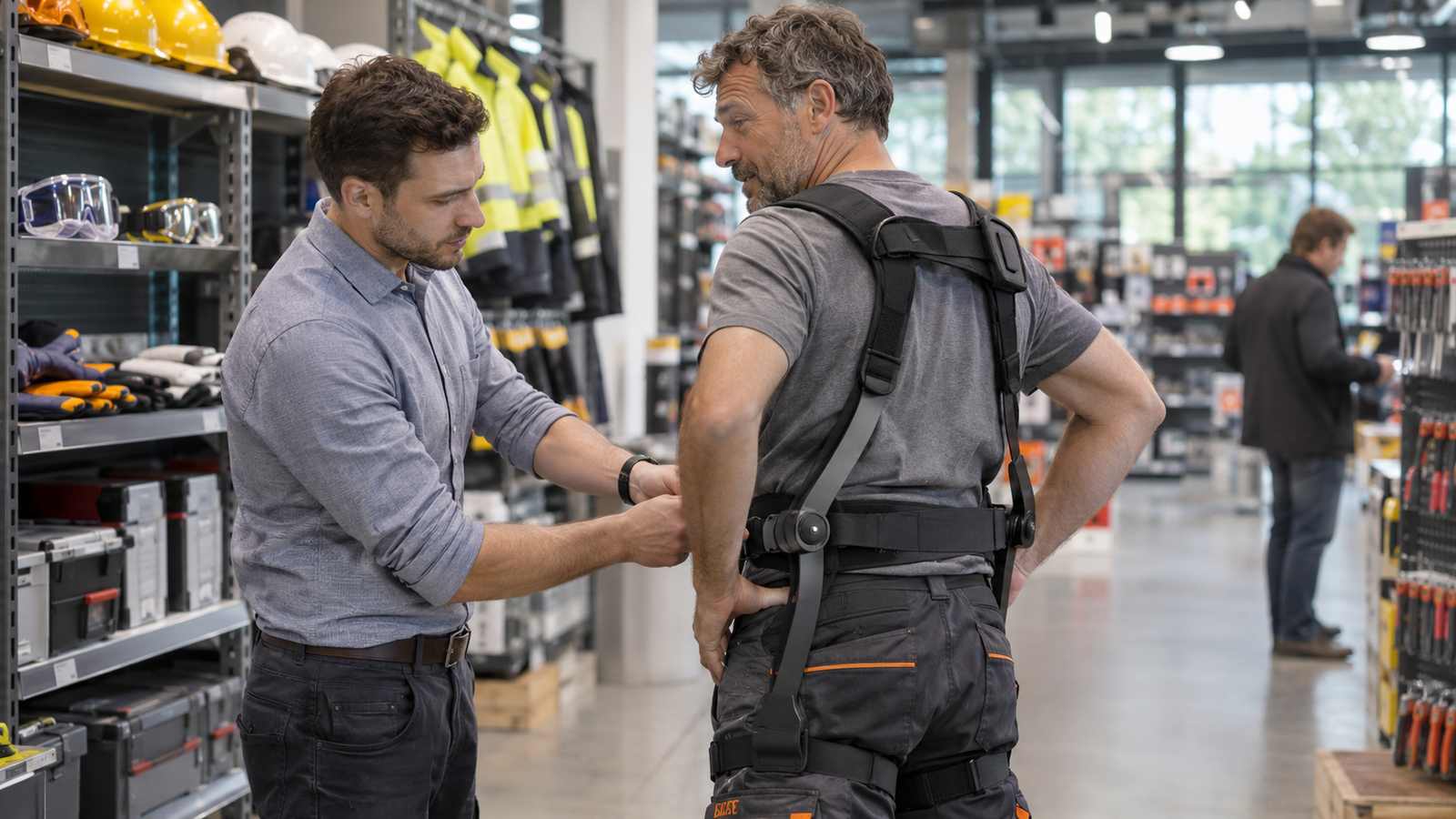
Würth’s network adds an existing relationship with small and medium-sized trades businesses. According to the partners, customers can seek guidance locally, try the equipment and receive support in assessing specific tasks. Würth also describes exoskeleton fitting and advice as part of its occupational-safety service offering.
Ottobock cites the passive IX Back Air for bending, lifting and carrying, alongside the more targeted CX Series. These examples illustrate the range under discussion; the announcement does not establish that every model is stocked in every participating branch.
Existing branches introduce exoskeletons to businesses already purchasing professional equipment.
Fitting and use-case discussions can help rule out unsuitable devices early.
The France plan could test whether this model scales beyond Germany’s branch network.
Workplace evaluation still decides the outcome
Ottobock points to Schühle Abdichtungen, a roofing and waterproofing business in Reutlingen, as an example of exoskeleton use in physically demanding trades work. The company emphasizes fitting the equipment into ordinary workflows rather than introducing it as a standalone demonstration.
For eligible German construction companies, BG BAU also lists support for specified exoskeleton training and workplace trials, with funding conditions that can extend to certain follow-on purchases. Its published support level is 50% of eligible costs, up to €1,500 per exoskeleton and measure. Businesses need to check the official conditions before assuming eligibility.
For a wider view of jobsite fit and constraints, see our construction exoskeleton sector guide and 2026 industrial exoskeleton analysis.
Exoskeleton Index analysis
Product performance will always matter. But the next phase of industrial adoption may be shaped just as strongly by who can provide a fitting, organise a workplace trial and support the customer after the first purchase.
That makes this partnership an important market signal. A technology that once sat largely inside specialist sales channels is entering a familiar purchasing environment for trades and construction businesses. For a small employer, local access could lower the time and uncertainty involved in evaluating a category they have never bought before.
The scale is promising, but branch coverage should not be confused with end-user adoption. What matters next is whether this reach produces well-matched trials, repeat purchasing and continued worker use. Our global distributor guide examines why these local routes matter, while the Ottobock / SUITX company profile provides additional manufacturer context.
What the branch counts do, and do not, show
Ottobock reports more than 90 participating Würth locations in Germany and announced targets for Germany and France. The company has not published associated unit sales, conversion rates, stock by branch or independently measured injury outcomes in this announcement. The French figure remains a plan for March 2027.
What to watch next
France is the clearest near-term test. The more revealing evidence will be how many branches provide meaningful demonstrations, which tasks lead to repeat orders, and whether local advice helps employers build sustainable exoskeleton programmes. Distribution can open the door; successful implementation will determine the market’s size.
Considering exoskeletons for your team?
Tell Exoskeleton Index about your tasks, work environment and location. We can help narrow the options and identify relevant suppliers and routes to a practical trial.
Discuss your workplace projectIndependent, application-led guidance. No single supplier or outcome is guaranteed.Sources and reporting notes
Ottobock, October 2, 2026: partnership, current branch availability, announced expansion targets, product examples and Schühle Abdichtungen case. Würth occupational-safety branch advisory service: local exoskeleton advice and fitting. BG BAU: current programme scope, eligible measures and funding conditions. Rollout quantities are company-reported, while commercial implications are Exoskeleton Index analysis.