
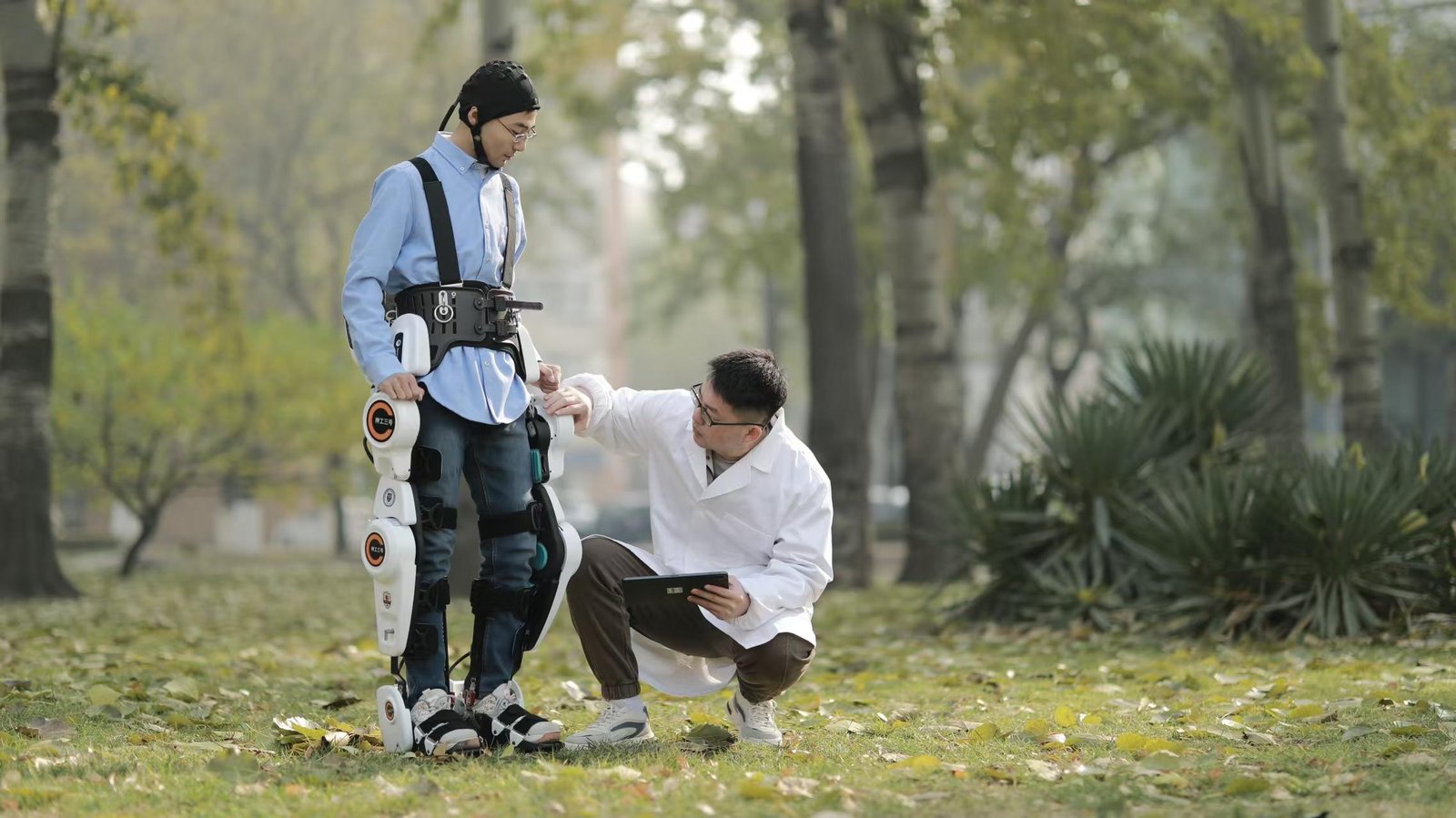
On 5 November 2026, a project led by Tianjin University’s Brain-Computer Interaction and Human-Machine Integration Haihe Laboratory completed a national clinical-research filing. Tianjin Huanhu Hospital is the reported clinical site. The following day’s announcement described it as China’s first non-invasive brain-computer-interface clinical research project filed under the country’s new biomedical technology framework.
What the filing covers
The registered project’s title translates to an exploratory study of the safety and feasibility of spinal cord stimulation combined with non-invasive brain-controlled hybrid exoskeleton training for lower-limb motor impairment after chronic stroke.
Tianjin University is developing the approach with the Haihe Laboratory, while Tianjin Huanhu Hospital is the reported clinical site. The announcement also names Suishi (Tianjin) Intelligent Technology and Beijing PINS Medical Equipment as participating technology companies.
The filing is important because it moves an already demonstrated research platform into a more clearly defined national clinical-research process. It does not mean the system has just been invented, nor that patients can now obtain it as an approved treatment.
How the brain, spine and exoskeleton are meant to work together
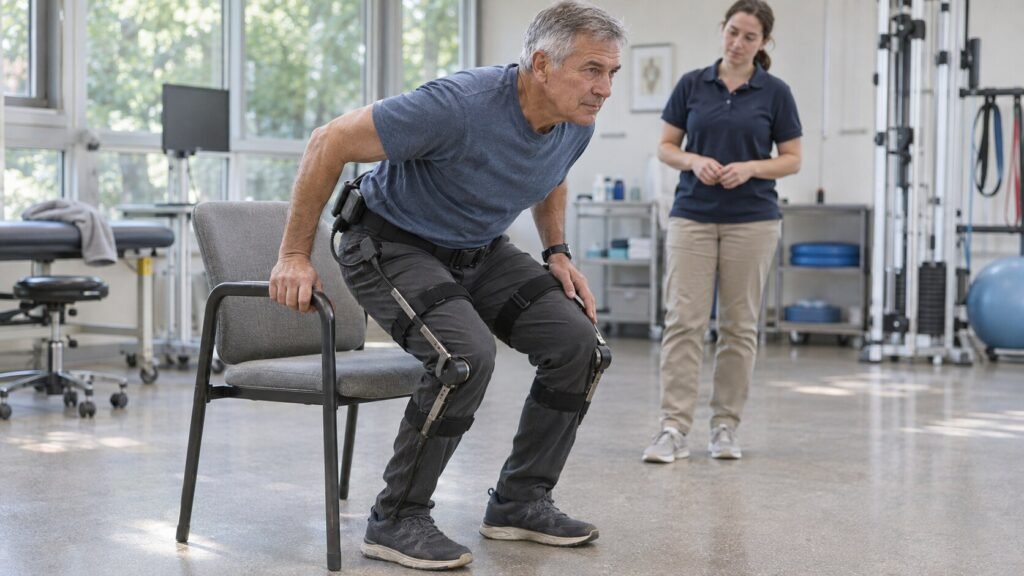
The concept is to connect the person’s attempted movement with stimulation and physical assistance. Instead of having a robot move a person’s legs independently of their intent, the research team aims to coordinate several signals and interventions during gait training.
Non-invasive BCI
Records brain activity associated with movement intention and uses it to inform the training system.
Spinal stimulation
Aims to modulate spinal pathways involved in movement. The platform has been described as incorporating implanted stimulation.
Hybrid exoskeleton
Supports lower-limb gait training, with the broader system also described as using functional electrical stimulation.
These are the research team’s proposed mechanisms and system components, not a demonstration that the combined treatment improves recovery.
The distinction between non-invasive brain sensing and spinal stimulation matters here. The announcement calls the brain-computer interface non-invasive; earlier official descriptions of Shengong–Shenchi identify an implanted spinal stimulation component. The overall intervention should therefore not be described as wholly non-invasive.
Why focus on people whose stroke recovery has plateaued?
Stroke rehabilitation often involves repeated walking practice, but some people continue to experience major lower-limb impairment long after the initial event. The Tianjin programme is aimed particularly at patients whose progress has slowed or plateaued.
The research hypothesis is that pairing voluntary movement intention with coordinated neural and mechanical assistance may engage pathways that conventional robot-assisted walking does not address in the same way. That is an interesting clinical question, especially if the timing between brain signals, spinal stimulation and gait movement can be controlled reliably.
Whether that produces better outcomes than established rehabilitation methods will require controlled clinical evidence. The available November announcement does not report comparative patient outcomes.
The regulatory milestone, explained
China’s Regulations on the Administration of Clinical Research and Clinical Translational Application of New Biomedical Technologies, issued under State Council Order No. 818, took effect on 1 May 2026. The rules establish a framework for research involving emerging biomedical interventions and distinguish clinical research procedures from subsequent authorization for wider clinical application.
According to Tianjin’s official account, this is the first non-invasive BCI clinical research project to complete the relevant filing under that framework. That is a specific regulatory first, not evidence that China has approved the first brain-controlled exoskeleton for routine clinical use.
What this does, and does not, establish
Confirmed: A study combining non-invasive BCI, spinal stimulation and hybrid exoskeleton training has completed the national clinical-research filing described by the Tianjin authorities. Not established: Treatment effectiveness, long-term patient benefit, superiority over conventional rehabilitation, medical-device marketing authorization or routine clinical availability.
The technology was introduced earlier in 2026
The Shengong–Shenchi system was publicly introduced in Tianjin in May 2026. Contemporary reports from Tianjin University described a platform combining non-invasive brain sensing, implanted spinal cord stimulation, hybrid exoskeleton technology and other neuromodulation tools. An exploratory clinical programme was discussed at that launch.
The November development is therefore the formal research-filing milestone, not the initial product unveiling or the announcement of a successful clinical trial. Keeping those events separate is essential to understanding how far the technology has progressed.
What to watch next
The next meaningful development will be evidence from the clinical work at Tianjin Huanhu Hospital. Several details will determine how much this approach could matter beyond the research setting:
- Study design: the number and characteristics of participants, eligibility criteria, comparison group and follow-up period.
- Safety and feasibility: how reliably patients can complete training and whether combined stimulation introduces manageable risks.
- Functional outcomes: changes in walking ability, balance, motor control and performance outside the training setting.
- Added value: whether synchronized BCI and spinal stimulation deliver benefits beyond exoskeleton-assisted gait training alone.
For the exoskeleton sector, this is another sign that rehabilitation research is moving toward systems that integrate intent detection, stimulation and robotic assistance. The clinical case for combining them is still being tested.
For context, Exoskeleton Index previously covered China’s national plan naming BCI-driven exoskeletons as a rehabilitation technology priority. The latest filing is a separate, project-level development within that broader direction.
Sources
- Tianjin Municipal Government / Tianjin Daily, report on the first non-invasive BCI clinical-research filing, 6 November 2026 (Chinese).
- Tianjin University News, Shengong–Shenchi system introduction and exploratory clinical programme, May 2026 (Chinese).
- State Council Order No. 818, Regulations on the Administration of Clinical Research and Clinical Translational Application of New Biomedical Technologies, effective 1 May 2026 (Chinese).
- National Health Commission, implementation guidance for the clinical-research filing and assessment framework (Chinese).