
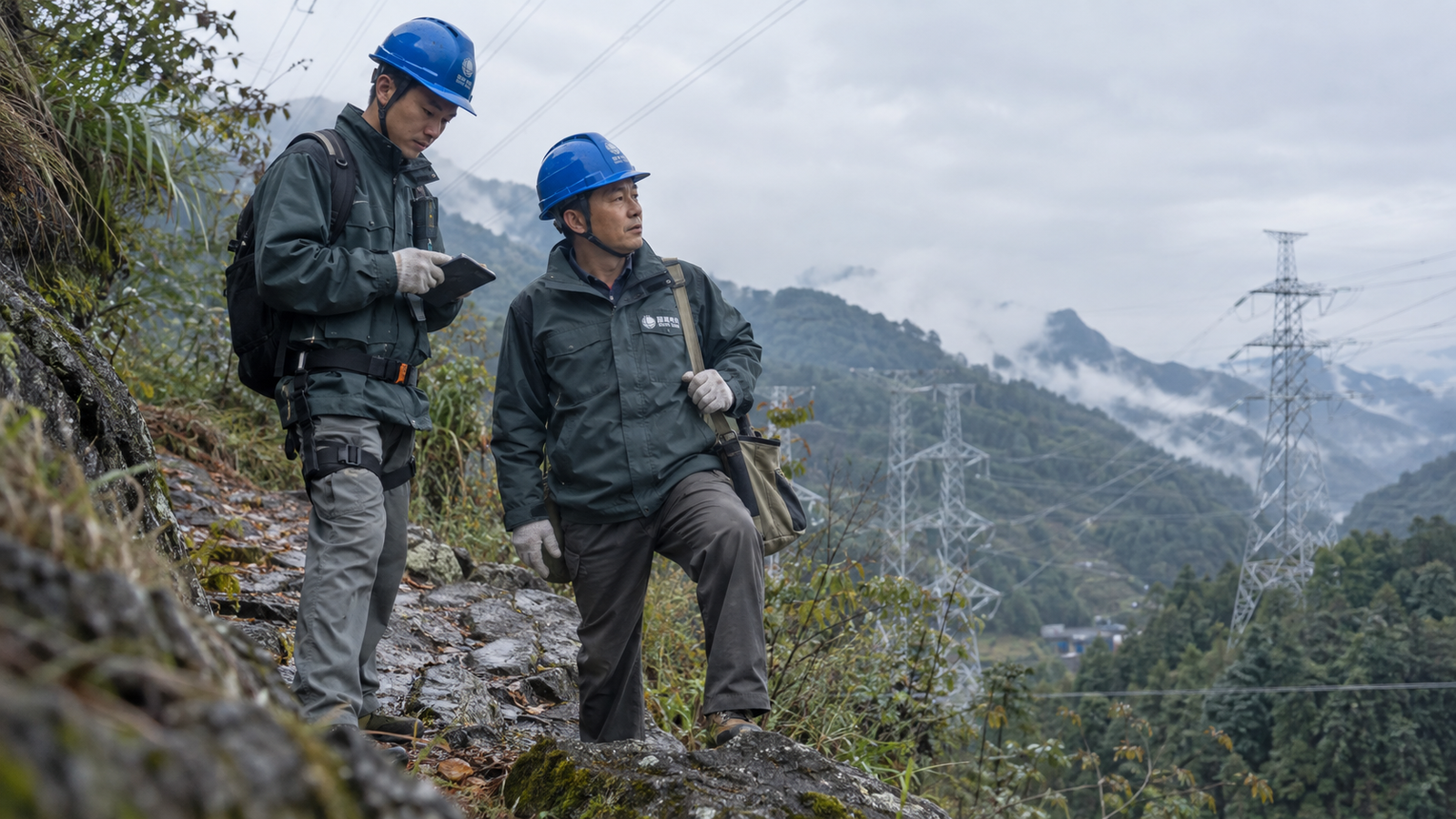
State Grid’s Xiaoshan power unit has tested lightweight AI walking exoskeletons during real transmission-line inspection work in the mountains outside Hangzhou, putting two workers on steep, rain-soaked terrain with inspection tools while wearing 1.85 kg powered assistance systems.
At a glance
- Operator
- State Grid Hangzhou Xiaoshan Power Supply Company
- Trial date
- September 3, 2026
- Task
- Mountain transmission-line inspection and grounding-resistance testing
- Device type
- Powered lower-limb walking-assist exoskeleton with dual motors and gait recognition
- Reported device weight
- 1.85 kg
- Reported endurance
- Up to 8 hours / about 15 km of assisted walking on a full charge
- Donning time
- About 2 minutes with assistance
- Manufacturer / model
- Not identified in the published State Grid-supplied report
A field trial on wet mountain terrain, not a trade-show demonstration
On the morning of September 3, State Grid employees Shen Xianhua and Xie Qinghua arrived at a mountainous section of the Jinshi transmission line in Hangzhou’s Xiaoshan district to inspect towers and conduct grounding-resistance measurements.
The difference from a normal inspection was what they were wearing.
According to a September 4 report from Chao News, with photographs supplied by State Grid Hangzhou Xiaoshan Power Supply Company, the workers put on walking-assist exoskeletons before heading into the mountains with infrared thermometers, grounding-resistance instruments, binoculars and maintenance tools.
The previous day’s rain had left sections of the route muddy and slippery. The report describes the devices being used through both ascents and descents rather than on a controlled indoor surface.
One of the workers said he felt upward assistance while lifting his legs on climbs and cushioning while descending. Those observations are user reports from the trial, not independently measured biomechanical outcomes.
The device weighs 1.85 kg and uses dual-motor assistance
The system is described as a carbon-fibre, articulated walking-assist exoskeleton with a net device weight of 1.85 kg.
Its control system uses a self-developed AI algorithm and gait recognition to track walking posture, joint angles and cadence, then select an assistance mode in real time. Two motors provide synchronized assistance to the lower limbs.
The published specifications state up to eight hours of endurance and roughly 15 km of assisted walking on a full charge, a range the report says is intended to cover a typical day of line-inspection walking.
The workers reportedly completed donning in about two minutes with each other’s help.
The manufacturer and model were not identified in the State Grid-supplied report. Exoskeleton Index is therefore not assigning the device to a specific commercial product based only on similarities in weight or architecture.
State Grid has already been testing exoskeletons in other power-work environments
The Xiaoshan trial is significant, but it is not State Grid’s first use of wearable assistance.
In January 2026, State Grid Xinjiang Electric Power workers used a power-inspection exoskeleton while patrolling the 750 kV Saiyi transmission line in winter conditions. That system was reported to support up to 25 km of continuous walking after a 1.5-hour charge and to reduce walking effort by 30%, according to a report sourced to State Grid. The Xinjiang deployment was aimed at long-distance and high-altitude line inspection.
State Grid had also publicized exoskeleton-assisted power work before 2026, including equipment used by workers in Zhejiang and Xinjiang for transmission-line maintenance and pole work.
That context changes the interpretation of the Xiaoshan test. The interesting development is not that a Chinese utility has discovered exoskeletons for the first time. It is that wearable assistance is appearing repeatedly across different branches, terrains and power-maintenance tasks.
Exoskeleton Index analysis
Power-line inspection is a strong test case for industrial exoskeletons because the physical problem is different from repetitive lifting in a warehouse.
Workers may need to cover long distances over steep, uneven terrain while carrying diagnostic equipment. Full automation can remove some inspection work through drones, sensors and autonomous robots, but there are still tasks where a human needs to reach the site, evaluate equipment and work in an environment that is difficult to standardize.
That makes lower-limb assistance potentially relevant in a way that back-support or overhead-work exoskeletons are not.
The Xiaoshan trial is also commercially interesting because the system is relatively light at a reported 1.85 kg. In outdoor inspection work, every kilogram carried by the worker competes with tools, water, protective equipment and the terrain itself. A wearable system that becomes another heavy load can erase part of the benefit it is supposed to provide.
The evidence is still early. This report covers a small field trial and does not publish heart-rate data, metabolic measurements, task-time comparisons, fatigue scores, safety outcomes or a longer-term user-acceptance study.
But repeated utility deployments matter. Exoskeleton adoption is often discussed as if the market will be won through factories and warehouses alone. Power infrastructure is another category where human mobility remains operationally important even as inspection becomes more automated.
Why this matters for industrial exoskeleton adoption
The trial adds another example of exoskeletons being evaluated in real work rather than only in controlled demonstrations.
Earlier this week, Athens International Airport’s deployment of 15 passive back-support exoskeletons showed how wearable support is moving into routine baggage operations. The State Grid case is different: it focuses on powered lower-limb assistance for mobile outdoor work.
Together, these cases illustrate why the industrial exoskeleton category is unlikely to converge around one device architecture. Baggage handling, warehouse picking, overhead assembly and mountain inspection impose different loads and movement patterns.
For organizations considering a similar technology, Exoskeleton Index recommends starting with the task rather than the product. Our exoskeleton pilot playbook outlines how to define the task, choose users, establish baseline measurements and decide whether a trial should scale.
What remains unknown
The published report does not identify the exoskeleton manufacturer or model, purchase price, procurement route, number of devices available to the Xiaoshan unit, or whether the system will move from trial use into routine deployment.
The reported 8-hour endurance and 15 km assisted range are product specifications rather than independently verified field measurements. The trial report also does not provide quantified reductions in fatigue, metabolic cost, injury risk or inspection time.
State Grid’s Xiaoshan unit says it plans to expand the use of embodied-intelligence equipment in transmission operation and maintenance. The next useful proof point will be whether exoskeletons become a repeat operational tool across more crews and routes, with measured outcomes rather than only positive first-use feedback.
What to watch next
Three questions now matter: whether the Xiaoshan trial expands beyond the initial workers, whether State Grid standardizes exoskeleton use across additional line-inspection environments, and whether future deployments disclose the manufacturers and performance data behind the systems.
China’s exoskeleton market is already developing across consumer, medical and industrial segments. Exoskeleton Index recently reported 39.5% year-over-year growth in exoskeleton-assist sales value on monitored Chinese platforms, while our broader China market analysis shows how different segments are scaling at very different speeds.
Sources
- Chao News — State Grid Hangzhou Xiaoshan power unit tests AI exoskeletons for mountain inspection, September 4, 2026
- State Grid-sourced report — Xinjiang transmission-line inspection using power-inspection exoskeletons, January 30, 2026
- China Electrotechnical Society — 2026 conference agenda covering exoskeletons as auxiliary equipment for live-line work and intelligent inspection