
2026 TRAIL BUYER GUIDE
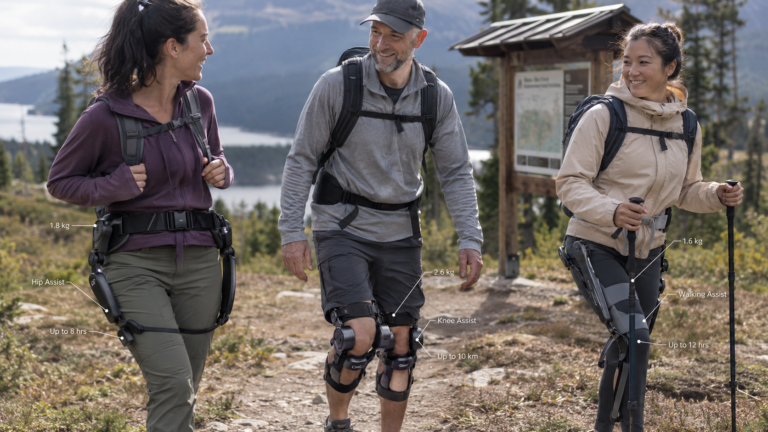
Hiking exoskeletons are now a real consumer product category. Several powered systems can be bought today for hills, long walks and outdoor mobility, while a second wave of hip-and-knee products is moving from preorder toward delivery.
What matters on a trail, however, is very different from what looks impressive on a specification sheet. Sustained climbing exposes battery limits. Descents change which joints matter. A hiking backpack can compete with a hip-mounted exoskeleton for the same space around the pelvis. Weather, fit and the way assistance feels after several hours can matter more than peak motor power.
Our current view: for a buyer who wants a premium, commercially available hiking exoskeleton today, Hypershell X Ultra S remains the most defensible all-round choice. DNSYS X1 is the strongest value route into powered hip assistance, Ascentiz H Ultra stands out for long manufacturer-listed range and modularity, NAVEE EXO S Pro is now one of the most relevant lightweight EU options, and VIGX π Plus remains an interesting endurance-focused challenger with a thinner independent evidence base.
Climb, descent, stairs or mixed trail?
Can the system finish the route you actually walk?
Will the exoskeleton and backpack work together?
What has been tested beyond manufacturer claims?
Best hiking exoskeletons in 2026: the short answer
There is no single winner for every trail. The category is splitting into different price points, levels of refinement and assistance architectures. These are the products we would shortlist first.
The strongest current combination of trail relevance, commercial maturity and independent testing.
Lower-cost powered hip assistance with low mechanical weight and replaceable-battery logic.
Dual batteries, 50 km manufacturer-listed range and a platform explicitly aimed at demanding outdoor use.
€1,099, about 1.8 kg and now supported by useful independent outdoor testing.
Competitive price, dual hot-swappable batteries and hiking-focused positioning, but less independent evidence.
2026 hiking exoskeleton shortlist at a glance
This comparison is intentionally trail-focused. We do not rank products by wattage alone because different control systems, joint locations, fit and battery conditions make headline figures a poor substitute for real-world usability.
| Product | Current price at cutoff | Weight | Architecture | Best fit | Evidence view |
|---|---|---|---|---|---|
| Hypershell X Ultra S | US$1,999 / €1,999 MSRP | 2.538 kg | Powered hip | Premium hiking, steep climbs, mixed terrain | Established consumer evidence |
| DNSYS X1 Carbon | US$889 on current official listing | 1.6 kg mechanical weight | Powered hip | Value-focused hiking and outdoor walking | Established / developing |
| Ascentiz H Ultra | US$1,599 fall sale; US$1,999 list | 2.5 kg | Powered hip / modular platform | Long trail days and range-focused buyers | Developing |
| NAVEE EXO S Pro | €1,099 in EU store | 1.8 kg | Powered hip | EU buyers, lighter trail use, hills and stairs | Developing |
| VIGX π Plus | US$1,399 | 2.1 kg incl. two batteries | Powered hip | Long outdoor days, hot-swap battery users | Early / developing |
Prices and commercial status were checked against public manufacturer/store information on 13 October 2026. Promotions, regional taxes, shipping and included batteries can change the final purchase price. Weight definitions also differ between manufacturers.
What actually counts as a hiking exoskeleton?
“Hiking exoskeleton” is a useful buyer category, not a regulatory class. We include a product when it assists independent human movement and has credible relevance to trail walking, sustained climbing, descending slopes, stairs, long-distance outdoor movement or carrying a backpack.
That excludes many sophisticated systems in the wider Exoskeleton Index product directory. Rehabilitation exoskeletons serve a different user. Industrial back-support systems solve a different problem. A research prototype does not become a credible hiking recommendation simply because it has been demonstrated outdoors.
Most products in this guide also assume that the user can already walk independently and maintain balance. They should not be confused with medical mobility devices.
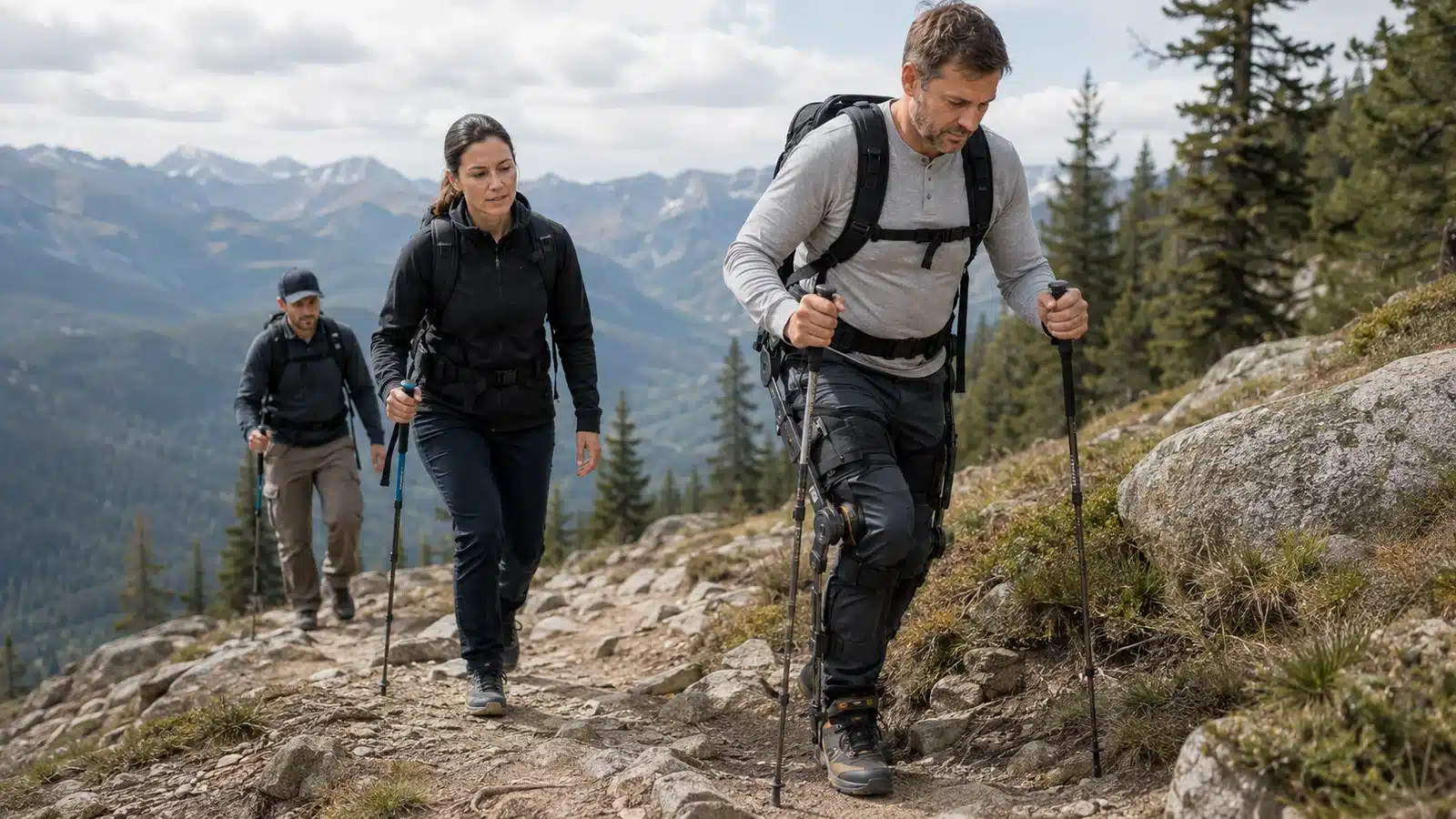
Sustained gradients are where current hip systems often make their strongest case.
Hip assistance does not address knee loading in the same way as a powered knee system.
Hip belts and exoskeleton frames may compete for the same body space.
Gradient, assistance level, load and temperature can change practical endurance materially.
Splash resistance is useful; it is not permission to ignore severe rain, mud or immersion.
Our picks: the hiking exoskeletons to consider
Hypershell X Ultra S — best premium all-round hiking choice
Hypershell remains the strongest current benchmark for a premium hiking exoskeleton because the latest generation combines terrain-focused hardware with one of the best independent evidence records in the category.
Why it stands out on the trail
Hypershell lists up to 1,000 W of assistance, 12 intelligent modes, IP54 protection, 2.538 kg total weight and two batteries rated at up to 30 km each under the company’s specified test conditions.[1] The range is sold across major European markets and direct retail channels rather than being limited to preorder or crowdfunding access.
What independent testing tells us
WIRED’s May 2026 review is unusually useful because it tested the product in the kind of conditions that expose both strengths and weaknesses. The assistance became clearly more valuable on steeper inclines, while flatter walking gave the reviewer much less reason to carry the device. WIRED also found that higher assistance settings could reduce practical battery estimates dramatically compared with headline maximum range.[2]
That is exactly the distinction a hiking buyer needs. The X Ultra S is most convincing when the terrain creates repeated lower-limb demand, not when a fit user is walking an easy flat path.
Main trade-off
Price is the obvious one. Backpack compatibility also deserves a real fitting test because serious hiking packs and hip exoskeletons both depend on the pelvis. A system that fits perfectly without a pack can feel very different once a loaded hip belt is added.
EI view
If we had to choose one currently shipping consumer exoskeleton for mixed hiking terrain, X Ultra S remains the most defensible premium pick. Its advantage is not simply maximum output; it is the combination of control refinement, trail relevance, availability and enough independent testing to understand where the product genuinely helps.
View the EI Hypershell X Ultra S profile → · Check Hypershell price & availability →
DNSYS X1 Carbon — best value route into powered hiking assistance
DNSYS is important because it has pushed the entry price of powered hip assistance down while keeping a mature direct-sales channel and a replaceable-battery design.
Why it stands out
The current official X1 Carbon page lists US$889 against a US$1,299 regular price, approximately 1.6 kg of mechanical weight, a 15 km manufacturer-listed base range and a three-second battery swap. DNSYS also offers Carbon Pro configurations with two batteries for a stated 30 km total range.[3]
What independent testing tells us
Independent coverage confirms that the X1 can provide meaningful assistance, but refinement is not equal across brands. In WIRED’s head-to-head testing, Hypershell was judged smoother and quieter while DNSYS delivered a more obvious and sometimes jerkier sensation of power.[4] That does not remove X1 from the shortlist; it helps explain why it is our value pick rather than our premium pick.
Main trade-off
The X1 family has several configurations, and DNSYS promotional pricing moves frequently. Buyers should confirm the exact model, included battery count and material specification rather than assuming every “X1” listing is equivalent.
EI view
For buyers who want genuine powered assistance without starting at flagship pricing, X1 Carbon is one of the strongest current entries. The lower mechanical weight is attractive for outdoor use, but trail comfort still depends on fit, straps, control quality and how the system interacts with a backpack.
Ascentiz H Ultra — best long-range modular challenger
H Ultra is the most hiking-oriented member of the current Ascentiz H Series, combining a dual-battery configuration with an explicitly outdoor-focused mode set and modular platform strategy.
Why it stands out
Ascentiz’s current fall sale lists H Ultra at US$1,599 against a US$1,999 list price. The company lists 1,100 W peak output, 2.5 kg total weight and up to 50 km / 31 miles from two batteries.[5] Those are manufacturer specifications, not a standardized comparison with Hypershell or DNSYS, but the extra battery capacity is still relevant for long outdoor days.
What independent testing tells us
Tom’s Guide tested earlier H1 Pro hardware at CES 2026 and highlighted comfort, low perceived bulk and easy donning.[6] That evidence supports the platform direction, but it should not be treated as long-duration validation of the final commercial H Ultra or every current performance claim.
Main trade-off
The current commercial H Series has a shorter owner history than Hypershell. We want more independent evidence on durability, service, battery performance and sustained use before treating its 50 km maximum as anything more than a first-party ceiling.
EI view
Ascentiz is one of the most credible challengers for hikers who prioritize range and platform flexibility. The proposition is stronger now that the H Series is an ordinary commercial product rather than simply a Kickstarter concept.
View the EI Ascentiz H Ultra profile → · Check Ascentiz price & availability →
NAVEE EXO S Pro — best new EU value option
NAVEE now belongs in the primary hiking shortlist because it combines direct European retail, low weight and real independent outdoor testing at a price below most premium competitors.
Why it stands out
NAVEE’s EU store lists EXO S Pro at €1,099, with manufacturer specifications including 1.8 kg total weight, 960 W peak power, a replaceable 5,000 mAh battery, IP54 protection and up to approximately 40,000 assisted steps.[7]
What independent testing tells us
Sky TG24 tested the device on inclines, stairs and a 5 km running session. The publication described the assistance as natural and progressive and found the system especially relevant for trekking, elevation changes and longer movement, while still noting the need for adaptation to the wearable hardware.[8]
Main trade-off
NAVEE is a newer entrant in wearable robotics. The question is no longer whether the hardware can create useful assistance; it is whether service, parts, warranty handling and long-term durability can develop quickly enough to match the appeal of the launch product.
EI view
For a European buyer, EXO S Pro is now too relevant to leave out of a serious hiking shortlist. It is lighter and cheaper than several premium rivals, and the independent field evidence is more useful than a launch demo alone.
VIGX π Plus — strongest spec-led challenger, with an evidence caveat
VIGX π Plus fits the hiking use case extremely well on paper: moderate price, dual hot-swappable batteries, outdoor positioning and relatively low total weight.
Why it stands out
VIGX currently lists π Plus at US$1,399 against a US$1,499 regular price. The product page lists 2.1 kg including two batteries, up to 24,000 steps, hot-swapping without powering down and a maximum assisted speed of 15 km/h.[9]
The evidence caveat
This is where we separate specification appeal from confidence. VIGX publishes detailed claims around trekking, knee loading, metabolic cost and endurance, but much of the long-form “testing” currently available is hosted by VIGX itself. That is not equivalent to an independent publication testing a final retail unit without manufacturer editorial control.
Main trade-off
Buyers are taking more evidence risk than with Hypershell. The current specification-to-price proposition is attractive, but we would like to see independent multi-hour trail testing and owner support history catch up.
EI view
VIGX π Plus deserves a place in the primary shortlist, but not a “best overall” label yet. If the real-world evidence eventually matches the current product sheet, it could become one of the more competitive long-day hiking systems in this price band.
Hypershell vs DNSYS vs Ascentiz vs NAVEE: what actually separates them?
These are the four products most likely to appear on the same buyer shortlist. Their differences are less about a simple “more power = better” hierarchy and more about price, refinement, range strategy and market maturity.
Choose it if refinement, independent testing and a mature premium ecosystem matter most.
Choose it if price and low mechanical weight are the main barriers to trying powered hip assistance.
Choose it if dual-battery range, modularity and platform direction matter more than having the longest evidence history.
Choose it if you are in Europe and want a lighter, aggressively priced new entrant with credible early field testing.
Use the EI Compare tool for current database specifications, then check each product profile for the latest evidence, price and source trail.
Which hiking exoskeleton fits your trail?
The easiest way to narrow the market is to start with the route, not the brand.
Prioritize: assistance timing, climbing performance, fit and enough battery margin for the descent.
Best fit: Hypershell / Ascentiz / NAVEEPrioritize: replaceable batteries, power management, comfort after several hours and serviceability.
Best fit: Ascentiz / Hypershell / VIGXPrioritize: real configuration price, battery included, return terms and enough independent evidence to judge usability.
Best fit: DNSYS / NAVEEPrioritize: low weight, quick donning, sitting comfort and portability more than maximum output.
Best fit: WIM S / NAVEE / SidekickPrioritize: hip-belt compatibility, spare-battery strategy and whether support hardware interferes with the pack.
Trial before purchaseWhat matters on the trail more than headline specifications
Uphill assistance is where current hip systems make the clearest case
Independent testing repeatedly suggests that the effect of powered hip assistance becomes easier to feel as the gradient increases. That makes intuitive sense: the wearer is repeatedly lifting the thigh against gravity, and the device has a clearer mechanical task.
This does not mean every steep-trail user needs 1,000 W. Assistance timing, fit and control quality determine whether available motor output becomes useful movement rather than an intrusive push.
Downhill is a different mechanical problem
Descending is not simply uphill in reverse. The lower limbs perform substantial eccentric work while the knees repeatedly control loading. A hip-only device may offer descent-specific control, but that is not the same as directly assisting the knee.
This is why the next generation of hip-and-knee systems matters so much for hiking. Buyers should ask what a product does downhill, not simply how powerful it feels on the climb.
Backpack compatibility can decide whether a good exoskeleton becomes a bad hiking product
Most serious hiking backpacks transfer load through a padded hip belt. Most current consumer exoskeletons also anchor around the pelvis. Those two systems can press against each other, change strap tension, obstruct batteries or move the backpack away from its intended position.
If backpacking is a real use case, test the exoskeleton with the actual loaded pack. Ten minutes of real fitting can reveal more than several pages of specifications.
Battery range is not standardized
Hypershell publishes distance per battery. DNSYS publishes 15 km and 30 km depending on configuration. Ascentiz publishes up to 50 km from two batteries. NAVEE and VIGX use assisted-step figures. Dephy describes walking range in miles.
These numbers are not directly comparable. Gradient, user mass, pack weight, temperature, speed, assistance level, stops and starts, battery age and control mode can all change practical endurance.
Our rule for remote hiking: plan around conservative real-world endurance, not the manufacturer’s maximum. If completing the route depends on the motor still being active, the battery plan is part of the safety plan.
Hot-swappable batteries may matter more than the largest quoted range
For longer days, the ability to replace a battery can be more valuable than a large theoretical maximum. It lets the user carry extra energy, replace an aging pack and avoid tying the useful life of the entire product to one integrated battery.
There is a trade-off: spare batteries add weight to the backpack. That extra mass belongs in the real hiking calculation.
Weather resistance is useful, not magical
IP54 is common among current hiking-oriented products. It provides useful protection against dust ingress and splashing water, but it does not mean the device can be submerged or used without limits in severe weather. WIM S is notable for a manufacturer-listed IP65 rating, but exact operating guidance still matters.
Before serious outdoor use, check the manual for rain, mud, snow, cleaning, temperature and storage after wet conditions. A lifestyle image in bad weather is not an operating specification.
Where the weight sits matters as much as the number
A 2.5 kg system around the pelvis can feel different from the same mass farther down the leg. Manufacturers also mix “mechanical weight,” “total weight” and battery-included figures, so simple sorting by kilograms can be misleading.
The useful questions are whether the device bounces, whether it remains tolerable when powered off, whether it can be packed away and how much battery mass must be carried for the intended route.
How much does a hiking exoskeleton cost in 2026?
The practical consumer market now has a recognizable price ladder. Entry-level powered hip assistance has moved below US$1,000, several credible outdoor systems sit between roughly US$1,000 and US$1,600, and premium or more complex architectures extend toward US$2,000 and beyond.
Below US$1,000, DNSYS is currently the clearest route into the category. X1 Carbon is listed at US$889 at the research cutoff. Buyers should still check which battery and material configuration is attached to the price because the X1 family is broader than one SKU.
Around the US$1,000–1,600 level, the market becomes much more competitive. NAVEE EXO S Pro sits at €1,099 in Europe, VIGX π Plus at US$1,399 and Ascentiz H Ultra at US$1,599 during the current fall sale. This is increasingly the price band where buyers can choose based on fit, evidence, battery strategy and local support rather than simply accepting the only available product.
At roughly US$2,000, buyers are paying for premium positioning, refinement or broader architecture. Hypershell X Ultra S carries a US$1,999 / €1,999 MSRP. Hypershell Halo moves to €2,299 in Europe because it adds powered knee assistance and four motors, although it remains a preorder rather than a normal buy-now comparison.
Price should include ownership reality, not just the checkout number. Spare batteries, shipping, regional tax, replacement straps, return friction and repair geography can materially change the value of a hiking exoskeleton. A cheaper device with difficult support can become the more expensive purchase over time.
Are hiking exoskeletons actually worth it?
For the right route and the right user, increasingly yes. The strongest current case is not that an exoskeleton turns a healthy hiker into a superhero. It is that powered assistance can reduce how demanding repeated elevation feels and help some people preserve distance, pace or participation that would otherwise be limited by fatigue.
They make the most sense when hills are the problem
The value proposition becomes easier to understand when the route contains sustained gradients. Independent Hypershell testing shows exactly this pattern: relatively little reason to wear the system on flat terrain, then a much more obvious benefit once the trail climbs. A buyer whose limitation appears primarily on hills is therefore a stronger candidate than someone expecting a dramatic advantage on easy level ground.
They can make sense for active older hikers without being “medical devices”
A consumer exoskeleton may be useful for an independently mobile older adult who still hikes but tires earlier on elevation or longer days. That is different from needing balance replacement, neurological gait rehabilitation or a regulated mobility device. The market is beginning to serve the space between “fully unrestricted” and “clinical device,” but the distinction has to remain clear.
They are harder to justify for remote backpacking today
Backpacking adds two problems at once: the hip belt may interfere with the wearable, and battery planning becomes more consequential when the route extends beyond easy charging access. A system can still be useful, but buyers should be much more conservative than they would be for a three-hour day hike near infrastructure.
They are not automatically worth it for fit hikers on flat trails
If you already walk long distances comfortably and your usual terrain is gentle, the exoskeleton may simply add hardware, straps and battery management to an activity that did not need assistance. In that case the best purchase may be no exoskeleton at all yet, or a much lighter everyday-walking architecture rather than a premium hiking system.
The category is becoming more credible precisely because those distinctions are now possible. “Worth it” is no longer a yes-or-no verdict on exoskeleton technology; it is a fit question between the person, the route and the product.
Better for lighter outdoor walking than technical hiking
Some products belong in the outdoor conversation without being our first choices for demanding mountain trails.
WIRobotics WIM S
WIM S is currently sold in Korea for ₩2.79 million and is built around compact, low-profile walking assistance rather than maximum trail output.[10] Its strength is the possibility of making ordinary long walking easier without wearing a large outdoor-focused system.
That can be highly relevant for parks, sightseeing, gentle trails and travel. It is less convincing as a recommendation for steep technical terrain or remote hiking.
Dephy Sidekick
Sidekick takes a fundamentally different approach by applying powered assistance at the ankle. Dephy currently sells the Starter Pack for US$4,500 and lists 1.4 kg per side including battery, with up to five miles at Power Level II.[11]
Independent CES testing found the push noticeable and intuitive after adaptation.[12] But the price, dedicated footwear and 3–5 mile battery window make it a difficult mainstream recommendation for serious hiking.
The next hiking wave: Halo, Vastnaut One and MO/GO
Halo matters because it combines powered hip and knee assistance through four motors. Hypershell currently lists €2,299 in Europe, 1,490 W manufacturer-listed power, 20 km range and shipping from late November 2026.[13] For hiking, the architectural shift matters more than the headline power number because knee assistance could change the experience of descents as well as climbs.
Vastnaut’s 4×4 places powered assistance at both hips and knees. Kickstarter currently lists 2.7 kg, 20 km manufacturer-listed range and late-pledge pricing around US$1,549, while the FAQ says campaign backers are expected to receive units in October–November 2026 and post-campaign orders from December.[14] We classify it as fulfilment-stage rather than normal retail until production delivery and independent testing are established.
MO/GO remains one of the clearest attempts to integrate powered knee assistance directly into outdoor apparel. The current reservation requires a US$99 deposit toward a US$4,999 total price, with Summer 2027 delivery for new reservations.[15] It is relevant to the hiking future, not today’s buy-now shortlist.
Hip systems dominate the current consumer market because they are relatively compact and keep hardware away from the lower leg. Halo, Vastnaut and MO/GO point toward a different question: whether direct knee assistance creates enough value on descents, stairs and demanding terrain to justify the extra complexity.
Who should consider a hiking exoskeleton?
The strongest current use case is not “become superhuman.” It is extending an activity that already matters to you: staying out longer, making repeated climbs less fatiguing, keeping up on elevation-heavy routes or reducing the amount of energy a trail demands.
Especially when independent walking and balance remain intact but elevation or long duration is becoming the limiting factor.
Current hip systems make their clearest case where repeated climbing creates a predictable demand for assistance.
For this user, low-profile products can matter more than maximum motor output.
Consumer exoskeletons are improving quickly. Buyers should be comfortable with firmware, battery management and visible wearable hardware.
Who probably should not buy one yet?
A consumer hiking exoskeleton is probably a poor purchase if you already hike comfortably and expect a dramatic transformation on easy flat terrain; if you need a device to provide balance or prevent falls; if you need medical rehabilitation; if you cannot verify fit; if you plan remote multi-day expeditions without a realistic battery strategy; or if the manufacturer cannot provide service in your region.
Older hikers can absolutely be relevant users, but age alone is not the selection criterion. Our dedicated Exoskeletons for Older Adults in 2026 guide explains where consumer mobility products end and medical or clinical pathways begin.
What to check before buying
A paved incline, forest trail, loose scree and alpine route are not equivalent use cases.
Do not evaluate only the impressive part of the demo.
Loaded pack fit can completely change waist comfort and hardware clearance.
Ask what endurance looks like at your assistance level and gradient, not only the laboratory maximum.
Replacement pricing, charging time and availability matter to long-term ownership.
Height, thigh circumference, hip geometry and leg length can affect fit.
Some wearable robotics products impose stricter conditions once activated or used outdoors.
A US$1,000–2,000 exoskeleton should not be treated as disposable electronics.
Long hands-on use exposes noise, discomfort and battery behaviour that demos often miss.
Fit is personal. A short real fitting can reveal problems a table cannot.
Exoskeleton Index verdict
Hiking is one of the clearest consumer use cases for powered exoskeletons in 2026. Sustained inclines create a repeatable demand for assistance, and the market now contains enough real commercial products for buyers to choose between price, refinement, range and architecture rather than simply choosing between “prototype” and “nothing.”
Our current shortlist starts with Hypershell X Ultra S for the strongest premium all-round package, DNSYS X1 Carbon for value, Ascentiz H Ultra for long-range modularity, NAVEE EXO S Pro for a compelling EU value option and VIGX π Plus as the strongest spec-led challenger that still needs more independent validation.
The next major change may come from hip-and-knee systems such as Hypershell Halo and Vastnaut One. If they deliver reliably at scale, hiking comparisons may shift from “which hip exoskeleton is best?” to “which joint architecture fits this route?”
Methodology
This guide was refreshed using public information available through 13 October 2026. Inclusion in the main shortlist required meaningful relevance to hiking or outdoor walking, identifiable commercial access, sufficiently clear specifications and enough evidence to evaluate the product beyond a concept announcement.
Commercial status: “available” means a consumer could place an order through a current public sales channel at the research cutoff. “Regional” means commercial access exists but is geographically limited. “Preorder” or “fulfilment-stage” means normal retail delivery is not yet established.
Evidence hierarchy: manufacturer specifications are treated as first-party claims; independent journalist testing is used to evaluate real-world feel and usability; peer-reviewed evidence is used when directly relevant; manufacturer-hosted testimonials or field reports are not treated as independent validation.
Ranking philosophy: we do not assign one numerical score across products because control systems, weight definitions, range protocols, joint architectures and target users differ. “Best” labels refer to a specific buying decision, not universal superiority.
Affiliate disclosure: Exoskeleton Index may earn commissions from selected partner links, including Hypershell and Ascentiz. Commercial relationships do not determine inclusion, evidence grading or editorial conclusions.
Frequently asked questions
What is the best hiking exoskeleton in 2026?
For a buyer seeking a premium, currently shipping all-round hiking product, Hypershell X Ultra S is our strongest current reference point because of its trail relevance, commercial maturity and comparatively strong independent testing. DNSYS X1 Carbon is the value pick, Ascentiz H Ultra is the long-range modular challenger, NAVEE EXO S Pro is an important lightweight EU option and VIGX π Plus is a strong specification-led contender.
How much does a hiking exoskeleton cost?
Many current powered hip systems sit roughly between US$800 and US$2,000, depending on region and promotion. At the 13 October 2026 cutoff, DNSYS X1 Carbon was listed at US$889, NAVEE EXO S Pro at €1,099, VIGX π Plus at US$1,399, Ascentiz H Ultra at US$1,599 on fall sale and Hypershell X Ultra S at US$1,999 / €1,999 MSRP.
Do hiking exoskeletons actually help uphill?
They can. Independent testing of products such as Hypershell has found the effect much more obvious on inclines than on flat ground. The size of the benefit still depends on fit, assistance timing, user, gradient and power setting.
Do hiking exoskeletons help downhill?
Some hip systems include downhill-specific control, but architecture matters. Hip assistance is not the same as directly supporting knee flexion and extension. This is one reason four-motor hip-and-knee products such as Hypershell Halo and Vastnaut One are strategically important to watch.
Can I wear a hiking exoskeleton with a backpack?
Often yes, but do not assume compatibility. Serious hiking packs and hip exoskeletons both use the pelvis, so belts, motors and straps can interfere with each other. Test the device with your actual loaded pack whenever possible.
How long does the battery last?
There is no standardized answer. Manufacturers use kilometres, miles or assisted-step counts, and real endurance changes with gradient, assistance level, user weight, pack load, temperature and speed. Long-distance hikers should plan conservatively and favor systems with replaceable batteries when practical.
Are hiking exoskeletons waterproof?
Most should not be treated as waterproof. IP54 is common and provides useful resistance to dust and splashing water, but it does not imply immersion protection or unlimited use in severe weather. Check the exact operating guidance for the model you are considering.
Are consumer hiking exoskeletons medical devices?
Most products in this guide are sold as consumer mobility, outdoor or wellness products rather than regulated medical devices. They generally assume independent walking and balance and should not be treated as substitutes for clinical rehabilitation or medical mobility systems.
Hypershell or DNSYS: which is better for hiking?
Hypershell currently has the stronger premium case because independent testing has praised the refinement of its latest control system and its performance on inclines. DNSYS is substantially cheaper and lighter on the published mechanical-weight figure, making it the stronger value option. Fit, budget and terrain should decide the final choice.
Is Hypershell Halo available now?
Halo is currently a preorder product. Hypershell lists shipping from late November 2026. Because normal customer delivery is not yet established, we treat it as the most important near-term watch product rather than a current buy-now winner.
Is Vastnaut One shipping?
Vastnaut is in the fulfilment stage rather than normal retail maturity. Its Kickstarter FAQ states that campaign backers are expected to receive units in October–November 2026, with post-campaign orders beginning in December, subject to destination and logistics.
Where can I compare hiking exoskeletons?
Use the Exoskeleton Index Compare tool for side-by-side product data, browse the Product Directory for the wider market, or see Consumer Exoskeleton Comparison 2026 for deeper comparison methodology.
Selected sources
- Hypershell — New X Series current EU pricing and specifications.
- WIRED — Hypershell X Ultra S review, May 2026.
- DNSYS — X1 current commercial page, pricing and battery information.
- WIRED — Hypershell / DNSYS head-to-head testing, January 2026.
- Ascentiz — Fall Hiking Sale, current H Pro / H Ultra pricing and key specifications.
- Tom’s Guide — Ascentiz H1 Pro hands-on at CES 2026.
- NAVEE — EXO S Pro current EU product page.
- Sky TG24 — NAVEE EXO S Pro outdoor field test, August 2026.
- VIGX — π Plus current retail page and manufacturer specifications.
- WIRobotics — WIM S current Korean retail listing.
- Dephy — Sidekick Starter Pack current price and specifications.
- Engadget — Dephy Sidekick hands-on at CES 2026.
- Hypershell — Halo preorder pricing, architecture and delivery timing.
- Vastnaut / Kickstarter — current fulfilment timing and campaign specifications.
- Skip — MO/GO current reservation price and Summer 2027 delivery window.
Editorial note: Exoskeleton Index is constructive about the long-term potential of wearable robotics for outdoor mobility, but product enthusiasm is not a substitute for verification. Commercial status, price and specifications can change quickly. Manufacturer performance claims remain attributed to manufacturers, and our recommendations may change as independent testing and owner experience accumulate.