
A new peer-reviewed study of Human in Motion Robotics’ XoMotion Beta 2 provides an unusually detailed look at what happens when a self-balancing rehabilitation exoskeleton moves beyond technical demonstration and into repeated clinical testing.
Published on 14 September 2026 in BioMedical Engineering OnLine, the pilot evaluated an investigational version of XoMotion with three adults living with chronic motor-complete spinal cord injury.
Participants generally reported positive usability after familiarization. Clinical operators were more cautious, identifying challenges around setup, joystick responsiveness, system stability and workflow.
The study also documented skin irritation and bruising, as well as one serious adverse event involving a tibial fracture during a sit-to-stand-to-sit transfer.
The researchers described the contributing factors as multifactorial and reported that their post-event review did not identify a confirmed device malfunction.
The result is not a simple positive or negative verdict on XoMotion. Instead, the study provides something more useful: a detailed view of the practical issues that emerge when autonomous balance, powered movement, user screening and clinical workflow have to work together.
At a glance
| Device | XoMotion Beta 2 investigational self-balancing exoskeleton |
| Manufacturer | Human in Motion Robotics |
| Study type | Pilot usability and safety evaluation |
| Participants | 3 adults with chronic motor-complete spinal cord injury |
| Neurological level | T3–T10 |
| ASIA Impairment Scale | A–B |
| Study duration | 4 weeks, 12 sessions |
| Operators | 6 research-team operators |
| Activities | Screening, device familiarization, fitting, donning and doffing, sit-to-stand, overground walking and Functional Gait Assessment-based tasks |
| Participant usability | Generally positive, with areas for improvement around transfers, messaging and movement transitions |
| Operator usability | Moderate, with challenges around setup, joystick responsiveness and perceived system stability |
| Safety findings | Skin irritation, bruising and one serious tibial fracture event |
| Publication | BioMedical Engineering OnLine, 14 September 2026 |
| DOI | 10.1186/s12938-026-01623-5 |
Why self-balancing changes the rehabilitation exoskeleton problem
Most established overground rehabilitation exoskeletons rely on crutches, walkers or direct assistance to help the user maintain balance.
XoMotion takes a different approach.
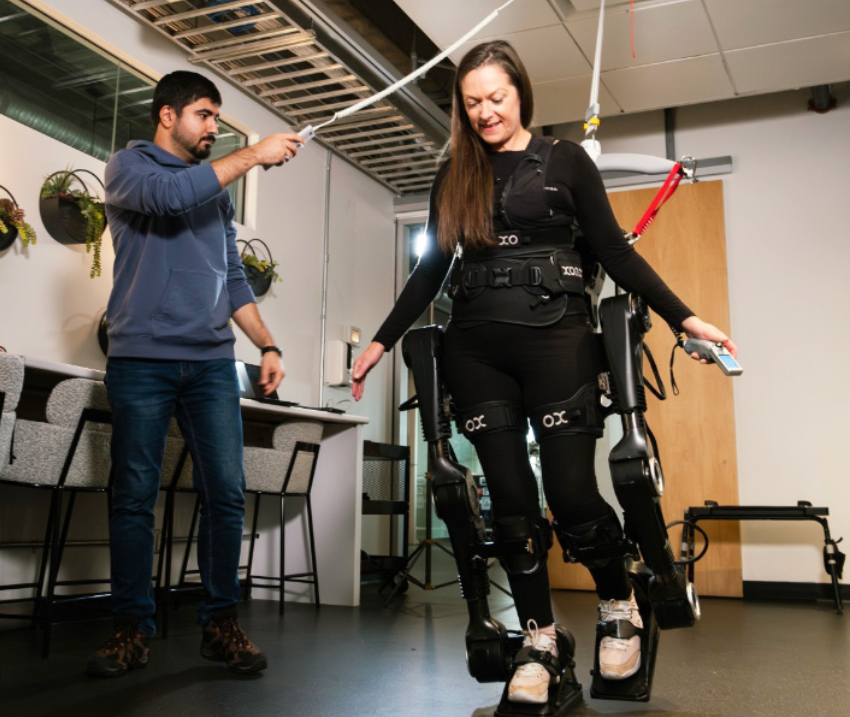
Human in Motion Robotics describes XoMotion as a self-balancing, hands-free platform intended for people with lower-extremity motor deficits. The system combines powered lower-limb movement with sensing and control intended to support upright mobility without continuous reliance on external gait aids.
That potentially changes the experience for the wearer, but it also changes what needs to be evaluated.
For a self-balancing exoskeleton, clinical usability is not only about whether the system can produce a walking motion. It also depends on fitting, transfers, movement transitions, control responsiveness, operator oversight and how predictably the device behaves throughout a session.
The new study is useful because it examines several of those less visible parts of deployment.
Participants generally reported positive usability
The study enrolled three adults with chronic motor-complete SCI and evaluated the Beta 2 prototype over 12 sessions across four weeks.
The protocol included three phases. Participants first underwent screening, anthropometric assessment and simulator familiarization. The second phase included fitting, donning and doffing practice and baseline measurements. The final phase involved exoskeleton-assisted training.
Training included sit-to-stand movements, overground walking and tasks based on the Functional Gait Assessment.
Participant feedback was generally positive. The paper reports high usability ratings including confidence using the system and ease of setup, while also identifying areas that needed improvement.
Those included the process of transferring onto the device before donning, clarity of device messaging and movement transitions.
That distinction matters. A user can become comfortable with an exoskeleton while still encountering friction around the broader process required to enter, configure and operate the system.
The operator experience exposed a different set of challenges
Six research-team operators completed a separate operator-experience questionnaire.
Their ratings were more moderate than the participant responses.
Operators identified challenges involving device setup, joystick responsiveness and perceived system stability during early familiarization activities.
This difference between participant and operator experience is one of the most useful findings in the paper.
In clinical rehabilitation, an exoskeleton is not evaluated only by the person wearing it. Therapists and technical staff also have to screen the user, configure the system, supervise sessions and respond if the device behaves unexpectedly.
A system can therefore feel capable to the person wearing it while still creating meaningful operational friction for the clinical team.
The study documented minor adverse events and one serious fracture
The researchers reported adverse events including skin irritation and bruising.
One participant also experienced a serious adverse event involving a tibial fracture during a sit-to-stand-to-sit transfer and was withdrawn from the study.
The event deserves careful interpretation.
The paper states that the contributing factors were considered multifactorial. Following the event, the device and available operational information were reviewed, and the investigators reported that they did not identify a confirmed device malfunction.
The study therefore does not attribute the fracture to a single mechanical failure.
Instead, it reinforces how safety in rehabilitation robotics can depend on the interaction between participant-specific factors, setup conditions, movement mechanics and device operation.
The study was designed to inform further development
The tested system was explicitly described as the XoMotion Beta 2 investigational prototype.
That distinction is important.
The purpose of the study was to collect structured feedback during beta-stage testing and use those findings to inform subsequent development.
The paper also includes a manufacturer commentary providing context on the evolution of the platform after the Beta 2 testing period.
The findings should therefore be understood as evidence about a development-stage configuration rather than automatically applied to every later XoMotion unit.
Exoskeleton Index tracks the current platform separately in the XoMotion product profile.
Current XoMotion positioning
Human in Motion Robotics currently positions XoMotion as a self-balancing rehabilitation platform for people with lower-extremity motor deficits.
The company’s current website highlights hands-free operation, complex walking movements and postural control, and states that XoMotion is not yet FDA cleared in the United States.
This makes the usability evidence particularly relevant. As the platform progresses through clinical deployment and regulatory development, the questions extend beyond whether self-balancing movement is technically possible.
Hospitals and rehabilitation providers also need to understand setup, staff workload, user selection, training, safety procedures and how consistently the system performs across repeated sessions.
Our analysis
The most important part of this study is not whether XoMotion Beta 2 received a positive or negative usability score.
It is what the paper reveals about the transition from a technically capable self-balancing exoskeleton to a system that can be used repeatedly inside clinical care.
Removing the need for external balance aids could change the value proposition of an overground exoskeleton. It may free the upper body and expand the types of movement a user can perform.
But autonomous balance does not remove complexity. It moves some of that complexity elsewhere.
Fitting, transfers, control responsiveness, movement transitions, user screening and operator workflow become part of the performance equation.
The contrast between participant and operator feedback is especially useful.
Participants generally reported high usability, while operators reported more friction around setup, responsiveness and stability.
User experience and clinical deployability are not the same measure.
A device can feel capable to the person wearing it while still requiring substantial staff time, training and operational adaptation.
The serious adverse event reinforces another point: technical performance alone is not enough to characterize readiness for clinical deployment.
Risk mitigation also has to account for participant-specific factors, training conditions, setup and the way the device is operated.
That does not make the study evidence against self-balancing exoskeletons.
It makes it evidence that the path to wider clinical adoption involves more than improving balance algorithms.
The systems that progress furthest may ultimately be those that combine mobility capability with repeatable setup, clear operator feedback, appropriate screening and predictable clinical workflows.
Caution
This was a very small pilot involving only three participants.
It cannot establish the overall safety, clinical effectiveness or usability of XoMotion across the wider spinal-cord-injury population.
The study also did not compare XoMotion directly with another rehabilitation exoskeleton, conventional gait therapy or another mobility intervention.
It therefore cannot establish superiority over other rehabilitation approaches.
The serious fracture event should also not be simplified into a claim that the exoskeleton caused the injury. The investigators described the contributing factors as multifactorial and reported that post-event review did not identify a confirmed device malfunction.
At the same time, the event should not be minimized. Serious adverse events are relevant evidence when evaluating an emerging clinical technology and should remain visible in the evidence record.
There are also important study-relationship considerations.
Human in Motion Robotics supported the work through an equipment-loan agreement, in-kind travel, on-site training and technical support, and reimbursement of participant expenses. Four of the study authors were affiliated with Human in Motion Robotics.
The authors state that they had no competing interests, and the work was peer reviewed. The manufacturer involvement nevertheless remains relevant context when interpreting the findings.
What to watch next
The most useful next evidence will come from larger studies using later XoMotion configurations and more representative clinical workflows.
- Whether later systems reduce setup and transfer burden for clinical operators;
- whether improvements in responsiveness and workflow remain consistent across repeated clinical use;
- how self-balancing performance behaves across users with different body dimensions and impairment profiles;
- whether autonomous balance translates into measurable functional or rehabilitation benefits;
- how XoMotion compares with established rehabilitation exoskeletons or conventional therapy; and
- how the platform progresses through additional regulatory and commercial pathways outside its current markets.
Why this matters for the wider exoskeleton market
Self-balancing systems represent one of the more ambitious directions in rehabilitation robotics.
The goal is not simply to power the legs, but to coordinate movement and postural control closely enough that the user can remain upright without continuously relying on external balance aids.
That capability could expand what overground exoskeletons are able to support.
But the XoMotion Beta 2 study shows why technical capability is only one layer of readiness.
Clinical adoption also depends on user selection, setup, fitting, operator training, workflow, safety monitoring and evidence collected across a sufficiently large and representative population.
For Exoskeleton Index, rehabilitation systems should therefore be evaluated across separate dimensions: technical capability, participant experience, operator usability, clinical evidence, safety context and commercial maturity.
Explore the XoMotion product profile, review Human in Motion Robotics, browse the Exoskeleton Product Directory, or explore other systems in the Healthcare & Rehabilitation category.
Sources
- Tsang P, Souza WH, Walden TP, et al. Pilot usability and participant experience evaluation with an investigational self-balancing overground exoskeleton in adult users with chronic motor-complete paraplegia. BioMedical Engineering OnLine. Published 14 September 2026.
- Human in Motion Robotics — XoMotion official product and clinical information.