
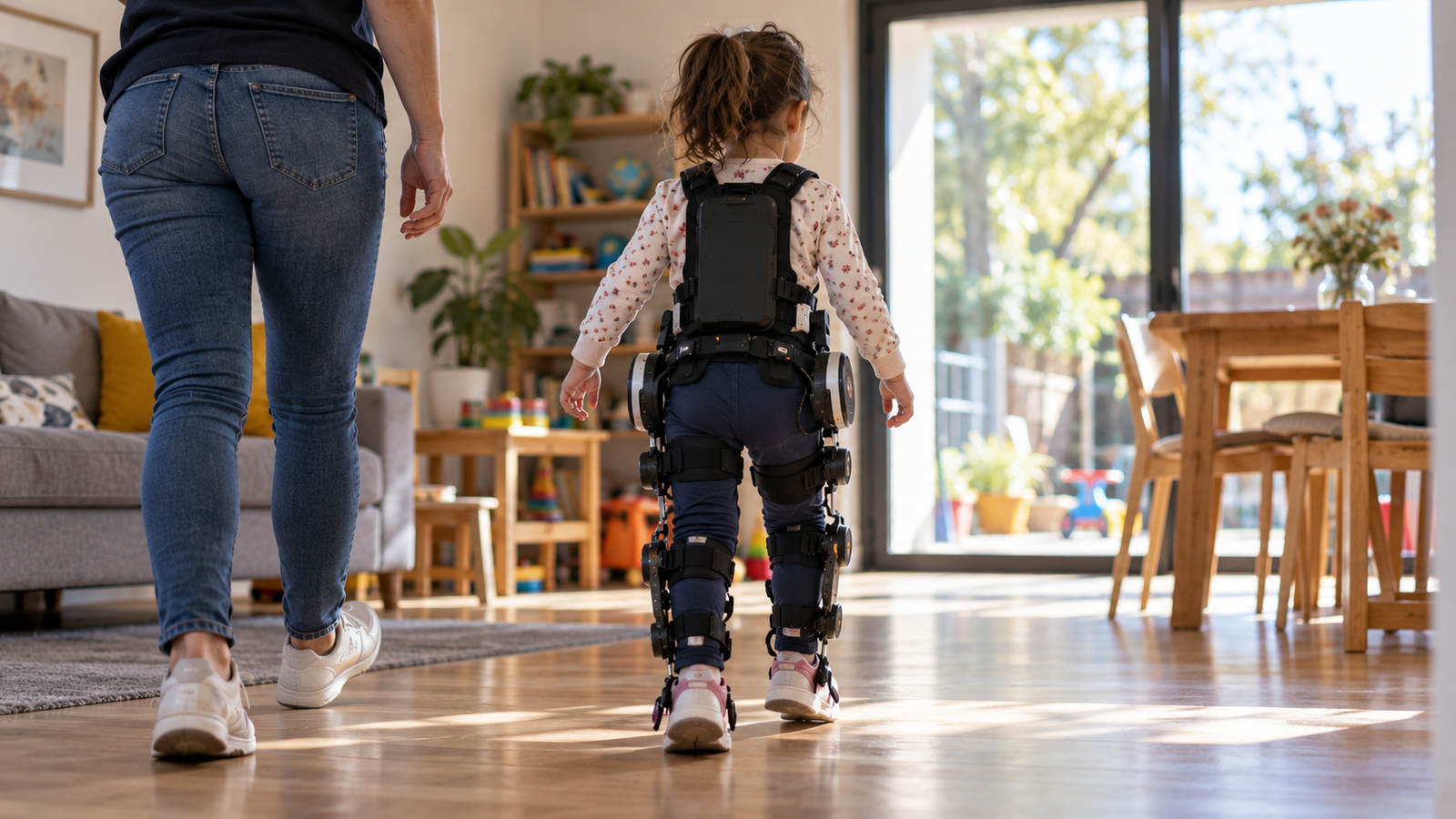
Marsi Bionics’ EXPLORER MB has received CE marking as a medical device, moving the company’s pediatric walking exoskeleton closer to broader personal use outside rehabilitation centres. The milestone follows a 50-child multicentre study in homes and community environments, where the device was used in 94% of planned sessions with no serious adverse events. The bigger signal is the setting: pediatric exoskeletons are beginning to move from supervised therapy toward everyday mobility.
- Product
- EXPLORER MB
- Manufacturer
- Marsi Bionics
- Regulatory milestone
- CE marked as a medical device
- Market
- Pediatric mobility / healthcare and rehabilitation
- Positioning
- Personal-use powered pediatric walking exoskeleton
- Intended environment
- Everyday settings including home, school, parks and community environments
- Approximate age range
- 2 to 17 years, according to Marsi Bionics
- Recent clinical study
- Prospective multicentre safety and usability study
- Participants
- 50 children aged 2 to 17 with neurological or neuromuscular conditions
- Study exposure
- Eight sessions per participant in home and community environments
- Planned sessions completed
- 94%
- Serious adverse events
- None reported
- Average donning time
- 4.7 ± 1.8 minutes
- Median satisfaction score
- 4/5 on QUEST 2.0
- Average session duration
- 21.2 ± 15.1 minutes
- Average steps per session
- 392 ± 244
The important development is not simply another CE mark
Marsi Bionics has spent years developing pediatric exoskeletons for children with neurological and neuromuscular conditions. Its established ATLAS 2030 platform is principally associated with rehabilitation and supervised clinical use. EXPLORER MB is trying to solve a different problem. Marsi positions the device as a powered pediatric walking exoskeleton intended for personal use in everyday environments. That means moving wearable robotics away from a scheduled rehabilitation session and into places such as the home, school, street or park. The recent CE marking is therefore more important than a conventional product-compliance milestone. It gives Marsi a clearer regulatory pathway toward making a pediatric exoskeleton part of everyday mobility rather than equipment used primarily inside a clinical programme.EXPLORER MB is designed around life outside the clinic
Marsi Bionics describes EXPLORER MB as a pediatric wearable exoskeleton designed to assist walking in children with neurodevelopmental disorders. The company says the system is intended to adapt as the child grows and covers an approximate age range from 2 to 17 years. Its intended environments are equally important. Marsi explicitly positions EXPLORER for everyday settings such as:- the home;
- school;
- parks;
- streets; and
- other community environments.
A 50-child study tested the device where it is actually intended to be used
The regulatory milestone comes shortly after publication of one of the most relevant studies yet for EXPLORER. Researchers evaluated the system in a prospective, multicentre, open-label study involving 50 children aged 2 to 17 years. The participants had neurological or neuromuscular diseases affecting motor function. Importantly, testing did not take place only inside a rehabilitation laboratory. Children used EXPLORER in their homes and usual community environments, with support from caregivers and researchers. Each participant was scheduled for eight sessions. The study was primarily designed to examine safety and usability, rather than to prove long-term clinical effectiveness. That distinction matters. The researchers were asking whether a pediatric exoskeleton designed for personal mobility could realistically be used outside a specialised centre.94% of planned sessions were completed
The device was used in 94% of the planned sessions. Researchers reported no serious adverse events. Average donning time was: 4.7 ± 1.8 minutes. Median satisfaction measured using the QUEST 2.0 assistive-technology questionnaire was: 4 out of 5. Use was also distributed across both indoor and outdoor environments. Researchers reported:- 52.7% of use in indoor environments; and
- 47.3% in outdoor environments.
Safety and usability are different from clinical effectiveness
The study authors concluded that the results provide preliminary evidence that EXPLORER is safe and usable in real-world settings. That is encouraging. It is also narrower than saying the exoskeleton has been proven to improve long-term walking ability or replace another mobility device. The study was not designed to establish outcomes such as:- long-term changes in independent walking ability;
- reduced wheelchair use;
- improvements in muscle strength;
- prevention of secondary complications;
- long-term participation outcomes; or
- comparative effectiveness versus alternative mobility technologies.
The CE milestone should also be described precisely
Marsi Bionics announced that EXPLORER MB has received CE marking as a medical device. Founder and CEO Elena García Armada separately described the milestone as CE marking received from the competent authority. That is the terminology Exoskeleton Index uses. Some Spanish media coverage has described the event as approval by the European Medicines Agency. That is not the appropriate description of the regulatory pathway for this medical device. The relevant milestone is the product’s CE marking. CE marking enables a medical device that satisfies the applicable European requirements to be placed on the relevant European market under its certified intended use. It should not be interpreted as a guarantee of reimbursement, immediate availability in every European country or adoption by individual health systems. Those are separate commercial and healthcare-access questions.Personal use changes the business model as much as the technology
The distinction between institutional and personal exoskeletons is commercially significant. A rehabilitation centre may purchase one system and use it across many patients under professional supervision. A personal-use system has a very different relationship with the user. Fit needs to remain appropriate over time. Training may need to involve parents or caregivers. Service and maintenance have to work outside a hospital engineering department. The device may need to accompany the child between different environments. And the payer may no longer be a single hospital procurement department. Potential routes could involve healthcare systems, insurers, disability programmes, foundations, regional authorities or private payment depending on the country. That makes regulatory clearance only one part of the commercialization problem.Growth is a uniquely pediatric engineering challenge
Children are not simply smaller adult exoskeleton users. Their body dimensions change. Their gait patterns develop. The underlying conditions can affect muscle tone, joint range, posture and motor control differently from one child to another. A personal pediatric exoskeleton therefore needs to remain usable while the child grows. Marsi explicitly describes EXPLORER as a device that evolves with the child’s growth across an approximate age range of 2 to 17 years. How that adjustability works in practice will be particularly important for buyers and payers. A device that requires frequent component replacement or specialist refitting could produce very different lifecycle economics from one that accommodates growth through a wider adjustment range. That is one of the areas where real post-market experience will matter more than the initial specification.Exoskeleton Index analysis
The important signal here is the transition from therapy technology to personal mobility technology. Medical exoskeletons have historically developed around institutions. A hospital or rehabilitation centre acquires the system. Trained professionals operate it. Sessions take place in controlled environments. The patient arrives, uses the device and leaves. EXPLORER is built around a different assumption. The exoskeleton goes where the child goes. That changes the product. Usability becomes more important. Donning time matters more. Caregiver training matters more. Outdoor compatibility matters more. Growth matters more. Service availability matters more. And perhaps most importantly, reimbursement becomes a different problem. This is part of a broader shift we have been tracking across the medical exoskeleton market. Recent research around systems such as ReWalk is increasingly examining what happens when an exoskeleton leaves the laboratory or rehabilitation centre and enters ordinary life. The relevant question is no longer only: Can the person walk with the robot? It becomes: Can the technology fit into the person’s actual day? For pediatric systems, that question may be even more important. A child does not live inside a gait laboratory. The meaningful environments are home, school, play, family activities and the community. The 50-child EXPLORER study does not yet prove long-term personal adoption. But it tests the product in the environments that will ultimately determine whether personal pediatric exoskeletons become a sustainable category. The CE marking now brings that question closer to the commercial market.The evidence also gives Marsi something many emerging products do not yet have
A common problem in the exoskeleton market is that commercialization and evidence development happen at different speeds. A product may reach demonstrations or early sales while the publicly available evidence still comes primarily from laboratory prototypes. EXPLORER now has a useful combination:- a defined personal-use positioning;
- a dedicated pediatric design;
- a prospective multicentre study;
- testing across home and community environments;
- reported safety and usability outcomes; and
- CE marking as a medical device.
CE marking does not solve the reimbursement question
For pediatric personal-use exoskeletons, market access is likely to be one of the defining challenges. Medical-device regulation and healthcare reimbursement solve different problems. CE marking addresses the regulatory pathway. It does not determine whether a national health service, insurer or regional authority will pay for the system. Nor does it establish the eventual patient contribution, rental model, servicing arrangement or replacement policy as a child grows. This distinction is particularly relevant in Europe, where reimbursement pathways vary significantly between countries. Marsi has already participated in institutional pediatric exoskeleton procurement. In Spain, public-sector procurement has included Marsi systems for pediatric rehabilitation, and recent hospital tenders show continuing demand for pediatric robotic gait technology. Personal use is different. The commercial opportunity may ultimately depend on whether healthcare systems treat an exoskeleton more like rehabilitation equipment, a mobility aid, an orthotic device or a separate category of assistive technology. That classification can have major consequences for access.What remains unknown
CE marking is an important regulatory milestone, but several questions remain before EXPLORER can be considered an established personal mobility category. Marsi Bionics has not publicly disclosed broad European sales volumes for EXPLORER MB. Exoskeleton Index has also not identified a public retail price that can be treated as a validated European transaction price. Availability may vary by country, distributor, clinical pathway and individual eligibility. The recent study involved 50 children and eight planned sessions per participant. It provides useful preliminary safety and usability evidence but does not establish long-term adherence or long-term clinical benefit. Average usage of approximately 21 minutes and 392 steps per study session should not be interpreted as expected daily use after commercialization. No serious adverse events were reported in the study, but a larger post-market population and longer exposure will provide a much stronger picture of safety in repeated everyday use. Finally, CE marking does not establish reimbursement. The ability of families to access EXPLORER will depend not only on regulatory status but also on local healthcare, insurance and funding pathways.What to watch next
The next important signal will be actual personal-use deployment. How many children receive EXPLORER MB outside structured research? How often do they use it? Which environments become the most common? How frequently does the system need adjustment as the child grows? And what level of caregiver support is required after the initial training period? Pricing and reimbursement will be equally important. If public health systems or insurers begin creating repeatable pathways for personal pediatric exoskeletons, the market could become substantially larger than institutional rehabilitation alone. Long-term evidence should also show whether the high satisfaction and usability reported in the initial study persist over months rather than eight structured sessions. The broader question is larger than EXPLORER itself. Pediatric exoskeleton research has spent years demonstrating that robotic walking assistance is technically possible. The next phase is about whether the technology can become something children can realistically use as part of everyday life. EXPLORER MB’s CE marking moves that question from research closer to the market. Explore the EXPLORER MB product profile, view the Marsi Bionics company profile, or browse the wider Healthcare & Rehabilitation exoskeleton market.Sources
- Elena García Armada / Marsi Bionics: EXPLORER MB receives CE marking as a medical device, September 2026
- Marsi Bionics: EXPLORER MB personal-use pediatric exoskeleton positioning and intended environments
- Archives of Physical Medicine and Rehabilitation: Explorer — Safety and Usability of a Gait Exoskeleton for Children with Motor Disabilities in Natural Environments, published online 13 August 2026