
The European Innovation Council is funding PHYS-EXO, a new €300,000 project that will combine an active back-support exoskeleton with egocentric perception, semantic mapping, risk reasoning and task planning. The goal is significant: move exoskeletons beyond reacting to the wearer’s posture or movement toward systems that can understand hazards, tasks and spatial context around the user.
- Project
- PHYS-EXO — Physical Embodied Intelligence for Next-Generation Smart Exoskeletons
- Coordinator
- Scuola Universitaria Professionale della Svizzera Italiana (SUPSI), Switzerland
- Research institute
- Dalle Molle Institute for Artificial Intelligence (IDSIA USI-SUPSI)
- Funding programme
- European Innovation Council Advanced Innovation Challenges
- Challenge
- Accelerating Physical AI: Embodied Intelligence for the Next Frontier of AI-Powered Robotics
- EU contribution
- €300,000
- Project start
- 1 September 2026
- Project end
- 31 May 2027
- Starting maturity
- TRL 4 existing vision-enabled active back-support exoskeleton
- Phase 1 target
- TRL 5 validation in relevant rescue and industrial environments
- Planned AI stack
- Egocentric perception, semantic mapping / SLAM, risk reasoning, task planning and human-centric control
- Test environment 1
- Urban Search and Rescue in a simulated collapsed building
- Test environment 2
- Industrial manual handling in a dynamic factory environment
- Grant agreement
- 101326967
The important shift is from movement recognition to environmental understanding
Most modern active exoskeletons already contain some form of intelligence.
Sensors can identify posture, estimate movement, detect gait phases or determine when assistance should be delivered.
But those systems generally understand the wearer much better than they understand the world around the wearer.
PHYS-EXO is attempting to change that.
The project describes today’s industrial and rescue exoskeletons as largely reactive systems that rely on posture or motion signals without a detailed understanding of nearby hazards, tasks or spatial context.
Its proposed architecture adds an environmental intelligence layer around the wearable robot.
Instead of asking only:
What is the user doing?
the system would also attempt to understand:
Where is the user, what is around them, what task is being performed and what risks are emerging?
That is a substantially more ambitious control problem.
PHYS-EXO combines five layers of Physical AI
The project describes a modular, Agentic AI-ready Physical AI pipeline built around five main functions:
- Perception to observe the environment from the wearer’s perspective;
- Semantic mapping and SLAM to build and continuously update a spatial representation of that environment;
- Risk reasoning to interpret hazards and constraints within the scene;
- Task planning to determine contextually appropriate actions or guidance; and
- Human-centric control to translate that information into assistance while keeping the wearer central to the system.
CORDIS says the system will combine egocentric multimodal perception with 3D environment reconstruction, reasoning, planning and adaptive control.
The processing is intended to operate in real time and at the edge.
That matters for a wearable system.
An exoskeleton operating in an industrial plant or collapsed building cannot necessarily depend on continuous cloud connectivity before deciding how to respond to its surroundings.
The project starts from an existing active back-support exoskeleton
PHYS-EXO is not beginning with a purely conceptual wearable.
According to the European Commission’s CORDIS project record, SUPSI-IDSIA already has a TRL 4 vision-enabled active back-support exoskeleton.
Phase 1 will extend that platform with:
- egocentric depth perception;
- preliminary semantic SLAM;
- a first-generation AI reasoning layer; and
- an integrated perception-to-control loop.
The stated objective is to reach TRL 5 by validating the resulting system in two application-relevant environments.
That maturity target is important.
PHYS-EXO is still an R&D project, but the programme is explicitly structured around moving promising Physical AI systems toward validation and eventual deployment rather than stopping at an isolated laboratory algorithm.
One test will put the system inside a simulated collapsed building
The first planned use case is Urban Search and Rescue.
PHYS-EXO intends to test the exoskeleton in a simulated collapsed-building environment.
This is a particularly demanding scenario for a context-aware wearable system.
A rescue worker may need to carry equipment while navigating debris, restricted passages, unstable surfaces and rapidly changing routes.
Traditional physical assistance could help reduce the load on the user.
A Physical AI system introduces another possibility: combining that assistance with an understanding of the surrounding environment.
The project’s stated goals include context-aware physical assistance, risk-aware navigation support and explainable decision guidance.
If those capabilities can eventually be validated, the value proposition becomes wider than simply reducing the physical effort of carrying or lifting.
The exoskeleton begins to function as part of a broader human-machine decision system.
That is particularly relevant to the Defense & Emergency Response exoskeleton market, where mobility assistance has to coexist with environmental uncertainty and safety-critical decisions.
The industrial test is equally important
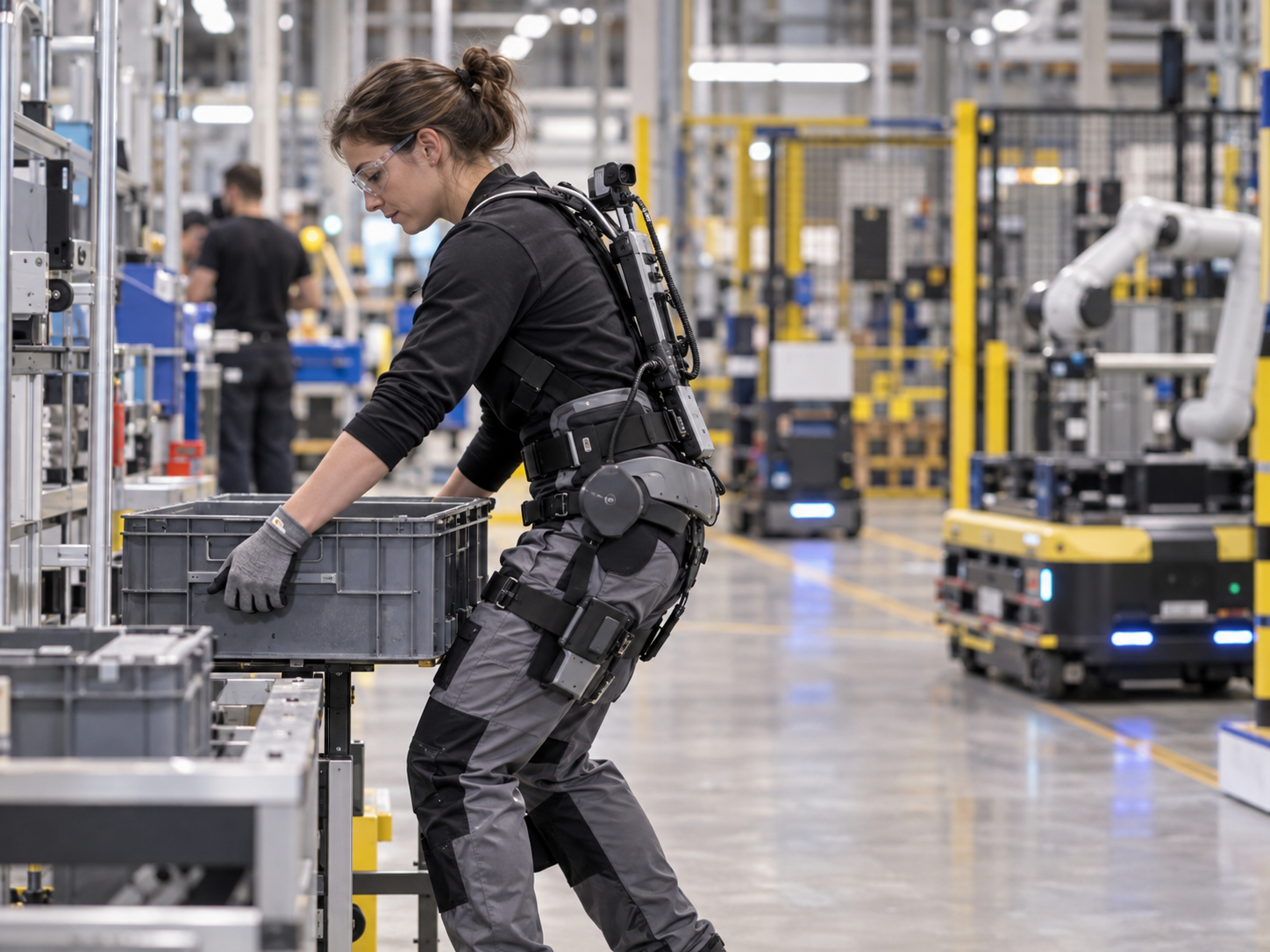
The second use case focuses on industrial manual handling.
The planned environment is not presented as a simple repetitive lifting station.
CORDIS describes a dynamic factory containing:
- moving robots;
- restricted areas;
- heavy lifting tasks; and
- changing environmental conditions.
That makes the experiment more interesting from a workplace-exoskeleton perspective.
An ordinary active back-support system can adapt assistance according to the worker’s movement.
A context-aware system could potentially take information about the wider task into account.
For example, the relevant question eventually becomes not only whether the worker is bending, but why they are bending, where they are working and what is happening around them.
PHYS-EXO has not yet demonstrated that level of capability.
But that is the direction the architecture is designed to investigate.
“Physical AI” has a specific meaning here
Physical AI is becoming a widely used robotics term, and it risks becoming another label applied too broadly.
In PHYS-EXO, however, there is a relatively concrete technical definition behind it.
The European Innovation Council’s Physical AI challenge is focused on AI systems that can operate in complex physical environments through capabilities such as intelligent perception, cognition, adaptation and autonomous decision-making.
PHYS-EXO applies that concept directly to wearable robotics.
The significant difference is environmental context.
A conventional intelligent exoskeleton may recognize walking, lifting or bending and adjust assistance.
PHYS-EXO aims to combine information about the wearer’s movement with an evolving representation of the external world.
That moves the intelligence problem from:
motion → assistance
toward something closer to:
perception → environment model → risk reasoning → task planning → assistance.
The latter is substantially harder.
It may also be substantially more valuable.
The software layer could become as important as the mechanics
Occupational exoskeletons have historically been differentiated heavily through hardware.
Buyers compare weight, assistance force, supported body region, range of motion, battery life and mechanical architecture.
Physical AI introduces another potential competitive layer.
Future systems may also be differentiated by:
- what they can perceive;
- how accurately they understand the working environment;
- how quickly they update their environmental model;
- how reliably they identify hazards and restrictions;
- how their reasoning affects physical assistance;
- how decisions are communicated to the wearer; and
- whether the system continues to operate safely when perception or AI confidence is low.
For manufacturers, that could increase the importance of computer vision, edge AI and software integration alongside mechanical and biomechanical design.
For buyers, it could make product evaluation considerably more complex.
Exoskeleton Index analysis
PHYS-EXO is interesting because it points toward a different definition of a “smart exoskeleton.”
Today, smart often means that the device can recognize the wearer’s movement and adjust assistance.
That is useful, but it is still largely wearer-centric intelligence.
A system that understands both the human and the surrounding environment creates a different category of capability.
In an industrial setting, that could eventually mean assistance that changes according to the task, workstation, nearby machines or known restricted zones.
In rescue work, it could mean combining physical support with spatial awareness and risk information in an environment the user has never seen before.
The commercial implications could be significant.
If this architecture proves useful, the competitive advantage of an occupational exoskeleton may no longer come mainly from how much assistance the mechanism can provide.
It may increasingly come from how well the complete system understands the task.
That also changes the buyer conversation.
Instead of comparing only assistance levels, weight and ergonomics, an employer could eventually have to evaluate perception accuracy, latency, false detections, decision logic, cybersecurity, explainability and failure behaviour.
There is also a broader strategic implication.
Robotic automation usually attempts to remove the human from the physical task.
Physical AI exoskeletons take another approach: keep the human’s judgement and adaptability inside the task while adding machine perception, reasoning and physical support around them.
For environments that remain difficult to automate completely, that combination could become one of the more important long-term arguments for wearable robotics.
But PHYS-EXO is still at the beginning of that journey.
The next nine months need to demonstrate that adding environmental intelligence produces measurable value rather than simply adding sensors and computational complexity.
Selection into the EIC Physical AI programme is itself notable
PHYS-EXO is part of the first cohort of the European Innovation Council’s Advanced Innovation Challenges pilot.
The 2026 Physical AI challenge received 425 proposals.
Ten Physical AI projects were selected for the first stage.
Each receives €300,000 for up to nine months to develop, benchmark and validate its proposed technology.
The EIC says the programme is intentionally stage-gated.
The most promising projects may later have the opportunity to progress to a second stage, where grants of up to €2.5 million can support further development and real-world testing.
That additional funding has not been awarded to PHYS-EXO.
For now, its confirmed EU contribution is €300,000.
The distinction matters because the first phase is essentially a technical and validation gate.
PHYS-EXO will need evidence that the Physical AI architecture adds meaningful performance before the project can be considered a more mature deployment programme.
What would matter to industrial buyers
If context-aware exoskeletons begin moving toward commercial deployment, conventional ergonomic testing will not be enough.
A buyer would potentially need to evaluate several layers simultaneously.
Physical assistance: Does the system meaningfully reduce the target physical demand?
Perception: Can it reliably understand the environment under real lighting, obstruction, dust, movement and changing layouts?
Reasoning: Are hazards and task constraints interpreted correctly?
Control: Does environmental understanding actually improve when and how physical assistance is delivered?
Human factors: Does additional information help the wearer or create more cognitive load?
Operational reliability: What happens when sensors fail, confidence drops or the environment differs from the system’s training data?
Economics: Does the additional intelligence create enough operational value to justify the added hardware, software and support requirements?
Those questions are more demanding than evaluating a conventional passive support device.
They may also become increasingly important as AI moves deeper into industrial wearable robotics.
This is consistent with a broader shift already visible in workplace exoskeleton adoption: the strongest deployments are increasingly defined by task fit and measurable operational outcomes rather than by hardware specifications alone.
What remains unproven
PHYS-EXO started on 1 September 2026.
There are not yet published validation results showing that the proposed Physical AI architecture improves safety, productivity, rescue effectiveness or ergonomic outcomes.
The project objectives should therefore be treated as research targets rather than demonstrated capabilities.
CORDIS identifies the existing SUPSI platform as a TRL 4 vision-enabled active back-support exoskeleton. The planned TRL 5 status has not yet been achieved.
The public project record also does not provide a commercial product name, assistance torque, supported load, complete sensor specification, system weight, battery endurance or planned market price.
The stated capabilities around risk reasoning, task planning, risk-aware navigation and explainable guidance describe what PHYS-EXO intends to develop and validate.
They should not be interpreted as capabilities already proven in operational rescue or industrial deployments.
The €300,000 grant is the project’s confirmed Phase 1 EU contribution.
Although selected projects may later compete for substantially larger second-stage funding, PHYS-EXO has not been awarded a €2.5 million second-stage grant.
What to watch next
The first important signal will be whether PHYS-EXO can close the loop between perception and physical assistance.
Computer vision operating alongside an exoskeleton is one thing.
Environmental perception actually changing assistance or decision support in a useful, predictable and safe way is considerably more significant.
The project’s validation metrics should therefore be worth watching closely.
CORDIS says planned KPIs include perception accuracy, safe planning, ergonomic benefits, rescue effectiveness and industrial productivity.
The rescue trial will show how the system behaves in an unstructured environment.
The factory test should provide a clearer indication of whether semantic mapping and risk reasoning can add practical value around moving robots, restricted areas and manual handling.
The next commercial signal would be progression beyond Phase 1.
If PHYS-EXO demonstrates enough value to advance into larger-scale development and user testing, it would provide stronger evidence that Physical AI is becoming more than an adjacent research field for wearable robotics.
For now, the project represents an important question for the exoskeleton industry:
What happens when the wearable robot begins understanding the environment as well as the person wearing it?
Explore the Defense & Emergency Response exoskeleton category, read our analysis of workplace exoskeleton adoption, or browse the wider Exoskeleton Product Directory.
Sources
- European Commission CORDIS: PHYS-EXO — Physical Embodied Intelligence for Next-Generation Smart Exoskeletons
- European Innovation Council: First Advanced Innovation Challenges projects launched, 10 September 2026
- European Innovation Council: Advanced Innovation Challenges pilot
- SUPSI: IDSIA back-support exoskeleton research and validation background