
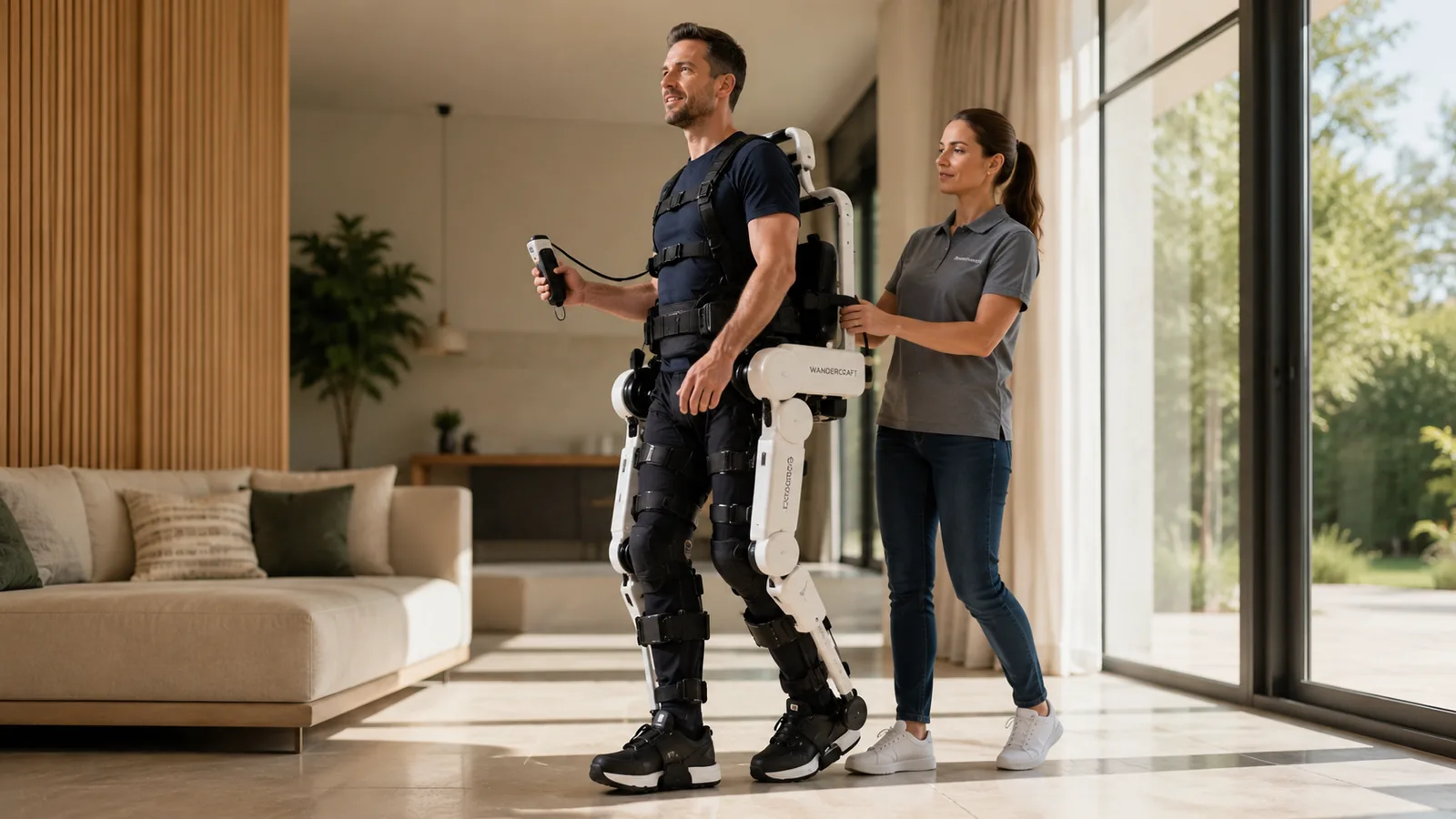
The U.S. Food and Drug Administration has cleared Wandercraft’s Eve personal exoskeleton for prescribed use by eligible adults with spinal cord injury, moving the company’s self-balancing technology from rehabilitation facilities toward personal mobility at home.
The clearance is an important regulatory milestone, but its scope needs to be read carefully. Eve is designed for hands-free upright mobility on level indoor surfaces and certain level outdoor areas immediately adjacent to a building. It requires a trained companion, clinical assessment, individualized fitting and structured training. Wandercraft describes the system as a complement to a wheelchair, not a replacement.
At a glance
- Device: Eve, Wandercraft’s self-balancing personal exoskeleton.
- FDA record: 510(k) K260381, with a decision dated 3 August 2026.
- Eligible population: Adults with spinal cord injury at any neurological level who meet the device’s individual eligibility requirements and can operate its remote control.
- Intended environment: Level indoor surfaces and qualifying level outdoor surfaces directly associated with a building, such as patios and terraces.
- Support requirement: Use under the supervision of a trained companion.
- Commercial timing: Wandercraft plans a U.S. commercial launch on 17 September 2026.
- Access context: A Medicare personal-exoskeleton reimbursement pathway already exists under HCPCS K1007, but Wandercraft has not yet established automatic coverage for Eve.
FDA clearance moves Eve beyond rehabilitation use
The FDA database lists Eve as a powered exoskeleton under product code PHL and records a “substantially equivalent” decision on 3 August 2026. The regulatory record also identifies three clinical trials associated with the submission.
Wandercraft announced the clearance on 11 August. The company says Eve enables eligible adults with spinal cord injuries to stand, walk, turn, bend and carry out activities while keeping their hands available rather than continuously relying on crutches or a walker for balance.
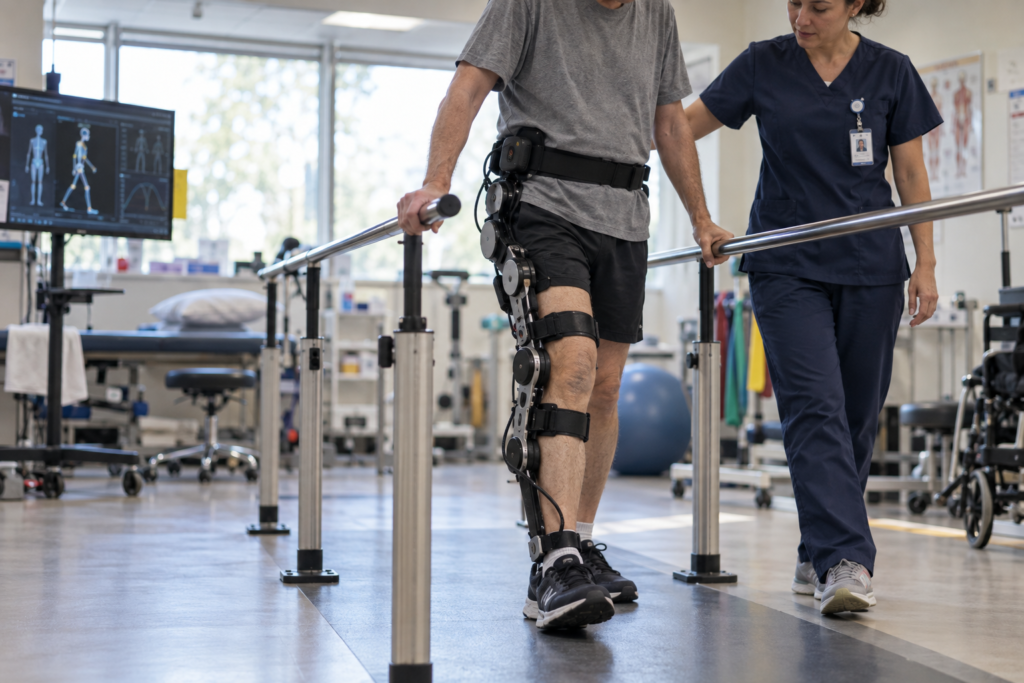
That is an important distinction from many established personal exoskeleton architectures. Eve uses active self-balancing technology derived from Wandercraft’s experience with Atalante X, its clinic-based rehabilitation platform.
Wandercraft says Atalante X is currently used in more than 150 rehabilitation and research centres worldwide. Eve attempts to translate parts of that self-balancing architecture into a system designed for prescribed personal use.
The clearance is broad by injury level, but not by user or environment
The phrase “spinal cord injury at any level” is significant, but it should not be interpreted as meaning that every person with spinal cord injury is eligible.
Eve remains a prescription device. Wandercraft says users must be at least 18 years old, tolerate standing, meet defined body-measurement and joint-mobility requirements and be able to operate the remote control. A licensed healthcare professional ultimately determines whether the device is appropriate after individual assessment.
The cleared environment is also narrower than general outdoor walking.
Wandercraft states that Eve may be used on firm, dry and level indoor surfaces and qualifying level outdoor areas associated with a building. It is not intended for stairs, slopes, ramps, wet or icy surfaces, public roads, crowded areas or sports.
A trained companion must remain present and within reach during use.
These boundaries matter because “personal use” does not mean unrestricted community ambulation. The regulatory milestone is the move from supervised rehabilitation sessions toward upright activity in selected everyday environments.
Training and service are part of the product
Commercializing a personal medical exoskeleton requires more than shipping hardware.
Wandercraft describes an access pathway that begins with clinical screening and individualized fitting. The user and companion then complete five training sessions of roughly two hours each. According to the company, those sessions can be completed within one week or spread over approximately 30 days.
Training covers transfers, remote operation, walking on level surfaces, movement in confined spaces, activities of daily living and emergency procedures.
The company has also been building a U.S. distribution and service network ahead of launch. National Seating & Mobility is expected to act as the exclusive complex-rehabilitation-technology distribution partner, using a network of more than 180 locations across the United States and Canada. Other announced partners include Walk US, Good Shepherd Rehabilitation and USVetServ for the Department of Veterans Affairs ecosystem.
That infrastructure may prove as consequential as the mechanical system itself. Personal exoskeleton adoption depends on identifying eligible users, fitting devices, training users and companions, documenting reimbursement cases and maintaining the product after delivery.
Medicare creates a pathway, not guaranteed coverage
Medicare has had a reimbursement pathway for qualifying personal exoskeletons under HCPCS code K1007 since 2024.
Wandercraft says it anticipates that Eve could become eligible for Medicare reimbursement within 60 to 90 days of its announcement and plans to pursue access through private payers and other funding sources.
That is a company expectation, not a current guarantee of coverage.
FDA clearance, coding and reimbursement are separate steps. Actual access will depend on coverage policy, eligibility, documentation, payer decisions and the commercial price of the system, which Wandercraft has not yet publicly disclosed.
Exoskeleton Index analysis
Eve is strategically important because it pushes self-balancing exoskeleton technology beyond the clinic and into a personal-use pathway. The more significant commercial question now shifts from whether Wandercraft can obtain clearance to whether it can repeatedly turn eligible users into trained, funded and supported owners. Distribution, reimbursement and service are becoming part of the competitive technology stack for medical exoskeletons.
The clinical programme focused on usable personal mobility
Wandercraft says its FDA submission was supported by a three-site clinical programme involving participants with spinal cord injury and their companions at the James J. Peters VA Medical Center, Kessler Foundation and Walk in New York.
The programme evaluated safety, training, usability and task performance relevant to personal use. Wandercraft reports that participants and companions were able to learn to operate the system and complete key functional and usability tasks.
The FDA database confirms three clinical-trial identifiers associated with the 510(k), but the clearance itself should not be treated as evidence that Eve will produce the same functional or health outcomes for every eligible user.
For buyers, clinicians and payers, the next important evidence will be published results showing how the system performs after users leave structured trials and begin using it over longer periods.
What remains unknown
The public material does not yet disclose Eve’s purchase price, expected first-year unit volume, final Medicare coverage status, private-payer policies or how many users can realistically be evaluated and trained through the initial U.S. network.
Longer-term personal-use data will also be important. FDA clearance establishes a regulatory pathway for the cleared indication; it does not by itself establish everyday adoption, payer uptake, long-term usage levels or replacement of existing mobility technologies.
Sources
- U.S. Food and Drug Administration, Eve 510(k) K260381.
- Wandercraft, FDA clearance and U.S. commercial-access announcement, 11 August 2026.
- Wandercraft, Eve intended use, eligibility and training information.
Explore the ecosystem
Explore healthcare and rehabilitation exoskeletons, browse the global product directory, or read our analysis of the exoskeleton market in 2026.