
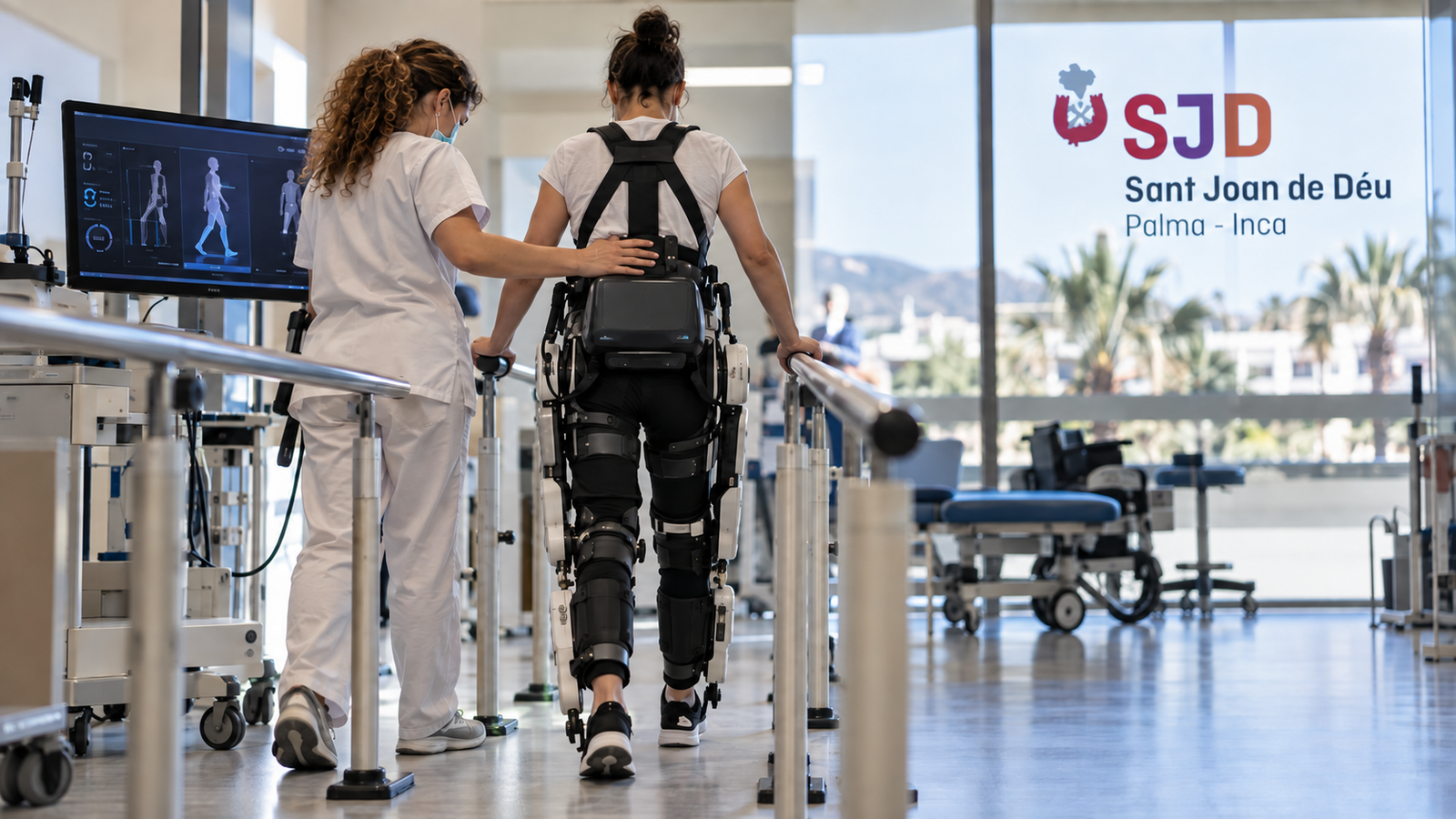
A €120,000 rehabilitation exoskeleton at Hospital Sant Joan de Déu in Palma has broken down after years of clinical use. The Balearic government says repair through the manufacturer had become extraordinarily complicated and costly, so a local group of engineers, makers and medical professionals is now trying to recover the device. The case raises a question that rarely appears in exoskeleton procurement: who will still be able to service an expensive medical robot seven or ten years after it is bought?
- Hospital
- Hospital Sant Joan de Déu Palma-Inca, Mallorca, Spain
- Original purchase
- 2019
- Purchase cost
- €120,000
- Device
- Historically identified as a Parker Indego rehabilitation exoskeleton
- Current problem
- Breakdown requiring repair; the failed component has not been disclosed publicly
- Repair route
- Local multidisciplinary project coordinated by CentreBit Menorca
- Historical use
- 55 patients and 462 sessions reported by February 2020; around 20 hours of rehabilitation per week from July 2019
- Product ownership history
- Parker Hannifin → Ekso Bionics → Wandercraft acquisition of Ekso Bionics in 2026
The interesting part is not that a medical robot broke
Complex rehabilitation equipment fails.
Motors wear. Batteries age. Sensors drift. Connectors, electronics and structural components can require maintenance after years of use.
What makes the Mallorca case interesting is what happened after the failure.
On 1 October, the Government of the Balearic Islands announced that CentreBit Menorca had created a multidisciplinary working group to repair the rehabilitation exoskeleton at Hospital Sant Joan de Déu in Palma.
The initiative began with a patient who had used the system. After the equipment suffered a breakdown, she approached the CentreBit FabLab looking for another route to restore it.
The government statement says the exoskeleton was manufactured in the United States and that, because of problems distributing this type of technology to Europe and other circumstances outside the hospital’s control, repair through the manufacturer had become extraordinarily complicated and costly.
That turns a local repair project into a much broader industry question.
For hospitals buying six-figure robotic systems, the real cost is not simply the acquisition price.
It is the ability to keep the device operational over its full clinical life.
Historical records identify the system as a Parker Indego
The 2026 repair announcement does not name the exoskeleton model.
Historical reporting does.
When the hospital introduced the device in 2019, local reporting identified it as the Parker Indego. Hospital material from the same period described a 17 kg system designed for rehabilitation across different patient sizes and capable of walking on indoor and outdoor surfaces.
Those characteristics are consistent with Parker’s clinic-focused Indego Therapy platform. Parker launched the next-generation Indego Therapy in 2018 specifically for rehabilitation centers, while the separate Indego Personal configuration was intended for home and community use.
Identification note: Exoskeleton Index is treating the Mallorca system as a Parker Indego rehabilitation exoskeleton at product-family level. The 2019 reporting strongly points to the clinic-use Indego Therapy configuration, but the 2026 repair notice does not provide a model number or submodel name. We are therefore not presenting the Therapy identification as newly confirmed by the current repair project.
The original acquisition was substantial.
Hospital Sant Joan de Déu said the device cost €120,000, funded by Pabisa Hotels and Obra Social “la Caixa”. At launch, the hospital described it as the first device of its category installed in Spain and the third in Europe.
The hospital also said the system could support up to six patients per day.
This was not a demonstration unit sitting idle
The lifecycle question matters because the exoskeleton appears to have entered real clinical use.
By February 2020, Hospital Sant Joan de Déu reported that 55 patients had completed 462 rehabilitation sessions with the system.
The hospital said it had been delivering around 20 hours of exoskeleton rehabilitation per week since July 2019.
Earlier reporting from November 2019 also documented 39 patients and 369 sessions, showing the device was already being integrated into the neurorehabilitation service within its first year.
The hospital continued to reference and demonstrate Indego in later rehabilitation activities, including spinal-cord-injury training events.
So the current breakdown is not simply a story about ageing inventory.
It concerns a medical robot that had been used as part of an established rehabilitation programme.
The product changed owners while the hardware stayed in the hospital
The Mallorca exoskeleton has also lived through a changing corporate landscape.
When the hospital bought the device in 2019, Indego belonged to Parker Hannifin.
In December 2022, Ekso Bionics acquired Parker’s Human Motion and Control business, including the Indego product line, for $10 million. The transaction included intellectual property, inventory, manufacturing assets and Indego units used for service and demonstrations.
The acquisition transferred the product family, but the transition also required Ekso to replace parts of Parker’s European commercial and regulatory infrastructure.
In its subsequent SEC filings, Ekso disclosed that it was relying on transitional services from Parker for the Indego business, including distribution-related support. The company said Parker’s European distribution contracts for Indego were scheduled to expire in March 2024 and that Ekso needed to establish replacement channels.
Those disclosures are relevant because the Balearic government’s 2026 repair statement specifically mentions problems around distribution of the technology to Europe.
But the connection must be handled carefully.
Evidence boundary: There is no public evidence that Parker’s 2022 sale of the Indego business, Ekso’s subsequent European distribution transition or any later ownership change caused the Mallorca repair problem. The Balearic government does not identify the failed part, the company contacted for repair, the repair quotation or the specific distribution obstacle involved.
That distinction is important.
The corporate history provides context for why long-term service continuity matters. It does not establish the cause of this particular breakdown.
The Indego line still has a European commercial presence
The situation is also more nuanced than saying the product simply lost European support.
Ekso Bionics currently maintains an Ekso Indego Therapy product page and continues to describe the system as a rehabilitation exoskeleton for individualized overground gait training.
Its current distributor directory lists Rebiotex as the distributor for Spain and Portugal.
That means the Balearic government’s reference to distribution difficulties should not be interpreted as evidence that there is no current Indego commercial channel in Spain.
Public information does not explain whether the hospital’s problem relates to an older Parker-era unit, availability of a specific component, service authorization, documentation, logistics, repair economics or another issue entirely.
For buyers, that uncertainty is itself instructive.
A distributor existing today does not automatically answer whether every older generation of hardware can still be repaired quickly and economically.
Another ownership change arrived just as the repair project became public
On the same date as the Balearic announcement, 1 October 2026, Wandercraft announced the acquisition of Ekso Bionics.
The transaction places the Ekso business inside a larger medical-exoskeleton group with operations and clinical relationships across Europe and North America.
Wandercraft said it intends to continue supporting the existing products and customers highlighted in its acquisition announcement.
However, that announcement does not resolve the practical question surrounding this specific 2019 Mallorca device.
The exoskeleton has now existed across three corporate eras:
Parker Hannifin → Ekso Bionics → Wandercraft-owned Ekso Bionics.
That is not unusual in medical technology.
But it illustrates why the expected operating life of the hardware and the expected life of the commercial structure around it are not necessarily the same thing.
Mallorca is now trying a local repair route
CentreBit Menorca says the working group has been active since July.
Participants include Hospital Sant Joan de Déu Palma-Inca, Makers Mallorca, ESMENT-AMADIP, the Official College of Industrial Engineers of the Balearic Islands and Fundación Medios Ingeniería Industrial.
The project is also seeking additional specialists in 3D printing, robotics, engineering, component design, prototyping and technical consulting.
That makes the initiative unusual.
Instead of treating the device only as proprietary medical equipment that must travel back through the original supply chain, the group is testing whether local engineering capability can recover at least part of its functionality.
There is an obvious constraint.
This is regulated medical equipment used with patients.
Spanish medical-device guidance states that devices placed into service must remain correctly installed and maintained according to the manufacturer’s instructions, while continuing to satisfy their intended safety and performance requirements.
The public announcement does not explain what component is being repaired, whether the work can be performed within existing manufacturer instructions, or what verification would be required before the device could return to clinical use.
Those details will determine whether this becomes a straightforward repair project or a much more difficult regulatory and technical problem.
Exoskeleton Index analysis
The Mallorca case exposes one of the least discussed costs in medical exoskeleton deployment.
A hospital does not really buy a €120,000 robot once.
It buys years of dependence on replacement parts, batteries, software, trained technicians, technical documentation, distributor continuity and manufacturer support.
That dependency matters more in exoskeletons than the typical purchase-price comparison suggests.
Medical exoskeletons are complex electromechanical systems. Many combine motors, sensors, proprietary control software, custom mechanical parts and patient-specific fitting procedures. A failure in one component can make the entire system unavailable even if most of the hardware remains functional.
The industry is also young enough that many of its first commercial systems are only now reaching the age where lifecycle support becomes a serious procurement issue.
Until now, most market conversations have focused on whether an exoskeleton can improve gait training, reduce therapist effort, obtain reimbursement or reach more patients.
The next question is less exciting, but just as important:
Can the installed base still be supported five, seven or ten years later?
That should change how buyers evaluate products.
A €20,000 difference in purchase price may matter less than whether a supplier can guarantee spare parts, remote diagnostics, regional service and repair turnaround for the next decade.
The Mallorca device also demonstrates why company stability and distribution structure belong inside total cost of ownership.
Ownership changes do not automatically create support problems. Acquisitions can strengthen a product by giving it more capital, broader distribution and better service infrastructure.
But every transition introduces operational questions that the physical device itself cannot answer.
Who holds the technical documentation?
Who is authorized to service older units?
Which parts remain in production?
Can a replacement component be shipped across regions?
Does the current distributor support hardware sold by a predecessor seven years earlier?
Those are not secondary purchasing questions.
For a hospital that expects a rehabilitation robot to remain useful for many years, they are part of the product.
What hospitals should ask before buying a medical exoskeleton
The Mallorca case suggests a practical procurement checklist that goes beyond specifications and clinical evidence.
- Parts availability: For how many years does the manufacturer guarantee replacement parts after purchase?
- Regional repair capability: Can trained technicians repair the device locally, or must it be returned to another country?
- Repair turnaround: What is the expected downtime for a safety-critical failure?
- Legacy support: Does the supplier commit to servicing older product generations after a new model launches?
- Distributor continuity: What happens to support if the local distributor changes or exits the market?
- Ownership changes: Are warranties, service contracts and spare-parts obligations transferable if the product line is sold?
- Software lifecycle: How long will the app, firmware and operating software remain compatible and supported?
- Diagnostic access: Can local service teams identify faults remotely, or does diagnosis require proprietary manufacturer tools?
- Total lifecycle cost: What should the hospital budget for batteries, preventive maintenance, major repairs and software over seven to ten years?
- End-of-support planning: What happens when the manufacturer formally ends support for the model?
These questions are especially important when hospitals compare products with similar clinical functions.
The strongest device on a specification sheet may not be the strongest long-term investment if its service model cannot support the expected operating life.
What remains unknown in Mallorca
Several important facts have not been disclosed publicly.
The failed component is unknown.
The cost quoted for manufacturer repair is unknown.
The public material does not identify which manufacturer, distributor or service organization was contacted.
It does not explain whether the hospital currently has a service agreement for the device.
It also does not say whether the local group intends to reproduce a mechanical component, repair electronics, replace a commercially available part or address another type of failure.
Most importantly, there is no public explanation yet of how the system would be validated before returning to patient use.
Those gaps prevent stronger conclusions about whether this is primarily a reliability problem, a spare-parts problem, a distribution problem or a repair-cost problem.
For now, the strongest conclusion is narrower and more useful:
a clinically used, six-figure exoskeleton has reached a point where maintaining access to repair has become difficult enough to mobilize a local engineering network.
What to watch next
The first question is whether the CentreBit-led group can identify and repair the fault.
The second is whether the repaired system can be returned to clinical use within the device’s safety and maintenance requirements.
A third question is whether Ekso Bionics, its current Spanish distribution network or Wandercraft becomes involved in the process.
If the issue can be solved with an equivalent replaceable component, the project could become a useful example of extending the life of expensive rehabilitation robotics.
If the repair depends on proprietary electronics, locked software, unavailable components or manufacturer-only procedures, the case may instead expose the limits of third-party maintenance for medical exoskeletons.
Either outcome would be valuable for the industry.
As more medical exoskeletons from the first commercial deployment wave move beyond five years in service, maintenance, spare parts and lifecycle support are likely to become a much larger part of the adoption conversation.
Explore the Ekso Bionics company profile, read our analysis of Wandercraft’s acquisition of Ekso Bionics, review the global exoskeleton distribution map, or browse the wider Healthcare & Rehabilitation exoskeleton landscape.
Sources
- Government of the Balearic Islands, 1 October 2026: CentreBit Menorca repair initiative for the Hospital Sant Joan de Déu exoskeleton
- Hospital Sant Joan de Déu Palma: 2019 acquisition and 2020 clinical-use reporting
- Mallorcadiario, 20 November 2019: hospital device identified as the Parker Indego
- Parker Hannifin, 20 September 2018: next-generation Indego Therapy launch
- Ekso Bionics, 5 December 2022: acquisition of Parker Human Motion and Control business and Indego product line
- Ekso Bionics SEC filing: Parker transition services and European Indego distribution arrangements
- Ekso Bionics: current Ekso Indego Therapy product information
- Ekso Bionics: current distributor directory, including Spain and Portugal
- Wandercraft, 1 October 2026: acquisition of Ekso Bionics
- AEMPS: Spanish medical-device requirements for installation, maintenance, safety and intended performance