
A practical barrier to adoption is beginning to change
For hospitals, purchasing a rehabilitation exoskeleton is only one part of adoption. The bigger question is how often the system can be used in a viable treatment programme, and who will pay for those sessions.
CCTV Finance reported that medical exoskeleton rehabilitation training has entered health-insurance or long-term-care insurance pilot arrangements in parts of Beijing, Shanghai, Jiangsu and Zhejiang. The reporting concerns medical rehabilitation services, not insurance coverage for consumer hiking or walking-assist devices.
The distinction matters. A reimbursable session can make use of equipment already installed at a hospital more affordable for eligible patients and more practical for providers to schedule. It does not mean the state has agreed to buy an exoskeleton for every patient.
One Zhejiang hospital reports a fivefold increase in use
The clearest operational numbers come from the Third Affiliated Hospital of Zhejiang Chinese Medical University. Niu Xuekang, deputy director of its rehabilitation assessment and treatment center, told CCTV Finance that the hospital’s reimbursement rate for exoskeleton rehabilitation training is 90%.
Before its pilot, the department reported approximately 40 exoskeleton training visits per month and a 15% equipment-utilization rate. After the pilot, monthly visits reached approximately 200 and utilization rose to 66%.
These figures come from one hospital’s reported experience. The underlying time periods, denominator used for equipment utilization, case mix and adjustment methods were not disclosed in the coverage. The figures do not establish a national average or prove that reimbursement alone caused the increase.
Even with those limitations, the change is notable. A medical device can be technically available but underused when patients cannot afford repeated training and hospitals have limited reimbursement routes. These numbers suggest that payment design could be an important part of expanding actual utilization.
What is being reimbursed?
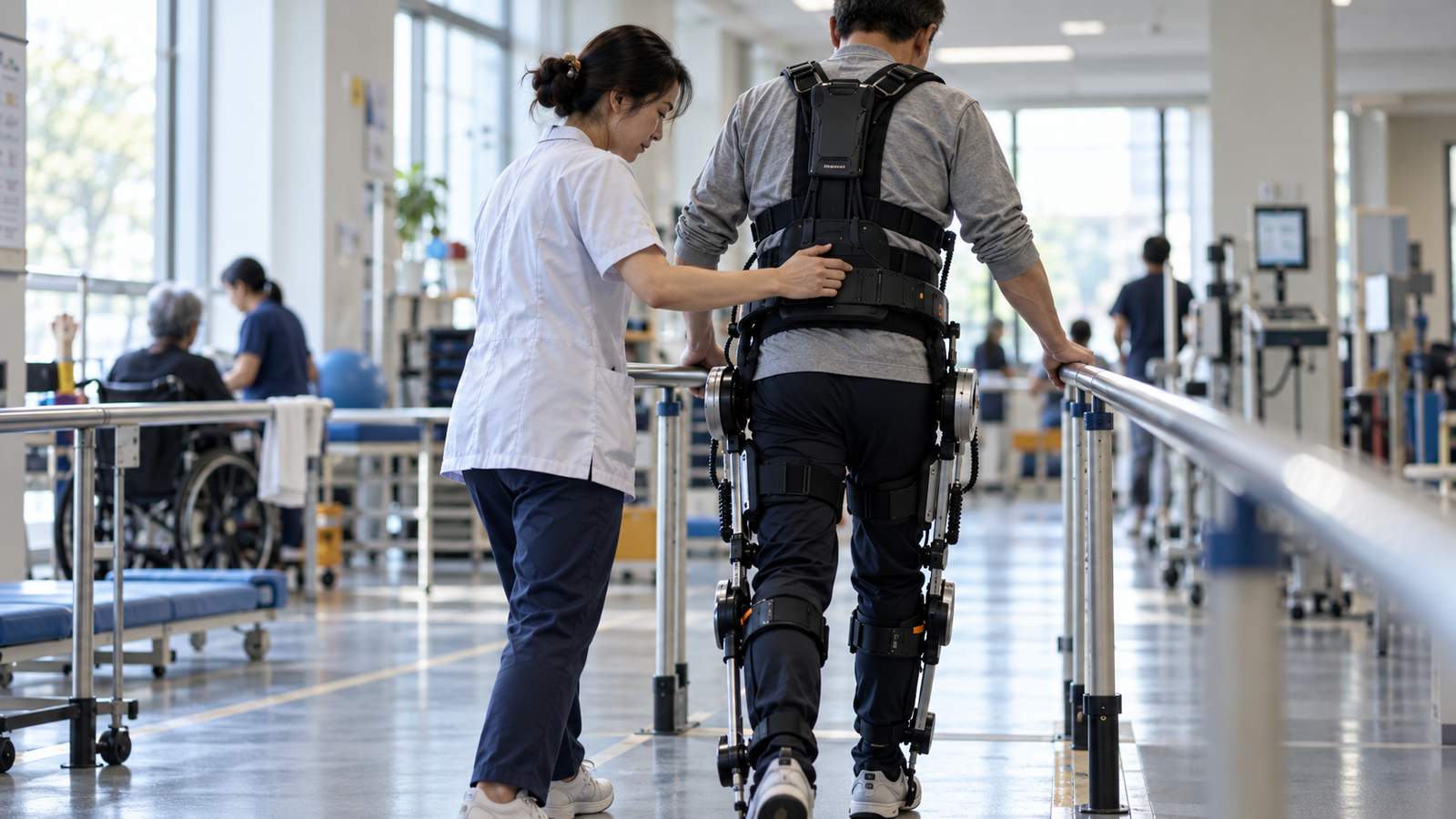
Medical exoskeletons can support repeated gait training, including stepping practice and movement control around the hip, knee or ankle. In a clinical setting, the therapy may involve a trained rehabilitation team, patient assessment, fitting, supervision and session planning.
China’s reported pilots concern the rehabilitation training item under local insurance arrangements. That is different from reimbursement for personal device ownership, a national list price for the hardware or a blanket approval of every brand and model.
Exact benefit eligibility, co-payment rules, qualifying diagnoses, participating institutions and the definition of a covered training session will need to be checked within each local programme. The October reporting does not provide a comparable tariff or full benefit schedule for all four regions.
Insurance coverage may make repeat supervised training affordable to more eligible patients.
Utilization matters when hospitals assess staff time, service capacity and the value of capital equipment.
For manufacturers, sustained reimbursable therapy may matter as much as an initial hardware sale.
Reported recovery outcomes still require separate evidence
The same hospital representative described improved balance scores, walking speed and walking distance among stroke patients after four to eight weeks of exoskeleton training. Those numbers provide context about the department’s clinical experience.
They should not be presented as proof that the device itself caused the gains. CCTV’s article does not identify a controlled study design, comparison group, sample size or published trial protocol for those claims.
Exoskeleton Index therefore treats the hospital’s training-volume data as an operational adoption signal, not evidence of comparative clinical efficacy.
Exoskeleton Index analysis
The most meaningful signal here is not a new robotic capability. It is a potential change in how medical exoskeleton use gets paid for.
Rehabilitation hardware competes for hospital budgets, clinical floor space and therapist time. When an institution owns a system but the treatment pathway does not adequately reimburse its use, attractive specifications alone do not create a sustainable service.
Insurance pilots introduce another variable: whether a facility can integrate robot-assisted training into a repeatable, funded clinical workflow. If utilization rises without sacrificing clinical quality, hospitals may be better positioned to justify training, maintenance and additional devices.
But this is not evidence that one reimbursement model will work across China. The next question is whether the utilization results can be reproduced across hospitals with different patient populations, staffing levels and payer rules.
The development also adds a payment dimension to China’s longer-term medical exoskeleton policy push, which already identifies exoskeletons and AI-assisted rehabilitation as technologies of strategic interest.
What manufacturers, hospitals and payers should watch
The next useful disclosures would be formal local reimbursement schedules, which patient groups qualify, the amount reimbursed per session, and whether medical exoskeleton training is funded as a distinct item or within broader rehabilitation packages.
Hospital-level reporting would be equally valuable: session counts across several sites, equipment uptime, therapist-to-patient requirements, adverse events, functional outcomes and cost per completed treatment course.
These are the details that determine whether expanded access converts into durable utilization, not just a temporary increase during a pilot.
For readers following the Chinese rehabilitation market, Exoskeleton Index’s China market analysis provides context on the differing commercial dynamics of medical, industrial and consumer exoskeletons. Our 2026 price and payment guide also explains why reimbursement, procurement and retail prices should never be treated as equivalent.
What this announcement does not establish
It does not confirm nationwide coverage, universal patient eligibility, reimbursement for consumer devices or a verified clinical benefit attributable to exoskeleton training. The 90%, 40-to-200 and 15%-to-66% figures all refer to one hospital’s reported experience.
Sources and reporting notes
CCTV Finance, reported October 17–19, 2026. Medical exoskeleton rehabilitation enters local insurance pilots, including the Zhejiang hospital interview and utilization figures, republished by Phoenix.
21jingji / 21st Century Business Herald, October 19, 2026. Additional Chinese-language coverage of the insurance and rehabilitation-training development.
Reporting note. The national policy ambition concerning commercial health insurance should not be confused with the operating rules of provincial and local public-insurance pilots. The hospital’s self-reported figures have not been independently audited for this article.