
Angel Robotics founder Kyoungchul Kong has returned as CEO, roughly two years after the South Korean wearable-robot company moved to professional management. His return comes as Angel Robotics expands technology developed for exoskeletons into robot actuators, control platforms and human-motion Physical AI.
The leadership change signals a broader strategy
Kong founded Angel Robotics in 2017 and served as chief executive until October 2024. The company developed wearable robots for clinical and industrial applications and completed its KOSDAQ listing during that period.
After management responsibilities shifted, Kong remained chairman of the board and led the Future Technology Institute, overseeing longer-term technology development. Angel Robotics announced on October 16 that its board had appointed him CEO again.
But the return is more than a change of personnel. The company is increasingly presenting the movement-sensing, actuation and force-control technologies developed through exoskeletons as a foundation for a wider robotics business.
The strategic question is whether the expertise gained from robots worn by people can become useful across robots that operate beyond the human body.
From wearable robots to reusable robotics technology
Exoskeletons must continuously respond to human movement. Unlike an autonomous machine operating separately from a person, a wearable robot must estimate the wearer’s intent, apply force at the right time and respond when movement changes unexpectedly.
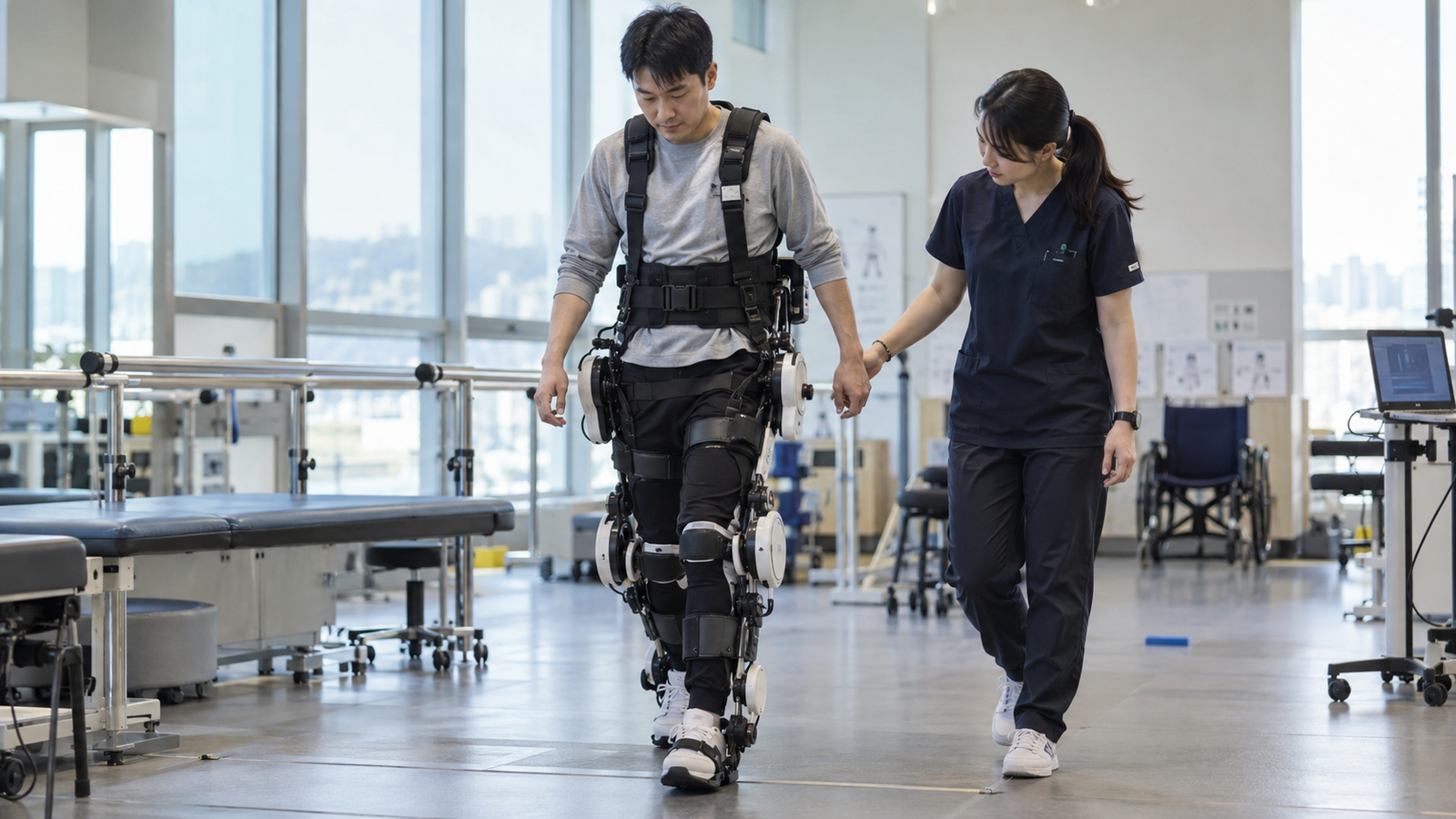
Angel Robotics has developed this expertise through systems such as the ANGEL LEGS M20, designed for overground gait rehabilitation, and the ANGEL SUIT H10, a powered hip-assist wearable robot.
The company now intends to make parts of that technology usable beyond its own finished exoskeletons.
Dates refer to company founding and management appointments, not product performance or commercial scale.
Three components define the new platform
Angel Robotics has introduced technology components that it presents as a more broadly applicable Physical AI stack. Its official platform documentation identifies three distinct elements.
A robotic actuator intended to generate and measure joint force, using active friction compensation.
An onboard robot-control engine designed around the company’s actuation technology.
A wearable research platform on which teams can develop and test their own control algorithms.
Those products show the distinction between a complete assistive device and components that other developers may integrate into new research or robotics systems.
In particular, phai-x1 preserves the connection to wearable robotics while opening the control environment to researchers and external development teams.
Human-motion data is becoming a strategic asset
Kong also leads research on a human-motion foundation model. According to the October 16 announcement, he was appointed director of the Joint Research Center for Human-Physical Intelligence in July, a research initiative involving KAIST and NVIDIA.
The objective is to learn from large-scale human-motion data so AI systems can better understand and predict physical movement.
That represents a different ambition from recognizing a small set of predefined walking states. A broader human-motion model could potentially support different types of robotic control and interaction, although its generalization and commercial performance remain to be demonstrated.
Angel Robotics says it intends to combine data accumulated through wearable robots and medical settings with AI as it develops the new business.
Exoskeleton Index analysis
Angel Robotics is testing whether years of human-machine interaction experience can become an advantage in the wider Physical AI market.
Wearable robots have a potentially valuable perspective on human movement: they can measure how people move while interacting directly with actuators and assistance systems. That creates practical expertise in gait timing, force control and movement-intent recognition.
But collecting movement data and developing a foundation model are not the same as establishing a competitive AI business. Dataset quality, permitted use, scale, independent benchmarks and the ability to transfer across tasks will determine whether this approach offers a durable advantage.
The company is also not abandoning exoskeletons. Its existing rehabilitation and mobility products remain a commercial foundation for the broader strategy.
The direction connects with other developments covered by Exoskeleton Index, including the PHYS-EXO research programme, which explores more adaptive and intelligent wearable robotic assistance.
The wearable-robot business continues
Angel Robotics says the expansion into actuators and AI will run alongside its existing wearable robotics and international business.
The company already supplies devices across rehabilitation and assistive mobility, and its October announcement says the ANGEL LEGS M20 has gained medical-device certifications in Thailand, Malaysia and Vietnam. It also reports certifications for the ANGEL SUIT H10 in Malaysia and Vietnam.
These are company-reported regulatory developments, not evidence that the newly announced AI platforms have already achieved widespread commercial use.
What is established, and what remains to be shown
Confirmed: Kong has returned as CEO. Angel Robotics has introduced phact, phorce and phai-x1, and is pursuing human-motion Physical AI research.
Not yet established: An independently benchmarked general-purpose human-motion model, wide third-party adoption of the platform or substantial revenue attributable to the new AI strategy.
What to watch next
The first test is commercial: whether developers beyond Angel Robotics begin adopting phact and phorce in other robot architectures.
The second is technical. Public detail on model-training data, evaluation methods and results would make it possible to assess the proposed human-motion foundation model beyond strategic positioning.
The third is ecosystem development. If phai-x1 becomes a practical platform for researchers building new wearable-control algorithms, it could create a path from the company’s exoskeleton experience into broader robotics research.
For now, Kong’s return marks a clear strategic commitment: Angel Robotics wants to build on its wearable-robot expertise while extending that expertise into components, control software and Physical AI.
Sources and reporting notes
EDaily, October 16, 2026. Founder returns as CEO and outlines Physical AI strategy, including research, management and international-business updates.
Angel Robotics. Official Physical AI platform, documenting phact, phorce and phai-x1.
Exoskeleton Index. Company profile and linked product records for existing wearable-robot context.
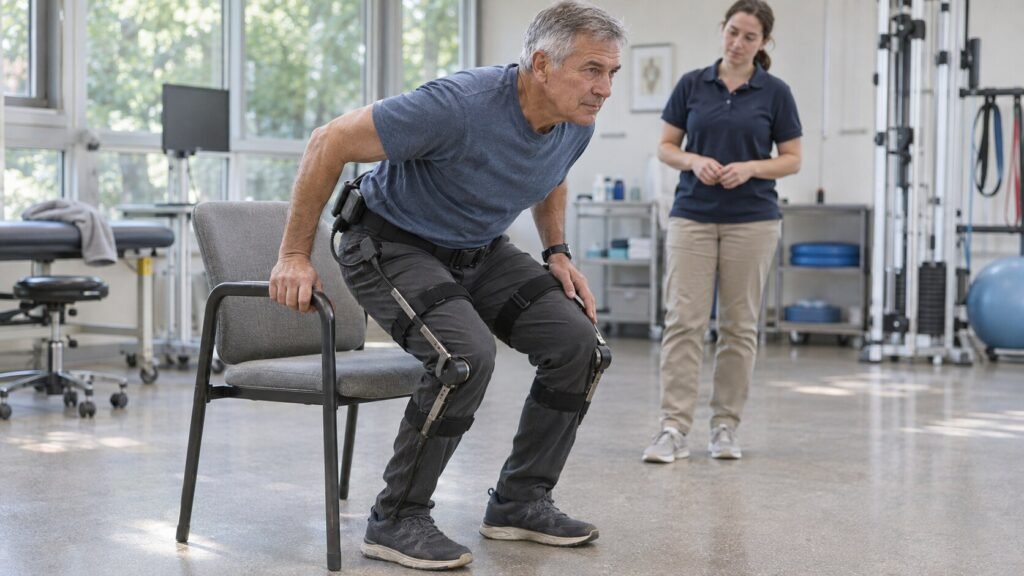
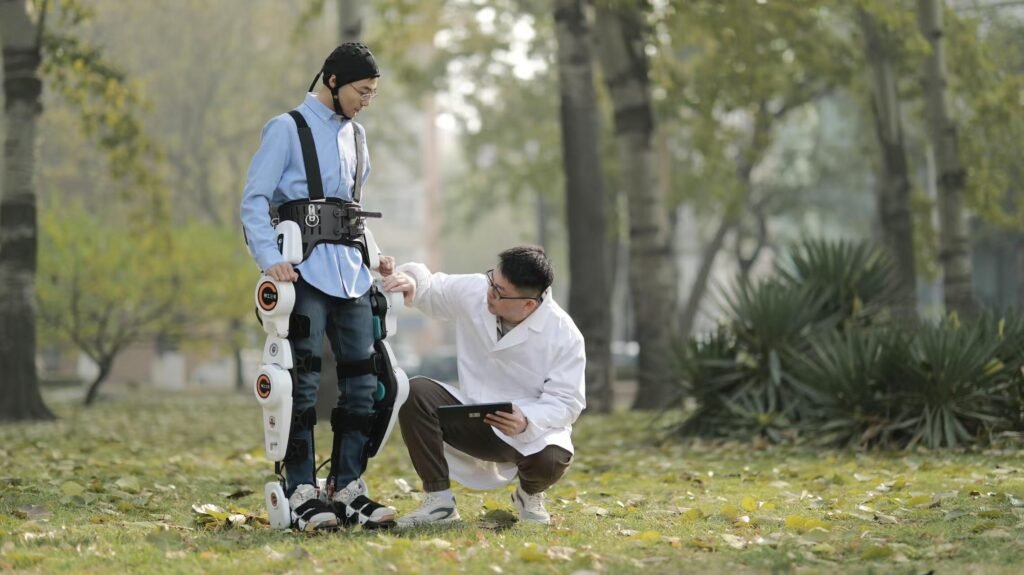
Reporting note: Future capabilities and the proposed foundation model are treated as company and research objectives, not as independent technical validation. The image selected for the article is an AI-generated editorial illustration, not a photograph of Angel Robotics equipment or facilities.