
A wheelchair that does more than carry its user
A wheelchair is generally designed to help someone move while seated. An exoskeleton is designed to assist movement through wearable mechanical support.
But what if one device could combine both functions?
That is the idea behind Oxilio, an unusual mobility system developed by French medical technology company Lifebloom.
The device allows selected users to move from a seated position to standing, then take steps while remaining supported by a wheeled mechanical structure. Instead of replacing the user’s leg movements, it helps make those movements possible with additional support and bodyweight unloading.
The concept is not entirely new. Lifebloom introduced Oxilio publicly before 2026 and has spent several years developing the technology.
What makes the latest news significant is that the company is moving from demonstrations and clinical testing into an initial commercial rollout.
On November 12, 2026, Lifebloom presented the first production units at its operation in Villeneuve-d’Ascq, near Lille, France.
French reporting describes an initial batch of 120 devices, with approximately 20 healthcare establishments placing orders and deliveries expected to begin shortly.
It is a meaningful step for a product that approaches walking assistance differently from conventional powered medical exoskeletons.
Figures are based on Lifebloom statements and French reporting in November 2026. The initial 120-unit batch should not be interpreted as 120 independently verified completed deliveries. The 80% assistance figure is manufacturer-reported.
How does Oxilio actually work?
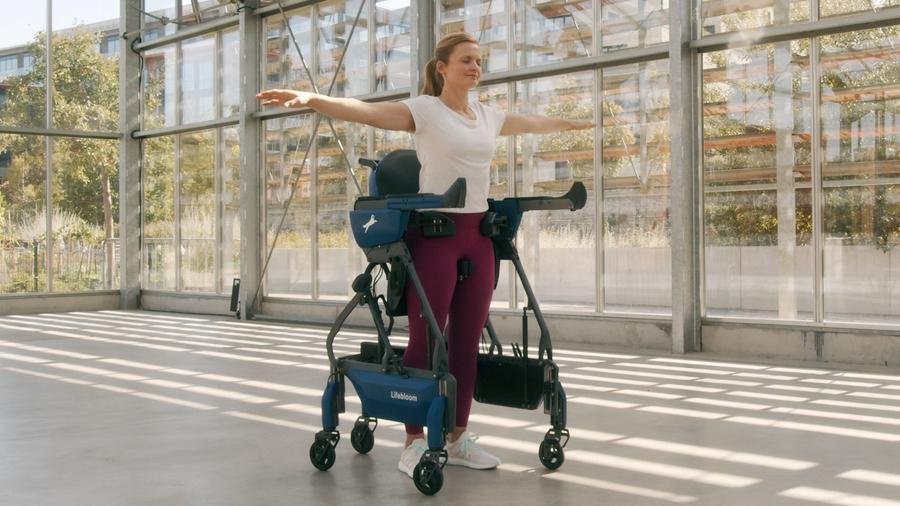
At first glance, Oxilio resembles a compact wheelchair with an unusually elaborate support structure.
It uses four wheels, a seat and adjustable supports around the user’s body. The mechanical system assists transitions between sitting and standing while helping redistribute bodyweight.
To stand, the user initiates the movement using whatever lower-limb function remains available. The support mechanism helps reduce the physical demand of rising upright.
Once standing, the person can take steps while the wheeled structure accompanies the movement. The frame provides support for balance and bodyweight, allowing walking in suitable accessible environments.
This is fundamentally different from a powered lower-limb exoskeleton that uses motors at the hip or knee joints to actively drive stepping.
Oxilio’s mobility assistance is based on a mechanical support architecture, and the walking movement remains user-driven. The system also incorporates electronics for monitoring and rehabilitation functions.
Lifebloom claims assistance of up to 80% of the user’s bodyweight. That should be understood as a stated support capability, not a universal reduction in walking effort or evidence that every user will experience the same amount of unloading.
The device is intended for people who retain at least some lower-limb function but struggle to stand or walk without support.
Three mobility functions in one device
Wheelchair-style seating
Users can begin in a supported seated position without transferring into a completely separate walking exoskeleton.
Assisted sit-to-stand
Mechanical support helps the user participate in rising to an upright posture while remaining supported.
Supported stepping
A wheeled frame follows the user’s movements and helps maintain balance and partial bodyweight support.
This combination is particularly interesting because sitting, standing and walking are usually treated as separate assistance tasks.
A rehabilitation exoskeleton may support walking once a person is upright, while a standing device may help someone rise without enabling independent movement afterwards.
Oxilio attempts to bring those transitions into one continuous mobility experience.
The distinction is relevant to the technologies examined in our Sit-to-Stand Exoskeletons Insight, where the challenges of assisted standing and sitting are often just as important as walking itself.
Lifebloom One: rehabilitation beyond the device
Oxilio is the physical component of a broader programme known as Lifebloom One.
The system combines the mobility device with activity monitoring and digital tools intended to support rehabilitation outside scheduled therapy sessions.
Lifebloom describes onboard sensors that collect information about standing activity, walking distance, step counts and movement patterns.
Healthcare professionals can review those measurements and adjust rehabilitation activities according to a patient’s needs.
The programme also includes digital exercise content and clinician-directed training plans.
The wider idea is to make upright movement practice possible more frequently, rather than limiting it to the periods when a therapist is physically present.
That is potentially valuable in rehabilitation, where the amount and consistency of appropriate activity can matter considerably.
However, whether more supported standing and walking with Lifebloom One leads to superior long-term outcomes still requires stronger clinical evidence.
What does the clinical evidence actually show?
Lifebloom reports encouraging early results from a clinical investigation conducted at Pitié-Salpêtrière Hospital in Paris.
The registered study, NCT05977270, examined Lifebloom One in people with acquired brain injury, including stroke or traumatic brain injury.
The registered investigation involved five participants and an eight-week intervention.
Researchers examined whether the programme could increase the amount of time participants spent standing and walking, alongside measures related to gait and balance.
According to Lifebloom, preliminary results indicated substantial increases in daily standing activity. The company has also reported that some patients improved their supported functional walking performance.
These findings are interesting because Oxilio is designed to increase opportunities for active upright movement among patients who otherwise have limited mobility.
But there are important limitations.
The study was very small and did not have a parallel randomised control group. It therefore cannot establish that the observed changes were caused exclusively by Lifebloom One.
The ability to walk with a supportive device also should not be confused with regaining equivalent walking ability without it.
Nor do the reported results establish lasting recovery after the intervention.
The appropriate interpretation is that Oxilio has produced promising preliminary activity and feasibility observations in selected patients.
Larger controlled studies are needed to determine the clinical benefit, durability of outcomes and which patient groups may benefit most.
Who could benefit from Oxilio?
Lifebloom positions the system for people with reduced mobility who retain at least partial lower-limb function. Potential applications include selected patients recovering from stroke, incomplete spinal cord injury, fractures or significant physical deconditioning.
Individual suitability depends on clinical assessment, physical characteristics and the environment in which the device will be used.
Because Oxilio moves on four wheels, it should not be considered a solution for stairs, uneven terrain or environments unsuitable for wheeled mobility.
From a research project to 120 production units
Lifebloom was founded in 2019 and has spent several years developing its mobility assistance technology.
Earlier public demonstrations attracted attention for the unusual combination of wheelchair seating and upright walking assistance.
The company has since worked toward manufacturing, clinical validation and commercial deployment.
In March 2026, French business reporting described an €8 million financing package supporting industrialisation.
That included approximately €6 million in equity financing and €2 million in public support associated with France 2030.
The company established an assembly operation of approximately 1,000 square metres in Villeneuve-d’Ascq.
November reporting states that approximately 80% of Oxilio components are sourced in France, with many suppliers located within roughly 200 kilometres of the assembly site.
The first 120 devices represent an initial commercial production batch rather than an established large-scale national deployment.
Approximately 20 healthcare facilities reportedly placed orders, with initial deliveries expected to follow the November presentation.
For a medical mobility product, this is an important transition.
Manufacturing a device at scale is only one part of the challenge. Healthcare providers also need installation, staff training, maintenance and appropriate patient selection.
The company is initially targeting professional healthcare settings. A broader home-use offering is also being developed, with demonstrations and a waiting-list pathway available through Lifebloom.
A general public retail price has not been confirmed.
Exoskeleton Index analysis
Oxilio is particularly interesting because it challenges the assumption that the future of assistive exoskeletons must always involve fully wearable powered robotic legs.
Lifebloom is approaching the problem from a different direction: bringing standing and walking assistance into a wheeled mobility system that users already understand.
That could be valuable for selected patients who retain some lower-limb function but cannot safely stand or walk unaided.
The design also highlights an important principle in wearable mobility technology: the most useful solution is not necessarily the one with the most advanced robotic actuation.
Sometimes the engineering challenge is to provide the right amount of assistance while preserving natural movement and making the equipment practical enough for regular use.
Oxilio’s combination of mechanical support, wheeled stability and connected rehabilitation tools reflects that approach.
Its commercial progress is encouraging, but the critical next evidence will come from actual healthcare implementation.
Can clinicians integrate the device into ordinary rehabilitation programmes? Can patients use it frequently enough to obtain meaningful benefits? And can the company deliver consistent support as installations increase?
Those questions will determine whether Oxilio becomes a distinctive demonstration device or a sustainable addition to clinical mobility care.
A different direction for assistive mobility
The wider exoskeleton industry is beginning to move beyond proving that machines can help people move.
The more demanding question is whether these systems can be used regularly, comfortably and reliably outside specialist demonstrations.
Oxilio offers one possible answer, especially for rehabilitation facilities seeking to increase opportunities for supported standing and walking.
It also illustrates why assistive mobility cannot be reduced to a single category of exoskeleton.
Powered walking devices, passive supports, sit-to-stand systems and wheeled hybrids address different user needs.
Our Exoskeletons for Older Adults Insight explores those distinctions, including which products can be purchased, rented or trialled and why the correct assistance type matters.
For readers investigating Oxilio specifically, the Oxilio product profile provides a structured overview of the device, its classification, intended use and official product source.
What comes next for Lifebloom?
The first healthcare installations will offer a useful opportunity to evaluate Oxilio beyond its early clinical and demonstration environments.
The most important questions concern real-world patient selection, frequency of use, clinical outcomes, safety and the practical demands placed on care teams.
The initial production batch is a significant commercial milestone, but it is not yet evidence of large-scale adoption.
What makes Lifebloom worth following is the combination of a distinctive mechanical design, a clear rehabilitation application and progress toward real institutional use.
A wheelchair that can support the transition to standing and user-driven walking is an unusual proposition. Now the challenge is to demonstrate how much difference it makes in everyday care.
Can exoskeletons help people stand up and sit down?
Explore the technologies behind sit-to-stand assistance, including powered systems, passive supports, rehabilitation devices and their real-world limitations.
Explore the Sit-to-Stand Insight Independent research, technology and product analysis.Sources and reporting notes
November 2026 rollout. Les Numériques, November 14, 2026 . Reporting on Lifebloom’s November 12 production presentation, initial 120-unit batch and expected deliveries.
Additional French reporting. The Intelligent, November 14, 2026 . Healthcare orders, local manufacturing, component sourcing and commercialisation context.
Official product and therapy information. Lifebloom — Healthcare Facility / Walk Unit . Intended applications, rehabilitation programme, connected monitoring, regulatory statements and manufacturer-reported outcomes.
Clinical investigation. NCT05977270 — The Effects of Lifebloom One on Physical Activity After Acquired Brain Injury . Registered investigation involving five participants and an eight-week intervention.
Commercialisation and financing. Le Journal des Entreprises, March 30, 2026 . Financing and industrialisation plans.
Reporting boundary. The 120-unit figure refers to an initial production rollout, not independently verified completed installations. Assistance percentages and preliminary clinical outcomes are manufacturer-reported. The available small, uncontrolled investigation does not establish general clinical effectiveness or lasting unaided walking recovery.