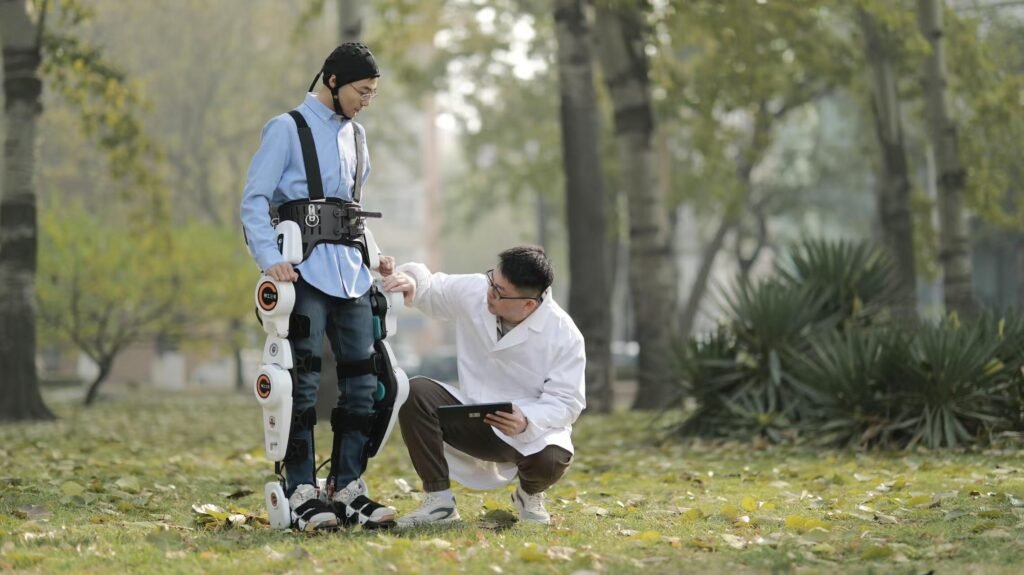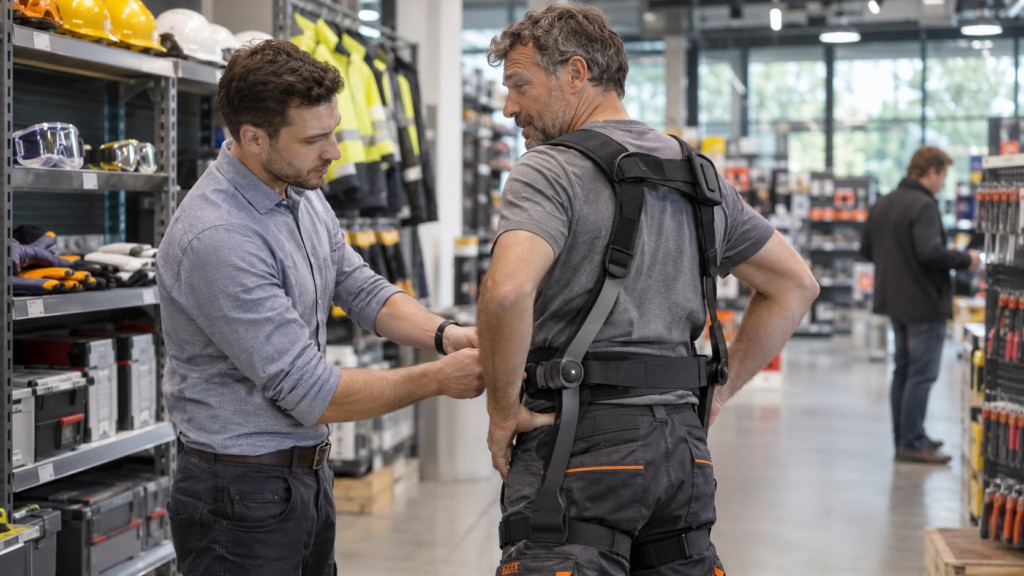

Getting up is only half the movement
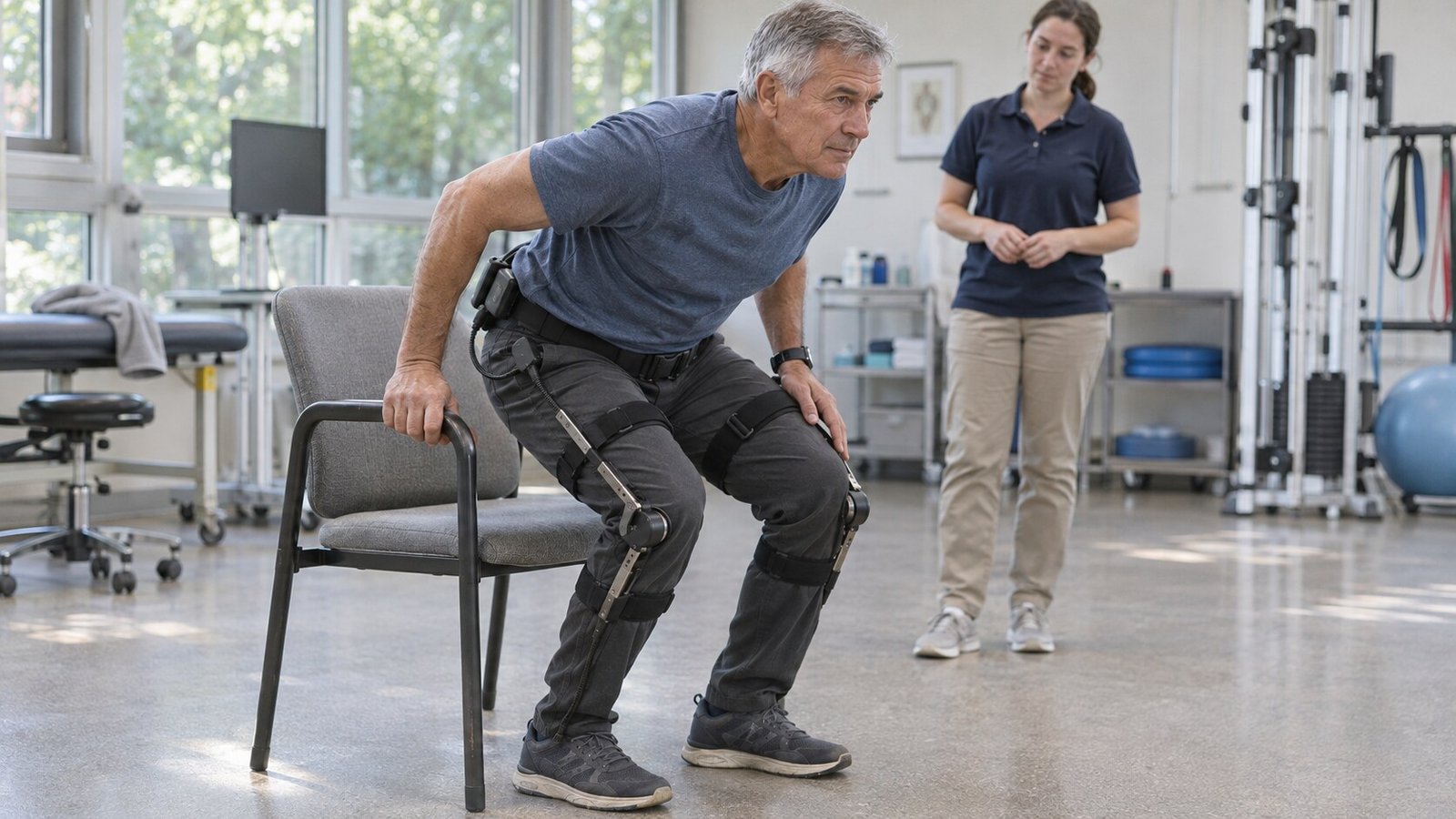
Standing up from a chair can demand considerable effort from the knees and hips. Sitting down is different. Gravity helps the body descend, but the legs must control that descent and keep the movement stable.
A newly published review examines how wearable exoskeletons assist these everyday transitions. Its central message is that a device’s performance across a complete sit-to-stand cycle can conceal important differences between rising and lowering.
The review, led by Mimi Li and colleagues, was published on November 6, 2026, in the Journal of Bionic Engineering.
What the researchers actually reviewed
The researchers identified 54 distinct wearable system designs from studies published between 2010 and 2025. The devices included powered rigid exoskeletons, flexible powered systems, hybrid designs and a smaller number of unpowered solutions.
That is a review of 54 designs, not 54 clinical trials demonstrating improved mobility. Only 15 studies reported muscle-activity measurements that could be combined quantitatively, producing 35 effect-size observations.
EMG measures electrical activity in muscles. A reduction can indicate unloading during a tested movement, but it does not by itself show improved independence, lower fall risk or better long-term mobility.
Powered rigid systems showed larger muscle unloading
Across the EMG studies, wearable assistance was associated with an estimated 20.79% reduction in muscle activation. The powered rigid subgroup showed a larger estimated reduction of 37.27%, compared with 12.08% for powered flexible systems.
The unpowered subgroup did not show a statistically significant pooled reduction. That should not be interpreted as proof that every passive design is ineffective. Devices, participants, movement protocols and measurement methods differed considerably across the included research.
Statistical heterogeneity was high, with an I² value of 86%. These subgroup results describe patterns across studies, not a controlled head-to-head ranking of commercial products.
Why sitting down needs its own assessment
Rising from a chair relies on generating enough force to lift the body. Sitting down involves controlling the body’s downward momentum. The two phases do not necessarily require the same assistance or control strategy.
In a phase-specific analysis of powered systems, the estimated muscle-activity reduction was 15.73% during standing up and 30.89% during sitting down. Although the second estimate was numerically larger, the direct difference between the two phases was not statistically significant (p = 0.159).
What the results do support is a more careful way of testing devices. A single value for the full movement may not tell a clinician, researcher or prospective user how well the system assists each part.
What this review does not establish
Most of the underlying studies involved small participant groups, often fewer than ten people. The review largely measures changes in muscle activity, not whether users can rise independently, lower themselves safely, prevent falls or continue using a device at home.
It also cannot establish that a particular product is suitable for an individual user. Many designs were research prototypes rather than commercially available systems.
Exoskeleton Index analysis
The practical question is not simply whether an exoskeleton can help someone stand. It is whether the device assists the movement the person actually struggles with.
Someone with knee weakness may need help rising from a low chair. Another person may be able to stand but have difficulty controlling the return to a seated position. A device that supports walking or holds a standing posture should not automatically be classified as providing both forms of chair-transfer assistance.
For product evaluation, stand-up and sit-down functionality should be documented separately, alongside balance requirements, supervision, fitting limits and evidence from real users. The review provides a research basis for making that distinction more explicit.
What buyers and clinics should verify
The reviewed designs point to several questions that matter beyond headline muscle-unloading figures.
Confirm whether assistance is available while rising, during controlled descent, or throughout both movements.
Check balance needs, arm support, chair geometry, trained operator requirements and the intended clinical or personal setting.
Muscle activity, task completion, repeated chair rises, safety and independent use answer different questions.
For broader context on mobility assistance, product availability and intended users, see our 2026 guide to exoskeletons for older adults.
What to watch next
Future research needs larger participant groups and consistent tests of standing up and sitting down as separate tasks. Useful outcomes would include successful independent transfers, controlled descent, repeatability, time to complete the movement and adverse events, alongside muscle and joint measurements.
The next challenge is translating laboratory unloading into reliable assistance in everyday environments. For people who struggle with chairs, toilets or other seated transitions, that may be more meaningful than an improvement in a single movement metric.
Looking for an exoskeleton that supports chair transfers?
Exoskeleton Index can help organisations identify relevant lower-limb technologies and assess their intended use, evidence and supplier availability.
Explore suitable products and suppliers Independent market information, not individual medical adviceSources and reporting notes
Primary source. Li M, Situ R, Wang X, et al. “Advances in Wearable Sit-to-stand Exoskeleton Designs: A Systematic Review and Meta-analysis of Assistive Performance.” Journal of Bionic Engineering. Published November 6, 2026. Read the peer-reviewed open-access study.
Reporting limitations. The review included 54 unique system designs but pooled EMG evidence from only 15 studies. Substantial between-study heterogeneity, small participant samples and differences in testing limit generalisation to clinical outcomes or individual products. Phase-specific estimates should not be presented as a statistically significant direct difference between rising and sitting.