
From field testing to an actual mountain rescue
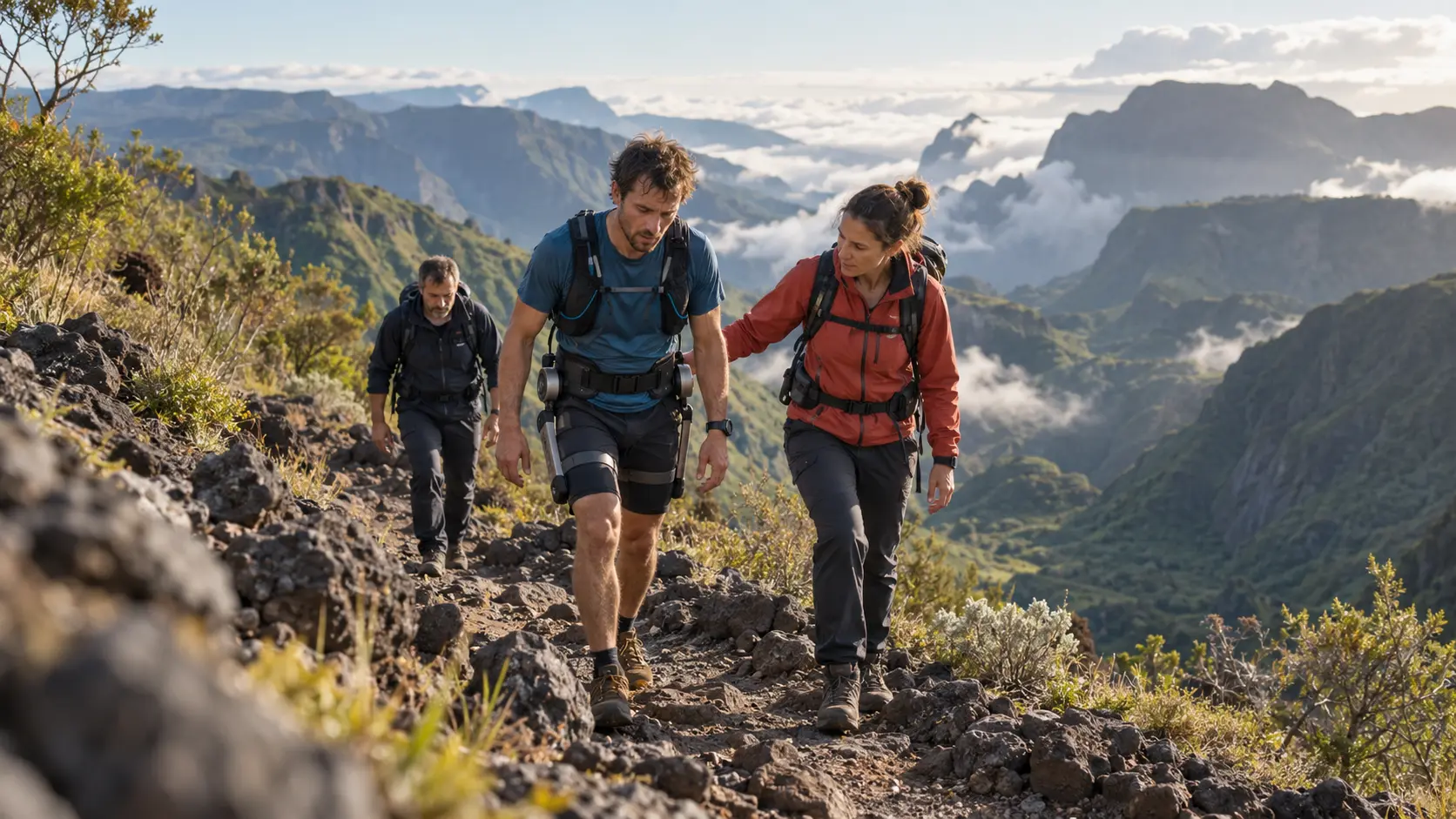
Mountain-rescue teams sometimes encounter people who are conscious and able to move, but unable to continue along difficult terrain without assistance. Transporting someone on a stretcher or arranging another form of evacuation can be complex on narrow, steep trails. During October’s Grand Raid on La Réunion, local high-mountain gendarmes used a walking-assistance exoskeleton as one part of a supervised rescue.
According to the Gendarmerie de La Réunion, a runner became unable to continue walking near the Brèche during the night of October 17–18. Members of the PGHM responded alongside a physician from the French emergency medical service, SAMU.
What the rescuers reported
The participant first received an intravenous infusion, then was fitted with an exoskeleton intended to assist walking. Accompanied by rescuers, the person moved toward Maïdo over roughly two hours. An ambulance subsequently provided transport for further care.
The Gendarmerie says its team had tested an exoskeleton on Réunion’s trails in January 2026 and describes the Grand Raid intervention as the unit’s first operational deployment. This is an account from the responding organization, rather than a manufacturer demonstration.
The two-hour figure is the duration of accompanied walking reported by the Gendarmerie, not an independently measured time saving. The first-use claim applies to the local unit, not to all French or global rescue services.
A potentially useful option, but only for specific rescue situations
This case should not be interpreted as evidence that an exoskeleton can replace technical evacuation. A person must still be medically assessed, have sufficient stability and be capable of progressing under supervision. Terrain, weather, equipment fit and battery capacity also matter.
Walking assistance only makes sense when clinical assessment supports supervised movement.
Steepness, footing, route width and the ability of rescuers to remain close affect practicality.
Training, fitting time, equipment availability and fallback evacuation routes remain essential.
The public account identifies the equipment as a walking-assistance exoskeleton but does not name its manufacturer or model. It provides no measured physiological outcomes and no comparison with the time or staffing required for a conventional evacuation.
Another documented rescue, a different operating team
The Grand Raid intervention follows a separately documented case in South Africa. Earlier in October, Exoskeleton Index reported on a Hypershell-assisted descent during a Table Mountain rescue, where an exhausted hiker continued on foot alongside a mountain-rescue team.
The two events should not be treated as controlled evidence of effectiveness, nor should the unnamed device in La Réunion be assumed to be Hypershell. What they have in common is more modest and more useful: emergency teams have now described real incidents in which walking assistance formed part of the response.
Exoskeleton Index analysis
For rescue applications, the key question is not whether a wearable robot can make someone walk faster. It is whether the device adds a safe, practical option for a carefully selected person and terrain.
That requires evidence beyond individual success stories: clear deployment criteria, appropriate medical oversight, training, failure procedures, fitting time, adverse-event reporting and comparative operational data. We do not yet have that evidence from this incident.
The case is nevertheless relevant to EI’s defense and emergency-response coverage, where laboratory capability and field readiness must remain separate judgments.
What is confirmed, and what remains unknown
The local Gendarmerie confirms that the device contributed to assisting a participant during the Grand Raid and that the escorted walk to Maïdo took two hours. The person’s diagnosis, the device model, whether another evacuation option was considered, and any measurable operational advantage have not been disclosed. The announcement does not establish nationwide deployment by the French Gendarmerie.
What to watch next
Follow-up information from the PGHM could clarify the device used, how often teams train with it, the types of incidents considered suitable, and whether the equipment becomes part of routine rescue planning. Those details would be more informative than treating one successful intervention as proof of a broader transformation.
Sources and reporting notes
Gendarmerie de La Réunion, October 21, 2026. Original statement from the responding rescue organization, including the prior tests, intervention sequence and reported duration.
Actu Forces de l’Ordre, October 22, 2026. Report on the Grand Raid exoskeleton-assisted evacuation, with additional contextual limitations.
Exoskeleton Index reporting note. The device is not assigned to a specific manufacturer or product. The case is an operational account, not a comparative medical trial or a quantified rescue-efficiency study.