
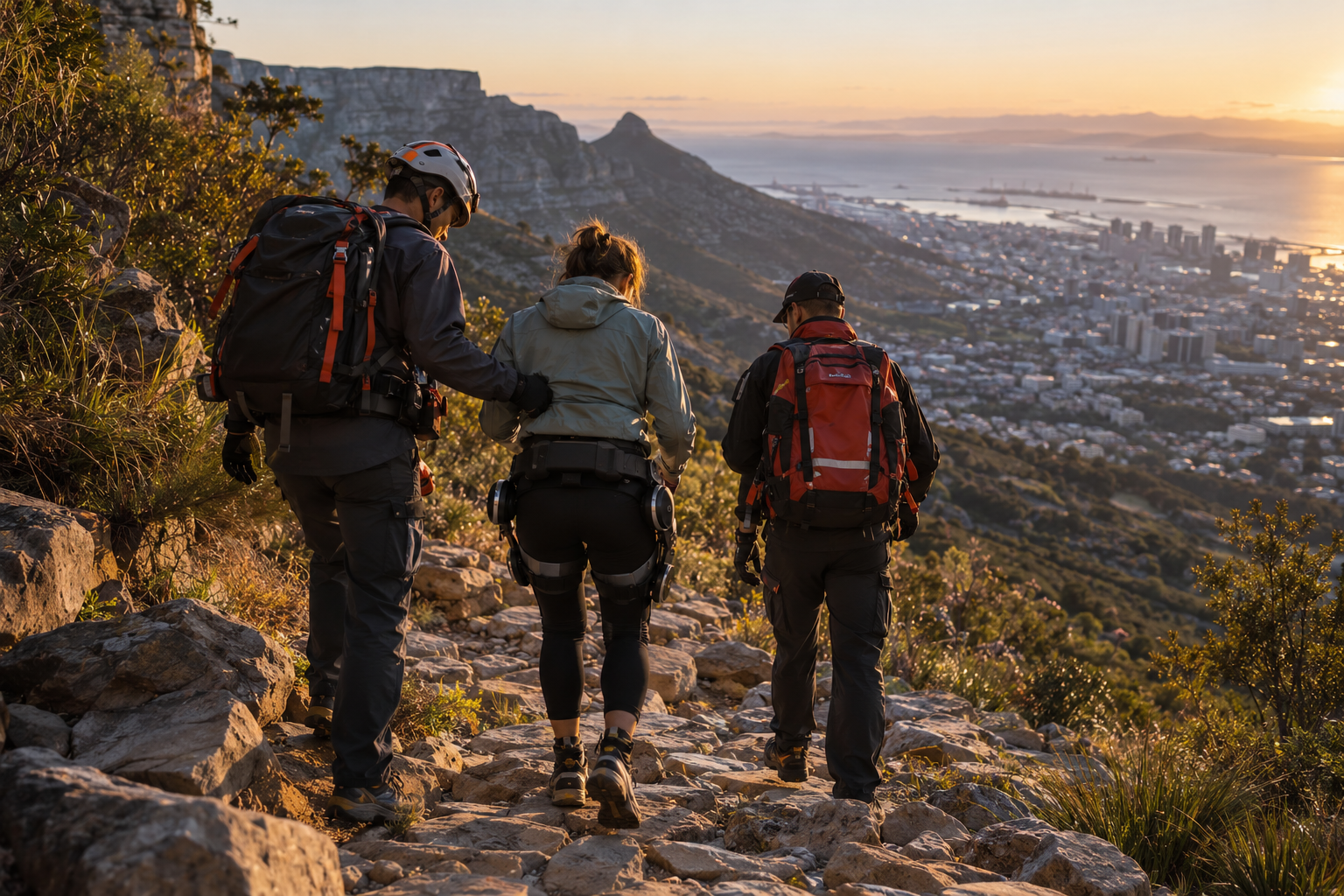
A Hypershell powered exoskeleton was used during an active mountain rescue on Table Mountain after an exhausted 47-year-old hiker became unable to comfortably continue down Platteklip Gorge. Wilderness Search and Rescue says the device helped her continue the descent on foot with rescuers alongside her, marking the first deployment of an exoskeleton during a rescue operation in South Africa.
- Organisation
- Wilderness Search and Rescue, Western Cape
- Location
- Platteklip Gorge, Table Mountain, Cape Town, South Africa
- Date
- 26 September 2026
- Person assisted
- 47-year-old exhausted hiker
- Device
- Hypershell powered hip-assist exoskeleton
- Application
- Assisted walking during an active mountain rescue
- Outcome
- The hiker continued descending on foot with the exoskeleton and rescuers alongside her
- Operation completed
- Shortly after 23:00
- Previous evaluation
- WSAR began evaluating Hypershell technology in real mountain environments in May 2026
- Significance
- WSAR describes the incident as the first deployment of an exoskeleton during a rescue operation in South Africa
- Exact model
- Not publicly confirmed
The rescue began after a routine hike became a difficult descent
The incident started with a family hiking up Platteklip Gorge on Table Mountain on Saturday afternoon.
By the time they reached the summit, the Table Mountain Aerial Cableway had closed for the day.
With daylight fading and a long descent still ahead, the family contacted Wilderness Search and Rescue, or WSAR, to let the organisation know they were beginning the descent and might require assistance.
A small rescue team, including a Western Cape Government Health and Wellness EMS paramedic, headed up the route to meet them.
By that point, the family’s 47-year-old mother was exhausted and struggling to continue safely down the steep gorge.
The rescue team then deployed one of the technologies WSAR had already been evaluating: a powered Hypershell exoskeleton.
The lightweight battery-powered system is worn around the hips and thighs and provides powered assistance while the user walks.
According to WSAR, once the device was fitted, the woman’s steps became steadier and her confidence improved.
She was then able to continue descending on her own feet while the rescue team remained alongside her.
The entire family was safely off the mountain shortly after 23:00.
The alternative could have required a more resource-intensive evacuation
The significance of the deployment is not simply that an exoskeleton was present during a rescue.
It changed the type of assistance the team could provide.
WSAR told South African media that in this incident the exoskeleton allowed an exhausted but still ambulatory hiker to continue walking rather than immediately requiring a stretcher evacuation.
That distinction can matter considerably in mountain rescue.
A stretcher evacuation across steep terrain can require substantially more personnel, equipment and time than an assisted walk-off.
WSAR said the exoskeleton provided another option for helping someone off the mountain without necessarily committing the additional resources that a stretcher carry would require.
The organisation also emphasized that the decision remains with rescuers assessing the person, terrain and conditions in front of them.
An exoskeleton therefore does not replace established rescue techniques.
It potentially adds another option between independent walking and full evacuation when fatigue, rather than injury or complete loss of mobility, is the main limiting factor.
The device had already been under evaluation for mountain rescue
This was not the first time WSAR had worked with Hypershell.
In May 2026, the organisation announced a collaboration with the company to evaluate powered exoskeleton technology in real mountain environments.
The original focus was primarily on rescuers.
Mountain rescue personnel may need to travel long distances across steep and uneven terrain while carrying medical equipment, communications hardware, ropes and other technical rescue gear.
WSAR said it wanted to understand whether powered assistance could reduce fatigue and help rescuers remain effective during demanding operations.
The organisation was careful at the time to describe the collaboration as an evaluation rather than an endorsement.
WSAR specifically highlighted the difference between controlled testing and real rescue environments involving steep trails, changing weather, extended deployments and significant carried loads.
The Western Cape’s mountain terrain was therefore being used as a practical test environment for the technology.
Four months later, the exoskeleton moved from evaluation into an actual rescue operation.
The unexpected part is who wore the exoskeleton
The original WSAR evaluation focused heavily on whether exoskeletons could support rescuers themselves.
The Table Mountain deployment demonstrated another possible use case.
The person wearing the exoskeleton was the hiker being rescued.
That creates a different operational role for the technology.
Instead of reducing fatigue in a rescuer carrying equipment uphill, the system provided mobility assistance to a person who remained capable of walking but was struggling to continue because of exhaustion.
This distinction is important.
A powered hip exoskeleton does not provide the same capability as a stretcher, medical walking device or full rehabilitation robot.
It still depends on the wearer being able to maintain balance and participate actively in walking.
That makes exhaustion an unusually relevant scenario for consumer-derived powered mobility technology.
The person may still have functional walking ability while lacking enough endurance to safely complete the remaining route without assistance.
A consumer exoskeleton moved into an operational rescue environment
Hypershell is primarily known for commercially available consumer exoskeletons designed for hiking, walking and outdoor mobility.
Its current X Series uses bilateral powered hip assistance to augment movement during walking across different terrain.
Hypershell has increasingly promoted search and rescue as a professional application through its HyperLIFT initiative.
The company now lists multiple rescue organisations around the world as part of an expanding evaluation and collaboration network.
Those include mountain and search-and-rescue teams in North America, Europe, Asia and South Africa.
The Table Mountain incident is important because it moves the conversation beyond controlled demonstrations and training exercises.
The device was deployed during an actual callout involving a real person, changing terrain, darkness and a rescue team making operational decisions in real time.
That does not prove the technology is ready for every rescue environment.
It does make the evidence qualitatively different from a promotional hiking demonstration.
The exact Hypershell model remains unconfirmed
Public reporting consistently identifies the device as a Hypershell exoskeleton.
However, neither the public WSAR material reviewed by Exoskeleton Index nor the detailed rescue reports identify the exact model used.
That distinction matters because Hypershell now markets multiple powered exoskeleton configurations.
The current Hypershell X Ultra S, for example, is positioned as the flagship model of the newest X Series, but there is not enough public evidence to say that this was the specific unit used on Table Mountain.
Exoskeleton Index is therefore treating the rescue as a Hypershell brand-level deployment rather than attaching it to an individual product record without confirmation.
This preserves an important evidence boundary.
The fact that a manufacturer has several visually similar products does not make a specific model identification reliable unless the rescue organisation, manufacturer or another authoritative source confirms it.
This is operational evidence, not clinical evidence
The rescue provides something the exoskeleton sector does not have in large quantities: documented real-world operational use.
But it should not be confused with controlled evidence of safety or clinical effectiveness.
There was one hiker.
The incident was not a trial.
No physiological measurements were collected publicly.
There was no comparison condition showing how the same descent would have progressed without powered assistance.
The public reporting also does not quantify how much energy expenditure, muscle activity or perceived exertion changed while the woman wore the device.
The strongest evidence from this incident is therefore operational:
An exhausted but ambulatory hiker was fitted with a powered consumer-derived exoskeleton during a genuine mountain rescue and was able to continue walking down the route with rescuers alongside her.
That is meaningful.
It is simply a different type of evidence from a randomized trial, biomechanical study or formal rescue-equipment validation.
Exoskeleton Index analysis
The Table Mountain deployment may point to an interesting application between consumer mobility and professional rescue equipment.
Most consumer exoskeletons are marketed around hiking, walking endurance and recreational mobility.
Mountain rescue organisations face a different but related problem.
They need to move people and equipment across difficult terrain while managing fatigue, limited personnel and time.
Sometimes the person being rescued is injured and cannot walk.
Sometimes they remain fully mobile.
And sometimes they sit between those two conditions: physically capable of walking, but no longer capable of completing the route safely without assistance.
That middle category may be where powered mobility exoskeletons become particularly interesting.
If an exhausted but otherwise ambulatory person can continue walking with assistance, a rescue team may be able to avoid or delay escalation to a more resource-intensive evacuation.
That does not make the exoskeleton a replacement for a stretcher, helicopter, rope-rescue system or medical assessment.
It gives the rescue team another tool.
The commercial origin of the technology makes this development particularly notable.
Historically, many emergency-response exoskeleton concepts have begun as highly specialized research or military systems.
Here, the direction is reversed.
A relatively compact consumer outdoor exoskeleton is being evaluated for a professional emergency-response application.
That may become a broader pattern.
Consumer volumes can drive lower prices, lighter hardware, better batteries and more mature manufacturing. Professional users can then evaluate whether the same architecture is useful for specific operational tasks.
The Table Mountain rescue provides an early real-world example of that crossover.
It does not establish a rescue market by itself.
But it shows why the Defense & Emergency Response category may increasingly include technologies that did not originate as dedicated rescue equipment.
The operational requirements are much higher than recreational use
A hiking exoskeleton used by an individual consumer and the same technology carried by a rescue team are exposed to very different expectations.
A recreational user can stop, rest or remove the device if it becomes uncomfortable.
A rescue team needs to know what happens when conditions are less forgiving.
Operational questions include:
- how quickly the device can be fitted to an unfamiliar user;
- whether different body sizes can be accommodated efficiently;
- how reliably the system performs during steep ascent and descent;
- how battery endurance changes under real rescue conditions;
- whether rain, dust or cold affect operation;
- how rescuers manage a battery or motor failure during a descent;
- whether the device interferes with medical assessment or other rescue equipment;
- how much training rescuers require before fitting it to another person;
- which patients are appropriate candidates for assisted walking; and
- when a conventional evacuation remains the safer choice.
Those questions cannot be answered by consumer specifications alone.
They require repeated field evaluation and operational protocols.
That is also why WSAR’s approach is important.
The organisation began evaluating the technology months before the first reported operational deployment rather than treating a rescue call as an improvised product demonstration.
What remains unverified
The exact Hypershell model used during the Table Mountain rescue has not been publicly confirmed in the material reviewed by Exoskeleton Index.
No physiological or biomechanical measurements were reported from the incident.
The rescue therefore does not quantify how much the device reduced fatigue, energy expenditure or muscular effort.
The public information also does not establish how frequently WSAR carries a Hypershell unit during operational callouts, how many devices the organisation currently has access to or what formal criteria are used to decide when the technology should be deployed.
No evidence from this individual case establishes effectiveness for injured patients, people unable to maintain independent balance or people requiring technical evacuation.
The successful assisted descent should also not be interpreted as general proof that consumer exoskeletons are certified rescue equipment.
WSAR’s original collaboration announcement explicitly described the programme as practical assessment and learning rather than an endorsement.
More deployments, structured testing and defined operating procedures would be needed before broader conclusions could be drawn.
What to watch next
The most important question is whether the Table Mountain case remains an isolated deployment or becomes part of repeatable rescue practice.
Future incidents could show whether exoskeletons are most useful for supporting rescuers, exhausted ambulatory patients or both.
A defined operating protocol would be particularly significant.
That could include criteria for patient selection, fitting procedures, battery management, fallback plans and conditions where exoskeleton-assisted walking should not be attempted.
Data from repeated deployments would also help answer whether the technology materially reduces the personnel or time required for selected rescues.
There is a wider industry question as well.
Hypershell is already building relationships with search-and-rescue organisations through its HyperLIFT programme.
If other consumer exoskeleton manufacturers follow the same path, emergency response could become a secondary professional market for hardware originally developed for hiking and personal mobility.
For now, the Table Mountain case provides a rare and useful data point.
A commercially available powered mobility architecture moved beyond testing and was used during a genuine rescue operation to help an exhausted hiker remain independently mobile.
That is a much stronger real-world signal than another staged trail demonstration.
Explore the Hypershell company profile, browse current exoskeleton products, or explore the wider Defense & Emergency Response exoskeleton landscape.
Sources
- Wilderness Search and Rescue: partnership with Hypershell to evaluate exoskeleton technology in mountain rescue, 30 May 2026
- IOL: First successful use of exoskeleton in South African rescue, 28 September 2026
- Cape Argus: First for South Africa as robotic exoskeleton aids Table Mountain rescue, 27 September 2026
- Arrive Alive / WSAR: Robotic Legs to the Rescue, South African first on Platteklip Gorge, 28 September 2026
- Hypershell: HyperLIFT search-and-rescue programme