
Can people keep using a personal exoskeleton once structured rehabilitation is over? A peer-reviewed Italian study offers an unusually long look at that question. Seven people with chronic paraplegia had access to a ReWalk 6.0 personal exoskeleton at home for a median of 33 months, with six logging more than 3,000 steps per month. The findings are encouraging, but the small, cross-sectional study cannot prove broader health benefits or establish safety rates.
A different test of what personal exoskeletons can do
Exoskeleton research often centres on a relatively short training programme. Investigators measure walking speed, endurance, metabolic demand or functional performance over weeks of supervised use.
Those studies answer important questions, but they leave another one open: does somebody continue to use the device after it becomes part of everyday life?
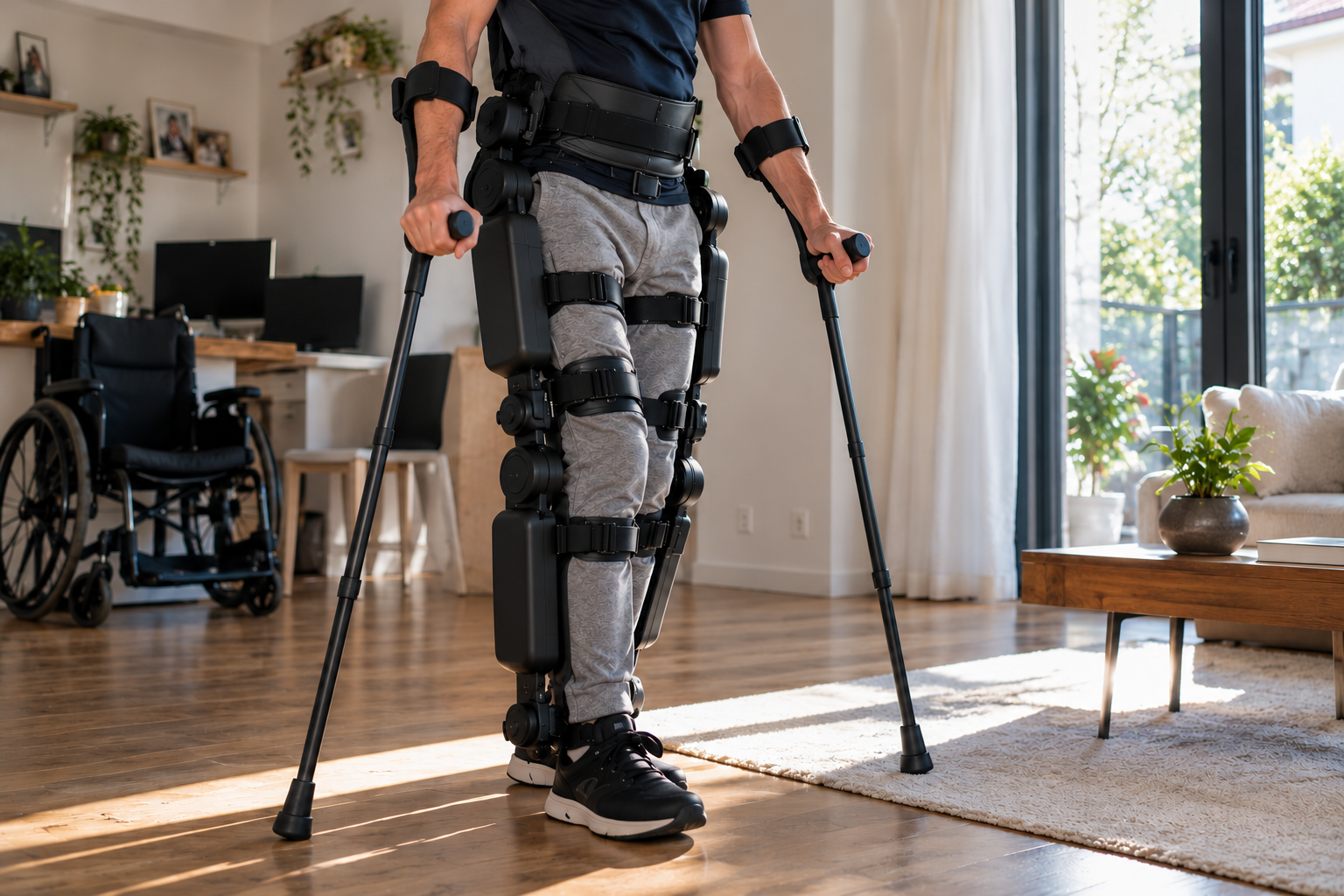
Researchers at Italy’s Centro Protesi Inail examined seven users who had previously completed structured training and then had a ReWalk 6.0 Personal Exoskeleton available in their domestic environment for extended periods.
The team recalled participants for a single-day assessment and examined recorded utilisation, reported adverse events, mobility performance, usability, satisfaction and self-reported health measures.
The peer-reviewed study appeared in Spinal Cord Series and Cases on June 26, 2026. Manufacturer Lifeward issued a separate public announcement on October 14, bringing attention to its findings.
The sample comprised seven selected and trained users. These are descriptive outcomes from an uncontrolled cross-sectional study, not proof that ReWalk caused changes in health or function.
People were still using the device years later
The median period of access was 33 months, with individual observation periods ranging from 20 to 45 months. Six participants recorded more than 3,000 exoskeleton-assisted steps per month. Across the group, monthly recorded activity ranged from 446 to 12,822 steps.
That spread matters. It shows sustained use was possible for several participants but was not consistent across everyone. The recorded counts should not be interpreted as total steps taken in daily life or as evidence that the device replaced a wheelchair.
The researchers identified an important explanation for the participant with much lower activity: limited availability of a qualified caregiver.
That finding may prove as useful to clinicians and operators as the headline step counts. A personal exoskeleton can be technically capable and still remain unused if the required help is unavailable when someone wants to stand or walk.
Walking performance and satisfaction remained measurable
At the follow-up assessment, participants walked a median of 129 metres during the six-minute walk test without stopping and recorded a median walking speed of 0.43 metres per second in the 10-metre walk test.
Participants also gave the technology a median 4.2 out of 5 score on the QUEST assistive-technology satisfaction scale and a median 70 out of 100 on the System Usability Scale.
All seven reported that walking with the exoskeleton improved their quality of life and mental health. The company also reported participant-perceived improvements in bowel and bladder management and pain.
Those perceptions deserve to be reported, but not overstated. Without a comparator group or a prospectively controlled baseline, the study cannot establish that exoskeleton use caused those improvements or determine whether similar outcomes would occur in a broader spinal cord injury population.
The observation window reaches up to 45 months, providing unusually long-term information about home access.
Participants expressed high satisfaction and perceived benefits, though the study cannot attribute causation.
Limited caregiver availability was linked to markedly lower exoskeleton use for one participant.
No falls were reported, but seven users cannot establish a safety rate
The researchers reported no falls or exoskeleton-related fractures during the observed periods. That is encouraging for the participating users and provides useful context about their experience after training.
It is not evidence that falls cannot occur or that a population-level risk has been quantified. With seven participants, even an absence of reported events leaves substantial uncertainty about uncommon adverse outcomes.
Selection, medical eligibility, structured training, home circumstances and the requirement for qualified support all matter when interpreting these findings.
What this study does not establish
It was a cross-sectional assessment of seven long-term users, not a randomized or controlled trial. It does not prove improvements in pain, bowel or bladder function, mood or quality of life were caused by ReWalk. It also cannot establish that all eligible patients would use the device for years, or that the system can replace their normal mobility equipment.
The caregiver bottleneck is a commercial and clinical problem
The most revealing operational finding may be the participant with lower use.
The authors specifically identify the availability of a qualified caregiver as a major factor in continued access. In other words, the limiting resource may sometimes be human assistance rather than battery power, motor torque or walking speed.
That changes how the industry should think about home deployment. A personal medical exoskeleton requires more than delivering hardware. Programmes must consider screening, training, assistance requirements, follow-up, repair access and the daily circumstances in which someone wants to use the device.
Exoskeleton Index explored this infrastructure problem in its coverage of Lifeward’s ReWalk 7 access pilot with Ottobock Care. That is a separate, newer-generation commercial initiative, but the practical barriers to successful home use overlap.
Exoskeleton Index analysis
The strongest finding here is not a record walking distance. It is that some appropriately selected, trained users continued to use a personal exoskeleton over a period measured in years.
That addresses a central question in assistive robotics: whether an impressive clinical capability can persist as something a person genuinely uses after the demonstration or rehabilitation programme ends.
The range of observed activity also exposes a crucial limitation. An individual’s environment, support network and routine can determine whether access translates into use. A device may be effective at generating powered steps and still see low utilisation if another person is required but unavailable.
For patients, clinicians and payers, this type of evidence may help frame real-world expectations. For manufacturers, it suggests that product performance and service design cannot be evaluated separately.
But the next level of evidence still needs larger prospective cohorts, clearer use definitions, systematic adverse-event tracking and comparison groups. Seven selected participants cannot settle questions of effectiveness or generalizability.
Important: this was ReWalk 6.0, not the newer ReWalk 7
The researchers evaluated the ReWalk 6.0 Personal Exoskeleton. It would be inaccurate to present these results as a longitudinal trial of the current ReWalk 7 Personal Exoskeleton, which entered the market later.
Both belong to the wider ReWalk personal mobility family manufactured by Lifeward, but feature changes, controls and training experiences may differ by generation.
The company currently markets the ReWalk personal system as a prescription medical mobility product for eligible people with spinal cord injury, not a general-purpose consumer exoskeleton. Eligibility and assistance requirements are clinically assessed.
This distinction is also relevant when comparing research across studies. An earlier Exoskeleton Index report on 12 people using ReWalk for home activities examined kitchen and grooming tasks. That is a different study from the present seven-person long-term analysis, with a different sample and objective.
What should come next?
The next question is how long-term activity looks across a much larger and more representative population. More users, standardised activity logs and clearer reporting on caregiver time would help identify why some people use the technology more often than others.
We also need evidence that distinguishes access from practical independence. Steps taken with an exoskeleton demonstrate use; they do not automatically show that it improves all activities of daily living or substitutes for wheelchair mobility.
For now, the study supports a more focused conclusion: after appropriate selection and training, a small group of ReWalk 6.0 users continued to achieve measurable walking activity with a personal exoskeleton years after receiving it. The findings warrant attention precisely because they move the discussion beyond short trials while showing how much remains to be learned.
Sources and reporting notes
Cutti, A. G., et al., June 26, 2026. Long-term availability of powered exoskeleton for ambulation in domestic context, Spinal Cord Series and Cases, 12, article 13 (2026). DOI: 10.1038/s41394-026-00739-z. A PubMed record confirms the research design and publication date.
Lifeward, October 14, 2026. Company announcement reporting the seven-person descriptive figures, satisfaction scores, walking measures and user-reported outcomes.
Exoskeleton Index. Lifeward company profile, current ReWalk 7 product profile and separate home-activity research coverage for context.
Reporting note: The original study was published in June; Lifeward highlighted it in October. The evaluated device was ReWalk 6.0, and the small, non-controlled design does not establish causation or population-level safety.