
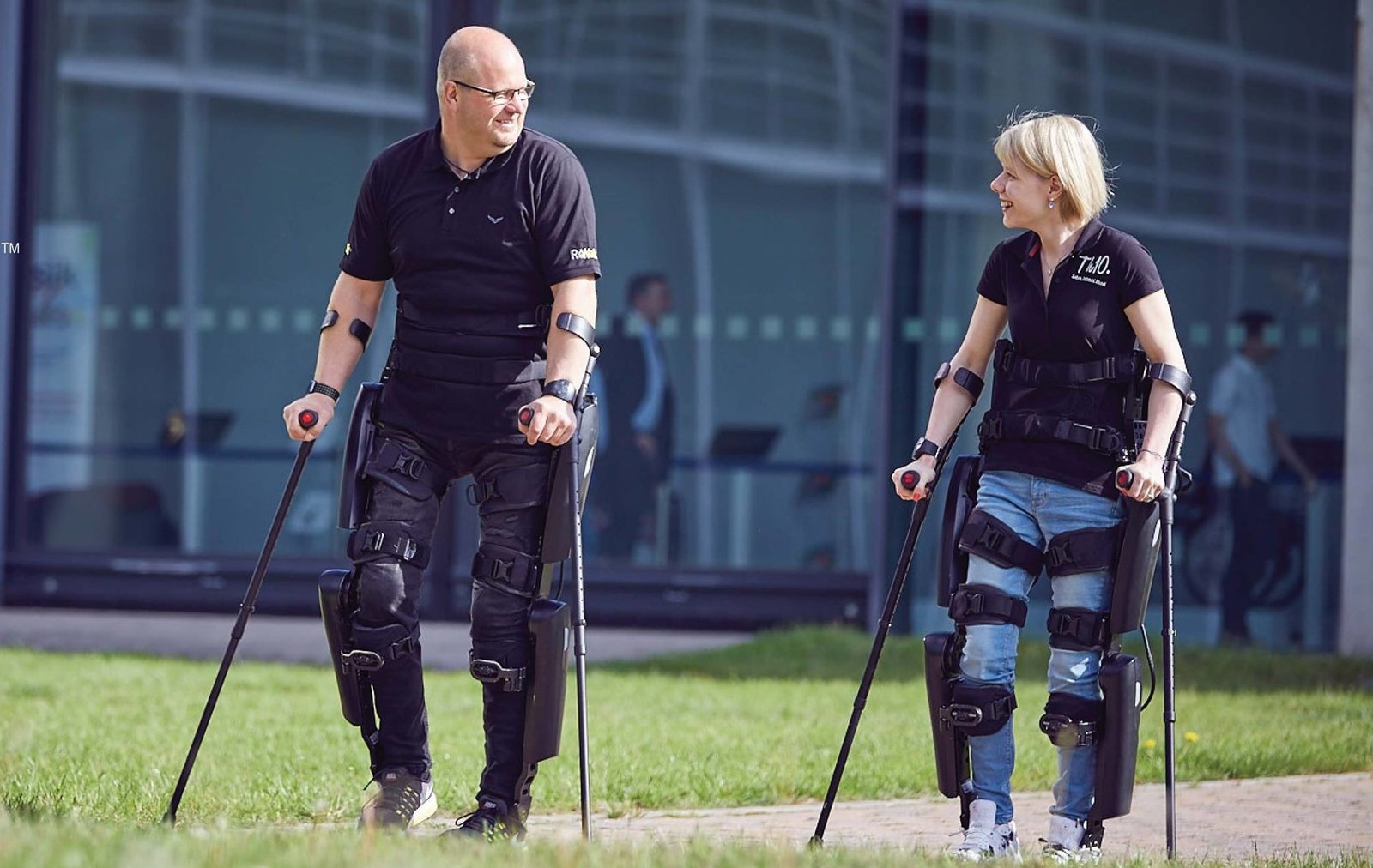
A new peer-reviewed study has taken personal exoskeleton research beyond walking distance and into users’ homes. Twelve people with chronic spinal cord injury used a ReWalk personal exoskeleton for everyday kitchen and grooming activities, giving researchers a closer look at what upright mobility can and cannot add once the device leaves a rehabilitation environment.
- Study
- Beyond Walking: Exploring Functional Use of Exoskeletons in the Home Environment
- Device
- ReWalk personal exoskeleton; the public study material does not establish that all participants used the current ReWalk 7 generation
- Company
- Lifeward
- Study type
- Mixed-methods observational pilot study
- Participants
- 12 people with paraplegia due to chronic spinal cord injury
- Setting
- Participants’ homes
- Kitchen activities
- Completed by all 12 participants
- Grooming activities
- Completed by 10 of 12 participants
- Perceived performance
- COPM performance scores improved significantly after home observations, P=.008
- Satisfaction
- COPM satisfaction scores improved significantly, P=.003
- Reintegration measure
- RNLI-M scores improved significantly, P=.04
- Pain
- Participants reported lower pain during exoskeleton use than during wheelchair use, P=.01
- Bowel and bladder
- 8 of 12 participants reported improvements
- Reported barriers
- Need for a companion and limited device agility
- Publication
- The Internet Journal of Allied Health Sciences and Practice, September 2026
The study asks what happens after the walking test ends
Personal lower-limb exoskeletons have traditionally been evaluated using measures such as gait speed, walking distance, standing time and the ability to complete structured walking protocols.
Those measures establish whether the technology can support upright mobility.
They tell us much less about what someone actually does once they are standing.
The new study focused on activities of daily living and instrumental activities of daily living performed in participants’ own homes.
Researchers observed 12 people with paraplegia due to chronic spinal cord injury using a personal exoskeleton to carry out everyday activities while standing.
Lifeward identifies the system used in the study as the ReWalk personal exoskeleton.
All 12 participants completed kitchen activities
Every participant performed kitchen tasks while using the exoskeleton.
Ten of the 12 also completed grooming activities.
Those are simple findings, but they matter because they demonstrate use beyond locomotion itself.
A personal exoskeleton is not being purchased simply to reproduce a gait-training session at home. Its potential value depends partly on whether standing gives a user access to activities, environments or interactions that are difficult to perform from a seated position.
The study therefore moves the evidence closer to functional use.
It does not establish that participants became independent in all of those activities, or that the exoskeleton was more efficient than a wheelchair. But it shows that selected household tasks were performed while users were standing in the device.
Perceived performance and satisfaction improved
Researchers used the Canadian Occupational Performance Measure to assess how participants viewed their own performance and satisfaction with activities they considered important.
COPM performance scores improved significantly following the home observations, with P=.008.
Satisfaction scores also improved significantly, with P=.003.
The distinction between perceived performance and objectively measured task performance is important.
COPM is a participant-centred measure. It captures whether people feel they are performing meaningful activities more successfully and whether they are more satisfied with that performance.
That can be a relevant outcome for an assistive mobility device, but it should not be interpreted as evidence that the exoskeleton made every activity objectively faster, safer or more independent.
The study also found a change in reintegration scores
The researchers used a modified version of the Reintegration to Normal Living Index to assess the importance of performing activities of daily living and instrumental activities of daily living while using the exoskeleton.
RNLI-M scores improved significantly, with P=.04.
Rather than focusing exclusively on gait mechanics, the study attempts to capture whether performing selected activities while standing has value in the context of everyday life.
Participants reported less pain during exoskeleton use
Pain was assessed using the Numeric Pain Rating Scale.
Participants reported significantly lower pain while using the exoskeleton than while using their wheelchair, with P=.01.
That is an interesting observation, but it needs to remain within the limits of the study.
The result does not establish that ReWalk is a treatment for chronic pain or that replacing wheelchair use with exoskeleton use would reduce pain over the long term.
It reports a difference in pain ratings under the conditions evaluated in this small observational study.
Eight participants reported bowel or bladder improvements
Eight of the 12 participants reported improvements in bowel and bladder function associated with exoskeleton use.
This finding is relevant because secondary physiological effects of upright activity have long been part of the clinical discussion around personal exoskeletons.
But the evidence here is preliminary.
The bowel and bladder changes were participant-reported in a small observational study. The research was not designed as a controlled physiological trial capable of establishing a specific treatment effect.
The finding should therefore be recorded as a reported association rather than proof that ReWalk produces a defined bowel or bladder benefit.
The barriers are as important as the positive findings
Participants also identified limitations to home use.
The study highlights two in particular: the need for a companion and limited device agility.
These constraints are important because the threshold for useful home mobility is different from the threshold for successful rehabilitation walking.
A device may allow someone to stand and perform a kitchen activity while still being slower or less maneuverable than a wheelchair for many other movements around the home.
Companion dependence also affects how independently and how frequently the exoskeleton can realistically be used.
These findings make the study more informative, not less.
They show that functional value is a balance between new capabilities and the practical requirements needed to access those capabilities.
The evidence should not automatically be assigned to ReWalk 7
There is an important product-generation distinction.
The peer-reviewed study evaluates a personal exoskeleton, and Lifeward identifies the system as the ReWalk personal exoskeleton.
The publicly available study material reviewed by Exoskeleton Index does not establish that every participant used the current ReWalk 7 Personal Exoskeleton.
The findings should therefore be treated as evidence for the ReWalk Personal product family rather than automatically described as clinical validation of the seventh-generation system.
That distinction matters because evidence should stay attached to the device generation that was actually studied whenever that information is available.
The study arrives as Lifeward is trying to expand home access
The publication also comes at a relevant commercial moment.
Lifeward and Ottobock Care launched a six-month U.S. pilot in August intended to expand the regional infrastructure around ReWalk 7 evaluation, reimbursement, training and follow-up.
Exoskeleton Index covered the programme in Lifeward and Ottobock Care Test a Scalable U.S. Access Model for ReWalk 7.
The commercial challenge is increasingly not simply whether an eligible person can obtain a personal exoskeleton.
It is whether the device becomes useful enough in daily life to justify the evaluation, reimbursement, training, companion support and ongoing service required to put it into use.
That makes evidence about what people actually do at home increasingly important.
Exoskeleton Index analysis
The strongest part of this study is not the P values.
It is the shift in what the researchers chose to evaluate.
Personal exoskeleton evidence has spent years answering the question: can someone walk in the device?
As the category moves further into personal and reimbursed use, that question is becoming insufficient.
The next question is: what can someone meaningfully do because they are standing?
The kitchen and grooming observations begin addressing that gap.
All 12 participants performing kitchen activities and 10 performing grooming activities shows that upright exoskeleton use can extend beyond locomotion for trained users.
But the reported barriers prevent a simplistic conclusion.
Companion dependence limits independent use. Limited agility may make a wheelchair substantially more practical for many movements. And participant-reported satisfaction does not automatically translate into objective functional superiority.
Standing access and functional independence are related, but they are not the same outcome.
That is why the most valuable interpretation is not that ReWalk is “better than a wheelchair.” The study does not establish that.
Instead, it suggests that personal exoskeletons may create functional value for specific activities where being upright changes what the user can access or how they experience the task.
This is also why the Wandercraft Eve wheelchair-comparison study is worth watching. The evidence base is beginning to move toward direct activity-level comparisons rather than treating walking itself as the endpoint.
What the study does not establish
This was a small observational pilot involving only 12 participants.
There was no randomized control group, and participants were not assigned to long-term exoskeleton use versus wheelchair use.
Several of the headline outcomes are participant-reported measures, including perceived performance, satisfaction, pain and bowel or bladder changes.
The significant P values therefore should not be interpreted as proof that ReWalk objectively improves all daily activities or produces established physiological benefits.
The study population also consisted of people able to use a personal exoskeleton at home, which may not represent the wider population of people with chronic spinal cord injury.
The publicly available study material also does not establish that all participants used the current ReWalk 7 generation.
What to watch next
The next step should be larger studies that separate subjective benefit from measurable functional performance.
Useful evidence would compare task-completion time, quality, exertion and assistance requirements between exoskeleton and wheelchair use for specific activities.
Longer-term utilization is another major gap.
Researchers need to understand how frequently personal exoskeleton owners actually use their devices after training, which activities drive repeat use and which practical barriers cause usage to decline.
The pain finding also deserves controlled follow-up, as do the reported bowel and bladder changes.
Most importantly, future research should help identify the situations where upright mobility provides enough added value to justify the additional setup, companion requirements and mobility constraints.
That would give users, clinicians and payers a much clearer picture of where personal exoskeletons fit alongside wheelchairs rather than trying to position one technology as a universal substitute for the other.
Explore the ReWalk 7 product profile, the Lifeward company profile, Exoskeleton Index’s healthcare and rehabilitation directory and our analysis of the Lifeward-Ottobock Care access pilot.