
Lifeward and Ottobock Care have launched a six-month U.S. pilot designed to expand access to the ReWalk 7 Personal Exoskeleton. The programme is not a new hardware launch. It is a test of whether established patient-care infrastructure can make personal exoskeleton evaluation, reimbursement, training and follow-up easier to deliver at regional scale.
The bottleneck is increasingly access, not just hardware
Lifeward announced the pilot on 5 August 2026. Under the programme, the companies plan to increase awareness of ReWalk 7 among rehabilitation hospitals and spinal cord injury centres, develop regional clinical and reimbursement expertise, and build local support for patient evaluation, training and follow-up.
That is a meaningful shift in where commercial competition can occur.
For a personal medical exoskeleton, regulatory clearance is only one step. An eligible user still needs to be identified, clinically evaluated, fitted, trained and supported. When third-party reimbursement is involved, the case also needs documentation, claim submission and payer approval.
A manufacturer can develop the device, but scaling all of those services nationally is a different operational problem.
What ReWalk 7 is cleared to do
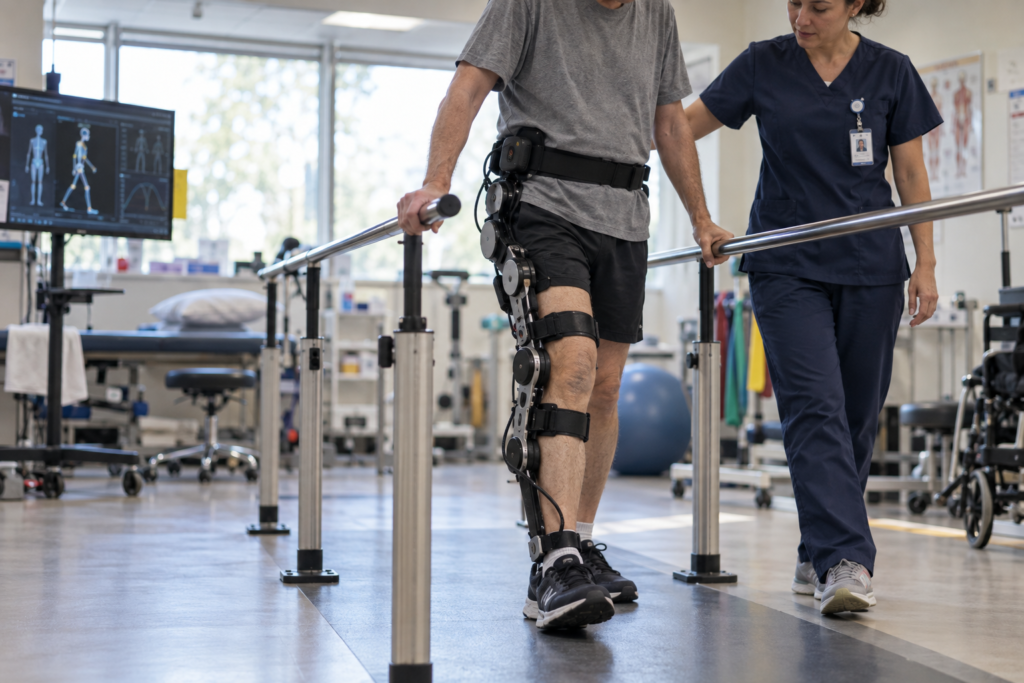
ReWalk 7 is a battery-powered lower-limb exoskeleton that provides powered hip and knee movement for eligible adults with spinal cord injury.
The U.S. Food and Drug Administration cleared the seventh-generation system in March 2025. The FDA summary describes a wearable prescription device controlled through a wrist unit, crutch-mounted controls and body movement sensed by the system. Intended uses include standing and walking on level surfaces and mild slopes, as well as ascending and descending stairs and curbs within the cleared user groups and training requirements.
Compared with earlier generations, Lifeward added updated controls, customizable walking speeds, connected features and therapist-facing tools.
Those changes matter for usability, but they do not remove the need for patient selection and structured training. ReWalk remains a prescription mobility system for defined spinal cord injury populations, not a general-purpose consumer walking aid.
Reimbursement has already changed the commercial context
The access discussion is more significant because the U.S. reimbursement environment has evolved.
Lifeward states that Medicare personal-exoskeleton claims using HCPCS code K1007 have been assigned to the brace benefit category for dates of service from 1 January 2024. The company has also reported additional payer progress, including commercial and Medicare Advantage coverage decisions.
That progress has shown up in revenue, but not in a straight line.
Lifeward reported that ReWalk Personal exoskeleton revenue increased materially in 2024, with its SEC filing attributing a $3.9 million increase primarily to higher U.S. ReWalk Personal revenue following Medicare coverage. Full-year ReWalk Personal revenue then slipped 3% to $8.5 million in 2025 from $8.9 million in 2024. In Q1 2026, ReWalk Personal revenue increased 11% year over year to $1.6 million.
The mixed pattern is useful. Coverage can create a pathway to sales, but reimbursement alone does not guarantee smooth quarter-by-quarter growth. Referral generation, evaluation capacity, payer administration, patient eligibility and product delivery still matter.
Why Ottobock Care could matter
Ottobock Care brings an established clinical footprint rather than simply another sales channel.
Lifeward says the U.S. network includes more than 50 patient-care clinics with certified prosthetist-orthotists, clinical liaisons, patient-care coordinators and technical specialists. The pilot is intended to use that infrastructure to create regional support around the ReWalk process.
For the exoskeleton market, this is potentially more important than adding another distributor that simply carries the product.
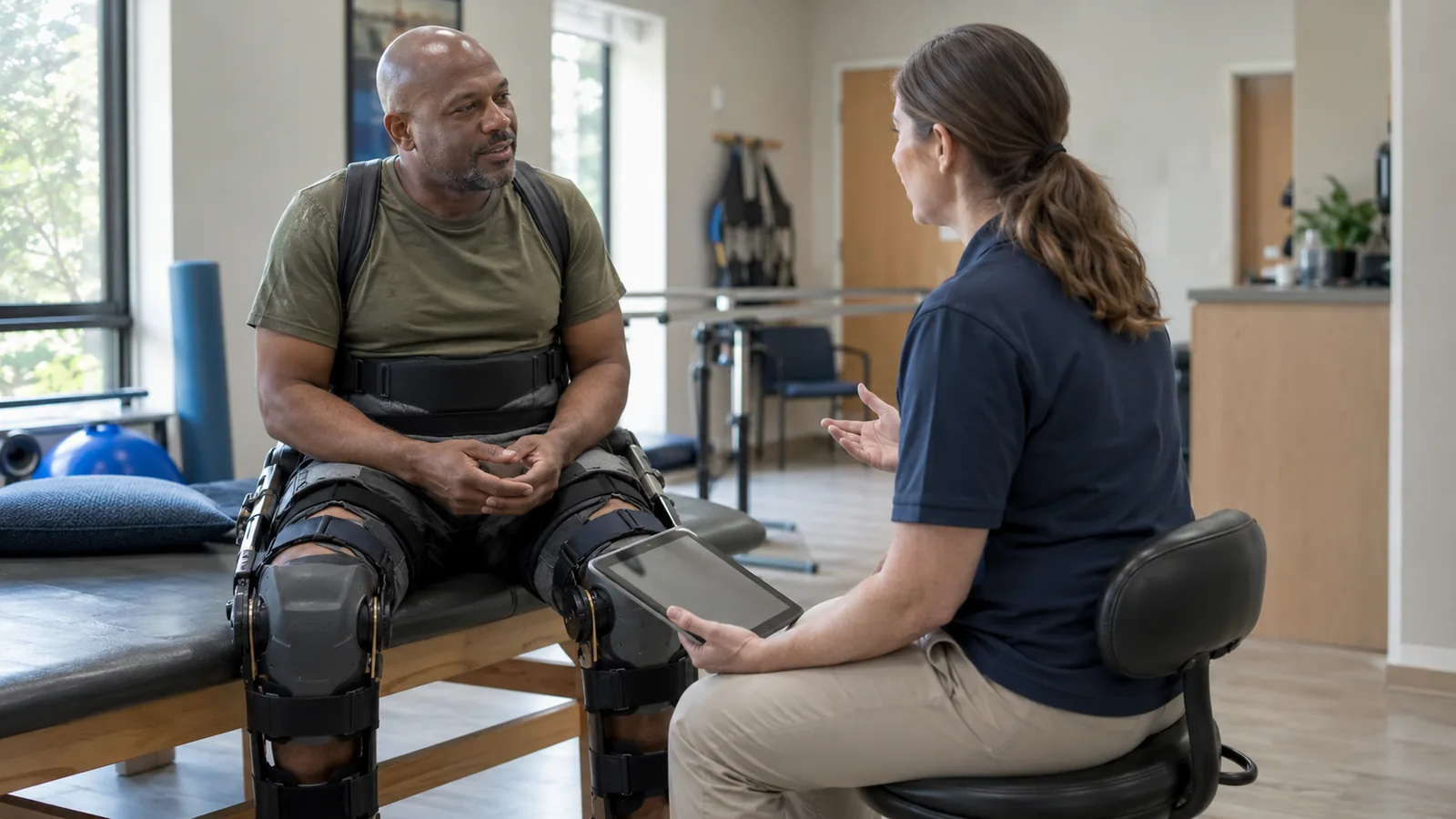
Personal exoskeleton adoption has a service component. A user cannot be treated like a customer buying a standard piece of electronics. Evaluation, fitting, payer documentation, training and follow-up all influence whether an approved device becomes an actively used mobility system.
If Ottobock Care can reduce the friction between those steps, the model could make ReWalk distribution more scalable without Lifeward having to build every local clinical function itself.
This is part of a broader channel strategy
The Ottobock Care pilot is not Lifeward’s first attempt to expand through specialised partners.
In 2025, the company announced an agreement with CorLife, a division of Numotion, focused on workers’ compensation claims. It also signed international distribution arrangements and continued to formalise reimbursement pathways in markets including Germany.
Taken together, the strategy points toward a more networked commercialization model: Lifeward develops and manufactures the exoskeleton while specialised care, reimbursement and distribution partners help move eligible users through the procurement process.
That model is common in mature assistive-technology markets. Its appearance around personal exoskeletons is therefore a positive sign of category development even if the absolute number of devices remains small.
What a useful pilot result would report
Lifeward has not publicly disclosed a target number of patients, clinics or ReWalk 7 deliveries for the six-month programme.
A meaningful readout would ideally include:
- number of referrals and completed evaluations;
- percentage of evaluated users meeting clinical eligibility requirements;
- payer approval and denial rates;
- time from referral to coverage decision;
- time from approval to fitting and training;
- completed device deliveries;
- training completion and follow-up rates;
- regional differences in access or reimbursement.
Without those data, the announcement should be treated as an access experiment rather than evidence of national scale.
Sources
- Lifeward, pilot programme with Ottobock Care, 5 August 2026.
- U.S. FDA, ReWalk 7 510(k) summary, March 2025.
- Lifeward, Q1 2026 financial results, 15 May 2026.
- Lifeward, full-year 2025 financial results, 18 March 2026.
Explore the ecosystem
View the ReWalk 7 product profile, explore the Lifeward company profile, or browse more healthcare and rehabilitation exoskeletons.