
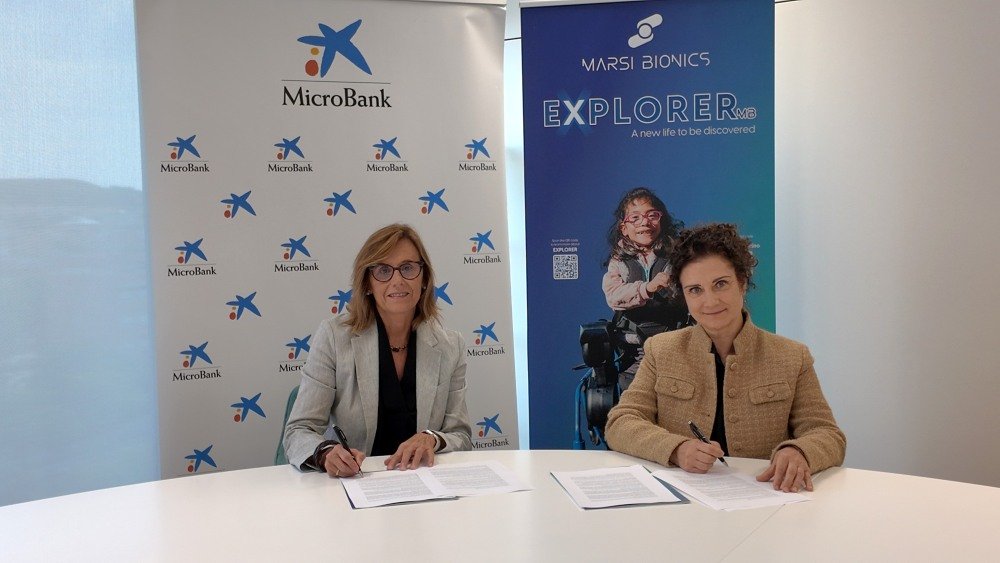
Pediatric exoskeleton financing has gained a dedicated banking route in Spain. MicroBank, CaixaBank’s social bank, has opened an annual financing line of up to €3 million (approximately US$3.36 million) to help eligible families acquire Marsi Bionics’ EXPLORER MB. The newly disclosed price is €49,900 (approximately US$55,900), and maintenance costs can also be included in the financing.
A Public Price Puts the Access Question Into Focus
The agreement provides one of the clearest public price signals yet for a personal-use pediatric exoskeleton in Europe.
The EXPLORER MB is priced at €49,900, approximately US$55,900.
Until now, much of the discussion around the device had focused on regulatory approval, safety, usability and the possibility of moving pediatric exoskeletons beyond rehabilitation centres.
The financing announcement moves affordability directly into the conversation.
MicroBank has made available up to €3 million per year, approximately US$3.36 million, under the agreement with Marsi Bionics.
The facility can finance both acquisition of the exoskeleton and the selected maintenance option.
At the €49,900 base price, €3 million would theoretically correspond to approximately 60 devices if the entire annual facility were used solely for hardware purchases.
That is a simplified calculation rather than a MicroBank financing target. Actual volumes will depend on individual loan amounts, maintenance costs, approvals and utilisation of the facility.
USD equivalents use an October 10, 2026 exchange rate of approximately €1 = US$1.12045 and are rounded for readability. The approximately 60-device figure is an Exoskeleton Index calculation based on the financing ceiling and base device price, not a stated sales target.
The Financing Can Include Maintenance
The financing arrangement does not stop at the initial hardware purchase.
MicroBank says the maximum financeable amount for each case can include both the cost of the device and the chosen maintenance option.
That is particularly relevant for a personal exoskeleton expected to operate outside a controlled rehabilitation clinic.
EXPLORER MB is positioned for children with motor difficulties associated with conditions including cerebral palsy, neuromuscular diseases, acquired brain injury and spinal cord injury.
Its intended role extends into everyday environments, allowing eligible children to explore their surroundings and participate in daily activities with family and friends.
For a device used this way, technical support, training, follow-up, fit and maintenance become part of the access model rather than secondary considerations.
Marsi Bionics says it will provide those services directly or through designated partner organisations.
Families Still Need Both Clinical Suitability and Credit Approval
The financing line lowers the upfront payment barrier, but it does not make EXPLORER MB automatically available to every applicant.
The programme is intended for families resident in Spain, and the commercialisation, delivery and associated services for financed devices must take place in Spain.
Each application remains subject to MicroBank’s normal internal credit-risk assessment and approval.
The bank says the family does not need to provide real collateral or a guarantor.
There is also a clinical and technical step before the financing request can proceed.
Each case requires an individualised viability report prepared by the organisation designated by Marsi Bionics to provide technical and clinical support.
That assessment must confirm the technical and functional suitability of the exoskeleton for the child, the recommended period of use and the maximum financeable amount.
The financing arrangement is supported by the European Investment Fund.
CE Marking Solved One Barrier, Not the Payment Problem
The agreement follows closely behind an important regulatory milestone for the device.
EXPLORER MB received CE marking in 2026, supporting its commercialisation as a medical device and its move toward personal use outside traditional rehabilitation settings.
As Exoskeleton Index reported after the CE-mark milestone, the development answered part of the regulatory question but left major commercial questions unresolved.
One was the price.
Another was how families could realistically access a personal exoskeleton if the cost was not fully covered by a healthcare system, insurer or disability-support programme.
The new MicroBank agreement provides one possible answer in Spain.
It is important, however, to distinguish financing from reimbursement.
A loan changes how the €49,900 cost can be paid over time. It does not eliminate the cost or establish that Spain’s public healthcare system will reimburse the device.
Personal Exoskeletons Change the Economics of Medical Robotics
Medical exoskeleton commercialisation has historically centred on institutions.
A hospital or rehabilitation centre can acquire one system and use it across many patients, usually with trained professionals supervising each session.
The purchase cost can therefore be spread across years of use and many users.
Personal-use pediatric exoskeletons create a different economic model.
One device is much more closely associated with one child and their everyday mobility.
That creates the possibility of a substantially larger unit market, but it also moves the payment problem closer to individual families.
The CaixaBank announcement estimates that around 11,000 children in Spain could potentially use this type of technology.
That figure should not be interpreted as a sales forecast or as the number of children clinically eligible for EXPLORER MB specifically.
Clinical suitability, family preference, financing eligibility, healthcare pathways and alternative mobility technologies will all narrow the number of actual users.
Readers can explore EXPLORER MB alongside other lower-limb and pediatric exoskeletons in the Exoskeleton Index directory.
Financing Is Becoming Part of the Commercial Model
High-cost assistive technologies rarely scale through hardware specifications alone.
The route to payment can be as important as the device itself.
Different markets may ultimately rely on combinations of public reimbursement, insurance, charitable funding, leasing, rental, bank financing and direct family payment.
In Spain, MicroBank is effectively becoming part of the commercial infrastructure around EXPLORER MB.
The arrangement now connects several pieces that personal medical exoskeletons need before they can move toward broader use: regulatory clearance, individual suitability assessment, long-term support and a mechanism for financing the purchase.
Whether those pieces translate into meaningful numbers of delivered personal systems is now the more important question.
Exoskeleton Index analysis
The €49,900 price may be the most revealing number in this announcement.
Personal pediatric exoskeletons are increasingly moving from a technology-access problem toward a financing and reimbursement problem.
EXPLORER MB has already crossed several barriers that historically kept pediatric exoskeletons primarily inside laboratories and rehabilitation programmes.
The device has been evaluated with children in home and community environments, received CE marking and is positioned specifically for personal use.
The next barrier is economic.
A €49,900 medical device is beyond the normal discretionary spending of most households.
A dedicated loan can remove the need to pay the full price upfront, but it does not make the underlying technology inexpensive.
That is why the distinction between financing and reimbursement matters.
Financing spreads the cost across time. Reimbursement transfers some or all of that cost to a healthcare system, insurer or another payer.
For personal medical exoskeletons to reach meaningful scale, both routes may eventually be needed depending on the country and healthcare system.
The Spanish programme now provides a useful real-world test.
The meaningful indicators will be how many families apply, how many applications are approved, how many systems are actually delivered and whether public or insurance-based funding develops alongside private financing.
For the exoskeleton sector, those numbers may increasingly matter as much as the next improvement in motors, batteries or gait algorithms.
What to Watch Next
The most important next number is the number of EXPLORER MB systems actually financed and delivered to families.
Several other commercial details remain publicly unclear.
MicroBank and Marsi Bionics have not disclosed a standard interest rate, maximum repayment period or representative monthly payment for the programme in the announcement reviewed by Exoskeleton Index.
It is also not yet clear how much of the €3 million annual facility will actually be drawn.
Longer-term access will depend partly on whether financing is complemented by reimbursement, disability funding or other public and private payment routes.
Real-world use should also provide better information on maintenance, adjustment and technical-support requirements as children grow and use the device outside clinical settings.
Those costs will help determine whether €49,900 represents most of the long-term economic burden or primarily the initial entry price.
The broader milestone is already clearer.
A personal pediatric exoskeleton in Europe now has a public price, CE marking and a dedicated banking route intended to help families finance access.
That moves the conversation another step away from whether the technology can exist and toward a harder question: who can realistically access it?
Sources and reporting notes
CaixaBank / MicroBank, September 28, 2026. MicroBank and Marsi Bionics agreement on financing access to pediatric exoskeletons .
Exoskeleton Index. EXPLORER MB product profile .
Exoskeleton Index. Marsi Bionics company profile .
Exoskeleton Index, September 27, 2026. EXPLORER MB Gets CE Mark as Pediatric Exoskeleton Moves Beyond the Clinic .
Currency note: USD equivalents use an October 10, 2026 EUR/USD rate of approximately 1.12045 and are rounded for readability.
Financing note: The €3 million figure is the maximum annual financing line made available under the agreement. It is not funding already disbursed, a confirmed sales figure or a commitment to finance approximately 60 devices.
Market-size note: The estimate of approximately 11,000 potential pediatric users in Spain comes from the CaixaBank/MicroBank announcement and refers to this type of technology broadly. It should not be interpreted as 11,000 confirmed candidates for EXPLORER MB.