

RoboCT says it plans to pursue an IPO within the next three years as its consumer robotics business accelerates. The listing ambition is notable, but the more useful signal for the exoskeleton market is the scale data disclosed alongside it: management says 2026 revenue is expected to reach the hundred-million-yuan level, consumer robotics sales are targeting roughly tenfold growth, the UGO rehabilitation line has reached 1,800 medical and care institutions, and the company now sells into nearly 50 countries and regions.
- Company
- Hangzhou RoboCT Technology Development Co., Ltd. (RoboCT / 程天科技)
- IPO target
- Within three years, according to deputy general manager Sun Yue
- 2026 revenue
- Management says company revenue is expected to reach the RMB 100 million level
- Consumer business
- Management says consumer robotics sales are pushing toward the hundreds-of-millions-of-yuan range and targeting roughly 10× growth in 2026
- Medical footprint
- UGO series reported in 1,800 hospitals, clinics and elderly-care institutions, with more than 1 million cumulative service interactions
- International reach
- Company says its product portfolio is sold in nearly 50 countries and regions
- Recent financing
- RMB 100 million-level Series B+ announced in March 2026
The IPO plan reveals more than a financing milestone
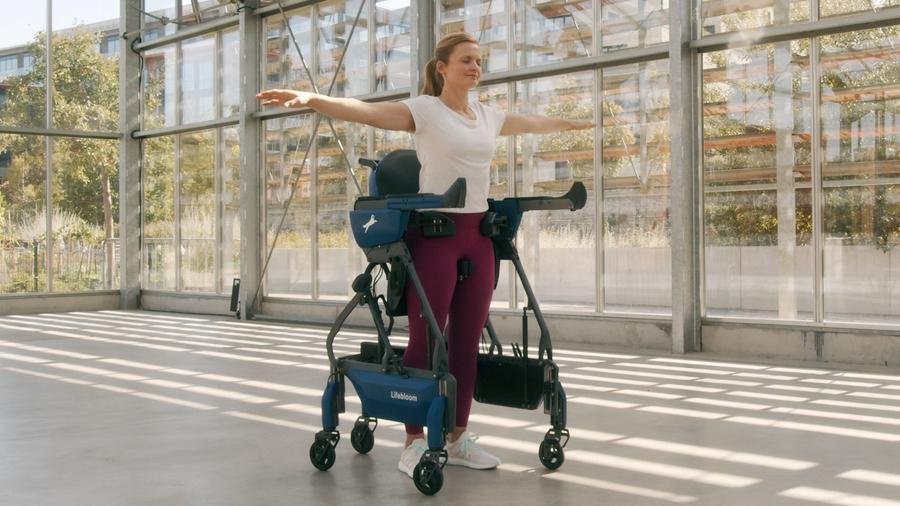
RoboCT’s deputy general manager Sun Yue disclosed the three-year IPO goal during the fifth Global Digital Trade Expo in Hangzhou, where the company was demonstrating its GoGo-H Pro walking-assistance exoskeleton alongside medical rehabilitation systems and a brain-computer-interface exoskeleton platform.
For Exoskeleton Index, the important part is not whether RoboCT eventually lists on that timetable. No exchange, filing schedule or transaction structure has been announced publicly.
The more interesting development is that a private exoskeleton manufacturer has started putting concrete business-scale figures into the public domain.
Sun told Chinese financial publication Caiwen that RoboCT’s 2026 revenue is expected to reach the hundred-million-yuan level. He also said sales of the company’s consumer robotics products had grown from several million yuan in earlier years to tens of millions, and were now pushing toward the hundreds-of-millions-of-yuan range, with approximately tenfold growth expected in 2026.
The wording matters. These are management forecasts reported in an interview, not audited financial statements, and the exact revenue mix is not disclosed. The figures should therefore be treated as company-reported growth targets rather than confirmed recognised revenue.
RoboCT is trying to build beyond the rehabilitation market
RoboCT’s earlier growth was built around medical rehabilitation. Its UGO powered lower-limb exoskeleton is positioned for gait rehabilitation and walking training, while KidGo targets pediatric rehabilitation.
The newer growth thesis is much broader.
At the Hangzhou event, RoboCT presented products spanning medical rehabilitation, daily walking assistance and industrial support. The company said its current portfolio covers five broad categories and six product series.
That expansion is visible in its consumer strategy. GoGo-H targets everyday mobility and elderly-care scenarios in China, while Ascentiz is being developed as an overseas-facing modular exoskeleton brand. RoboCT’s own March financing announcement said Ascentiz had attracted more than 3,000 Kickstarter backers and raised more than US$2.5 million in 45 days.
Exoskeleton Index has also tracked the Ascentiz H + K modular platform as it moved into European pricing and broader consumer positioning at IFA 2026.
The combination is strategically important. RoboCT is not relying on a single rehabilitation device or a single buyer type. It is attempting to use medical rehabilitation as the technical and commercial base for consumer mobility, outdoor assistance and other wearable-robotics markets.
The medical installed base remains central to the story
Caiwen reported that RoboCT’s UGO rehabilitation series has entered 1,800 tier-two-or-higher hospitals, clinics and elderly-care institutions in China, with more than 1 million cumulative service interactions.
If those figures are comparable across reporting periods, they would represent a substantial expansion from earlier public company figures.
Evidence note: RoboCT’s current main website still displays more than 600 domestic partner hospitals and 620,000 cumulative service interactions, while its March 2026 financing announcement referred to more than 920,000 patients served. The September interview reports 1,800 hospitals, clinics and care institutions and more than 1 million service interactions. These public metrics use different labels and may cover different institution types or reporting periods. Exoskeleton Index is therefore not treating them as directly comparable or independently verified deployment counts.
That distinction is important because installed-base claims are one of the most useful indicators of commercial maturity in medical exoskeletons, but only when the underlying definitions are consistent.
What can be said with more confidence is that RoboCT is operating across a meaningful medical network while simultaneously trying to move into higher-volume consumer categories.
A fresh financing round is supporting that transition
In March 2026, RoboCT announced an RMB 100 million-level Series B+ financing led by ABC Capital, with participation from Huichuan Capital and Hangzhou Capital. The company said it was its second financing round within a year.
The stated uses of the capital line up closely with the strategy now being described publicly: international and domestic expansion of consumer exoskeletons, embodied-intelligence R&D, registration of new brain-computer-interface products and channel development.
That financing matters because moving from medical rehabilitation into consumer hardware changes the operating requirements of an exoskeleton company. Higher-volume consumer products require manufacturing capacity, inventory planning, retail or ecommerce channels, customer support, product returns, software maintenance and significantly broader marketing than a hospital-focused capital-equipment business.
RoboCT is therefore attempting two different scaling models at once: deepen the medical installed base while building a higher-volume consumer business.
International expansion is becoming part of the growth case
Sun told Caiwen that RoboCT’s products now reach nearly 50 countries and regions. The company also cited European CE certification and multiple ISO certifications as part of its international expansion.
Exoskeleton Index has already seen evidence of that channel expansion in Southeast Asia. In September, RoboCT products were introduced through Robotimize across rehabilitation settings in Singapore and Northern Malaysia.
The new disclosure makes that expansion more significant. International distribution is not being presented as a side project. It is becoming part of the company’s stated growth case alongside consumer products and medical rehabilitation.
Exoskeleton Index analysis
RoboCT’s three-year IPO ambition is useful mainly because it forces a more commercial question onto the exoskeleton sector: what does scale actually look like for a company trying to operate across medical, consumer and industrial wearable robotics?
Most exoskeleton news still arrives as product specifications, clinical studies, pilot projects or distributor announcements. Revenue, installed base, sales mix and capital requirements are disclosed far less often, particularly by private companies.
RoboCT is now giving the market at least a partial view.
The emerging model is notable. Medical rehabilitation provides regulated products, institutional relationships and accumulated user data. Consumer products potentially provide higher unit volumes and faster geographic expansion. International brands such as Ascentiz create a route into markets where the RoboCT name itself may have less recognition.
There is also a meaningful risk in that model. Scaling consumer hardware is very different from selling rehabilitation equipment to institutions. Unit economics, returns, warranty costs, repeat use and customer retention can become more important than demonstration demand or crowdfunding totals.
That is why the next stage of disclosure matters more than the IPO headline itself.
If RoboCT moves toward a listing, investors and industry observers should eventually get access to metrics that the exoskeleton sector rarely sees today: audited revenue, segment mix, gross margins, unit shipments, geographic concentration, R&D spend and the actual contribution of medical versus consumer exoskeletons.
For a sector still trying to establish which commercialization models can scale, those numbers could be more valuable than another product launch.
What to watch next
The immediate question is whether RoboCT turns its stated IPO ambition into a formal listing process. No exchange or filing has been announced.
Beyond that, four indicators would materially improve the picture:
- Audited revenue: whether the 2026 business actually reaches the scale described by management.
- Consumer unit sales: whether the claimed tenfold growth translates into sustained deliveries rather than launch-period demand.
- Revenue mix: how much comes from rehabilitation systems, consumer exoskeletons, industrial products and international markets.
- Deployment definitions: whether RoboCT standardises how it reports hospitals, clinics, care institutions, patients and cumulative service interactions.
The direction is already clearer than it was a year ago. RoboCT is positioning itself not simply as a rehabilitation-exoskeleton supplier, but as a multi-market wearable-robotics company attempting to scale medical, consumer and international businesses in parallel.
Whether that model can support a public-market company is still unproven. The next few years may provide one of the clearest financial tests yet for the commercial maturity of the exoskeleton sector.
Sources
- Caiwen, September 27, 2026: Global Digital Trade Expo interview with RoboCT deputy general manager Sun Yue
- RoboCT, March 5, 2026: Series B+ financing announcement
- RoboCT official website: current company deployment and service metrics
- Exoskeleton Index: RoboCT company profile
- Exoskeleton Index: UGO Exoskeleton profile
- Exoskeleton Index: RoboCT expansion in Singapore and Northern Malaysia