
Two developments in the same week are showing how rehabilitation robotics is being pushed beyond trade-show demonstrations in Southeast Asia. In Singapore, St Luke’s Hospital signed a memorandum of understanding with Robotimize to develop a technology-enabled Rehabilitation Centre of Excellence. Days later, Robotimize introduced three RoboCT exoskeletons across healthcare and care settings in Northern Malaysia. Neither development confirms a large exoskeleton purchase, but together they show the regional infrastructure around adoption starting to deepen.
- Singapore development
- St Luke’s Hospital and Robotimize signed an MOU at RehaCare Asia 2026
- Singapore objective
- Advance a technology-enabled Rehabilitation Centre of Excellence
- Hospital scope
- Capability building, research, technology adoption and expansion across day rehabilitation, gym programmes, frailty, neurological and post-acute deconditioning
- Malaysia development
- Robotimize introduced three RoboCT exoskeletons across private centres, rehabilitation institutions and care settings in Northern Malaysia
- Products shown
- UGO, KidGo and GoGo
- Manufacturer
- RoboCT
- Confirmed purchase volume
- Not disclosed
- Evidence status
- The Singapore MOU is confirmed by St Luke’s Hospital and RehaCare Asia. The Malaysia rollout is based on Robotimize’s company announcement.
St Luke’s is framing the problem as adoption, not device acquisition
The Singapore agreement was formalised during the MotusAcademy and RehaCare Asia Leadership Forum on 9 September.
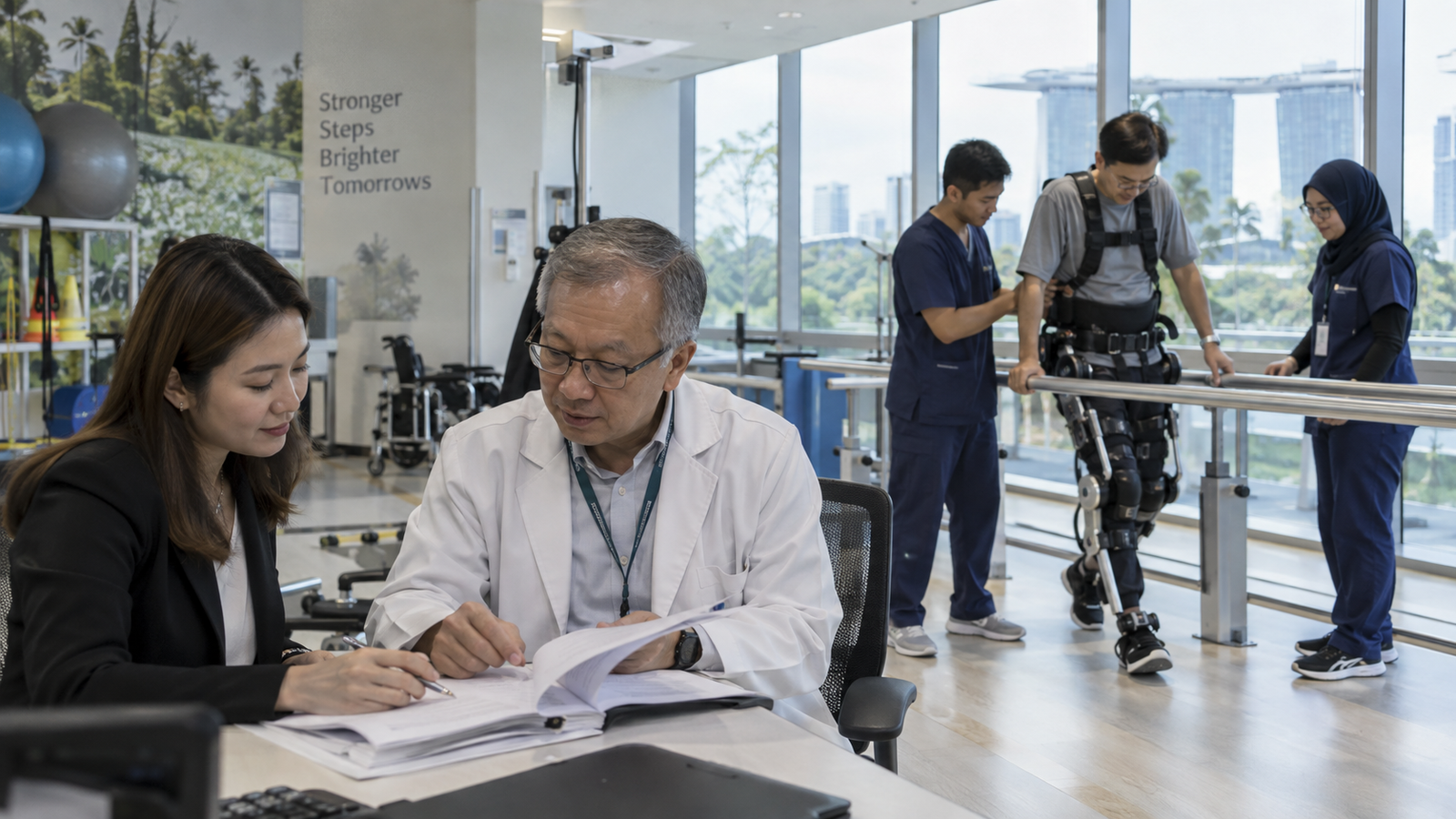
St Luke’s Hospital says the partnership with Robotimize is intended to advance a technology-enabled Rehabilitation Centre of Excellence and support more intensive and personalised rehabilitation. The scope includes capability building, research and technology adoption across day rehabilitation, gym programmes, frailty, neurological rehabilitation and post-acute deconditioning.
Robotimize describes the partnership in similar terms, with an emphasis on integrating rehabilitation robotics and related technologies into clinical workflows, research, staff capability and community care.
That distinction matters. The announcement is broader than an exoskeleton deployment. St Luke’s has not announced that it purchased a specific RoboCT exoskeleton, and the MOU should not be reported as one.
What it does show is a healthcare provider and technology company formalising work around the harder part of rehabilitation robotics: implementation.
Northern Malaysia adds a more exoskeleton-specific rollout
Robotimize followed the Singapore agreement with a separate announcement on 14 September covering Northern Malaysia.
The company says it introduced three lower-limb exoskeleton systems from RoboCT to healthcare providers and care communities across the region: UGO, KidGo and GoGo.
The devices were shown across several care environments, including hospitals, rehabilitation institutions, private centres and elderly-care settings. Company material shows UGO being demonstrated to clinical staff at a hospital in northern Malaysia and GoGo being presented in an elderly-care centre in Penang.
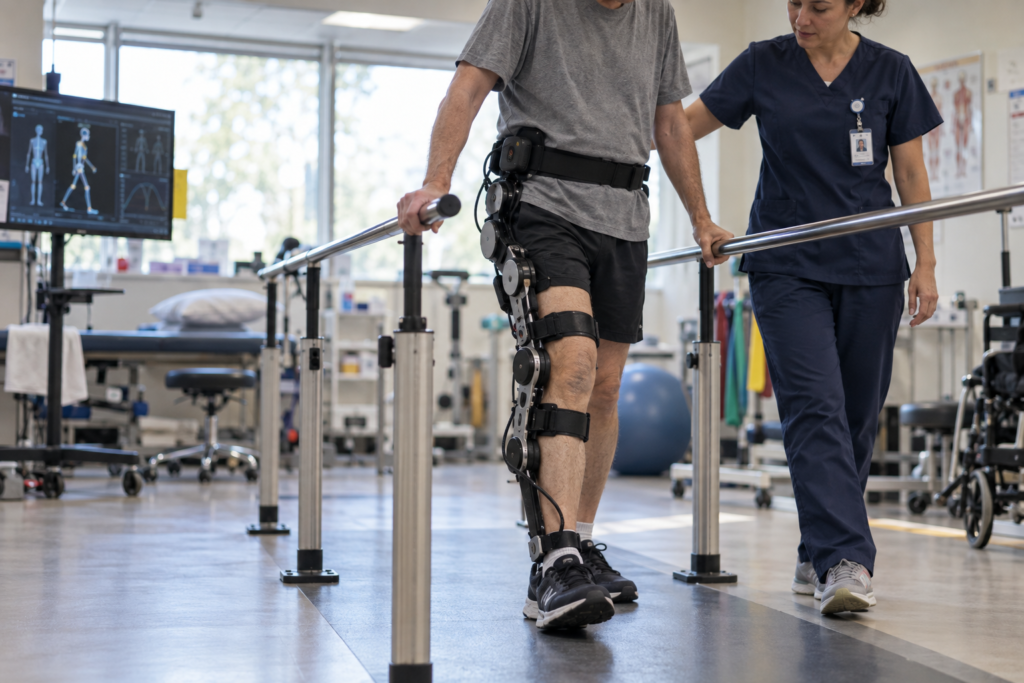
The range is designed to address different populations. UGO is positioned for adult lower-limb rehabilitation, KidGo for paediatric gait training, and GoGo for mobility support in other care settings.
Robotimize says the aim is to allow clinicians and caregivers to evaluate how different exoskeletons could fit existing rehabilitation programmes rather than present one device as suitable for every patient group.
The regional model is increasingly about portfolios and local implementation
Southeast Asia is a particularly interesting market for rehabilitation robotics because adoption conditions differ sharply between health systems, hospital types and countries.
A manufacturer may have a clinically capable device but still need local partners for regulatory work, demonstrations, clinician training, service, distribution and procurement.
Robotimize is positioning its ACE strategic-partnership portfolio as one way to provide that layer. The company is not developing all of the exoskeleton hardware itself. It is bringing external technologies, including RoboCT systems, into regional healthcare relationships.
That approach resembles the distribution and implementation partnerships emerging elsewhere in the exoskeleton industry. The value of the local partner is increasingly tied to whether it can help a device move from an exhibition floor into a repeatable clinical workflow.
Exoskeleton Index analysis
The important signal here is not that three exoskeletons were demonstrated in Malaysia or that another MOU was signed in Singapore. Either event on its own could remain superficial.
The more interesting pattern is the operating layer forming around rehabilitation robotics in the region.
St Luke’s is explicitly talking about capability building, research, workflow integration and community care. Robotimize’s Malaysia rollout is similarly being framed around training, support and matching different systems to different care settings.
That is closer to what sustainable adoption actually requires.
Rehabilitation robots are rarely plug-and-play capital equipment. Hospitals need to identify appropriate patients, train staff, schedule sessions, maintain the devices, measure outcomes and justify the cost. Community settings add another layer because staffing, space and technical support can be more limited than in major hospitals.
The regional opportunity therefore depends on more than how many devices a distributor can import. It depends on whether suppliers can build local clinical confidence and service capacity around them.
For RoboCT, the Singapore and Malaysia activity also broadens the commercial context around products such as UGO and KidGo. The manufacturer is gaining exposure through a partner that is attempting to connect multiple technologies to hospital and community-care pathways.
What is not yet confirmed
Neither announcement provides a disclosed exoskeleton fleet order, purchase value or installation count.
The St Luke’s MOU covers rehabilitation technology broadly and should not be interpreted as confirmation that the hospital has purchased RoboCT exoskeletons.
In Northern Malaysia, Robotimize describes introductions and evaluations across care settings. It does not disclose which institutions have committed to buying the systems, how many units may be deployed or the commercial terms.
The company also notes that availability, indications and use remain subject to applicable local regulatory approvals and clinical requirements.
What to watch next
The strongest evidence of progress will be named deployments rather than additional demonstrations.
For Singapore, the key questions are which technologies enter St Luke’s clinical programmes, which patient groups are selected and whether the partnership produces measurable workflow or outcome data.
For Malaysia, the important follow-up is whether UGO, KidGo or GoGo move from demonstrations into purchased or contracted clinical use, and whether Robotimize establishes recurring training and service relationships around those systems.
Those details will show whether the current activity is primarily market development or the beginning of sustained rehabilitation-robotics adoption.
Explore the RoboCT company profile, UGO product profile, KidGo product profile and Exoskeleton Index’s healthcare and rehabilitation directory.
Sources
- RehaCare Asia: MotusAcademy Leadership Forum agenda and St Luke’s Hospital × Robotimize MOU signing
- St Luke’s Hospital Singapore: MOU announcement and scope
- Robotimize: partnership and implementation statements
- Robotimize company release: ACE exoskeleton introductions across Northern Malaysia, 14 September 2026
- RoboCT: Malaysia product demonstration and training context