
A randomized pilot involving 36 people with post-stroke hemiplegia found larger improvements in balance, walking endurance, timed walking and several gait measures when unilateral lower-limb exoskeleton training was added to rehabilitation. The results are encouraging because multiple outcomes moved in the same direction, but the study remains small and does not yet establish whether the gains persist after training ends.
- Study
- Unilateral Exoskeleton Training for Balance/Gait in Hemiplegic Stroke: Pilot Study
- Publication
- Behavioural Neurology
- Published
- 27 September 2026
- Participants
- 36 people with post-stroke hemiplegia
- Group allocation
- 18 participants in the exoskeleton group and 18 in the conventional rehabilitation group
- Study site
- Shanghai Yangzhi Rehabilitation Hospital, Tongji University School of Medicine
- Recruitment period
- October 2022 to December 2023
- Primary outcome
- Berg Balance Scale
- Secondary outcomes
- 10-m walking time, six-minute walking distance, three-dimensional gait analysis, Hospital Anxiety and Depression Scale and pain VAS
- Device
- Unilateral lower-limb exoskeleton rehabilitation training robot; the available indexed abstract does not identify a commercial model
- DOI
- 10.1155/bn/4208995
Both groups improved, but the exoskeleton group improved more
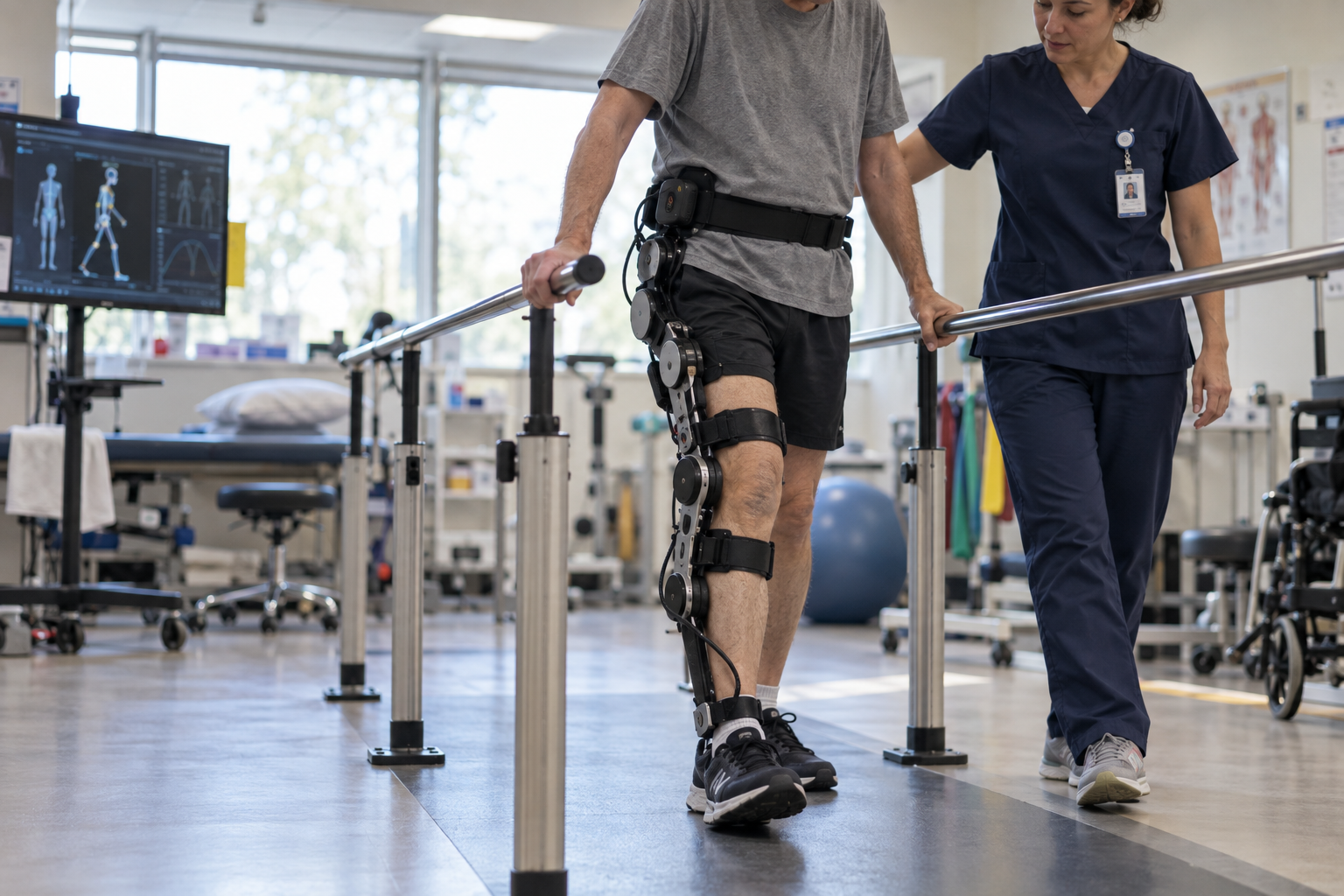
The study compared conventional rehabilitation with rehabilitation that incorporated a unilateral lower-limb exoskeleton robot.
Thirty-six people with post-stroke hemiplegia were randomly assigned between the two groups, with 18 participants in each.
Both groups improved.
The important result is that participants receiving exoskeleton-assisted training showed larger changes across several different measures rather than on a single isolated endpoint.
Those measures included clinical balance, walking endurance, timed walking and joint movement during gait.
That makes the result more informative than a study showing improvement only on one questionnaire or one laboratory measurement.
Balance showed the clearest difference
The study’s primary outcome was the Berg Balance Scale, a 56-point clinical assessment used to evaluate functional balance.
The exoskeleton group improved by an average of 5.50 points.
The conventional rehabilitation group improved by 3.11 points.
The between-group difference was statistically significant at p < 0.001.
That was the strongest statistical signal reported in the study.
The result suggests that integrating unilateral robotic gait training into rehabilitation may provide additional benefit for balance recovery compared with conventional rehabilitation alone.
It does not establish that the exoskeleton itself was solely responsible for the improvement.
The intervention was delivered as part of a rehabilitation programme rather than as an isolated replacement for therapy.
Walking endurance also improved more with exoskeleton training
The researchers also measured six-minute walking distance.
Participants in the exoskeleton group increased their distance by an average of 15.89 metres.
The conventional rehabilitation group improved by 9.73 metres.
The between-group difference reached statistical significance at p = 0.017.
This is useful because the six-minute walk test captures something different from balance alone.
It reflects the distance a person can sustain over several minutes rather than simply whether they can perform one short walking task.
That said, statistical significance does not automatically establish that the additional improvement is clinically meaningful for every stroke patient.
The study is small, and larger trials would be needed to determine how stable the effect is across different levels of impairment.
Timed walking showed the same direction of change
The researchers also examined the time required to complete a 10-metre walking test.
The exoskeleton group reduced its walking time by an average of 8.82 seconds.
The conventional group improved by 6.83 seconds.
The between-group difference was statistically significant at p = 0.030.
Again, both groups improved.
The study therefore should not be interpreted as showing that conventional rehabilitation was ineffective.
Instead, the evidence suggests that the group receiving unilateral robotic training experienced a larger measured improvement over the study period.
Three-dimensional gait analysis found changes at the hip, knee and ankle
The study becomes more interesting when the clinical tests are compared with the gait-analysis data.
The researchers measured movement at several lower-limb joints and reported larger improvements in the exoskeleton group.
Hip flexion improved by an average of 3.57° in the exoskeleton group compared with 1.72° in controls.
The between-group difference reached p = 0.018.
Knee flexion improved by 5.28° compared with 2.63°, with p = 0.046.
Ankle dorsiflexion improved by 4.81° compared with 1.09°, with p = 0.030.
Those measurements matter because stroke gait impairment is not simply a question of walking faster.
Hemiplegic gait can involve altered hip, knee and ankle movement as the person compensates for weakness, reduced motor control and asymmetry between the affected and unaffected sides.
Changes across several joints therefore provide additional context around the walking-test results.
The value of the study is the consistency across different outcomes
No single number makes this study particularly compelling.
The more useful signal is that several independent measures moved in the same direction.
Balance improved more.
Six-minute walking distance improved more.
Ten-metre walking time improved more.
Hip, knee and ankle movement also showed larger changes.
When clinical outcomes and biomechanical measurements point in the same direction, the result becomes harder to dismiss as an isolated change in one test.
It still does not remove the limitations of the study.
There were only 18 participants in each group, and small trials can produce effect estimates that change substantially when tested in larger populations.
Not every measured outcome favored the exoskeleton group
The researchers also evaluated psychological and pain-related outcomes using the Hospital Anxiety and Depression Scale and a visual analogue scale for pain.
Depression scores improved more in the exoskeleton group, with a reported mean change of 2.89 compared with 1.61 in the conventional group and p = 0.015.
However, there were no significant between-group differences in anxiety or pain.
Those secondary findings should be treated carefully.
The study was designed primarily around balance and lower-limb recovery rather than psychological outcomes.
The absence of a difference across every measure is also useful because it prevents the result from being interpreted as a universal benefit across all aspects of post-stroke recovery.
Exoskeleton Index analysis
The most useful part of this study is not that another group of stroke patients improved while using an exoskeleton.
That alone would tell us relatively little.
Stroke rehabilitation studies frequently show improvement over time, particularly when participants are receiving structured therapy.
The more important question is whether adding robotic training changes the size or pattern of that recovery compared with conventional rehabilitation.
This pilot provides an encouraging signal.
The exoskeleton group did not outperform the comparison group on just one measure. Larger gains appeared across balance, walking endurance, timed walking and several joint-motion parameters.
That strengthens the case for studying unilateral systems more closely.
Unilateral exoskeletons are also conceptually interesting for hemiplegic stroke because the impairment itself is asymmetric.
Instead of mechanically controlling both legs in the same way, a unilateral system can focus assistance on the affected side while allowing the unaffected limb to remain more directly involved in natural gait.
That does not mean unilateral architecture is inherently superior to bilateral rehabilitation robots.
Different patients may require different levels of support, and device design, control strategy, assistance intensity and stage of recovery can all influence the outcome.
The current evidence is therefore moving toward a more useful question than simply asking whether robotic rehabilitation works:
Which robotic architecture, training dose and assistance strategy works best for which stroke patient?
That is ultimately the evidence clinicians and buyers will need.
The study fits a broader shift toward more targeted stroke exoskeletons
Lower-limb rehabilitation robotics has historically included large treadmill-based systems, bilateral powered exoskeletons and overground wearable devices.
More recent research is increasingly examining systems that target one affected limb.
An earlier randomized study published in the Journal of NeuroEngineering and Rehabilitation in 2024 also reported greater improvements in several balance and gait outcomes with unilateral exoskeleton-assisted overground training compared with conventional treatment in people with subacute stroke.
That earlier trial additionally examined changes in cortical activation.
The two studies should not be treated as direct replications.
They involved different study populations, protocols and outcome sets.
But together they illustrate growing interest in unilateral robotic assistance as a distinct rehabilitation architecture rather than simply a reduced version of a bilateral exoskeleton.
For the healthcare and rehabilitation exoskeleton market, that distinction could eventually matter commercially as well.
Clinics may not simply choose between robotic rehabilitation and conventional therapy. They may increasingly need to choose between different categories of robotic assistance based on patient profile and therapeutic goal.
What the study does not establish
This remains a pilot study with only 36 participants.
The findings therefore need confirmation in larger randomized controlled trials before they can be generalized across the wider stroke population.
The available indexed abstract does not identify the commercial model of the unilateral exoskeleton used in the study.
That limits the ability to translate the findings directly to a specific product or compare the intervention with other systems in the Exoskeleton Product Directory.
The study also does not establish whether the measured differences persist after supervised rehabilitation ends.
Long-term follow-up will be important because an improvement recorded immediately after training may not necessarily translate into lasting independent mobility.
The results should also not be interpreted as evidence that unilateral exoskeleton training is superior for every person after stroke.
Stroke severity, time since stroke, baseline walking ability, cognitive status, spasticity, balance and other clinical factors can influence who is able to use a particular robotic system and how much assistance is appropriate.
Finally, the study reports statistically significant differences.
It does not establish the cost-effectiveness of adding the technology to routine rehabilitation or whether the additional improvement justifies the equipment, staffing, fitting and training requirements in different clinical settings.
What to watch next
The most important next step is a larger randomized trial.
A bigger population would allow researchers to determine whether the observed differences remain stable and whether particular patient subgroups benefit more than others.
Longer follow-up is equally important.
Future studies should establish whether improvements in balance and walking remain after robotic training stops and whether they translate into greater independence outside the rehabilitation environment.
Device-specific reporting would also improve the value of the evidence.
Assistance architecture, control strategy, training intensity and the amount of therapist involvement can differ substantially between exoskeleton systems.
Without those details, positive results from one trial cannot automatically be transferred to another product.
Operational evidence will eventually matter as well.
Clinical buyers need to understand not only whether an exoskeleton improves an outcome, but how long fitting takes, how many patients can use the device per day, how much therapist supervision is required and whether the system can be integrated efficiently into existing rehabilitation workflows.
This new study does not answer all of those questions.
It does add another encouraging piece of evidence that unilateral lower-limb exoskeleton training may provide additional benefit when integrated into post-stroke rehabilitation.
Explore Healthcare & Rehabilitation exoskeletons or browse the wider Exoskeleton Product Directory.
Sources
- Zhou S, Wang S, Qu X, Fan J, Xu H, Chen L, Liu L. Unilateral Exoskeleton Training for Balance/Gait in Hemiplegic Stroke: Pilot Study. Behavioural Neurology, 27 September 2026. DOI: 10.1155/bn/4208995
- JoVE Visualize: Indexed study abstract and outcome data
- Journal of NeuroEngineering and Rehabilitation: Earlier randomized trial of unilateral lower-limb exoskeleton training after stroke, 2024