
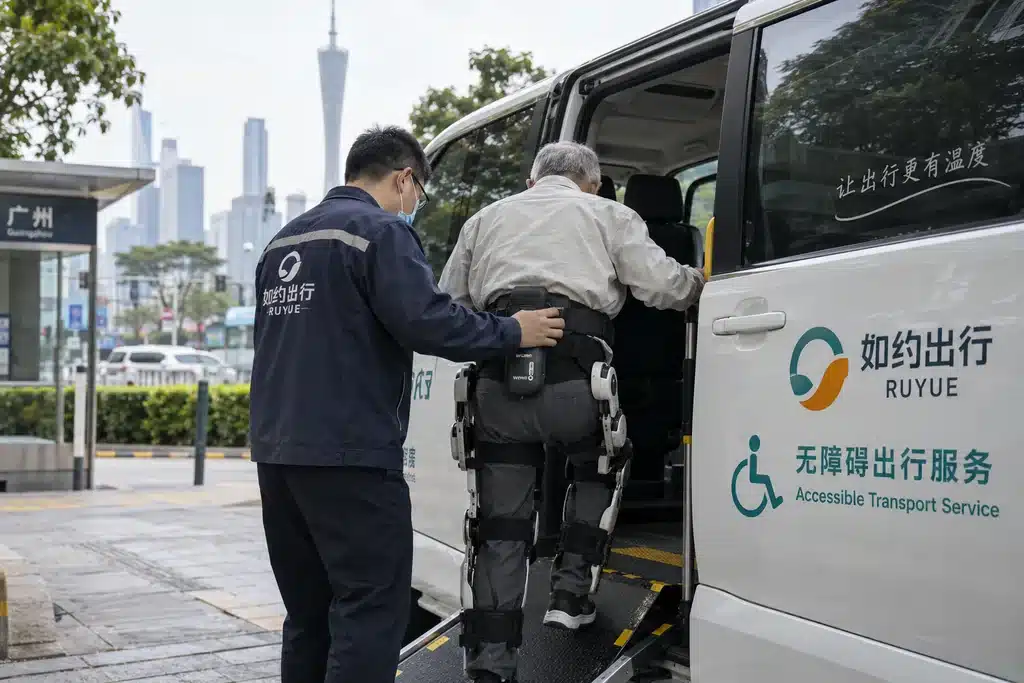
Guangzhou’s Ruyue mobility service has introduced wearable exoskeleton robots as part of an upgraded accessible transport service for older adults, disabled passengers, people recovering after surgery and others with limited mobility. The move places exoskeleton technology in an unusual real world setting: helping passengers stand, transfer and enter or leave vehicles.
- Location
- Guangzhou, China
- Operator
- Guangzhou Ruyue Mobility Group
- Service
- Ruyue multifunction accessible transport
- Technology
- Wearable walking assist exoskeleton robots
- Target users
- Older adults, disabled passengers, people recovering after surgery and people with limited mobility
- Reported use
- Assistance with standing, stepping, transfers and entering or leaving vehicles
- Manufacturer
- Not publicly identified
- Launch reported
- 10 September 2026
Exoskeletons enter an accessible transport service
Ruyue has upgraded its multifunction vehicle service with a combination of wheelchair accessible equipment and wearable exoskeleton robots.
According to Guangzhou Daily, the vehicles include nonslip wheelchair ramps and wheelchair restraint systems. The new exoskeleton equipment is intended for older passengers with reduced lower limb strength who may have difficulty standing or taking steps independently.
The wearable systems are described as providing support during standing, stepping and getting into or out of a vehicle. The operator says the aim is also to reduce the physical burden on accompanying family members and lower risks during passenger transfers.
The service is intended for several types of journeys, including hospital appointments, transport after hospital discharge, trips involving elderly care institutions and community transport for older residents.
Drivers are being trained to use the equipment
The exoskeleton is not being introduced as a standalone demonstration device.
Ruyue says drivers are receiving specific training in the operation of both wheelchair equipment and exoskeleton robots, integrating the technology into the wider transport service.
That operational element is important. Using an exoskeleton in a transport setting involves more than providing walking assistance. Staff need to understand fitting, user support, transfers and the limitations of the equipment across passengers with different mobility needs.
Ruyue is part of Guangzhou Public Transport Group and operates a large mobility network in the region. Its wider business includes conventional taxis, ride hailing and autonomous vehicles, giving the company an established transport infrastructure through which assistive mobility services could potentially expand.
A different model for accessing exoskeleton technology
Most commercial exoskeletons currently reach users through direct purchase, rehabilitation clinics, hospitals, workplaces or specialist care providers.
Guangzhou’s approach introduces another possible access model: exoskeleton technology provided as part of a mobility service.
A passenger may only need physical assistance during specific parts of a journey, such as standing from a seated position, transferring between a wheelchair and another surface, or navigating the short distance required to enter a vehicle.
Shared access could therefore be relevant for people who would benefit from occasional assistance but do not need or cannot justify owning an exoskeleton themselves.
Exoskeleton Index analysis
The most interesting part of the Guangzhou development is not a new exoskeleton product. It is the environment in which exoskeleton technology is being introduced.
Accessible transport sits between personal mobility, healthcare and community care. If wearable robots can be incorporated safely into that environment, it expands the potential role of exoskeletons beyond conventional rehabilitation and individual ownership.
The development also fits a broader pattern emerging in China around mobility technology for an ageing population.
China’s national consumer policy now explicitly calls for exoskeleton robots to enter elderly households and encourages age friendly technologies to reach communities, hospitals, pharmacies and care institutions.
Separately, China’s Ministry of Commerce reported that sales value for exoskeleton assist devices rose 39.5% year over year on monitored key platforms in July 2026.
Those developments measure different things and should not be combined into a single adoption claim. But together with the Guangzhou service, they show exoskeleton technology appearing across a broader set of consumer, care and mobility channels.
For the wider exoskeleton market, distribution and access models may eventually matter as much as hardware improvements. A technically capable device has limited impact if potential users cannot easily discover, try or access it.
What the announcement does not tell us
The available information leaves several important questions unanswered.
Ruyue has not publicly identified the exoskeleton manufacturer or product model. The number of devices available through the service has also not been disclosed.
There are no published figures on passenger usage, fitting time, successful transfers, safety outcomes, user acceptance or whether the technology has been evaluated against conventional transfer assistance.
The service should therefore be viewed as an emerging deployment model rather than evidence that exoskeleton assisted transport has already demonstrated effectiveness at scale.
Why this matters for elderly mobility
China is actively developing products and services for its ageing population, and exoskeletons are increasingly being positioned within that wider mobility and care ecosystem.
The Guangzhou service is notable because it connects wearable robotics to an everyday activity rather than a laboratory or product demonstration.
For older adults with limited lower limb strength, the difficult part of a journey can be the transition between sitting, standing, walking a short distance and entering a vehicle. Technologies that assist those transitions may serve a different role from exoskeletons designed for continuous recreational walking or formal gait rehabilitation.
Exoskeleton Index currently tracks more than 100 systems associated with healthcare and rehabilitation, covering applications ranging from clinical gait training to personal mobility and assistive walking.
What to watch next
The strongest evidence of progress will come from actual service data.
Key questions include how often passengers choose to use the exoskeletons, which mobility limitations are best suited to the service, how long fitting and transfers take, how staff manage different users and whether the model expands to additional vehicles or districts.
Identification of the exoskeleton supplier would also be significant because it would show which manufacturers are beginning to enter shared community mobility services rather than relying only on direct product sales or institutional procurement.