
Shenzhen-based rehabilitation robotics company MileBot Robotics has raised nearly RMB 100 million in strategic investment, adding another significant financing event to China’s rapidly developing exoskeleton sector.
The round was led by China Securities Capital, with Haoguan Capital reported as the financial adviser. MileBot plans to direct the capital toward advanced flexible actuation and brain-computer-interface development, expansion across hospital, community and home-care environments, and deeper international growth.
The financing is notable not simply because another robotics company has raised capital. MileBot is being presented by Chinese financial reporting as a company that has already moved into scaled medical-device sales and, according to 36Kr, reached profitability while expanding internationally.
That makes the transaction useful evidence for a broader question: is China’s exoskeleton industry moving from technology development toward repeatable commercialization?
At a glance
- Company: Shenzhen MileBot Robotics Technology Co., Ltd.
- Funding: Nearly RMB 100 million in strategic investment.
- Investor: China Securities Capital.
- Headquarters: Shenzhen, China.
- Founded: 2016.
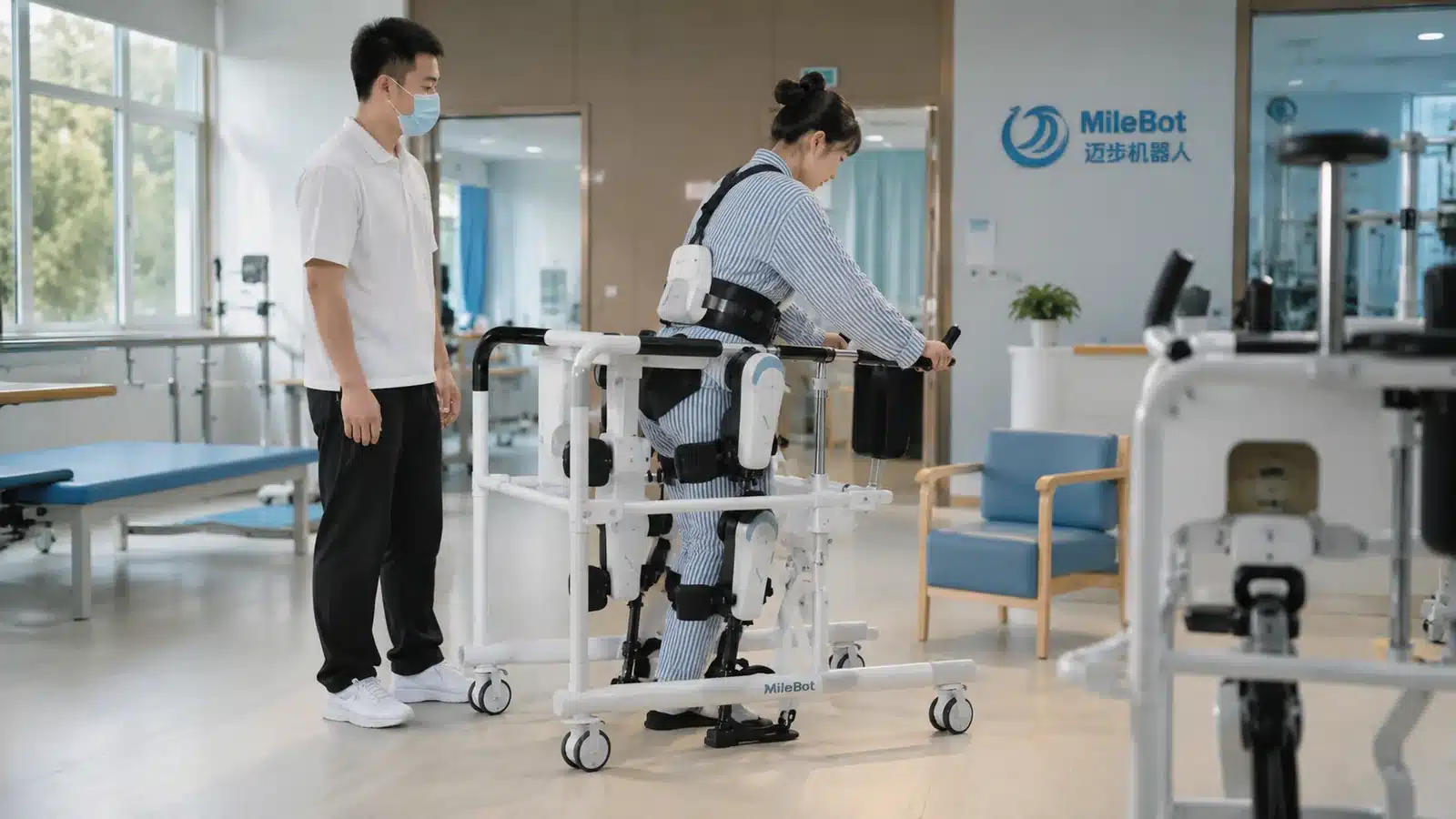
- Core focus: Lower-limb medical rehabilitation exoskeletons and rehabilitation robotics.
- Funding priorities: Flexible actuation and BCI development, hospital-to-home product expansion and international growth.
- Commercial status: Chinese reporting says core products have NMPA Class II medical-device certification and are in scaled sales.
The capital is going toward more than additional hospital robots
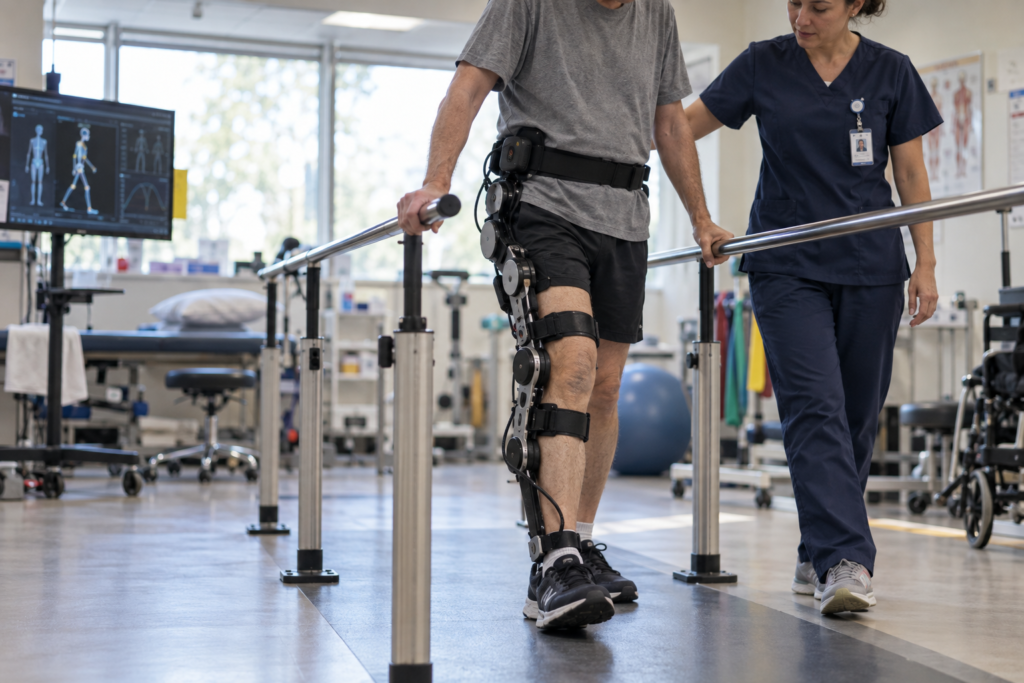
MileBot has historically focused on rehabilitation systems for people recovering from conditions such as stroke and other neurological impairments.
The company combines gait analysis, sensors, biomechanical modelling and compliant actuation with the goal of creating active rather than purely passive rehabilitation training.
Reporting surrounding the new investment describes three priorities for the next stage.
First is deeper technology development. MileBot intends to continue combining flexible actuation with technologies including brain-computer interfaces and to move those systems toward clinical translation.
Second is a broader care pathway. Instead of remaining concentrated in rehabilitation hospitals, the company wants its product portfolio to cover hospital rehabilitation, community care and home-based mobility assistance.
Third is international expansion. MileBot has already been building outside China, and the new financing is intended to accelerate that process.
That combination is commercially important. The medical exoskeleton industry has often struggled with a narrow deployment model in which expensive hardware is sold into specialist institutions and used under supervision. Extending product families into community and home environments can expand the addressable market, but it also requires different pricing, service, usability and regulatory strategies.
Reports of profitability make MileBot particularly worth watching
The most interesting claim surrounding the financing may be MileBot’s commercial performance.
36Kr describes the company as one of the first domestic Chinese medical exoskeleton developers to establish a profitable model. It also reports that MileBot’s 2025 performance grew by close to 200% and that overseas markets contributed more than one-third of revenue.
Those figures are important but should be treated carefully. They come through business reporting around the company and have not been presented as independently audited financial statements available to Exoskeleton Index.
Even with that qualification, the direction is notable.
Exoskeleton companies have historically been easier to evaluate on prototypes, patents and research papers than on repeat sales, export revenue and profitability. If MileBot is genuinely converting clinical technology into sustained commercial demand, that is a stronger market signal than another demonstration platform.
The financing arrives as China’s exoskeleton market becomes measurable
Chinese financial reporting citing IDC estimates that China’s exoskeleton robot market exceeded RMB 1.6 billion in 2025, with approximately 26,000 units shipped.
The composition of that market is particularly interesting.
Medical rehabilitation remained the largest contributor by market value, while consumer-assistance products reportedly generated more than 70% of shipment volume.
That split illustrates two very different commercialization models developing at the same time.
Medical systems can command much higher prices because they operate in regulated clinical environments and provide specialised rehabilitation functions. Consumer systems can sell at much lower unit values but potentially reach much larger volumes.
China increasingly has active companies on both sides of that divide.
Hypershell, VIGX and other manufacturers are pushing consumer walking and outdoor systems, while medical robotics companies such as MileBot are working through clinical certification, hospital deployment and rehabilitation markets.
For a broader view of those dynamics, see our analysis of the global exoskeleton market in 2026 and the Healthcare & Rehabilitation sector.
Exoskeleton Index analysis
The strongest signal in the MileBot financing is not the RMB 100 million figure by itself.
Capital has entered exoskeleton companies before, including companies that later struggled to turn engineering progress into repeatable sales.
What makes this transaction more interesting is the combination of several signals appearing together: regulated medical products, reported scaled sales, claimed profitability, overseas revenue and fresh capital intended to broaden the company’s deployment model.
That is what commercialization looks like when an industry begins maturing.
The next phase is also harder.
Hospital equipment can be sold through professional procurement channels and used by trained clinicians. Community and home products need to be easier to fit, operate, maintain and support. International markets add certification, distribution, reimbursement and service requirements that vary substantially by country.
In other words, moving beyond the hospital expands MileBot’s opportunity while also exposing it to a much more complicated commercial environment.
China is developing an unusually broad exoskeleton ecosystem
China’s position in exoskeletons deserves more attention than it often receives in Western coverage.
The country now has manufacturers working across medical rehabilitation, consumer mobility, industrial assistance and research platforms. It also combines a large domestic manufacturing base with an ageing population, an expanding rehabilitation sector and policy interest in robotics and assistive technology.
Recent Chinese policy has included rehabilitation-assistive technology, care robotics and exoskeletons within wider efforts to expand the country’s rehabilitation and intelligent-device industries.
Capital is following that activity.
MileBot’s round joins a broader sequence of financing across Chinese wearable robotics and exoskeleton manufacturers rather than standing as an isolated transaction.
For Exoskeleton Index, that reinforces why the global industry cannot be understood by tracking North American and European companies alone.
What remains unknown
- The exact valuation and full terms of the strategic investment.
- Audited revenue, profitability and margin information.
- The precise contribution of each MileBot product line to current sales.
- Which international markets are currently generating meaningful revenue.
- How quickly community and home products can scale outside institutional rehabilitation.
- How MileBot will navigate medical-device regulation and reimbursement across international markets.
- How quickly its flexible-actuation and brain-computer-interface research will translate into commercial products.
The funding does not prove that medical exoskeletons have solved their commercialization challenge. It does, however, add another credible signal that parts of China’s wearable-robotics industry are moving beyond prototype development toward measurable sales, international expansion and repeat investment.
Explore the ecosystem
Explore Healthcare & Rehabilitation exoskeletons, browse the global company directory, review the product database, or read our analysis of the Exoskeleton Market in 2026.
Sources
- STAR Market Daily / Cailian Press, reporting on MileBot’s strategic financing and IDC China exoskeleton-market data, 26 August 2026.
- PE Daily / Investment界, “MileBot completes nearly RMB 100 million financing,” 27 August 2026.
- 36Kr, reporting on MileBot’s commercial growth, profitability and international revenue, August 2026.
- Dealroom, funding summary for MileBot Robotics, 26 August 2026.