

From Pilot to Daily Operations: What Logistics Exoskeleton Deployments Actually Show
Recent airport, warehouse and delivery initiatives show how exoskeleton programmes move from demonstration to operational use. This evidence-led analysis separates deployment signals from performance claims and explains what buyers should measure before scaling.
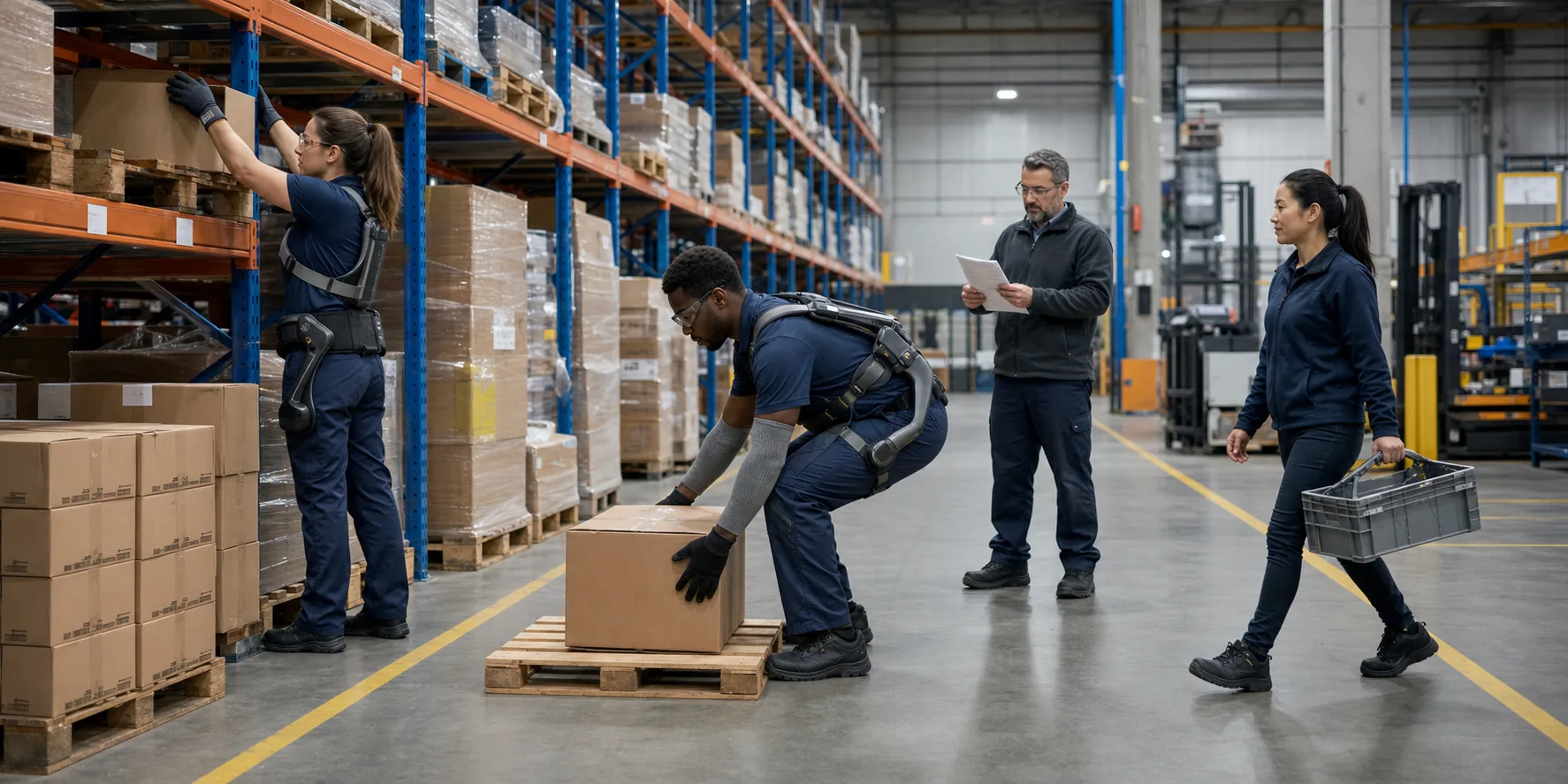
Logistics exoskeleton deployment succeeds when a device is worn safely for the right tasks across ordinary shifts—not when a demonstration looks impressive. Current airport, warehouse and delivery programmes show growing operational interest, while field studies show that task fit, actual wearing time, non-use, comfort, training and programme ownership determine whether biomechanical assistance survives contact with daily work.
Key takeaways
- An announcement or first-day demonstration is not evidence of routine use.
- Reduced muscle activity is a useful mechanism result, not proof of fewer injuries.
- Measure wearing time and removal as carefully as assistance.
- Select a task before selecting a device; evaluate the complete work cycle.
- Treat worker acceptance as operational data, not a communications problem.
- Scale only after predefined safety, fit, use, service and cost gates are met.
What counts as deployment?
“Deployment” is used loosely in exoskeleton announcements. It can describe a product demonstration, a four-hour usability session, a controlled pilot with selected workers, or equipment integrated into routine operations. Those situations have different evidentiary value. A buyer needs to know who wore the device, for which tasks, for how long, under whose supervision, and what happened when the device was inconvenient or unavailable.
Operational deployment means trained workers can obtain a safe fit and use the system during defined, ordinary tasks under a documented programme for inspection, cleaning, maintenance, incident response and evaluation. It does not imply effectiveness or scale; those require separate measures.
| Maturity | What it establishes | What it does not establish |
|---|---|---|
| Announcement | Intent, partnership or product availability | Worker use or outcomes |
| Demonstration | Basic feasibility in a staged task | Shift compatibility |
| Controlled pilot | Performance in bounded tasks and users | Routine adoption or economics |
| Limited deployment | Use by a defined group in live work | Site-wide coverage |
| Routine operational use | Repeat use with operational support | Multi-site transferability |
| Multi-site scale | Repeatability across several contexts | Universal benefit |
Why announcements and daily use are different
Announcements emphasize the selected lift and the maximum assistance. Daily operations include everything around that lift: walking to the task, scanning, opening packaging, entering vehicles, reaching, turning, waiting, cleaning and changing workers. A system can reduce lumbar muscle activity during one phase while imposing pressure, heat, restricted movement or process delay elsewhere.
The denominator is often missing. “Twenty workers trained” is not the same as twenty workers wearing a device for most eligible exposure. Report eligible hours, available hours, worn hours and assisted-task hours. Record removal events, refusals, failed fits and device downtime. Without these figures, high satisfaction among remaining users can conceal attrition.
Recent logistics deployment signals
Maastricht Aachen Airport’s reported introduction of German Bionic Exia is notable because airport cargo is a live, variable logistics environment. Independent reports describe operational use and manufacturer material describes adaptive powered assistance. Public information does not disclose the fleet size, worker coverage, precise apron-versus-warehouse task map or outcome data. It is therefore evidence of operational interest, not effectiveness.
Lotte Global Logistics and FRT Robotics offer a different maturity signal. Their July 2026 agreement concerns joint development, data collection, demonstrations and commercialisation. Lotte Hi-Mart appliance delivery and installation is a planned validation context. It should be classified as a development partnership, not a completed deployment. These distinctions prevent a procurement team from comparing unlike evidence.
Published field research provides a stronger basis for planning than company announcements alone. It also shows why results do not transfer automatically from one device or workflow to another.
What field research shows
Jakobsen and colleagues randomized 20 logistics workers to order picking with or without a passive back-support exoskeleton over 24 weeks. The device continued to reduce back-muscle activity during standardized lifting after the field period. Three intervention participants stopped using it. The small sample cannot establish injury prevention, but the duration and comparison group make the result valuable: a biomechanical effect can persist while individual adoption varies.
Hess and colleagues evaluated an active back exosuit with 146 warehouse workers during roughly four-hour field sessions. Eighty percent reported an intention to use the device for longer periods, and a model predicted intention-to-use with 78% accuracy from usability perceptions. This is useful acceptance evidence at scale, but it is not long-term use or a clinical outcome.
Siedl and Mara studied 31 order-picking workers in short field trials and found that perceived relief and usefulness were central to acceptance. A 2026 six-worker active-exoskeleton palletizing pilot reported a non-significant 7.6% average reduction in metabolic cost alongside comfort, movement and usability problems. Small and short studies cannot settle effectiveness, yet they reveal the implementation variables that should be measured.
Evidence interpretation: laboratory and standardized-task measures help explain mechanism. Longer field studies test whether that mechanism persists in work. Neither automatically proves fewer injuries, lower absence or positive return on investment.
Task fit before device selection
Start with an exposure map, not a vendor shortlist. Identify the specific lifts, postures, reaches, frequencies and durations that remain after higher-level controls have been considered. NIOSH places exoskeletons within a broader prevention approach; they should not replace elimination, substitution, engineering changes or workable administrative controls.
A promising target is frequent enough to matter, consistent enough for assistance to engage, and bounded enough that the system does not obstruct adjacent work. Palletizing from known heights may be easier to characterize than mixed-route appliance delivery. Airport cargo may combine warehouse lifts with aircraft access and vehicle movement. Order picking adds walking, twisting and variable shelf heights.
Use video and direct observation with worker consent. Break the process into subtasks and transitions. Note interactions with conveyors, racks, seats, stairs, fall protection, scanners, tools, uniforms and hot or cold zones. A device that performs well in the focal lift but fails during a necessary transition is not task-compatible.
Wearing time and non-use
Wearing time is the bridge between measured assistance and plausible operational benefit. Track it automatically when valid and with worker-controlled logs when data collection could distort trust. At minimum, record shift length, eligible exposure time, device availability, worn time, assistance-active time and reasons for removal.
Non-use categories should be specific: no safe fit, discomfort, heat, restricted movement, task change, hygiene, battery, fault, missing device, schedule pressure, supervisor instruction or worker choice. “Non-compliance” is not an explanation. Removal may be the correct safety response to a poorly matched task.
Trend data by task and time rather than publishing one adoption percentage. Early use can rise with novelty or fall during adaptation. Later use may concentrate among a subset of workers. Both patterns contain design and programme information.
Worker acceptance is operational data
Acceptance is not a personality trait. It reflects perceived assistance, comfort, autonomy, social meaning, trust, process compatibility and confidence that concerns will be acted upon. Systematic reviews of occupational implementation identify many interacting barriers and facilitators, including task fit, device usability, management support, peer experience and clear expectations.
Voluntary, informed participation generally produces cleaner data than pressure to wear a system. Workers should know that the device does not certify a heavier safe lift and that stopping use will not be treated as failure. Collect structured ratings and open comments. Report results for users who stop as well as those who continue.
Include workforce representatives before procurement and in review meetings. Avoid selecting only enthusiastic early adopters. The evidence base itself is demographically narrow: a 2026 review of 191 occupational exoskeleton studies found participants were approximately 78% male and that race or ethnicity was not reported. Fit and acceptance claims may therefore cover less of the real workforce than a headline suggests.
Powered, passive and adaptive systems
Passive systems use springs, elastomers or mechanical linkages to store and return energy. They can be light and do not require charging, but assistance may be tied to posture and can oppose non-target movements. Powered systems use motors or other actuators and can modulate assistance, at the cost of batteries, charging, software, added mass and service complexity. Soft exosuits distribute forces through textiles and cables; rigid frames may provide clearer load paths but add contact and clearance constraints.
“Adaptive” should describe an observable control function, not marketing tone. Ask what signals are sensed, which assistance variable changes, how rapidly it changes, what happens when classification is wrong, how settings are locked, and whether local data leave the device. Compare configurations under the same task and users. There is no universal percentage that converts assistance into a higher permissible load.
The Exoskeleton Index guide to powered versus passive exoskeletons provides an architecture overview; the back-support buyer’s guide turns those differences into procurement questions.
What “AI-powered” should mean
In a credible specification, artificial intelligence names a defined method and decision. A system may classify movement, estimate load or intent, select an assistance profile, or support fleet analytics. The vendor should state training and validation conditions, failure modes, update control, data retention and whether a person can override the output.
Do not infer that “AI” means greater assistance, automatic safety or independently proven outcomes. At Maastricht, German Bionic describes sensor-based movement recognition and adaptive control, but site-level evidence has not been published. In the Lotte–FRT project, data collection and control improvement are goals; public reports do not document the algorithm. Those are different evidence states.
If worker data are collected, involve privacy, security and labor stakeholders. Define the minimum data needed, access, retention, secondary use and deletion. A device must not quietly become an individual performance-monitoring system without a lawful and transparent programme.
Fit and workforce coverage
Fit determines force transfer, comfort and movement. Report the share of the eligible workforce that can achieve a safe fit—not only the range printed in a specification. Test relevant clothing, seasonal layers and PPE. Record body dimensions or fit categories only when necessary and with appropriate privacy controls.
A fit failure is a product–workforce mismatch, not a worker failure. Provide a non-exoskeleton path for people who cannot or do not wish to wear the device. Recheck fit after cleaning, component replacement and configuration changes. For shared equipment, verify that adjustment is fast and repeatable without encouraging shortcuts.
Safety across the whole work cycle
Risk assessment should cover donning, adjustment, target work, transitions, breaks, doffing, charging, storage, cleaning and maintenance. Consider pressure, chafing, heat, balance, restricted escape, snagging, tool access, vehicle seating, stair use, emergency egress and interactions with other PPE.
ASTM F3749-25 provides a logistics-focused approach to assessing exoskeleton use, while other ASTM standards address terminology, task description, fit, training and risk management. Standards help structure evidence; they do not certify that a specific site is safe. ISO/CD 25563 remains a committee draft under development and must not be represented as a current certification.
Define stop conditions and incident reporting before the pilot. A worker should be able to remove a system without penalty. Near misses, skin issues and unexpected movement are leading indicators, not anecdotes to discard.
Training, maintenance and programme ownership
Name a programme owner with authority across ergonomics, operations, safety, maintenance, IT and procurement. Vendor training is a starting point; the employer remains responsible for site-specific work. Training should cover intended tasks, exclusions, fit, inspection, donning, settings, stop conditions, emergency removal, cleaning and reporting.
Use competency checks rather than attendance alone. Train supervisors not to raise production expectations or load limits because a device is present. Reassess after task, product, software or staffing changes.
Maintenance plans need inspection intervals, consumables, textile washing, battery cycling, charging capacity, spare units, software ownership, fault escalation and turnaround time. Measure service labor and downtime. Powered systems also need a plan for updates and configuration control so that a later pilot phase is comparable with the first.
What buyers should measure
| Claim | Required measure | Minimum useful duration | Common interpretation error |
|---|---|---|---|
| Reduces physical demand | Task-specific biomechanical or physiological measure plus exposure | Repeated sessions; field confirmation | Calling an acute change injury prevention |
| Workers will use it | Eligible, worn and assisted hours; non-use reasons | Several weeks across normal variation | Surveying only remaining users |
| Improves productivity | Quality-adjusted output with task and staffing controls | Stable baseline and post-learning period | Ignoring mix, pace or novelty |
| Fits the workforce | Safe-fit rate across eligible workers and clothing | All relevant shifts/seasons | Quoting catalog size range |
| Is economical | Total lifecycle cost and realized eligible exposure | Service-representative period | Dividing purchase price by headcount |
Use a baseline before training and record ordinary variation. Predefine the primary decision measure and failure conditions. When outcomes are subjective, collect them at comparable times and include people who stop. When outcomes are quantitative, explain missing data and configuration changes.
Decision gates from pilot to scale
A pilot should end in a decision, not an indefinite showcase. Establish gates before equipment arrives and require evidence at each transition. A device can be technically safe yet fail task benefit or workforce coverage; it can be liked during a trial yet create an unsustainable service burden.
| Domain | Example gate | Stop or redesign signal |
|---|---|---|
| Task benefit | Predefined assistance or demand improvement in target exposure | No meaningful change or benefit outside actual exposure |
| Safety | No unresolved serious event; acceptable leading indicators | Unexpected hazard or unsafe workaround |
| Fit | Acceptable coverage with a safe alternative | Material exclusion of the workforce |
| Use rate | Sustained worn hours during eligible work | Novelty peak followed by decline |
| Non-use | Reasons understood and addressable | Task conflict, discomfort or coercion |
| Service | Documented cleaning, uptime and support | Fault or maintenance burden exceeds capacity |
| Cost | Credible lifecycle scenario | Business case depends on unproven injury savings |
| Decision | Scale, revise, hold or stop | No predefined owner or threshold |
The Exoskeleton Index pilot planning playbook provides a fuller sequence. Buyers can use the Product Directory, Compare tool and Companies directory only after the task and gates are defined.
The economic evidence gap
A 2023 systematic review of occupational quality, productivity and economic outcomes found only 15 eligible studies, most conducted in laboratories, and no direct economic evaluations. Broader reviews similarly emphasize laboratory dominance, small samples and heterogeneous devices. Claims of return on investment therefore often depend on assumed injury reductions rather than observed, controlled economic data.
Build a transparent scenario instead. Include equipment, fitting, training, programme management, cleaning, consumables, batteries, charging, software, data governance, maintenance, spares and downtime. Divide costs by realized assisted exposure, not the number of people invited to a demonstration. Show conservative, central and optimistic cases and identify which assumptions lack evidence.
Productivity may matter, but it must be quality-adjusted and separated from changes in staffing, load mix, route and work pace. Injury and absence outcomes require longer observation and careful controls. A pilot can justify a scale decision on safety, fit and sustained use without pretending to prove long-term savings.
A minimum viable pilot design
A useful pilot begins with a written protocol short enough for operations to use and specific enough for an independent reviewer to understand. Name the target task, eligible workforce, device configuration, comparison period, primary measure, secondary measures, safety stops and decision owner. Freeze the configuration during each evaluation phase or document every change. If a vendor tunes assistance after observing early results, treat the later phase as a new condition.
Collect a baseline that represents normal variation rather than a single convenient shift. Include different load mixes, staffing patterns and environmental conditions. A crossover design can help when the sample is small, but order and learning effects must be considered. Randomization is valuable where practical; when it is not, use comparable periods and explain the limitations.
Allow an adaptation period before drawing conclusions about comfort or throughput. At the same time, preserve early removal and fit data: these are real implementation outcomes, not noise. Schedule reviews soon enough to correct hazards but do not let informal adjustments erase the original result. Workers need a private route to report concerns, and evaluators should be able to stop use without production pressure.
At closeout, account for every eligible participant and device. Report who never achieved fit, who declined, who started, who stopped and who continued. Explain missing measurements. Present distributions and individual trajectories where privacy permits; an average can conceal a subgroup with strong benefit and another with unacceptable discomfort.
The procurement evidence pack
Procurement should request evidence that matches the intended task. A laboratory EMG study can support mechanism, but a buyer also needs field compatibility, safe-fit coverage, inspection procedures, cleaning validation, service levels and configuration control. Product certificates should be checked for scope, model and version. Marketing references to a standard are not equivalent to a certificate from a named conformity body, and a committee draft cannot certify a product.
Ask vendors for the raw definition behind every headline number. “Up to 30%” should identify the outcome, participants, task, comparator, duration, statistical treatment and product setting. Request adverse-event and withdrawal information, not only successful completions. If a case study reports productivity, obtain the denominator and any changes in staffing, pace, load mix or quality.
The commercial pack should define ownership, warranty, preventive maintenance, software and data terms, spare-unit policy, response time and end-of-life handling. For powered devices, include battery replacement, charging infrastructure and update support. For shared textile systems, include laundering capacity and the number of interchangeable garments required to keep equipment available.
From one site to another
Scale is a new test, not a photocopy of the pilot. A distribution center with fixed palletizing stations differs from a parcel hub, airport warehouse or home-delivery route. Repeat the task map and fit check at each site. Define which elements are fixed—safety rules, training competencies, data governance—and which require local adaptation.
Use a staged rollout with leading indicators visible to a central programme owner. Compare use and non-use across sites before combining results. A high-use site may have a narrower task, better storage or a supervisor who protects training time. A low-use site may reveal a design boundary that should prevent further expansion. Treat variation as evidence.
Finally, create a credible exit plan. Equipment that fails a gate should be withdrawn, stored or returned under a documented process; worker data should follow the retention policy; and normal ergonomic controls must continue. Stopping an unsuitable deployment is a successful safety decision, not a failed innovation programme.
Management support without coercion
Management support matters because pilots need protected training time, available equipment, maintenance capacity and permission to slow down when a fit or safety issue appears. It becomes counterproductive when leaders treat the technology as a predetermined success or set informal wearing targets. Workers may then hide discomfort, keep a poorly adjusted device on, or avoid reporting removal.
Set the tone in the protocol: participation and reporting are protected, production expectations do not increase because assistance is present, and adverse feedback will be reviewed. Supervisors should be evaluated on the quality of implementation, not the percentage of workers photographed in the device. Procurement and the vendor should not control the only route for interpreting worker feedback.
A joint review group can include operations, safety, ergonomics, maintenance, worker representatives, privacy or IT specialists and the supplier. Give it access to both positive and negative data. Record decisions and reasons so that later sites do not repeat abandoned configurations or lose useful adaptations.
Cleaning, charging and downtime are outcomes
Operational readiness is measurable. Log whether the correct size and configuration is available at shift start, how long inspection and donning take, the share of devices passing inspection, cleaning turnaround, charging completion, faults and time to restore service. These measures expose hidden labor and infrastructure costs.
Textiles that contact skin need an evidence-based washing process and enough spare garments to avoid sharing an unclean interface. Hard components need approved cleaning agents that do not damage materials or sensors. Batteries need safe charging locations and replacement planning. Software updates should have a test, approval and rollback process. A device that provides assistance only when perfectly prepared but is often unavailable has low realized value, whatever its laboratory performance.
Practical deployment scorecard
Use the following scorecard at each review. A red result in safety should stop progression. A weak result in task benefit, fit or use should return the programme to task selection or configuration rather than be averaged away by favorable survey responses.
- Task definition: exposure, transitions and exclusions documented.
- Baseline: comparable demand, discomfort, quality and cycle data recorded.
- Fit: coverage and safe alternatives documented.
- Use: eligible, available, worn and assisted hours known.
- Non-use: reasons categorized and reviewed with workers.
- Safety: leading indicators, incidents and stop conditions active.
- Service: cleaning, maintenance, charging and support tested.
- Data: purpose, access, retention and updates governed.
- Cost: lifecycle scenario based on realized exposure.
- Decision: named owner chooses scale, revise, hold or stop.
Methodology and limitations
This review combined current deployment reporting, official manufacturer and institutional material, peer-reviewed logistics field studies, systematic reviews, government guidance, standards records and existing Exoskeleton Index resources. Claims were classified by source type, duration, task and outcome. Current news starting points were checked against primary material where available; the Lotte and Maastricht reports lack public site-level outcome datasets.
Limitations: Long-term injury and economic evidence remains limited. Some deployments and studies involve manufacturers. Publication bias may favor successful demonstrations. Laboratory studies dominate the literature; field samples are often small. Workforce representation is narrow. Product configurations change, and results do not transfer automatically between tasks or sites. There is no universal correction factor for lifting limits. Operational conditions are site-specific.
Last evidence review: 31 July 2026.
Conclusion
Logistics exoskeletons have moved beyond laboratory novelty, but the evidence supports disciplined evaluation rather than automatic scale. Maastricht demonstrates operational interest in powered assistance for airport cargo. Lotte and FRT demonstrate structured co-development for logistics and appliance work. Field research shows that assistance can persist over months and that many workers report positive short-session usability; it also documents attrition, discomfort, low adherence and task conflict.
The decisive question is not whether a device can help one lift. It is whether the right workers can safely and voluntarily use it through the relevant exposure, with reliable service and a credible cost. Organizations that measure fit, wearing time, non-use and whole-cycle safety can make that decision. Organizations that count demonstrations cannot.
Exoskeleton Index resources
This article provides technical and procurement information, not medical, legal or workplace-safety advice. Employers remain responsible for applicable risk assessment, worker consultation and regulatory compliance.
References
- Jakobsen LS et al. Effects of 24-weeks in-field use of a back-supporting exoskeleton. Applied Ergonomics. 2025;125:104469. DOI.
- Hess A et al. Active back exosuits demonstrate positive usability perceptions among logistic warehouse workers. Applied Ergonomics. 2025;122:104400. PubMed.
- Siedl SM, Mara M. What drives acceptance of occupational exoskeletons? Logistics field evidence. 2021.
- Jakobsen LS et al. Occupational shoulder-exoskeleton field evaluation. Applied Ergonomics. 2023. DOI.
- Kim S, Porto R, Nussbaum MA. User experiences and adoption factors for a back-support exosuit in automotive logistics. 2025. SSRN.
- Ortiz J et al. Field evaluation of an active back-support exoskeleton for palletizing tasks. Electronics. 2026;15:2518. DOI.
- van Laar et al. Barriers and facilitators to occupational exoskeleton implementation: systematic review. 2026.
- Fournier et al. Occupational exoskeletons: quality, productivity and economic evidence systematic review. 2023.
- Kermavnar T et al. Effects of industrial back-support exoskeletons: systematic review. Applied Ergonomics. 2021.
- Kazemi et al. Demographic representation in occupational exoskeleton research: systematic review. 2026.
- ELSA LogiCare consortium. Three-month occupational exoskeleton trial protocol in logistics and care, 2026.
- NIOSH. Industrial exoskeletons.
- ASTM International. ASTM F3749-25, logistics applications assessment.
- ASTM International. F48 exoskeleton and exosuit standards.
- ISO. ISO/CD 25563, occupational exoskeletons—committee draft under development.
- Air Cargo News. Maastricht Aachen adopts AI-powered exoskeleton for cargo handling. 28 July 2026.
- German Bionic. Exia product information.
- MST Cargo. Cargo services at Maastricht.
- Seoul Economic Daily. Lotte Global Logistics and FRT partnership. 30 July 2026.
- FRT Robotics. Company and StepUp product information.
- de Looze MP et al. Exoskeletons for industrial application and their potential effects on physical work load. Ergonomics. 2016.
- Bogue R. Exoskeletons—a review of industrial applications and potential future developments. Industrial Robot. 2018.
- Theurel J, Desbrosses K. Occupational exoskeletons: overview of side effects and field considerations. 2019.
- Howard J, Murashov V, Lowe B, Lu ML. Industrial exoskeletons: need for intervention effectiveness research. American Journal of Industrial Medicine. 2020.
Need help evaluating the options?
Tell us your use case, organisation or region and what you are trying to evaluate. Exoskeleton Index can help identify relevant products and suppliers.
One Response